Northeast
Wes Moore praises Walz for military service, completing 'mission' despite retirement outrage

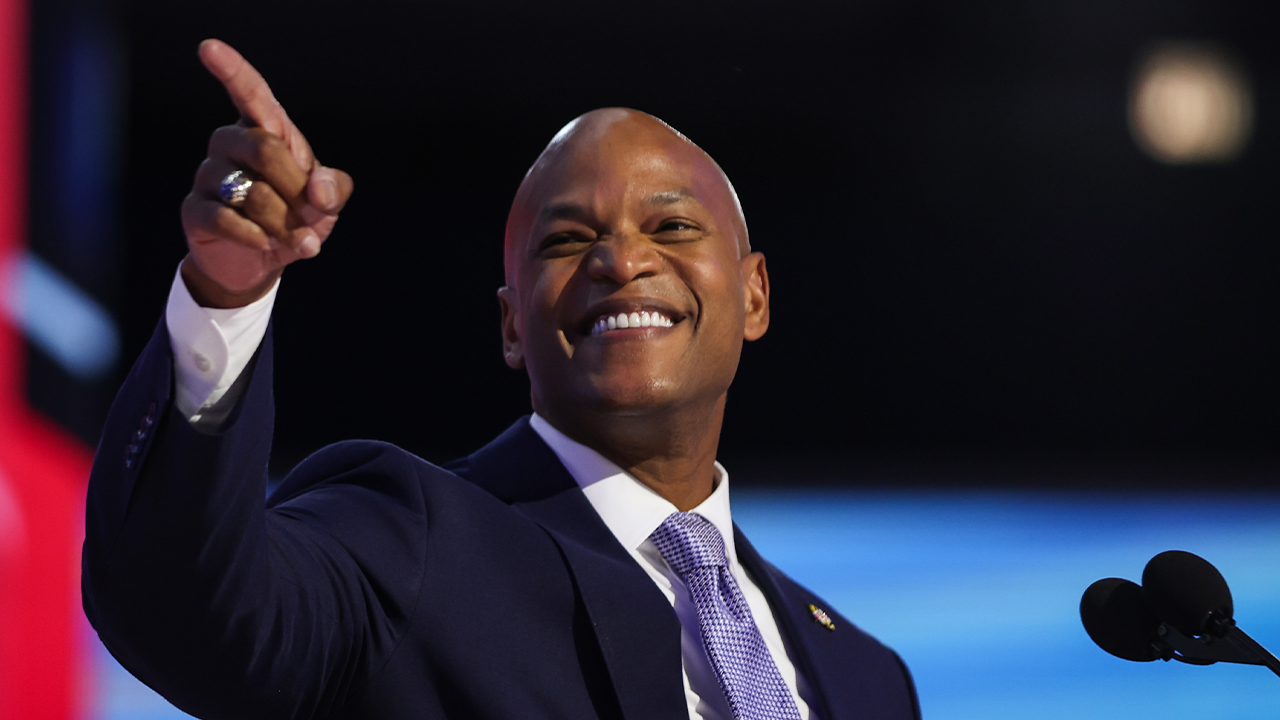
CHICAGO – Maryland Gov. Wes Moore, during his Democratic National Convention speech Wednesday, praised Minnesota Gov. Tim Walz’s military career and for completing the “mission,” despite ongoing criticism over Walz retiring from the Army National Guard before his unit deployed to Iraq.
“My fellow veteran, my brother and the next vice president of the United States, Tim Walz,” the Maryland Democrat said from the Chicago stage at the United Center Wednesday evening.
“Tim knows that in the military, you count the days towards mission completion,” Moore, an Army veteran, continued. “So guess what, y’all? We have got 75 days and a wake up until Election Day. Seventy-five days and a wake up for us to prove what Americans can do when the pressure is on.”
VETERANS INCREASINGLY CALLING OUT WALZ’S MILITARY RECORD: ‘SHAMEFUL’
Maryland Gov. Wes Moore speaks on stage during the third day of the Democratic National Convention at the United Center on Aug. 21, 2024 in Chicago. Delegates, politicians, and Democratic Party supporters are in Chicago for the convention, concluding with current Vice President Kamala Harris accepting her party’s presidential nomination. (Photo by Justin Sullivan/Getty Images)
“Patriots do not whine and complain. We put our heads down, and we get to work.”
Walz served 24 years in the Army National Guard before retiring in 2005, when he launched a successful congressional campaign and served as a member of the U.S. House representing Minnesota from 2007 until 2019. Walz left the House upon his 2018 election as the Gopher State’s governor.
WALZ ACCUSATIONS OF ‘STOLEN VALOR’ PROMPT BATTLE BETWEEN HOUSE VETERANS
Democratic vice presidential candidate Minnesota Gov. Tim Walz greets second gentleman Doug Emhoff during Day 1 of the Democratic National Convention at the United Center in Chicago on Aug. 19, 2024. (REUTERS/Brendan Mcdermid)
Criticisms have mounted that Walz retired just months before his battalion deployed to Iraq as war raged in the Middle East following the 9/11 attacks. Walz put in his papers for retirement at least five months before his battalion received deployment orders, according to the Minnesota National Guard.
FORMER LEADER OF WALZ’S BATTALION PUBLISHES SCATHING MESSAGE AIMED AT GOVERNOR’S MILITARY CAREER: REPORT
The campaign bus for Vice President Kamala Harris and Minnesota Gov. Tim Walz waits ahead of a kickoff bus trip at Pittsburgh International Airport in Pittsburgh on Aug. 19, 2024. (Fox News – Paul Steinhauser)
“He subverted the chain of command, and he went around the chain of command. The brigade [sergeant] major had no clue. These are all important facts, and he did it to continually feather his own bed… That was the shameful part of it,” retired Command Sgt. Maj. Paul Herr told Fox News earlier this month.
Following Harris naming him as her running mate, Walz has been slammed by a number of veterans for allegedly misrepresenting his service in the military, including identifying himself to the public as a retired “Command Sergeant Major.”
Walz was promoted to the command sergeant major rank following a deployment to Italy in 2004, but he did not complete coursework with the U.S. Army Sergeants Major Academy to retain the rank in retirement. Walz instead retired as a master sergeant, one pay grade below command sergeant major.
Democratic Minnesota Gov. Tim Walz’s military career has been scrutinized since he was announced as Vice President Kamala Harris’ running mate. (Glen Stubbe/Star Tribune via Getty Images)
“For 20 years, they let this guy go by with a lie that he deployed to Iraq, which he didn’t, and that he retired as a command sergeant major, which he did not. I mean, that’s just blatant lies,” Republican Virginia Senate candidate Hung Cao, a retired Navy captain, told The New York Post this month of Walz.
Walz also took the DNC stage on Thursday evening, when he spoke to the arena about his small town roots in the Midwest and his career as a teacher before diving into politics in the early 2000s.
“I grew up in Butte, Nebraska, a town of 400 people. I had 24 kids in my high school class, and none of them went to Yale. But I’ll tell you what. Growing up in a small town like that, you’ll learn how to take care of each other. That that family down the road, they may not think like you do. They may not pray like you do. They may not love like you do. But they’re your neighbors. And you look out for them, and they look out for you. Everybody belongs and everybody has a responsibility to contribute,” he said.
Vice President Kamala Harris will deliver her acceptance speech before the DNC on Thursday evening, following three nights of other high-profile Democrats such as former President Barack Obama, President Biden and former Secretary of State Hillary Clinton celebrating her candidacy.
Get the latest updates from the 2024 campaign trail, exclusive interviews and more at our Fox News Digital election hub.
Read the full article from Here

Boston, MA
‘Enough is enough’: Weekend violence in Boston sparks calls for change, from more police to community investment – The Boston Globe

“We are all saying today, enough is enough,” City Councilor Brian Worrell said Monday at a news conference in Roxbury. “We are calling for everyone to put down the guns, stop the community violence.”
He joined City Councilor Miniard Culpepper and others in calling for more resources to support grassroots organizations that work to reduce violence across Boston’s most historically underserved neighborhoods.
Culpepper said police are part of the solution, but real change comes from within impacted communities, and it doesn’t happen overnight.
Instead of taking a reactive approach, “we have to be consistent out there in the streets, promoting a culture of peace among our young people,” said Randy Muhammad, founder of 10,000 Fearless Peacemakers, a Dorchester-based group. “We need to be proactively in the community, building those relationships.”
Meanwhile, leadership of Boston’s largest police union decried a staffing crisis that has left the department lacking the manpower to properly respond to calls, especially on a busy weekend like July 4.
“Until we take back our streets, enforce the law, and have enough officers to do so, we’re just gambling that somebody won’t lose their life or get hurt,” said Larry Calderone, president of the Boston Police Patrolmen’s Association. “That should be an embarrassment to the city of Boston elected officials and the leadership of this department.”
Calderone described an incident early Sunday in Dorchester when disorderly revelers threw fireworks at the police. A crowd of several hundred people was effectively blocking traffic at the intersection of Franklin Hill Avenue and Shandon Road.
“While officers were attempting to gain control of the crowd and restore order, numerous individuals threw beverages, miscellaneous objects, and ignited fireworks in the direction of responding officers,” according to a police report provided by the department.
Calderone said three injured officers were sent to the hospital for treatment.
He argued that reductions in overtime spending have exacerbated the problem.
The department’s massive overtime budget, long a point of contention among police reform advocates, regularly places officers among the city’s highest-paid employees. Department officials said during a City Council hearing in May that they were working to minimize overtime shifts without letting staffing drop below necessary levels.
A Roxbury resident told the Globe on Sunday that she had called the police multiple times about noise complaints as a raucous block party continued into the early morning hours, but a dispatcher responded that officers were busy. Gunshots broke out around 3:15 a.m. in the area, killing one person and injuring several others, according to police.
“We’re woefully understaffed. We’re outnumbered on the street,” Calderone said in an interview Monday.
However, Police Commissioner Michael Cox refuted the union’s complaints. He said there were many factors that contributed to the recent violence.
“The lawless behavior of this weekend is a combination of large crowds, alcohol, illegal fireworks and firearms, and we will hold those responsible accountable,” he said in a statement Monday evening. “There is no correlation between overtime and crime.”
Cox said his department remains focused on strengthening relationships with the community, ongoing efforts that help prevent crime. He also said they’re continually adding new officers to the force and rising to the challenge amid a slew of major events this summer, including World Cup games, the country’s 250th anniversary and an upcoming Tall Ships festival.
“Thanks to the work of our officers and partnership with the public, crime is heading in the right direction,” he said. “As we work through the duration of an incredibly busy summer, public safety and officer wellness are our priorities.”
Overall, gun violence in Boston is rare and homicides are down compared to this time last year. But the numbers lose meaning when residents feel unsafe, said Steve Wilson of the Ella J. Baker House Violence Reduction Taskforce.
“Right now, to people that look like me, it doesn’t feel like the safest city in America,” he said. “So the work’s being done, and we’re going to continue the work.”
City officials often tout a holistic approach to crime-fighting, which means addressing the root causes of violence and investing in impacted neighborhoods. Mayor Michelle Wu recently announced her latest summer safety plan, offering paid summer jobs to Boston Public Schools students.
In a statement Monday, City Councilor Erin Murphy said she’s requesting a hearing on the safety plan. She also joined Councilor Ed Flynn in calling for a public safety summit.
Officials have not yet identified either of the weekend homicide victims. No arrests have been announced in the shootings.
“This weekend’s violence is a heartbreaking reminder that every life lost leaves behind families and communities who are forever changed,” said Clementina Chery, president and CEO of the Louis D. Brown Peace Institute. “Every homicide creates a ripple that extends far beyond the crime scene, and adds another family to a club that no one wants to join.”
Lea Skene can be reached at lea.skene@globe.com. Follow her on X @lea_skene.


HADDAM, Conn. — Thousands of Connecticut residents remained without power Monday, nearly 48 hours after a storm struck the state on Independence Day, as Eversource crews worked through rain to restore electricity across the region.
Dan Stevens, a chief lineman with Eversource with nearly 25 years of experience, said his team was on standby before the storm hit July 4, anticipating a significant weather event. Stevens and his crew were working in rural Haddam on Monday, restoring power to thousands of customers.
Crews ask for patience
Stevens said the work is demanding under normal conditions and becomes more difficult in the rain. Some crew members have been working 16-hour shifts. Downed trees and power lines across the state have created a continuous workload — with new jobs opening as others are completed.
“Have some patience,” Stevens said. “If you see somebody, good chance they’re not from this area so just have some patience. We know the first couple days everyone plays nice, and then as it progresses, 4-5 days into it people get impatient. But just hang in there and have a little patience, we all want the same thing here.”
Out-of-state help arrives
Eversource has brought in crews from Massachusetts, New Hampshire, Vermont and Canada to assist with restoration efforts in Connecticut.
As of Monday, 98 percent of Eversource customers had power restored. The company said it hopes to have power back for nearly all remaining customers by Tuesday night.
Copyright 2026 WFSB. All rights reserved.
-

 Wisconsin3 minutes ago
Wisconsin DOT begins $6.87M I-41 ramp deck overlay upgrades in Brown County Tuesday
-

 West Virginia8 minutes ago
11 Marshall student athletes suing NCAA over new rule – WV MetroNews
-

 Wyoming15 minutes ago
Election Q&A: Qwenton Eagle Oviatt for Wyoming secretary of state
-

 Crypto18 minutes ago
An Easy-to-Miss Radio Traffic Jam Is Behind Many Home WiFi Slowdowns
-

 Finance23 minutes ago
Fayette County Public Schools Board of Education approves audit contract, new finance director position
-

 Fitness30 minutes ago
Caroline Idiens and Jenni Falconer’s time-efficient 9-exercise workout builds full-body strength in 30 minutes
-

 Movie Reviews38 minutes ago
Film reviews: ‘The Invite’ and ‘Minions & Monsters’
-

 World48 minutes ago
Feds Detail Hoopster Kerr Kriisa’s Alleged $2.2M Criminal Side Hustle

