Pennsylvania Gov. Josh Shapiro claims Vice President JD Vance betrayed his Appalachian roots by going along with the administration’s freeze on SNAP subsidies. (Language warning)
NEWYou can now listen to Fox News articles!
Vice President JD Vance’s office hit back Monday at Pennsylvania Gov. Josh Shapiro, who used a Philadelphia press conference to criticize Vance while outlining the state’s contingency plan to keep SNAP (food stamp) benefits flowing during the government shutdown.
Advertisement
Shapiro had joined 24 states to successfully sue the USDA over November’s SNAP benefit suspension. The Commonwealth of Pennsylvania itself was not a plaintiff, as Republican Attorney General David Sunday was not involved.
Shapiro referenced Vance’s “Hillbilly Elegy” and the Ohioan’s strong bonds with his elders in Breathitt County, Kentucky – the heart of Appalachia – as he lit into what he described as the vice president’s “bull—- politics” that belie his Appalachian roots.
“America has a president and a vice president that don’t give a damn about all Americans,” he added.
SCHUMER, DEMS CALL ‘BULL—-‘ ON TRUMP ADMINISTRATION OVER FOOD STAMP SHUTDOWN THREAT
Vance press secretary Taylor Van Kirk responded in comments to Fox News Digital on Monday, saying the governor should “take a look in the mirror if he wants to see who is to blame for this Democrat shutdown.”
Advertisement
She said Shapiro and Democrats supported “Schumer’s shutdown” and in doing so “screwed over working-class men and women.”
“While little Josh was whining like a child about the problems his own party created, the Trump administration has been crafting a deal with commonsense Democrats to reopen the government and fund SNAP benefits,” Van Kirk added.
YOUNGKIN DECLARES STATE OF EMERGENCY OVER ‘DEMOCRAT SHUTDOWN’ DEPLETING SNAP BENEFITS FOR 850K VIRGINIANS
Shapiro had joined his fellow Montgomery County Democrat Val Arkoosh to discuss the SNAP freeze’s effects and what he and Arkoosh – the state’s human services chief — were doing to help affected families.
When a reporter told Shapiro that Vance criticized the court order demanding the release of SNAP funds, the governor said that he would expect President Donald Trump to do so but that Vance’s history wouldn’t presage the same response.
Advertisement
“JD Vance is a total phony… [he] rose to some prominence by writing a book about growing up in Appalachia, where there’s a whole lot of people who get SNAP,” Shapiro said.
VANCE BLAMES SCHUMER’S FEAR OF AOC PRIMARY CHALLENGE AS SHUTDOWN CAUSE
The Appalachian Regional Commission (ARC), led by permanent co-chair Gayle Manchin and 2025 co-chair Gov. Wes Moore of Maryland, considers 423 counties from Alabama to New York part of Appalachia, including three-quarters of Pennsylvania. ARC reported 1.4 million families in its region are on SNAP, including 14% of families in Appalachian Pennsylvania.
“[Vance] made millions of dollars on the backs of telling their stories, and then he turned his damn back on those very people who he likes to write about and claim as his own,” Shapiro said.
He added that Vance professes to be a person of faith, and cited a passage from the book of Deuteronomy that says people should respond to those in need with an open hand.
Advertisement
IN A SNAP, TRUMP BLAMED FOR BLOCKING FOOD ASSISTANCE TO LOW-INCOME FAMILIES
“So for JD Vance now to turn around after claiming all these things his whole life and literally go to court to stop hungry people from eating, that is not only phony, it’s shameful.”
“You’ll excuse me for getting emotional about it, but when I see hungry people in my state who are hungry because of JD Vance’s bull—- politics, that makes me angry. And that’s why I went to court.”
At the presser, Shapiro explained that Arkoosh’s office was able to fund SNAP through a state disaster declaration and directing millions of dollars to food banks through the Feeding Pennsylvania program.
Advertisement
CLICK HERE TO DOWNLOAD THE FOX NEWS APP
“Republicans in Congress must work across the aisle to quickly reopen the government and protect food assistance and access to health care for the millions of people in Pennsylvania and around the country still at risk because of this continued inaction,” Arkoosh said in a statement.
The war of words could preview a potential 2028 matchup as both Vance and Shapiro are considered top potential contenders for their parties’ presidential nominations next cycle.
Charles Creitz is a reporter for Fox News Digital.
Advertisement
He joined Fox News in 2013 as a writer and production assistant.
Charles covers media, politics and culture for Fox News Digital.
Charles is a Pennsylvania native and graduated from Temple University with a B.A. in Broadcast Journalism. Story tips can be sent to charles.creitz@fox.com.
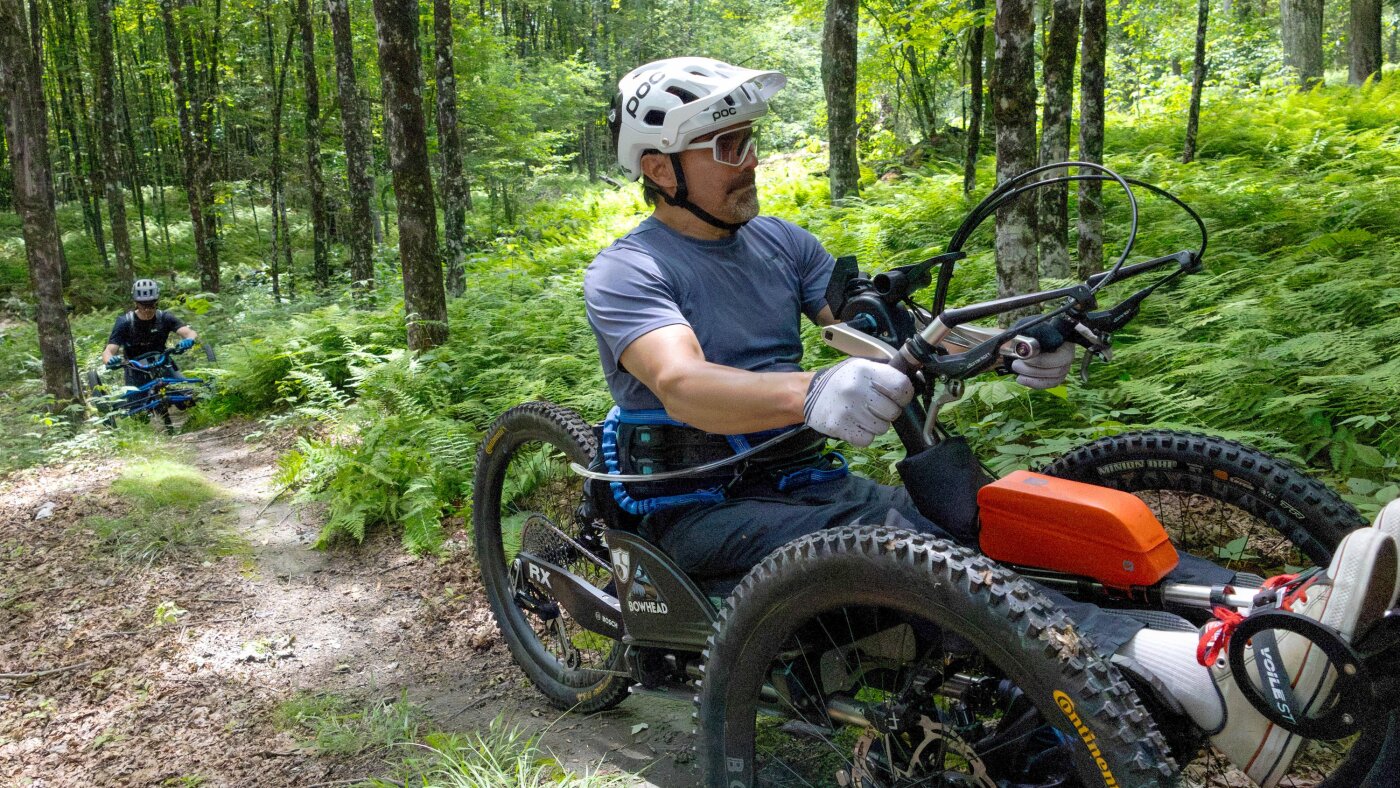
Louis Arevalo rides his adaptive mountain bike through the trails at Randolph Town Forest during an adaptive assessment on Thursday, June 25. Nick Bennette, with the Vermont Mountain Bike Association, rides behind.
Zoe McDonald/Vermont Public
hide caption
Advertisement
toggle caption
Zoe McDonald/Vermont Public
Mountain bike enthusiasts have been working for years on an ambitious 485-mile, multi-use trail called The Velomont that will span the length of the state.
When finished, the collaborative project will knit together existing trail networks, connect 27 communities and include huts and hostels for overnight stays.
Advertisement
New trail construction is finally ramping up after years spent on permits, plans and public input. And organizers say they want to make it as user-friendly as possible.
“For us, it’s not a huge lift to just be mindful when we’re trying to build trail or improve trail to think about the adaptive rider,” said Angus McCusker, the Velomont trail director with the nonprofit Vermont Huts and Trails.
McCusker is referring to the growing number of disabled athletes who mountain bike with specially designed equipment.
“The challenge,” said McCusker, “is we’re connecting to existing trail networks that were never intended for adaptive bikes. So, where we can, we’re trying to do adaptive assessments.”
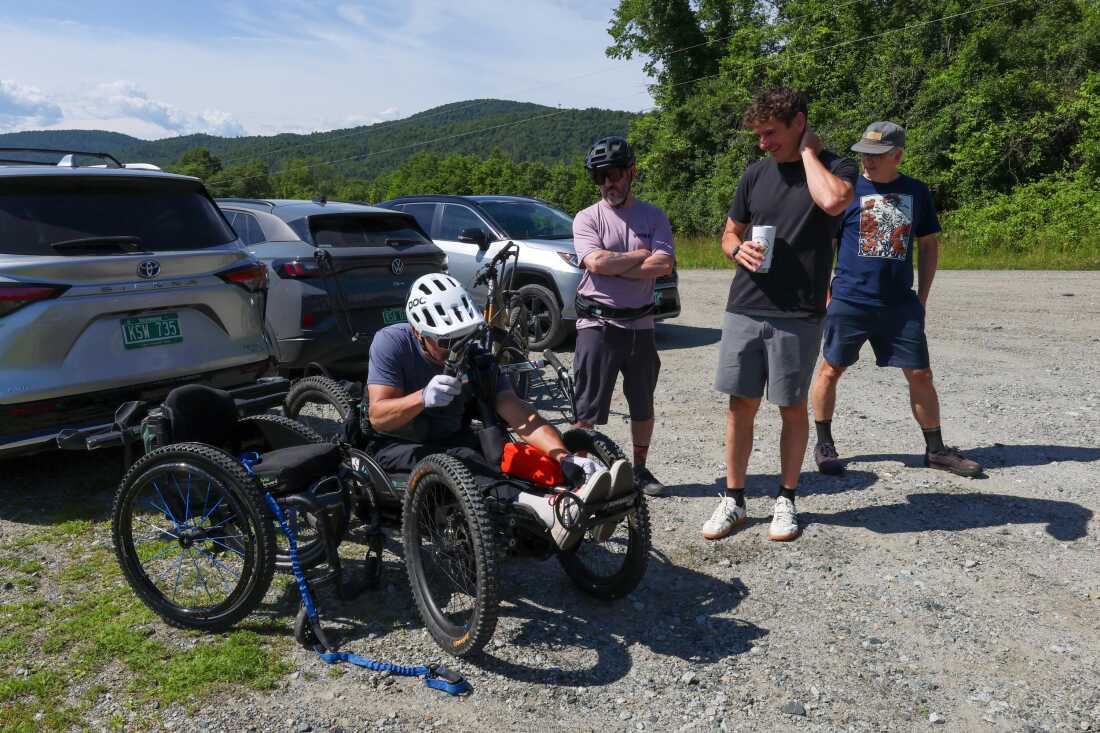
Louis Arevalo, left, straps into his adaptive mountain bike and chats with Jeff Dickson of the Vermont Mountain Bike Association, Angus McCusker with Vermont Huts and Trails, and volunteer Thatcher Hinman (all from left) ahead of a trail accessibility assessment in Randolph, Vermont, on Thursday, June 25, 2026.
Zoe McDonald/Vermont Public
Advertisement
hide caption
toggle caption
Zoe McDonald/Vermont Public
Advertisement
Louis Arevalo of Essex Junction is one of several adaptive athletes helping with that, most recently on some slightly overgrown single track trails in Randolph, a central Vermont town nestled along the eastern edge of the Green Mountains.
Arevalo pedals with his hands. He rides an electric powered recumbent-style three-wheeler that sits low to the ground. His service dog Azul chases along nearby.
“Once you realize what these bikes are capable (of) or this equipment actually opens up, it kind of blows your mind,” he said.
Arevalo was paralyzed in a skiing accident six years ago. Being able to get back on the trails has been a game changer, he said smiling.
“There’s a reason we live in the Green Mountain state. It’s because we like to get outside…you know, seeing the squirrels and chipmunks and birds… I mean, it’s life.”
Advertisement
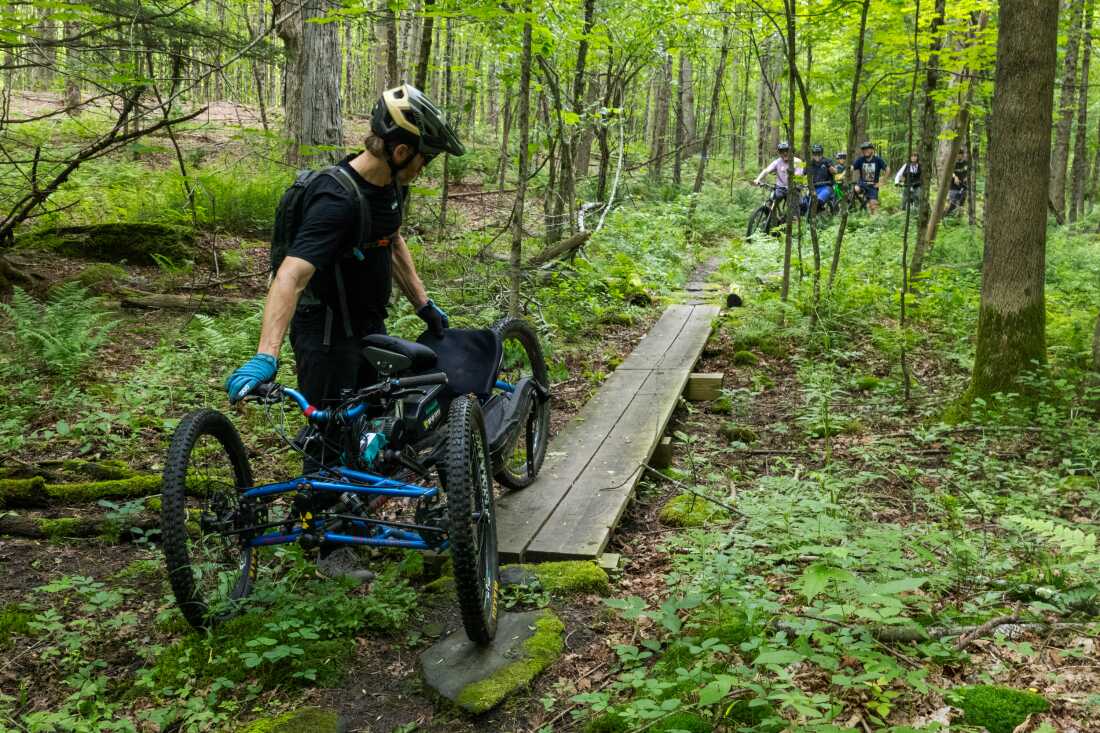
Nick Bennette, of the Vermont Mountain Biking Association, guides an adaptive bike over a narrow bridge, pointing out that other adaptive riders may have trouble getting across.
Zoe McDonald/Vermont Public
hide caption
toggle caption
Zoe McDonald/Vermont Public
Advertisement
But adaptive rigs like Arevalo’s are wider and heavier than regular mountain bikes, and not all trails are user-friendly.
Nick Bennette, who was testing a different type of adaptive bike, got hung up on several tight turns.
“It’s helpful to have different kinds of adaptive bikes on these tests because they all handle a little differently,” he said.
Advertisement
Bennette is executive director of the Vermont Mountain Bike Association, another nonprofit spearheading efforts around the Velomont. He and others involved in the assessment are taking detailed photos and notes on ways to make the trails more accessible.
“Just scalloping out a bit of material on the outside of that corner,” said Bennette, pointing to the area the bike got caught. “That will allow adaptive bikes to make that corner without really changing the way the trail rides.”
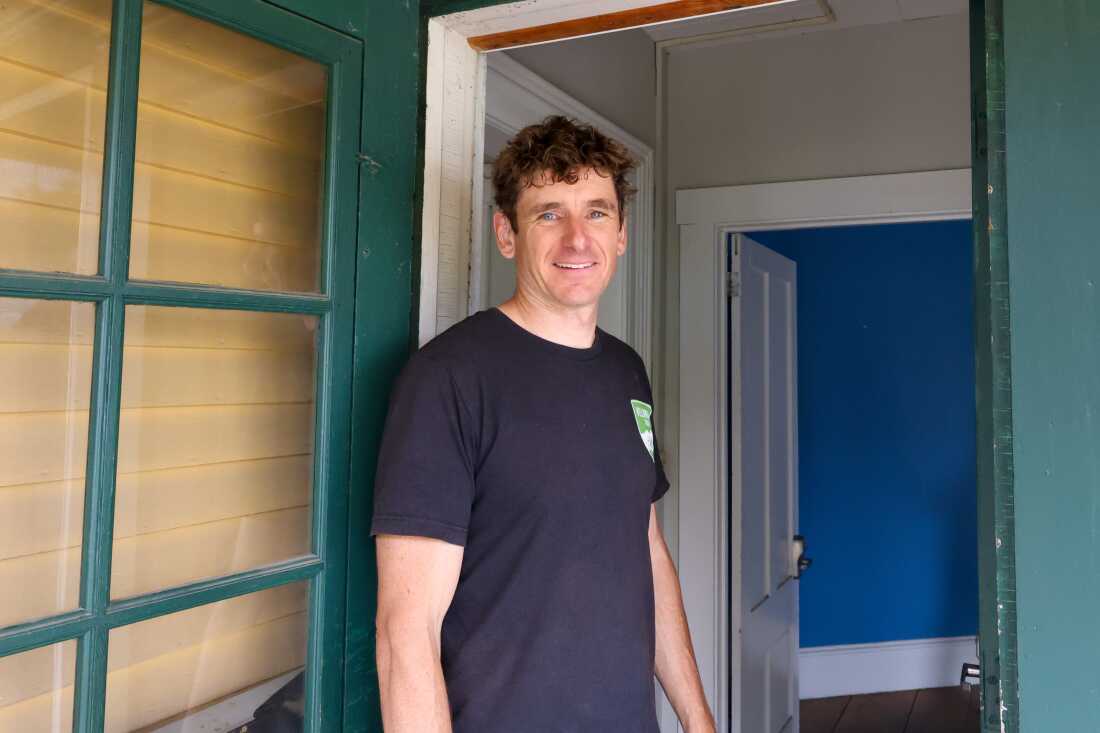
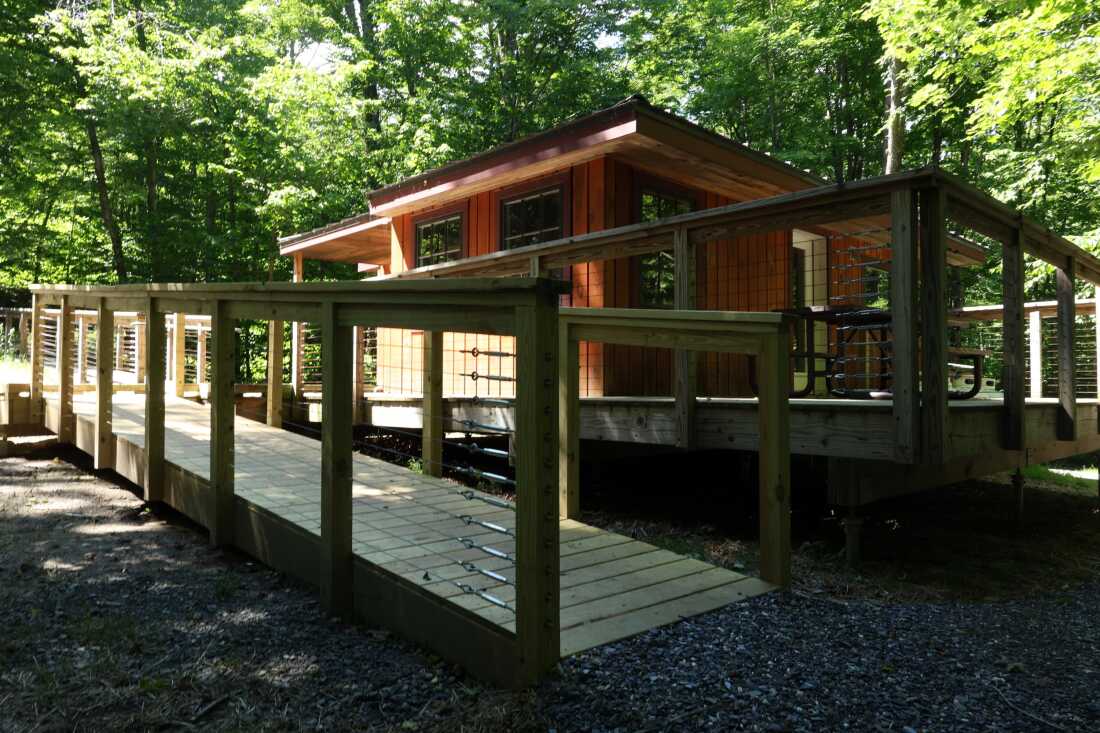
Angus McCusker with Vermont Huts and Trails is working to create accessible accommodations along the Velomont Trail, including a multi-group space in Randolph and a hut in Chittenden that has been outfitted with accessibility in mind.
Zoe McDonald/Vermont Public
hide caption
Advertisement
toggle caption
Zoe McDonald/Vermont Public
Contractors are also trying to reduce barriers at the trail’s overnight accommodations. This summer, contractors are building a new ADA accessible hostel in downtown Randolph.
And two remote huts along the trail will have locked sheds with off-road wheelchairs so bikers don’t have to haul their own.
Advertisement
At the Chittenden Brook Hut, McCusker highlighted a new ramp and wider driveway.
“So if you’re an adaptive rider, you can imagine rolling right up here and you can transfer to your chair that’s available here, and then roll down the ramp and go down to the fireplace, to the privy, to make your meal,” he said.
Louis Arevalo stayed at the hut last summer with other adaptive riders — his first camping trip since his accident.
“There was a babbling brook right there…and it was really refreshing to have easy access to a beautifully built hut that was easy to navigate, and then have these world-class trails right out the door,” he said. “And with these Velomont trails, I can actually plan a hut-to-hut trip with other people.”
The Chittenden Brook Hut includes accessible ramps, storage for adaptive bikes and specialized off-road wheelchairs for visitors.
Zoe McDonald/Vermont Public
Advertisement
hide caption
toggle caption
Zoe McDonald/Vermont Public
Advertisement
Jeff Alexander is counting on it. He’s director of strategic partnerships with Vermont Adaptive Ski and Sports, a nonprofit that helps people with disabilities access outdoor recreation.
An economic impact analysis the group commissioned estimates their programming generated more than $10 million last year.
“So the adaptive community has money, they travel, they want to travel and they want to play with everybody,” Alexander said. “We just need to level the playing field so that everyone can play together.”