Vermont
It’s time for a Vermont State Mushroom – The Mountain Times


Submitted
By Rep. Michelle Bos-Lun, D-Westminster
Editor’s note: Michelle Bos-Lun is a secondary school teacher in her second term representing Westminster, Rockingham and Brookline in the Vermont House.
I recently submitted a bill to create the Vermont State Mushroom after consulting with some important stakeholders: the elementary students of Windham Elementary School and the middle school students of the Compass School in Westminster. Both groups of students spent time learning about the wonders of wild mushrooms, and after considering diverse contenders students at both schools chose the same mushroom genus by a majority vote, Hericium. After counting all votes: Hericium americanum, commonly known as Bear’s Head Tooth, was the winning mushroom.
To determine which mushroom should be the state mushroom, I visited both schools and talked with students about a diverse array of mushrooms. We discussed pros and cons and symbolism from names and mushroom qualities. At Windham, the Lions Mane initially won. At Compass School, with more voting students, the ultimate winner was Bear’s Head Tooth. A return visit to Windham had all but two students supporting the Bear’s Head Tooth.
Many educators agree that getting students into nature is a desirable physical and intellectual activity. Compass science teacher Ron Bos-Lun (this writer’s husband) brings mushroom experts into the woods with his students every year to discover and identify fungi at Bald Hill Reserve in Westminster. Bos-Lun also brought Jack O’Lantern mushrooms to both Compass and Windham Elementary this fall to let students observe mushrooms that glow in the dark. He said they found it “enchanting.”
There were a range of reasons students thought Bear’s Head Tooth would be the best choice: A younger student said, “A mushroom that grows in trees would be great since Vermont has lots of trees.” The middle schoolers seemed more compelled by the uniqueness of the Bear’s Head Tooth and its medicinal qualities.
Learning about mushrooms, identifying them, cultivating them or harvesting ones found in the wild is an activity that almost anyone can do. I began to explore the world of mushrooms during the rainy, isolating months of the Covid-19 pandemic. First I could identify Lobsters, then Chicken of the Woods, then Chanterelles. Suddenly a whole new world opened up! Almost every walk I took in the woods I found new fungi — not all edible, but all interesting and beautiful in different ways. I learned a new word, “mycography” (the photography of mushrooms), and delighted in capturing images of the varied mushrooms. My new hobby gave me a reason to go into the woods and linger and explore. I want the same possibility for other Vermonters, especially children who study Vermont symbols in elementary and middle school.
Only five other states have a state mushroom at this time, though four others have had state mushrooms proposed. No other state has selected Hericium americanum as its state mushroom.
If the committee assigned to review this mushroom proposal decides to take up this bill, it would take testimony, including from the students who were involved in making the selection, myself as the lead sponsor of the bill and Vermont mycologists. We could have a state mushroom by the end of the legislative session in May — just in time for thousands of foragers young and old to head into the woods to see if they can find Bear’s Head Tooth mushrooms and other fungi that have emerged!
It is my hope that selecting a state mushroom will boost interest in foraging and mycography and will inspire other Vermonters to head to the woods and see what delights they can find (or some might take the easier option & buy cultivated mushrooms at farmers’ markets).
Do we have more important, complicated issues to decide this term than a Vermont State Mushroom? Yes. But it is important to remind Vermonters of the treasures we have in our woods. Letting Vermont youth know that their voice matters and they can impact policy on the state level is important too. A state mushroom would develop interest and knowledge about mushrooms in Vermont and perhaps encourage new people to go out in the woods looking not only for the state bird (Hermit Thrush), the state animal (Morgan Horse) or the state tree (Sugar Maple) but also the Vermont State Mushroom!
This bill is one that can empower youth voices and encourage people to spend time in nature. It could bring together legislators who might disagree about more complex issues but can pull together to support nature and students.
Designating a state mushroom shows that we value our woods and what grows in them. It sends a message that we value what kids think. It can motivate people to learn about and explore the world of fungi in Vermont, which acknowledges thousands of foragers and home cultivators who already are aware of how fantastic fungi can be. It’s time for a Vermont State Mushroom,
Hericium americanum.
Mushrooms can be exciting, nutritious, beautiful and medicinal and are not a partisan issue. Foraging and identifying mushrooms is a hobby thousands of Vermonters young and old enjoy. I am hoping the General Assembly can come together to establish a new symbol of Vermont, heeding the choice of some young budding mycologists from southern Vermont to have Vermont become the sixth state with a state mushroom.


Vermont
UVM wants to use state scholarship money to pay for a new sports complex. Vermont legislators are skeptical. – VTDigger

The University of Vermont is asking legislators for $15 million from a statewide student financial aid fund so the school can put it toward a long-planned campus sports complex instead.
While Gov. Phil Scott supports the proposal, it has gotten a cold reception so far from lawmakers. Scott included the funding move in his state budget proposal for the upcoming fiscal year, which starts in July. And he highlighted the project in his budget address to lawmakers at the start of the legislative session in January.
The House took the plan out of the version of a spending package it passed last week. The chamber’s bill, H.951, is now being considered in the Senate.
Both supporters and detractors of the plan agree it would mark a shift in the use of the state’s Higher Education Endowment Trust Fund, which helps pay for aid to students at UVM, in the Vermont State Colleges System or attending other schools in-state.
Last year, the trust fund paid for 675 scholarships averaging $1,400 each, according to data from the Vermont State Treasurer’s Office, which manages the pot of money. About three-quarters of the beneficiaries were first-generation college students.
But for UVM, the state fund — which recently saw a large infusion of cash — is an attractive option to get construction back underway on its “multipurpose center” project, which broke ground in 2019 but has stalled since the Covid-19 pandemic. The indoor venue would be among the largest in the state, school leaders have said.
Rep. Robin Scheu, D-Middlebury, chairs the budget-writing House Appropriations Committee. She said she opposes UVM’s plan because taking money out of the trust fund would make less available for student aid. Doing that, for a building project, is a policy decision that needs more scrutiny, she said.
“It’s completely unrelated to the uses of the fund — and that’s a huge policy shift,” she said of UVM’s project Wednesday.
One member of the appropriations panel was blunt in his criticism during a hearing on the plan earlier this year: “I don’t like this,” said Rep. Tom Stevens, D-Waterbury. The House Education Committee has also voiced its opposition to the proposal, calling it “well outside” the fund’s current purpose in a February memo.
State lawmakers put $6 million into the fund when they set it up in 1999. It gets new money from the estate tax on high-wealth individuals’ assets when they die, as well as an annual infusion of cash from the state’s collection of unclaimed financial property.
Every year, the state withdraws up to 5% of the fund’s assets for aid to students at UVM, Vermont State University and Community College of Vermont. Money is also sent to the Vermont Student Assistance Corp. for its financial aid programs.
The aid is drawn from the interest the fund accrues, because state law does not allow withdrawals that would reduce the amount of its principal. A smaller percentage of the fund can also be used to bolster UVM and the state colleges’ endowments — provided there are matching private donations available.
Both UVM and the governor’s office are pitching to take $15 million out of the trust fund’s principal. They argue the timing is ripe because the fund got a historic windfall of estate tax revenue last year: more than $26 million, which brought its total assets to nearly $66 million. Even after taking out $15 million for UVM’s new facility, they’ve argued, the fund would still be larger than in years past.
“I know it’s a departure from how those funds have been used for the past,” Marlene Tromp, the UVM president, told House Appropriations last month. “We believe this one-time investment is an appropriate use of those funds, because it will allow us to make such an impact on the state.”
The new facility would be able to seat 5,000 people, Wendy Koenig, UVM’s director of government relations, said at the same committee hearing. It would house the men’s and women’s basketball teams and host concerts, lectures, conferences and other events, according to previously-detailed plans. The project would also renovate existing athletic facilities on the site.
READ MORE

UVM has spent $75 million on the project so far and needs $100 million more to finish it, according to Tromp. The state’s infusion of cash would make some major donors who are on the fence more likely to step up, she said, as well as prevent UVM from needing to raise fees on its students to make up the funding gap.
She argued the facility would attract visitors to Burlington, boosting the local economy. It would also make UVM a more attractive campus for more students, which is a boon to the region and its future workforce. She recalled a similar facility at Boise State University, where she was the president before being hired at UVM last year.
“I used to be really proud when we hosted ‘Disney On Ice’ at my last campus, and all those kids and their families would come,” she said. “Because when you set foot on campus, it starts to change the way you think about college. It becomes your place. And we want people to feel like UVM is their place.”
Scott’s secretary of administration, Sarah Clark, reiterated the governor’s support for the project this week.
In a letter outlining areas of disagreement with the House-passed budget, she said the project would “not only be an investment in our higher education system, but in an economic development and cultural engine for Vermont.”
Vermont
As manufacturing jobs decline, Vermont business leaders take their concerns to the Statehouse – VTDigger

Theo Wells-Spackman is a Report for America corps member who reports for VTDigger.
The manufacturing industry generates billions for Vermont’s economy each year — but jobs in the sector are on the decline.
That’s according to state Chamber of Commerce President Amy Spear, who spoke to a packed room of lawmakers and business leaders at the Statehouse during manufacturing industry day programming Thursday morning. Manufacturing employment has fallen more than 11% since pre-pandemic levels in 2020, she said, and a recent long-term study on the industry returned a pessimistic outlook for the rest of the decade.
In general, Spear and her colleague Megan Sullivan said in an interview, manufacturers create relatively high-paying jobs with significant upward mobility in Vermont. They also form the backbone of a crucial facet of the state’s economy, Spear said: exports.
Manufacturing brings “new money” into Vermont, Spear told lawmakers Thursday. “It grows the economic pie rather than redistributing it,” she said.
Sen. Alison Clarkson, D-Windsor, chair of the Senate Economic Development Committee, echoed Spear’s comments.
“You are our partners in economic development, and we depend on you,” she told business leaders. “We are your cheerleaders in the Statehouse.”
But while manufacturers in the room applauded several recent legislative efforts to ease financial pressure on companies — including Covid-era relief and research and development tax credits in a bill currently under consideration — several expressed anxiety over the rising cost of doing business in Vermont.
Dave Laforce, who owns Built By Newport, a furniture manufacturer in the Northeast Kingdom, said the combination of electricity costs, property taxes and health care premiums had been crushing in recent years. But passing costs on to consumers isn’t an option when you’re facing international competition, he said.
“In my 35 years of being in this business, I have not seen the escalation of fixed costs that we’ve experienced in the last three years,” he told lawmakers.
In particular, Laforce joined Janette Bombardier, an executive at Chroma Technology in Bellows Falls, in raising concerns over the burden of the payroll tax lawmakers recently imposed to support child care growth. Many of Chroma’s employees live in New Hampshire and therefore cannot access the subsidy this tax pays for, Bombardier said, and even those on the Vermont side live in an area where the need for child care still far outstrips available slots.
“I’m not sure it’s doing what we’re all hoping it would do in terms of creating spaces,” Bombardier said of the payroll tax.
Recruiting an adequate workforce was perhaps the largest headwind that business leaders cited.
Ben Bristow of Nolato Vermont, a plastic and silicone molding company in Royalton, said his Swedish ownership had considered opening a new facility in the area several years ago. But when it became clear that hiring a 200-person staff in a short time would be difficult, the project abruptly moved to Hungary, he said.
Lt. Gov. John Rodgers concluded Thursday with a plea to strengthen and expand the state’s technical education centers and the apprenticeship programs that connect them with local manufacturers.
“If we’re going to encourage the next generation of builders, we need to get them involved in hands-on learning early,” he said.
— Theo Wells-Spackman
In the know
Testimony to lawmakers last year revealed that gaps in state alerts to crime victims sometimes caused them life-altering harm. After learning about those gaps, lawmakers on the House Corrections and Institutions Committee assembled a task force to improve the state alert system.
On Thursday members of that task force reported back with their most recent recommendations.
Victims have long asked lawmakers to make the automated alert system customizable. For example, someone might want to be alerted if the person who harmed them was released from prison. But they might not want to know if their abuser was merely transferred from one prison to another. Victims might also want to change the types of information they receive over time.
Kelsey Rice, a survivor of domestic violence who sits on the task force, told the committee that as more time passes after the moment when someone’s abuser is arrested, victims might want to change the types of information they receive. “The choices and decisions I made in that moment were not the same choices and needs that I identified needing later on,” Rice said.
Current state law leaves no room for that choice, task force members told the committee. They asked lawmakers to draft changes to Vermont law allowing victims to opt out of certain notifications.
— Charlotte Oliver
Gov. Phil Scott had harsh words at a press conference Wednesday for the House majority that voted last week in favor of the chamber’s budget proposal.
The Republican governor read aloud a letter he said he’d received from a Vermont-born man who wrote that he’s now leaving the state because his taxes have gotten too expensive.
“Apparently, the majority of House members have been hearing something different from their constituents,” Scott said before criticizing how the chamber is “proposing to increase property taxes by an average of 7%.”
The governor has proposed a plan that would increase property taxes too — by 4%. Ultimately, the size of the projected tax hike will depend on how much money legislators and the governor agree to use to buy down tax rates in the upcoming fiscal year.
Scott also said he disagrees with the House’s decision to draw on $9.5 million in interest from the state’s Technology Modernization Fund to pay for a number of one-time initiatives that weren’t part of his budget proposal. And he wants the Senate, which is now reviewing the budget bill, to back an idea he initially proposed to eventually send all of the state revenue from taxes on vehicle purchases to the Transportation Fund.
The Scott administration also opposes a portion of the House’s budget that would require detailed information about the state Agency of Education’s operations in some of the agency’s future spending proposals.
In testimony to the Senate Appropriations Committee later Wednesday, Adam Greshin, Scott’s commissioner of finance and management, called that language “basically a middle finger to the agency.”
— Shaun Robinson
On the trail
Attorney General Charity Clark is weighing in on the race for Chittenden County’s next top prosecutor.
On Thursday, Clark endorsed Bram Kranichfeld, who currently serves as Franklin County state’s attorney.
Kranichfeld, a Democrat, is running to the right of current Chittenden County State’s Attorney Sarah George, who is seeking reelection.
“Bram is incredibly caring, moral, and thoughtful. He is an excellent lawyer, someone whose judgment I trust. I believe he’s the change Chittenden County needs,” Clark said in a statement.
Some have said the race is off to a “spicy” start.
— Ethan Weinstein

Arnaldo Gregorio Alay Aguilar was following his navigation system while delivering a truckload of logs to New York and ended up at Vermont’s Highgate Springs border crossing into Canada.
Canadian officers would not let him back up the truck for safety reasons, his lawyers say. So he was forced to cross through, make a U-turn and report to a border official on the U.S. side.
That detour led to the 40-year-old trucker being held in federal custody for three weeks. But the government did not make a case for why, according to court documents.
The situation has similarities to a pattern that emerged in recent immigration operations in Burlington and South Burlington, where government lawyers failed to provide evidence when seeking to hold people picked up by U.S. Immigration and Customs Enforcement.
U.S. District Court Judge Geoffrey W. Crawford ordered Alay Aguilar’s immediate release last week “given the nature of the constitutional violations in this case,” according to the court order.
Federal officials “failed to provide Petitioner with a charging document or to articulate a clear or legally sufficient basis for his detention,” his lawyers stated in court filings.
In his order, Crawford noted that the government had offered no justification except a reinterpretation of the Immigration and Nationality Act as it applies to people who originally entered the U.S. without authorization and have been living in the country. Alay Aguilar has a pending asylum application from October 2025.
READ MORE

Federal lawyers argued that a person in his situation is subject to mandatory detention and not entitled to a bond hearing, at which an immigration judge would consider whether the person is a flight risk or a danger to the community.
That reinterpretation, Crawford determined, was wrong.
Amid the Trump administration’s continued crackdown on immigration, federal judges in Vermont this year have issued a string of rebukes to ICE for violating people’s constitutional rights while detaining them.
Nathan Virag, one of the lawyers who represented Alay Aguilar in federal court in Burlington, said the government had no grounds for holding his client.
“This is a person who did not try to leave the United States. It was an inadvertent reroute that should not count as a departure from the United States,” Virag told VTDigger. Virag is a lawyer with the Association of Africans Living in Vermont.
Co-counsel Erin Jacobsen, a lawyer with the Vermont Asylum Assistance Project, said the hearing March 25 was brief and featured “very little argument by the U.S. Attorney’s Office.”
Spokespeople for U.S. Customs and Border Protection, ICE and the Department of Homeland Security did not respond to questions via email about the case.
Alay Aguilar’s description of what happened when he reached the Canadian border March 5 is contained in the habeas corpus petition filed in U.S. District Court on March 23, the federal response filed March 24 and the judge’s order filed March 25.
A citizen of Ecuador, Alay Aguilar lives in North Carolina and had applied for asylum in October 2025, according to court filings. That case is pending.
A long-haul truck driver with a valid commercial driver’s license, he recently took up an extra gig — to haul timber from Vermont to New York — to pay for an immigration lawyer for an upcoming asylum-related hearing, according to his lawyers’ petition.
Alay Aguilar inadvertently crossed into Canada at Highgate Springs, one of the busiest border crossings in New England, while following directions on the truck’s navigation system, the petition said.
Canadian border personnel, who communicated with Alay Aguilar in Spanish, would not let him reverse the truck for safety reasons.
When Alay Aguilar tried to reenter the U.S., a Customs and Border Protection official gestured for him to exit the truck and walk into a building, which he did.
In the building, Alay Aguilar was allowed to communicate using Google translator on his phone. Officials said there was a problem with the truck’s manifest and ordered him to call the owner, which he did. CBP officials then spoke with the owner in English and did not translate the conversation, court documents state.
Officials then confiscated his phone and handed it to an ICE official. ICE personnel then handcuffed Alay Aguilar and drove him to an office about 15 minutes away where he was detained for about three hours, according to court documents, before being moved to Northwest State Correctional Facility and held there.
Court filings indicate Alay Aguilar fled Ecuador and entered the United States around November 2023. He was detained by the Department of Homeland Security near the Mexican border and held for a few weeks, after which he accepted the government’s offer to fly him to New York so he could pursue asylum outside of detention, his lawyers said in their petition.
He relocated to Charlotte, N.C., and applied for asylum. He received work authorization and is currently employed by a local company in North Carolina. He has lived and worked in North Carolina for two years, where he has friends and a serious girlfriend, his lawyers said in court documents.
“There were no changed circumstances after his release on his own recognizance in 2023, no criminal history, so it really was an unconstitutional detention,” Virag said in an interview.
Cases arising out of accidental border crossings are based on Homeland Security officials “misinterpreting” decades-old rules meant to punish people making an initial entry into the United States or those who are a danger to the community and pose a flight risk, Virag said. Judge Crawford noted in his order that Alay Aguilar had not been found to present a danger or a flight risk.
“These detentions serve no legitimate government purpose or interest,” Virag said.
Similar border crossing detentions last year — involving Alexi and his family and Jose Ignacio “Nacho” De La Cruz and his stepdaughter, for instance — illustrate some of the tactics CBP have used on noncitizens amid detention quotas mandated by the Trump administration.
As for Alay Aguilar, his detention was one of “fear, confusion, isolation, and hopelessness,” his lawyers said in court filings.
“This case had a good outcome, but Mr. Alay Aguilar was subjected to 20 days of detention with absolutely no due process whatsoever — a completely unjustified, inexcusable, traumatizing abuse of power,” Jacobsen said.
“In many ways, Arnaldo’s case was like the other unconstitutional detentions we’ve seen, with our government arresting and detaining people outside of regular and constitutionally required procedures,” she added.
And his lawyers would not have known about his case were it not for the Vermont Asylum Assistance Project’s detention check program, she said. Under that program, lawyers and interpreters proactively visit the detention centers in Vermont. Alay Aguilar was found at the St. Albans prison during one such visit on March 18, she said.
Now that Alay Aguilar has been freed, he is back in North Carolina.
“He will be able to resume what he was doing before his apprehension — working, taking care of his family and continuing to pursue his asylum case,” Jacobsen said.

Bo Lueders, guitarist and co-founder of hardcore metal band Harm’s Way, dies at 38

L.A. Affairs: I told my husband that something had to change. I just didn’t know what would come next

U.S. rescues pilot who ejected after fighter jet was shot down by Iran, officials say
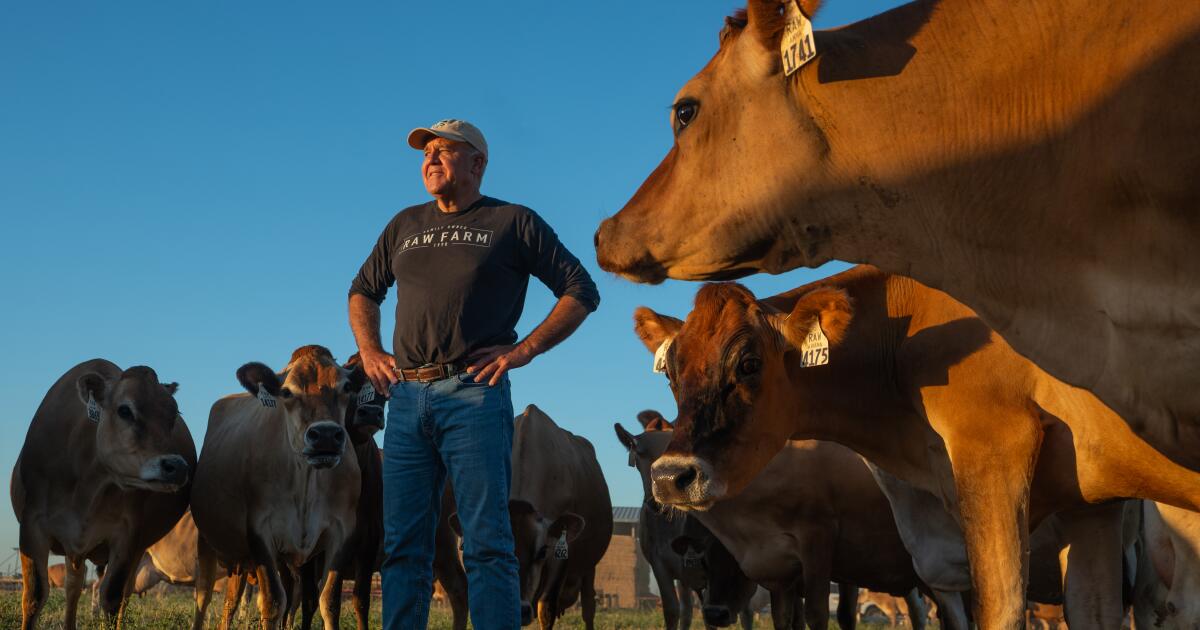
Amid E. coli outbreak, California-based Raw Farm voluntarily recalls cheddar cheese

Luka Doncic’s hamstring injury will test Lakers’ depth on eve of NBA playoffs

Florida High School Football Rankings: Top 25 teams – Oct. 21

How old is Bo Nix? What to know about Oregon quarterback ahead of 2024 NFL Draft

Cleary's 21 help Le Moyne down Central Connecticut State 69-64 in OT

99th annual Pony Swim held in Virginia

Indiana Members Credit Union announced as new anchor tenant at Bottleworks District

Two dozen Democrat-led states sue Trump over mail-in ballot limits

Trump’s ballroom fight sheds new light on an underground White House bunker

Video: Trump Struck Iran. Now Farmers Are Paying the Price.

What B-52 bombers bring to Iran fight — and what it means for the war now

Podcast: Hungary elects: what is at stake and who is likely to win?
-

 Culture1 week ago
Wil Wheaton Discusses ‘Stand By Me’ and Narrating ‘The Body’ Audiobook
-

 South-Carolina5 days ago
South Carolina vs TCU predictions for Elite Eight game in March Madness
-

 Miami, FL1 week ago
Jannik Sinner’s Girlfriend Laila Hasanovic Stuns in Ab-Revealing Post Amid Miami Open
-

 Culture1 week ago
What Happens When We Die? This Wallace Stevens Poem Has Thoughts.
-

 Minneapolis, MN1 week ago
Boy who shielded classmate during school shooting receives Medal of Honor
-

 Vermont5 days ago
Skier dies after fall at Sugarbush Resort
-

 Education1 week ago
Video: Transgender Athletes Barred From Women’s Olympic Events
-

 Politics5 days ago
Trump’s Ballroom Design Has Barely Been Scrutinized