Northeast
Trump assassination attempt: FBI reveals first photos of Thomas Crooks’ firearm, IEDs in car trunk

The FBI on Wednesday provided additional details about would-be Trump assassin Thomas Matthew Crooks’ activity before and during the July 13 campaign rally that left one man dead.
While the FBI has not established a definitive motive for the shooter or any co-conspirators with advanced knowledge of the attack, Kevin Rojek, special agent in charge of the FBI Pittsburgh Field Office, told reporters during a press call that Crooks had “a sustained detailed effort to plan an attack on some event, meaning he looked at any number of events or targets.”
The 20-year-old gunman “became hyper-focused” on Trump’s rally in Butler, Pennsylvania, when it was announced in early July. He had no identifiable political ideology, Rojek added.
Over the month leading up to the attack, Crooks made more than 60 searches related to both President Biden and former President Trump. In late September 2023, an account associated with Crooks “searched the former president’s campaign schedule and upcoming appearances in Pennsylvania,” Rojek said.
TRUMP ASSASSINATION ATTEMPT VICTIMS WITH LIFE-ALTERING INJURIES SEEK ACCOUNTABILITY: ‘IT WILL COME TO LIGHT’
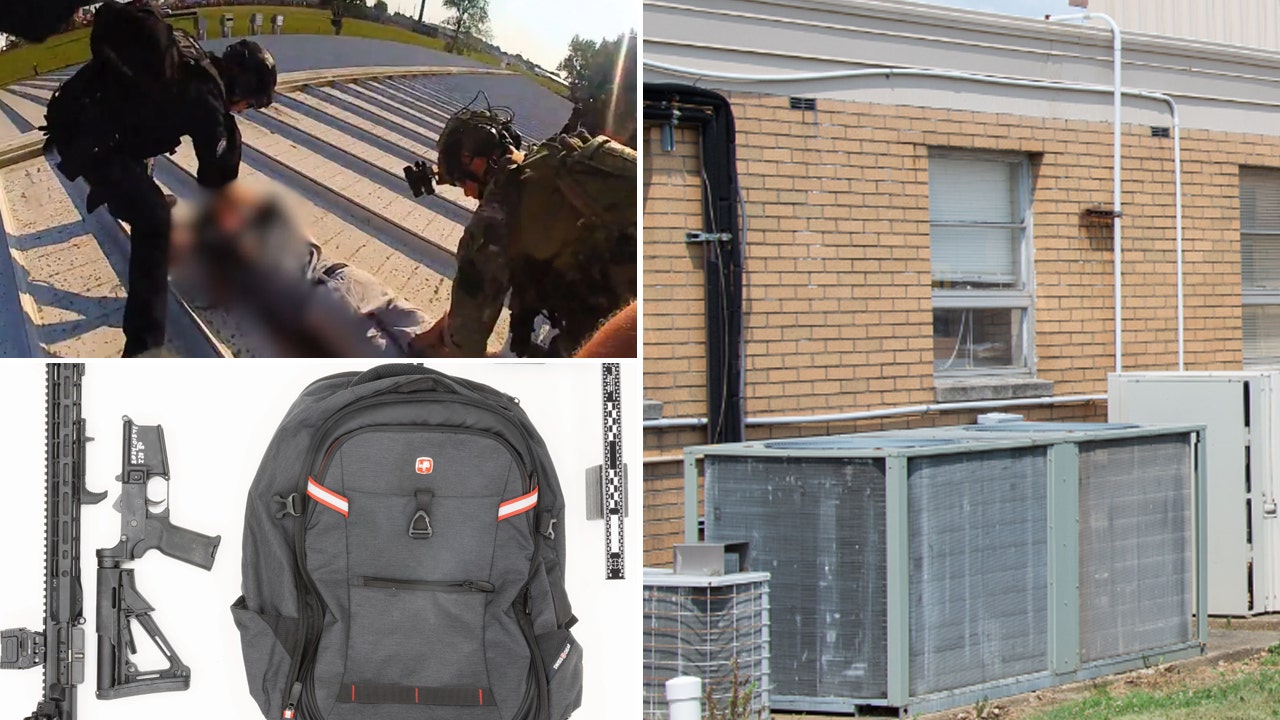
A photo shows the air conditioning unit Thomas Matthew Crooks used to access the roof ahead of the assassination attempt of former President Trump in Butler, Pennsylvania. (Federal Bureau of Investigation)
“Next, from April of 2024 through July 12, the subject searched campaign events for both former President Trump and President Biden, including events scheduled to take place in western Pennsylvania,” Rojek said. “Specifically on July 4, 2024, the subject searched for details of the former president’s campaign event in Butler.
On July 6, Crooks searched for specific details about Trump’s event in Butler.
TRUMP ASSASSINATION ATTEMPT TASK FORCE CHAIR QUESTIONS ‘FROZEN’ RESPONSE TO SHOOTER AFTER TOURING SITE
A photo shows Thomas Matthew Crooks’ semi-automatic rifle and backpack as it was likely transported following the assassination attempt of former President Trump in Butler, Pennsylvania. (Federal Bureau of Investigation)
“The subject registered to attend the rally, and that same day he specifically searched for, ‘How far was Oswald from Kennedy?’ ‘Where will Trump speak from at Butler Farm Show,’ ‘Butler Farm show podium,’ and ‘Butler Farm show photos,’” Rojek further explained. “On July 8, the subject search ‘AGR international.’ And on July 10, he searched ‘weather in Butler,’ and the 30 days prior to the attack, the subject conducted more than 60 searches related to President Biden and former President Trump.”
He also noted “specific searches conducted on July 5 to include, ‘When is the DNC convention?’ and ‘When is the RNC in 2024?’”
TRUMP ASSASSINATION TASK FORCE REBUFFS PARALLEL PROBE: WE’RE ‘THE ONLY TASK FORCE OF JURISDICTION’
A photo shows two explosive devices found in the trunk of Thomas Matthew Crooks’ car following the assassination attempt in Butler, Pennsylvania. (Federal Bureau of Investigation)
The FBI confirmed that Crooks was seen walking outside the rally perimeter by a row of vendors at 4:26 p.m. on July 13, about an hour and a half before Trump began speaking.
Video footage from a local business showed Crooks climbing up the American Glass Research (AGR) building and then traversing multiple rooftops between 6:05 and 6:08.
WATCH:
“Our overall finding is the subject was only on the roof for approximately six minutes prior to the shooting. Between 6:05 and 6:11 p.m.,” when he was neutralized, Rojek said, later refuting rumors that there was a second shooter.
The day of the rally, Crooks flew a drone for 11 minutes, between 3:51 p.m. and 4:02 p.m., Rojek told Fox News Digital.
WATCH:
The FBI’s observations from the drone’s flight path show it “would have been helpful for our subject to assess the security posture at the event,” the special agent-in-charge said.
“However, we will never be able to determine the exact motivation for why the subject flew the drone,” Rojek added. “We can only do that based on our assessment of the flight path and what we’re able to determine through our analysis by the lab.”
Read the full article from Here


There’s no way around it. To experience these sushi-focused multicourse tasting menus, you are going to splurge, at least a little. At omakase specialist O Ya, for instance, Tim and Nancy Cushman present raw fish in many creative forms over 20 to 25 bites, from oysters with watermelon pearls to hamachi with torched banana pepper to Peruvian-influenced chutoro. If the initially revelatory menu had started to feel somewhat rote, a Michelin pass-over and the restaurant’s 20th anniversary seem to have provided the spark to shake it up. Add a sake and wine pairing — a particular strength here — and the experience is going to cost more than $500 per person.
For a different creative take on omakase, head to Lexington to spend an evening at Michael Monaco’s six-seat Akame Nigiri and Sake. For $180, his 15-course tasting menu showcases premium fish from Japan alongside a freewheeling array of ingredients that might include mango, hummus, and Dorito powder; as at O Ya, Akame’s omakase includes Hokkaido uni and A5 Wagyu.
The bottom line:
O Ya: $378.78 (including taxes and fees; no gratuity required), optional beverage pairings $192-$240.
Akame Nigiri and Sake: $180, optional sake pairing $85.
O Ya, 9 East St., Boston, 617-654-9900, www.o-ya.restaurant. Akame Nigiri and Sake, 1707 Massachusetts Ave. #2, Lexington, 781-538-6581, www.akamenigiriandsake.com.

Steakhouse stakeout
Abe & Louie’s has been around since restaurateur Charlie Sarkis opened the steakhouse in 1965, and it’s still going strong. When you want old-school vibes — dark wood, white tablecloths, roaring fireplace, servers in jackets bringing you New York strips and martinis — this is your spot.

But if the Back Bay restaurant is too rich for your blood, there’s another steakhouse classic going strong, this one in Brighton: The Stockyard, opened in 1972. It’s got the fireplace, New York strips, and martinis, plus the right old-school vibe. The similarities should come as no surprise, as chef Bill Bramley and general manager Gerry Lynch both previously worked at Abe & Louie’s.
The bottom line:
Abe & Louie’s: Steaks $72-$195, martinis $18.
The Stockyard: Steaks $32-$98, martinis $14.
Abe & Louie’s, 793 Boylston St., Back Bay, Boston, 617-536-6300, www.abeandlouies.com. The Stockyard, 135 Market St., Brighton, 617-782-4700, www.stockyardrestaurant.com.

Postcards from Italy
Buzzy, swank, and Michelin-recommended, La Padrona is chef Jody Adams’s return to the Italian cuisine she was long known for at Rialto. She and executive chef Amarilys Colón draw from Liguria, Tuscany, Sicily, and beyond, applying New England ingredients to regional dishes. Come for charred cabbage with anchovy butter and risotto with lobster and uni, stay for the strong bartending.

Or head to Dorchester’s Via Cannuccia, where Italian chef Stefano Quaresima prepares dishes straight out of Rome. (The restaurant is named for the street he grew up on.) At this neighborhood favorite, you’ll find fresh, basil-laced eggplant Parmigiana; ravioli stuffed with sheep ricotta and blanketed with lamb ragu; Roman-style pizza; and porchetta with giardiniera. Weekend brunch brings beautiful pastries.
The bottom line:
La Padrona: Bucatini with red and green tomatoes, stracciatella, and basil $33; beef tenderloin $67; wine by the glass $18-$45; cocktails $22-$30.
Via Cannuccia: Fettuccine with fresh tomato, basil, and grana padano $29; short ribs $47; wine by the glass $13-$23; cocktails $16-$18.
La Padrona, 38 Trinity Place, Back Bay, Boston, 617-898-0010, www.lapadronaboston.com. Via Cannuccia, 1739 Dorchester Ave., Dorchester, 617-506-1877, www.viacannuccia.com.

Direct flights to France
For French fine dining, with a price tag to match, Mistral has been a mainstay in Boston for nearly 30 years. Come here to savor foie gras with duck confit, Dover sole meunière, and profiteroles, as well as thin-crust grilled pizza, tuna tartare, and other more-modern classics. The room is elegant and the service excellent.

For French bistro dining, with a price tag to match, there is Ma Maison. Jacky Robert’s Beacon Hill restaurant is a homier, more down-to-earth venture than Mistral, but the pâté, escargots, duck a l’orange, and souffles hit home (if home is a non-touristy arrondissement of Paris).
The bottom line:
Mistral: Escargots $21, roast duck with mushroom risotto and cranberry gastrique $54, wine by the glass $15-$40, cocktails $19-$20.
Ma Maison: Escargots $12, duck a l’orange with Brussels sprouts $31, wine by the glass $12-$18, cocktails $10-$12.
Mistral, 223 Columbus Ave., South End, Boston, 617-867-9300, www.mistralbistro.com. Ma Maison, 272 Cambridge St., Beacon Hill, Boston, 617-725-8855, www.mamaisonboston.com.

A toast to tapas
When it opened in April, Dalia took South Boston by storm. Like sister restaurants Capri and Prima, it is dressed to impress: The room is filled with wrought iron, Spanish tile, and carefully curated decorations. This eye candy is backed up by a menu of tapas, crudos, grilled meats, and more. Tapas here are only a bit more expensive than at other Spanish restaurants around town. But if you’re the type to be tempted by pricier dishes like grilled Wagyu, paella, or tuna crudo, that can start to add up.

For the original fanciful-decor-plus-tapas experience, drop an “a” off of Dalia and head to Dalí. Tchotchkes, bric-a-brac, art, and a laundry line of undergarments festoon the eye-catching Somerville institution, where tapas, paella, and drinks can be had for a little less. (The best tapas deal in town, however, might be Estragon’s $6 tapas happy hour, Mondays through Thursdays from 5-7 p.m.)
But if you want to focus on eating and drinking — because tapas were invented to accompany drinks, after all — Taberna de Haro is the best bet for your money. The Brookline restaurant is known for its Spanish wine program, and its food and hospitality are excellent too.
The bottom line:
Dalia: Average tapas price is $14.23. Paella $28-$36 half-portion, $56-$72 whole; wine by the glass $11-$20; cocktails $15-$16.
Dalí: Average tapas price is $13.80. Paella $38-$45, wine by the glass $9-$12, cocktails $14.
Taberna de Haro: Average tapas price is $13.42. Paella $42, wine by the glass $11-$15, cocktails $13-$15.
Dalia, 429 West Broadway, South Boston, 617-752-0429, www.daliaboston.com. Estragon, 700 Harrison Ave., South End, Boston, 617-266-0443, www.estragontapas.com. Dalí, 415 Washington St., Somerville, 617-661-3254, www.dalirestaurant.com. Taberna de Haro, 999 Beacon St., Brookline, 617-277-8272, www.tabernaboston.com.

Aegean idylls
Where to go when you can’t get to a Greek isle? The South End, of course. Here you’ll find Kaia, serving elegant, upscale meze, grilled fish, and more. Spanakopita goes black tie in this fine-dining iteration of the classic spinach pie, strewn with blossoms and snipped herbs, earthy with truffle vinaigrette. Tender grilled octopus comes with wild greens and dill gremolata. For a summery dessert, there’s watermelon shaved ice with pistachio powder and yogurt foam.

A half-mile away is Kava Neo-Taverna, still elegant, still serving meze and grilled fish, just a little more casual and traditional. The grilled octopus is simpler here, with olive oil, lemon, and oregano. There’s baked feta with cherry tomatoes, lamb meatballs, and Greek fries.
Whichever place you choose, there will be a wine list stocked with bottles from Greece.
The bottom line:
Kaia: Average meze price is $24.13. Whole grilled fish is market price; lavraki (Mediterranean sea bass) was recently $90. Wine by the glass $16-$32, cocktails $18.
Kava Neo-Taverna: Average meze price is $14.54. Whole grilled fish is market price; lavraki was recently $65. Wine by the glass $12-$16, cocktails $13-$16.
Kaia, 370 Harrison Ave., South End, Boston, 617-514-0700, www.kaiasouthend.com. Kava Neo-Taverna, 315 Shawmut Ave., South End, Boston, 617-356-1100, www.kavaneotaverna.com.

Choose your own tasting menu adventure
Nightshade Noodle Bar is known for next-level Vietnamese-influenced tasting menus that would stand out in the most food-forward locales. Yet here we are in Lynn, feasting on chef Rachel Miller’s innovative seven-, nine-, 14-, 21-, and 30-course meals of fermented rice cakes with crispy confit duck tongues, chilled percebes (a.k.a. goose barnacles) dipped in lime-pepper sauce, and grilled coconut sticky rice with caramelized clay-pot foie gras and Amarena cherries. A night at Nightshade is an adventure.

You won’t find anything exactly like it anywhere else. But in a similar spirit of experimentation and creativity, Brassica Kitchen + Cafe offers The Ride — a free-form tasting of dishes from on and off the menu, for two people or more. Last year, Jeremy Kean and Philip Kruta’s quirky Jamaica Plain restaurant moved a few doors down into a larger, stylish space, but their focus on fermentation and reducing waste remains the same. (And now there’s pizza.) Your meal might include tuna crudo with watermelon and miso powder; striper collar with cherries, cherry ponzu, and basil; and koji risotto with Parmesan — or anything else the chefs can dream up.
The bottom line:
Nightshade Noodle Bar: tasting menus $102-$468, optional beverage pairings $60-$220.
Brassica Kitchen + Cafe: The Ride $105, optional wine pairing $55. Both restaurants include taxes and fees in the tasting menu price; no additional gratuity required.
Nightshade Noodle Bar, 73 Exchange St., Lynn, 781-780-9470, www.nightshadenoodlebar.com. Brassica Kitchen + Cafe, 3712 Washington St., Jamaica Plain, 617-477-4519, www.brassicakitchen.com.
Devra First can be reached at devra.first@globe.com. Follow her on Instagram @devra_first.

A man from Fayette County has been arrested and is facing over 1,000 charges related to alleged animal cruelty and neglect.
Fayette County District Attorney Mike Aubele said that John Saxberg, 57, is facing charges in connection with what he called “a suspected illegal kennel operation” in Washington Township.
According to DA Aubele, Saxberg is accused of subjecting numerous animals to “deplorable conditions” and “circumstances constituting torture,” adding that approximately ten animals suffered serious bodily injuries.
Court records show that Saxberg is facing 1,029 criminal charges in total with offenses including aggravated cruelty to animals, cruelty to animals, neglect of animals, penalties related to dog licensing, and violations of vaccine requirements.
52 of the charges that Saxberg is facing are felonies, according to court records.
Online court paperwork shows that Saxberg was arraigned on Tuesday afternoon and is being held in the Fayette County Prison after bail was posted at $85,000.
A preliminary hearing for Saxberg is scheduled for late next week.

-
 Politics2 minutes ago
Seth Doane and Jim Axelrod among contenders for ’60 Minutes’ roles
-
 Science9 minutes ago
Contributor: The crucial medical question that AI can’t ever answer
-
 Sports12 minutes ago
Commentary: Lionel Messi is the ultimate summer romance
-

 World24 minutes ago
Spain pitches €850bn per year in common EU borrowing
-

 News47 minutes ago
DOJ warns of criminal charges for state election officials if noncitizens vote
-

 Los Angeles, Ca2 hours ago
Bicyclist killed by hit-and-run driver in Long Beach
-

 Detroit, MI2 hours ago
Child shot while riding bike outside home on Detroit’s west side, police say
-

 San Francisco, CA3 hours ago
Bay Area restaurant has strict policy on acceptable children behavior

