Rhode Island
Inside a Work of Art in Providence – Rhode Island Monthly


The sleek white kitchen has sunny views of downtown Providence. Photography by Angel Tucker
Allison Spain and her husband had just finished their second home renovation project when they saw an 1867 Italianate for sale on Providence’s Benefit Street.
The home had been vacant for years. The roof leaked, trees branched through windows and the rooms were cloaked in layers of dated wallpaper and musty carpeting.
But it mattered none — Allison was smitten with its ornate details and hardware, the marble fireplaces, the flowers hand-painted by the previous owner, the high ceilings and hardwood floors she knew could be burnished to a bright glow.

Ornate details, a vintage chandelier and marble fireplace frame the living room. Photography by Angel Tucker
“I was overwhelmed by the amount of work it needed, but I just loved it so much,” Allison says.
They put in a Hail Mary offer, sure that it would be denied. It wasn’t.
William G. Angell, president of the American Screw Company in Providence, built the stately home in 1867. It’s a vestige of Providence’s time as a manufacturing powerhouse, 4,000 square feet of opulence on four floors, with four bedrooms, four-and-a-half baths and marble fireplaces scattered throughout.

A new tile floor in the foyer is similar to one in Allison’s mother’s childhood home in the Azores. Photography by Angel Tucker
For a brief period — 1933 to 1941 — the home was deeded to Swan Point Cemetery. Frances Stanton, a talented artist and member of the Providence Art Club who taught at CCRI, lived there for decades until her death in 2019. It sat vacant until the Spains bought it in July 2023.
Allison, a Providence native, moved back home to be closer to her parents, who’d settled in Bristol. A nurse by training, she adored the architecture and charm of the old homes in the area. She and her husband, Ben, renovated two houses in the capital city — first on Irving Avenue and then on Savoy Street — before they found the one on Benefit Street.
“I enjoy bringing things that are in rough shape into something beautiful and making a home,” Allison says. “I think that correlates with nursing a little bit, too. It’s like taking care of things — being a good steward of the property, and then also taking care of the people who live there.”
Ben started demo right after closing, with Allison, their two children and two dogs moving in with her parents. During the days, she helped him pull up carpets, scrape off wallpaper and remove asbestos tiles from the third floor while wearing a respirator mask in the stifling August heat.

A mirror belonging to former owner Frances Stanton hangs in the dining room. Photography by Angel Tucker
It took them eight hours — per room — to peel off the padding underneath all that carpeting. They refinished and stained the floors an ebony shade, restored most of the windows, which were in terrible shape, and replaced the leaking roof. They couldn’t save Stanton’s delicate flower mural in the kitchen, but tenderly cleaned and restored several mirrors and chandeliers she left behind.
With all the large projects finished, the family officially moved in in October 2023.
In a final nod to Stanton’s legacy, they painted all the rooms in gleaming white tones.
“Frances was an artist. I just thought, ‘Let’s do an art gallery,’” Allison says. “I mean, you walk into an art gallery and it’s all white. I view this house as a piece of art.”

Homeowner Allison Spain painted the front door a mossy green to match the mail slot’s verdigris. Photography by Angel Tucker



The Rhode Island Lottery offers multiple draw games for those aiming to win big.
Here’s a look at March 4, 2026, results for each game:
Winning Powerball numbers from March 4 drawing
07-14-42-47-56, Powerball: 06, Power Play: 4
Check Powerball payouts and previous drawings here.
Winning Numbers numbers from March 4 drawing
Midday: 2-7-4-4
Evening: 7-6-0-2
Check Numbers payouts and previous drawings here.
Winning Wild Money numbers from March 4 drawing
08-11-12-18-24, Extra: 15
Check Wild Money payouts and previous drawings here.
Winning Millionaire for Life numbers from March 4 drawing
12-13-36-39-58, Bonus: 03
Check Millionaire for Life payouts and previous drawings here.
Feeling lucky? Explore the latest lottery news & results
Are you a winner? Here’s how to claim your prize
- Prizes less than $600 can be claimed at any Rhode Island Lottery Retailer. Prizes of $600 and above must be claimed at Lottery Headquarters, 1425 Pontiac Ave., Cranston, Rhode Island 02920.
- Mega Millions and Powerball jackpot winners can decide on cash or annuity payment within 60 days after becoming entitled to the prize. The annuitized prize shall be paid in 30 graduated annual installments.
- Winners of the Millionaire for Life top prize of $1,000,000 a year for life and second prize of $100,000 a year for life can decide to collect the prize for a minimum of 20 years or take a lump sum cash payment.
When are the Rhode Island Lottery drawings held?
- Powerball: 10:59 p.m. ET on Monday, Wednesday, and Saturday.
- Mega Millions: 11:00 p.m. ET on Tuesday and Friday.
- Lucky for Life: 10:30 p.m. ET daily.
- Millionaire for Life: 11:15 p.m. ET daily.
- Numbers (Midday): 1:30 p.m. ET daily.
- Numbers (Evening): 7:29 p.m. ET daily.
- Wild Money: 7:29 p.m. ET on Tuesday, Thursday and Saturday.
This results page was generated automatically using information from TinBu and a template written and reviewed by a Rhode Island editor. You can send feedback using this form.

When it comes to expressing ourselves, Rhode Islanders have elevated license plates to an art form. You might not be able to get a new vanity plate — the state suspended applications in 2021 after a judge ruled a Tesla owner could keep his FKGAS plates — but you can still express your Rhody pride with one of seventeen state-approved charity plates. The program has funded ocean research, thrown parades, saved crumbling lighthouses and even provided meals for residents. About half of the $43.50 surcharge goes to the associated charity, while the other half covers the production cost.
________________________
License plate images courtesy of the Rhode island division of motor vehicles.
Atlantic Shark Institute
Year first approved: 2022
Plates currently on road: 7,007
Total raised: $269,530
________________________
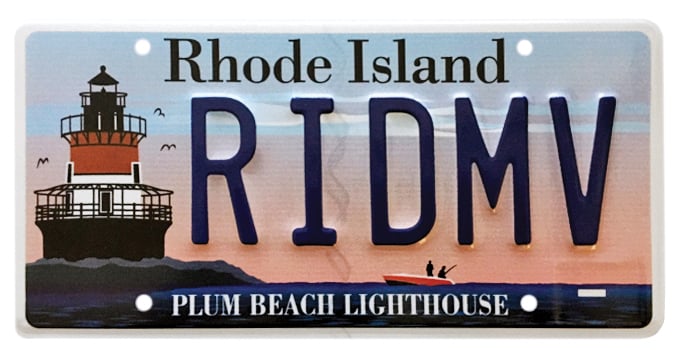
License plate images courtesy of the Rhode island division of motor vehicles.
Friends of Plum Beach Lighthouse
Year first approved: 2009
Plates currently on road: 5,024
Total raised: $336,890
________________________

License plate images courtesy of the Rhode island division of motor vehicles.
Wildlife Rehabilitators Association of Rhode Island
Year first approved: 2013
Plates currently on road: 2,102
Funds raised: $32,080
________________________

License plate images courtesy of the Rhode island division of motor vehicles.
Rocky Point Foundation
Year first approved: 2016
Plates currently on road: 1,616
Funds raised: $50,450
________________________

License plate images courtesy of the Rhode island division of motor vehicles.
Rhode Island Community Food Bank
Year first approved: 2002
Plates currently on road: 765
Funds raised since 2021: $11,060*
*Prior to 2021, customers ordered plates directly through the food bank, and total revenue numbers are not available.
________________________

License plate images courtesy of the Rhode island division of motor vehicles.
New England Patriots Charitable Foundation
Year first approved: 2009
Plates currently on road: 1,472
Funds raised: $136,740
________________________

License plate images courtesy of the Rhode island division of motor vehicles.
Audubon Society of Rhode Island and Save the Bay
Year first approved: 2006
Plates currently on road: 1,132
Funds raised: $61,380 for each organization (proceeds split evenly)
________________________

License plate images courtesy of the Rhode island division of motor vehicles.
Boston Bruins Foundation
Year first approved: 2014
Plates currently on road: 1,125
Funds raised: $36,880
________________________

License plate images courtesy of the Rhode island division of motor vehicles.
Beavertail Lighthouse Museum Association
Year first approved: 2023
Plates currently on road: 1,105
Funds raised: $37,610
________________________

License plate images courtesy of the Rhode island division of motor vehicles.
Bristol Fourth of July Committee
Year first approved: 2011
Plates currently on road: 1,104
Funds raised: $17,640
________________________

License plate images courtesy of the Rhode island division of motor vehicles.
Red Sox Foundation
Year first approved: 2011
Plates currently on road: 860
Funds raised: $88,620
________________________

License plate images courtesy of the Rhode island division of motor vehicles.
Gloria Gemma Breast Cancer Resource Foundation
Year first approved: 2012
Plates currently on road: 1,510
Funds raised: $33,360
________________________

License plate images courtesy of the Rhode island division of motor vehicles.
Providence College Angel Fund
Year first approved: 2016
Plates currently on road: 693
Funds raised: $23,220
________________________

License plate images courtesy of the Rhode island division of motor vehicles.
Rose Island Lighthouse and Fort Hamilton Trust
Year first approved: 2022
Plates currently on road: 383
Funds raised: $10,640
________________________

License plate images courtesy of the Rhode island division of motor vehicles.
Friends of Pomham Rocks Lighthouse
Year first approved: 2022
Plates currently on road: 257
Funds raised: $7,580
________________________

License plate images courtesy of the Rhode island division of motor vehicles.
Day of Portugal and Portuguese Heritage in RI Inc.
Year first APPROVED: 2018
Plates currently on road: 132
Funds raised: $3,190

PROVIDENCE, R.I. — Rhode Island Attorney General Peter Neronha will release on Wednesday findings from a multiyear investigation into child sexual abuse in the Diocese of Providence.
According to the attorney general’s office, the report will detail the diocese’s handling of clergy abuse over decades.
While the smallest state in the U.S., Rhode Island is home to the country’s largest Catholic population per capita, with nearly 40% of the state identifying as Catholic, according to the Pew Research Center.
Neronha first launched the investigation in 2019, nearly a year after a Pennsylvania grand jury report found more than 1,000 children had been abused by an estimated 300 priests in that state since the 1940s. The 2018 report is considered one of the broadest inquiries into child sexual abuse in U.S. history.
Neronha’s investigation involved entering into an agreement with the Diocese of Providence to gain access to all complaints and allegations of child sexual abuse by clergy dating back to 1950. Neronha’s office said in 2019 that the goal of the report was to determine how the diocese responded to past reports of child sexual abuse, identify any prosecutable cases, and ensure that no credibly accused clergy were in active ministry.
Rhode Island State Police also helped with the investigation.

Texas Plans Second Execution of the Year

Alabama Baseball Ties Stolen Base Record In Win Over Hornets

Dunleavy, EPA visit UAF to discuss regulations in the arctic environment

Haitian man detained at Arizona ICE facility dies in US custody, brother says

Arkansas to honor Nolan Richardson with statue outside arena

Florida High School Football Rankings: Top 25 teams – Oct. 21

Cleary's 21 help Le Moyne down Central Connecticut State 69-64 in OT

How old is Bo Nix? What to know about Oregon quarterback ahead of 2024 NFL Draft

99th annual Pony Swim held in Virginia

Indiana Members Credit Union announced as new anchor tenant at Bottleworks District

DHS defends McLaughlin against allegations husband’s company profited millions from ad contracts: ‘Baseless’

Sánchez defies Trump in political gamble as Madrid say no to war

Satellite images show Iran school strike hit more buildings than earlier reported

US submarine sinks Iranian warship by torpedo in a first since World War II

Which oil and gas facilities in the Gulf have been attacked?
-

 World1 week ago
Exclusive: DeepSeek withholds latest AI model from US chipmakers including Nvidia, sources say
-

 Massachusetts1 week ago
Mother and daughter injured in Taunton house explosion
-

 Wisconsin3 days ago
Setting sail on iceboats across a frozen lake in Wisconsin
-

 Maryland4 days ago
AM showers Sunday in Maryland
-

 Denver, CO1 week ago
10 acres charred, 5 injured in Thornton grass fire, evacuation orders lifted
-

 Florida4 days ago
Florida man rescued after being stuck in shoulder-deep mud for days
-

 Oregon6 days ago
2026 OSAA Oregon Wrestling State Championship Results And Brackets – FloWrestling
-

 Massachusetts2 days ago
Massachusetts man awaits word from family in Iran after attacks