Northeast
Remains of Pennsylvania woman who disappeared near sinkhole may have been found, coroners say

A Pennsylvania coroner’s office said Friday that investigators believe they have located the body of a woman who was last seen four days earlier near a sinkhole above a shuttered coal mine.
Sean Hribal, a deputy coroner in Westmoreland County, said searchers believe they have found the remains of 64-year-old Elizabeth Pollard.
A coroner was dispatched by law enforcement shortly after 11 a.m. to Unity Township, where crews have been excavating the abandoned coal mine in an effort to locate Pollard.
SEARCH INTENSIFIES FOR MISSING PENNSYLVANIA GRANDMOTHER AS CREWS ENCOUNTER UNSTABLE MINE SHAFTS
Elizabeth Pollard, 64, may have fallen into an enormous sinkhole while searching for her lost pet. (KDKA / Pennsylvania State Police via AP)
State police Trooper Steve Limani told the Pittsburgh Post-Gazette that there was massive relief among the search team that Pollard had been found.
“We were running out of options, time and resources,” Limani told the paper. “I was getting worried we weren’t gonna find her.”
Axel Hayes, Pollard’s son, said in a brief phone interview Friday that he had not heard from authorities and planned to call his father, Kenny Pollard, to let him know.
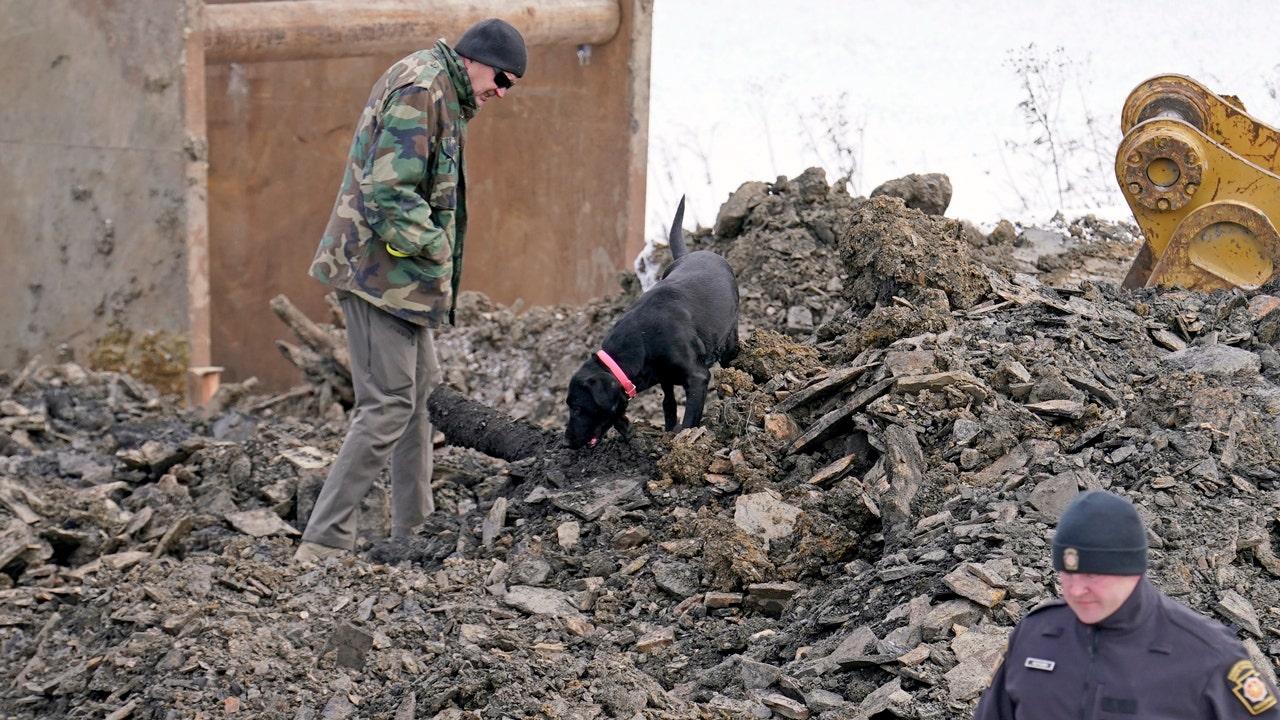
A rescue dog searches though debris that was removed from a sinkhole on Dec. 5, 2024, where rescue workers believe Elizabeth Pollard disappeared while looking for her cat, in Marguerite, Pennsylvania. (AP Photo/Matt Freed)
Elizabeth Pollard was last seen searching for her cat Pepper on Monday evening near a restaurant a half-mile from her home. Pollard’s family reported her missing around 1 a.m. Tuesday as the temperature in the area dropped below freezing.
The search focused on a sinkhole with a manhole-sized surface gap that may have only recently opened up in the village of Marguerite, above where coal was mined until about 70 years ago.
Police said they found Pollard’s car parked about 20 feet from the sinkhole. Pollard’s 5-year-old granddaughter was found safe inside the car.
Search intensifies for missing Pennsylvania grandmother suspected of falling into sinkhole (KDKA / NNS)
Hunters and restaurant workers who were in the area in the hours before Pollard’s disappearance told police they hadn’t noticed the sinkhole.
The effort to find Pollard included lowering a pole camera with a sensitive listening device into the hole, although it detected nothing. Crews removed a massive amount of soil and rock to try to reach the area where they believed she fell into the chasm about 30 feet deep.
Pollard grew up in Jeanette, about 12 miles from Unity Township, where she lived for much of her adult life. She previously worked at Walmart and was married for more than 40 years.
Read the full article from Here


Two parents are facing charges after police say more than 60 teenagers were drinking at a large party in their Plum Borough home.
According to court paperwork, Ian and Corrine Dryburgh have been charged with endangering the welfare of children, corruption of minors, and furnishing liquor to minors stemming from the incident that happened at a home in Plum Borough late last month.
Police said that officers went to the home after receiving a tip about a large party involving high school aged children.
When officers arrived at the home, they found numerous teenagers, empty beer cans and empty seltzer cans, and multiple bottles of vodka.
The parents told police that a birthday party for their 17-year-old daughter got out of hand and that some kids has been kicked out, but more came and they didn’t know what to do.
According to the criminal complaint, officers said they had been called to the home two previous times for similar reasons.
Police said a total of 66 underage kids were at the home.
Court records show that both parents have been cited via summons and preliminary hearings are scheduled for mid-April.

Connecticut is set to receive more than $154 million aimed at improving health care in rural communities.
The funding comes from the Centers for Medicare & Medicaid Services’ Rural Health Transformation Program, according to a community announcement.
The Connecticut Department of Social Services will lead the initiative, partnering with other state agencies to implement projects across four core areas: population health outcomes, workforce, data and technology, and care transformation and stability, according to the announcement.
The program will include several innovative projects, such as a mobile clinic pilot with four primary care and four dental vans, a health workforce pipeline through the Area Health Education Center and UConn Health Center, and community health navigators.
“Rural Connecticut has unique challenges, and its residents deserve the same access to high-quality care and support as anyone who lives anywhere else,” Lamont said. “This investment allows us to tackle those challenges head-on – from expanding mental health services and building a stronger health care workforce to modernizing our technology infrastructure and connecting residents to the services they need. This is about making sure every corner of Connecticut has the opportunity to thrive.”
The program was developed through extensive public engagement, including more than 250 written comments, meetings with health care providers, local government officials and community organizations, as well as in-person and virtual listening sessions held across the state, according to the announcement.
Andrea Barton Reeves, commissioner of the state Department of Social Services, highlighted the program’s long-term vision.
“This program reflects our commitment to building systems that work for rural residents over the long term,” she said in the release. “We are excited and grateful to CMS for this opportunity to make sure that our investments are coordinated, impactful, and built to last.”
The program aims to bring health care closer to rural residents while supporting the workforce that provides care, said Dr. Manisha Juthani, commissioner of the state Department of Public Health.
“Every person in rural Connecticut deserves good health care close to home, and the people who provide that care deserve real support too,” Juthani said. “This funding helps us bring care to where people are and build the healthcare workforce our communities need. When we invest in both, we give everyone a better chance at staying healthy.”
Additional information about the Rural Health Transformation Program, including opportunities for public engagement, will be made available as implementation proceeds.
For more information, visit the Connecticut Department of Social Services website at ct.gov/dss.
This story was created with the assistance of Artificial Intelligence (AI). Journalists were involved in every step of the information gathering, review, editing and publishing process. Learn more at cm.usatoday.com/ethical-conduct.

Looking up at the night sky in northern and rural Maine, it is a sight to behold, almost unique in today’s lit-up world. The Rangeley region is one of the last areas in the Northeast largely untouched by light pollution.
It is also a draw for many tourists and stargazers who come to the region for the clear view of the night sky.
A new group called Friends of the Western Maine Dark Sky hopes that by limiting the amount of light pollution, those views will be preserved for generations to come.
The group gathered at the Rangeley Lakes Heritage Trust on March 3 to talk about ways to educate the community on the importance of dark skies to the region.
One of their primary efforts is to try to designate Rangeley as an official Dark Sky community.
The designation will require a few steps. First, an application will be submitted to DarkSky International expressing an interest. Then, the town of Rangeley will need to adopt a new lighting ordinance at the June town meeting.
A new state law taking effect in October will require publicly funded outdoor lighting across the state to be dimmed at night to protect wildlife and dark skies. This includes using warm, yellow-toned bulbs, dimming or turning off nonessential lights and shielding lights so they don’t shine upward into the sky.
The town ordinance would create guidelines similar to the state laws on the kinds of lights used in town, as well as restrict some signs, such as LED message boards. Existing boards would be allowed to remain in place.
“The fact that the existing signage is grandfathered in perhaps bodes well for getting an approval of the town meeting,” said Linda Dexter, Dark Sky community certification coordinator at the Rangeley Lakes Heritage Trust, who is leading the effort. “It’s going to impact businesses in the town … right out of the gate, folks will tend to not vote for it.”
Even if an ordinance passes, change would likely be slow. Most of the group’s efforts will be on community education, such as informing seasonal residents to turn off the lights at their camps while they are gone for the winter. Also, the application may not be approved for up to six months after it is submitted, Dexter said.

Stolen bikes derail program that teaches Atlanta youth to ride

Minneapolis police investigating 3 shootings within 20 minutes

How to Watch 2026 Indianapolis SX, Talladega GNCC, and MXGP of Argentina Live on TV – Racer X

Plum Borough parents charged with supplying alcohol for underage drinking party

Augusta homeowners prep for golf week rentals

Florida High School Football Rankings: Top 25 teams – Oct. 21

Cleary's 21 help Le Moyne down Central Connecticut State 69-64 in OT

How old is Bo Nix? What to know about Oregon quarterback ahead of 2024 NFL Draft

99th annual Pony Swim held in Virginia

Indiana Members Credit Union announced as new anchor tenant at Bottleworks District

DOJ continues Biden autopen probe despite former president unlikely to face charges
Fact check: Did French border guards mock influencers returning from Dubai amid Iran war?

Iran’s fight for survival / The widening war / Trump’s nebulous goals : Sources & Methods

Map: 4.9-Magnitude Earthquake Shakes Louisiana

Paxton vows he’s ‘staying in this race’ even if Trump backs Cornyn in Texas GOP clash
-

 World1 week ago
Exclusive: DeepSeek withholds latest AI model from US chipmakers including Nvidia, sources say
-

 Wisconsin4 days ago
Setting sail on iceboats across a frozen lake in Wisconsin
-

 Massachusetts1 week ago
Mother and daughter injured in Taunton house explosion
-

 Massachusetts3 days ago
Massachusetts man awaits word from family in Iran after attacks
-

 Maryland5 days ago
AM showers Sunday in Maryland
-

 Florida5 days ago
Florida man rescued after being stuck in shoulder-deep mud for days
-

 Denver, CO1 week ago
10 acres charred, 5 injured in Thornton grass fire, evacuation orders lifted
-

 Oregon7 days ago
2026 OSAA Oregon Wrestling State Championship Results And Brackets – FloWrestling