Pittsburg, PA
Pirates GM Discusses Potential Konnor Griffin Extension


PITTSBURGH — The Pittsburgh Pirates have the best prospect in baseball in Konnor Griffin, who heads into a crucial 2026 season with great expectations on him.
Griffin turns 20 years old next April, but could ink his future with the Pirates before he even makes a plate appearance at the major league level.
The Pirates aren’t known for their frivolous spending, but keeping Griffin around for the long-term and committing to that early on in his career might be the way to go.
Pirates GM Addresses Konnor Griffin Extension.
Stephen J. Nesbitt of The Athletic spoke to Pirates general manager Ben Cherington at the Winter Meetings in Orlando, Fla. this week.
They spoke on a host of topics, like free agency, trades and offseason plans, as well as whether they would try and sign Griffin to an extension.
Cherington said that they haven’t had discussions with Griffin on a potential extension, as their focus is more on what is most important this offseason, such as big-time trades and signing free agents to bolster their lineup in 2026.
“You chase down 100 things, and three, four or five land,” Cherington said to Nesbitt. “That’s just the way it works. That’s still the stage we’re at.”
Would the Pirates Actually Sign Griffin to an Extension?
Most teams don’t normally sign players that haven’t made their MLB debut, but it has happened before in recent years.
Outfielder Jackson Chourio signed an eight-year, $82 million extension with the Milwaukee Brewers on Dec. 4, 2023.
Chourio had a solid start, finishing third in 2024 National League Rookie of the Year Award voting, with Pirates starting pitcher Paul Skenes winning the award.
The one prior to that was the Chicago White Sox signing outfielder Luis Robert Jr. to a six-year, $50 million contract in 2020.
There have also been four other times this has happened, but for lesser money that both Chourio and Robert signed without making their MLB debut.
|
Name |
Team |
Extension |
Year |
|---|---|---|---|
|
Jon Singelton |
Houston Astros |
5 Years, $10 million |
2014 |
|
Scott Kingery |
Philadelphia Phillies |
6 Years, $24 million |
2018 |
|
Eloy Jiménez |
Chicago White Sox |
6 Years, $43 million |
2019 |
|
Evan White |
Seattle Mariners |
6 Years, $24 million |
2019 |
|
Luis Robert Jr. |
Chicago White Sox |
6 Years, $50 million |
2020 |
|
Jackson Chourio |
Milwaukee Brewers |
8 Years, $82 milllion |
2023 |
The Pirates would likely have to pay more than what Chourio got, with Griffin having the title of best prospect in baseball.
Still, they would likely sign him for much less right now than if he does make his MLB debut in 2026 and has a great season, like winning the NL Rookie of the Year Award.
Why Konnor Griffin is Deserving of an Extension
No one expected Griffin to have the season he did after the Pirates took him ninth overall out of Jackson Preparatory School in Jackson, Miss., but he not only exceeded those expectations, he became a star in the making in less than a year.
Griffin quickly moved up in the Pirates minor league system. He started out with Single-A Bradenton after a strong showing in Spring Training, moved to High-A Greensboro on June 10, then finished off with Double-A Altoona on Aug. 18.
He slashed .333/.415/.527 for an OPS of .942 in 122 games this season, with 161 hits, 23 doubles, four triples, 21 home runs, 94 RBIs, 50 walks to 122 strikeouts and 65 stolen bases on 13 attempts.
The 19-year old led all of minor league baseball with 117 runs scored and the 19-year old became the first teenage draftee to have a 20-40 season, finishing with 21 home runs and 65 stolen bases. He was also the first minor league player to have a 20-60 season since 1982.
Griffin ranked amongst the best players in the minor leagues, including second in runs scored, fourth in batting average, fifth in hits, tied for seventh in RBIs and tied for eighth in stolen bases.
He was the first teenager since Vladimir Guerrero Jr. to hit .333 or better in a minor league season. He is also one of just five teenagers that were a part of the 20-40 club and stole the most bases of that group.
Griffin also played in the Futures Game during All-Star week, honoring the best prospects in baseball. Altoona teammate Esmerlyn Valdez joined him there as well, as the duo represented the Pirates for the National League.
Accolades Pile on for Griffin
Griffin’s great play earned him many awards and accolades, including earning the title of top prospect in baseball, with Baseball America, MLB Pipeline and The Athletic giving him the coveted spot.
He also won honors like Baseball America naming him their Minor League Player of the Year Award and MLB Pipeline naming him their Hitting Prospect of the Year and Debut of the Year.
The Pirates also honored Griffin with the Honus Wagner Player of the Year, given to the best player in their minor leagues, and the Bill Mazeroski Defender of the Year, given to the best defensive player in the minor leagues.
Griffin ended his season by earning an MiLB Gold Glove Award, which bodes well for the Pirates, who are reportedly eyeing him as the starting shortstop for 2026 Opening Day.
Make sure to visit Pirates OnSI for the latest news, updates, interviews and insight on the Pittsburgh Pirates!


A woman from Armstrong County is accused of stealing nearly $300,000 from the Penn Hills refrigeration company that she used to work for.
The Allegheny County District Attorney’s Office announced Thursday that Ashley Apperson, 34, of Leechburg is facing multiple charges after police she say she stole nearly $300,000 from Ventec Refrigeration.
According to the criminal complaint filed by police, detectives said that Apperson worked for the company from nearly four years and was responsible for things like processing payroll and other accounting duties and was terminated last month for performance issues.
Investigators said that the alleged thefts were discovered shortly after Apperson was terminated when an employee was looking up a check in the company’s computer system when a typo led to the discovery of a non-payroll check made out to Apperson in a large amount.
A further search of the computer system, according to police, showed that between January 2025 and last month, approximately 88 non-payroll checks were issued to Apperson. None of these checks were authorized by the business, police said.
Police said they obtained a search warrant for the bank account where the unauthorized checks were deposited and learned it belonged to Apperson.
In addition to the unauthorized checks allegedly being deposited into Apperson’s account, police said purchases were made by Apperson on a company credit card at places like Dave and Buster’s, PayPal, and Amazon.
Police said that when they questioned Apperson about the alleged thefts, she admitted to using funds for online gambling and that she wanted to take responsibility for wheat was stolen.
Investigators said they determined that the approximately amount of money stolen from the company by Apperson came to just shy of $300,000.
According to online court records, Apperson was arraigned and released on nonmonetary bail and is set to face a preliminary hearing early next month on charges of theft by unlawful taking, receiving stolen property, access device fraud, among others.

PITTSBURGH — As first impressions go, the Hoffmann family went top shelf Thursday at the new owners’ introductory news conference at PPG Paints Arena.
They talked a big game without coming across as arrogant or filled with bravado, they opened the door for Mario Lemieux to join them, and they made it clear that they intend on investing in the Penguins — and Pittsburgh — for generations to come.
Here are 10 observations from a significant day in Penguins history.
• Geoff Hoffmann, who will serve as governor and the face of Penguins ownership, wanted to alleviate any financial concerns that the fans may have.
While the Penguins have been financially stable since 2007, when it was announced that a new building had been approved, the franchise has filed for bankruptcy multiple times and flirted with leaving for other cities on numerous occasions.
Hoffmann said those days are over.
“It’s a storied franchise in a lot of different ways,” he said. “There have been some ups and downs on the business side of the organization. I’m here to tell you that has come to an end. This is not an investment for us. This is a commitment to a city, to an organization. The Penguins are going to be in Pittsburgh, and they’re always going to be in Pittsburgh as long as the Hoffmanns are a part of it. And the Hoffmanns plan to be a part of it for generations to come.”
• Mario Lemieux had a very icy relationship with Fenway Sports Group, the previous owners of the Penguins.
The Hoffmann family is well aware of that and wishes to have Lemieux involved in the organization as soon as possible. Hoffmann has already spent time with the 60-year-old living legend. Lemieux owned the Penguins from 1999 to 2021 after becoming one of the greatest players in history during his time on the ice in Pittsburgh (1984-97, 2000-2006).
“He’s been as good as advertised,” Hoffmann said of his time with Lemieux. “Just a great, great guy. I’m really hopeful that he will be a part of this in whatever way, shape or form makes sense for him. We would love for him to be a part of this. We know what he means to hockey, we know what he means to the Penguins, to the city, and to the NHL. Everyone will embrace him with open arms.”
• It’s been rumored for quite some time, and it seems inevitable that the Penguins’ ECHL affiliate is heading south. Wheeling has been the ECHL affiliate for the Penguins since 1998. However, the Hoffmann family owns the Florida Everblades of the ECHL and will continue to.
David Hoffmann, the family patriarch, chimed in when it was asked if the ECHL affiliate would change.
“One hundred percent,” he said. “They would run me out of Naples if we didn’t. There’s already people (there) wearing Penguins jerseys.”
• As reported by The Athletic earlier this week, the Penguins will continue to have their games broadcast on SportsNet Pittsburgh — which is operated by NESN and owned by Fenway Sports Group — for the 2026-27 season.
At that point, the contract expires.
Geoff Hoffmann said it remains unclear what will happen to the TV rights at that stage.
• Kyle Dubas and Dan Muse were on hand for the news conference, and they received quite a vote of confidence.
“We have the best GM and the best coach in the league,” Hoffmann said. “That work is done.”
The appeal of working with Dubas was something that drew the new owners to Pittsburgh.
“Kyle, we think, is a particularly talented executive,” Hoffmann said. “It was one of the things that attracted us to making this investment. We fully support him and his vision. We are prepared to give him the resources he needs to be as successful as we can possibly be as an organization.”
• Hoffmann was asked about how he plans on conducting himself as an owner. The Penguins have a history of low-profile owners. Even Lemieux, likely the most popular and beloved athlete in Pittsburgh history, was very much behind the scenes during his ownership days.
“I don’t think we’ll be quite like Jerry Jones, from a number of perspectives,” Hoffmann said with a laugh. “But we will absolutely be present. We aren’t going to micromanage the team. We’re going to bring in a president of business operations.”
FSG, while relatively well-liked by numerous Penguins employees, was based in Boston, and the Boston Red Sox and Liverpool FC are its crown jewels.
The Penguins are the crown jewel for their new owners.
“We bought a house,” said David Hoffmann, talking about a new residence in the Squirrel Hill neighborhood of Pittsburgh. “It’s usually a good sign that you’re going to be here.”
Said Geoff Hoffmann: “We’re excited to be fixtures in the community here.”
• David Hoffmann was particularly entertaining and direct on the few occasions he spoke.
His son Geoff answered a question about the ongoing issues with development around PPG Paints Arena. The issues between the Penguins, the Hill District and the city of Pittsburgh have been going on long before PPG Paints Arena existed.
“Many stakeholders need to be heard and taken care of,” Geoff Hoffmann said. “We will have that discussion when the time is right.”
Then, his father took the microphone.
“Let me ask you something,” David Hoffmann said. “One of the things I notice coming here, the hotel situation doesn’t seem to fit with the demand or all of the great assets we have here. Greg (Geoff’s brother) runs our real estate portfolio and runs it very well. We’ve had lengthy discussions about it. Why isn’t there a better choice for more hotels here? A hotel close here, that’s maintained well, looks good, is an attraction where everyone wants to go? It just doesn’t seem with all you have got on — four sports teams, three colleges, a vibrant community — that you have enough hotels. We’re very interested in building a hotel here.”
• Expect some renovations in the near future for the 16-year-old PPG Paints Arena.
“We think with some improvements and modernizations, we can make it an elite fan experience,” Geoff Hoffmann said.
Hoffmann said he’s hoping that work will begin within 12-18 months, when, “we’ll start swinging hammers.”
David Hoffmann noted that the Penguins’ building was a strong selling point.
“This arena is a good deal for an owner,” he said. “It’s more than a fair deal. It would (cost) $1.2 to $1.4 billion (to build) today.”
It was built for around $320 million and opened in 2010.
“The least we can do is support it and make it as nice as it can be,” Hoffmann said.
• While the Hoffmann family very much intends to let Dubas do his thing, the word “winning” came up many times during the news conference.
“You (the fans) will win in Pittsburgh,” Hoffmann said. “We are committed to it.”
• Anyone can say the right thing at news conferences, so we will see how things unfold with the new ownership group.
I can tell you this much: I’ve spoken with a number of people in the organization who have gotten to know the Hoffmann family in recent days. The consensus is 100 percent positive.
As billionaires go, they came across as remarkably down-to-earth Thursday. Those in the Penguins organization who have been exposed to them are very impressed and believe the new ownership group is utterly sincere in its desire to win championships and impact Pittsburgh positively.

There’s a threat of tornadoes today as a cold front slowly works its way through our area. The risk is low, with the Storm Prediction Center putting our chance at 2%. That’s the lowest chance (besides 0) on their daily risk map. We hardly ever reach the 5% threshold.
The reason for our severe storm chance today is a cold front that will stall on top of us late this afternoon into the evening hours. We should have a couple of hours ahead of the storms with sunny skies that will allow potential energy to build.
There looks to be just enough shear to mean we can’t rule out a quick spin up or two. Our tornado risk is low.
Looking at the overall severe weather chance, I open up the window for severe weather at around 2 p.m. and keep the window open through midnight. The front will arrive as what we call a short wave, which should arrive along I-80 at 2 p.m., and the line of storms will slowly work its way to the south.
Storms that fire along the line, though, will be racing east. This means conditions can change rapidly. Any storm cells could have gusty winds and even some small hail. Frequent lightning should be expected with just how fast they’re going to be moving. Downpours should also be expected, but unless we see storms training over the same area, our flood risk looks fairly low today.
While we wait for the storms, the weather is going to be surprisingly comfortable.
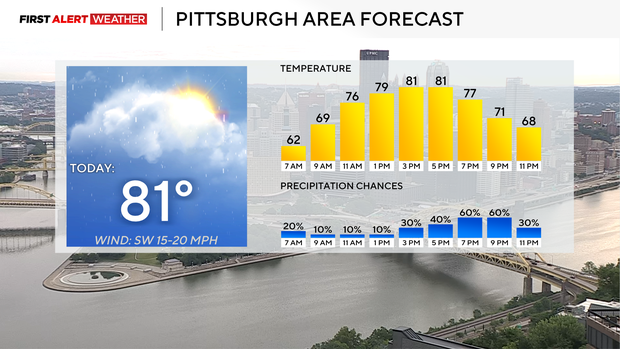
I have dew points in the low to moderate range all day long. It’ll be sunny heading into the afternoon. I have highs hitting the low 80s with comfortable weather in place through at least 3 p.m. in Pittsburgh.
Morning temperatures dipped to the low 60s, with noon temperatures expected to be in the mid 70s.
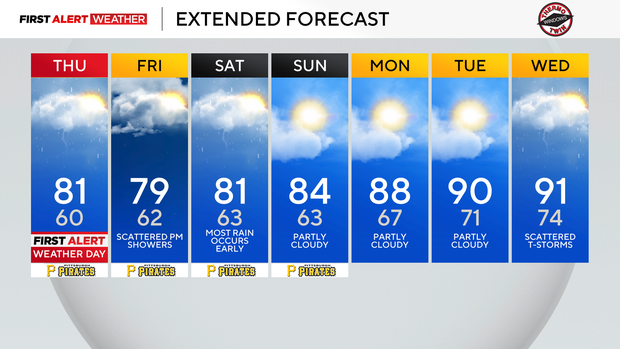
Similar to today, most of Friday is expected to be dry. There will be another chance for rain on Friday, but rain doesn’t arrive until after 8 p.m. Friday highs should hit the upper 70s. Friday’s rain will stretch into Saturday morning, with rain continuing overnight and most rain ending before sunrise.
I can’t rule out a scattered shower or two for the rest of the day on Saturday, but it’s looking pretty nice and dry. I have Saturday’s high hitting the low 80s, with highs going up to the mid-80s on Sunday. The area’s first heat wave of 2026 is now expected to arrive on Tuesday.
I have highs in the 90s from Tuesday next week through at least Friday, with temperatures never dropping below 70° during that time period.
-

 Colorado7 minutes ago
Avalanche Re-Signs Kulak | Colorado Avalanche
-
 Connecticut10 minutes ago
40 Years, Zero Accountability: The Union Deal That’s Been Emptying Connecticut’s Wallet
-

 Delaware15 minutes ago
Major bills loom as Delaware lawmakers face final day of session
-

 Florida22 minutes ago
Florida is bungling its food assistance money; it could hurt 3 million
-

 Georgia25 minutes ago
New Georgia laws going into effect July 1, 2026 | What to know
-

 Hawaii30 minutes ago
Hilo Pride parade and festival on Saturday – Hawaii Tribune-Herald
-

 Illinois40 minutes ago
Illinois Democrats face backlash after blaming Trump in Chicago cross-burning case | Fox News Video
-

 Indiana45 minutes ago
Top-rated freshman focused on one big thing before Indiana basketball season

