Northeast
Pennsylvania absentee voting underway in some counties

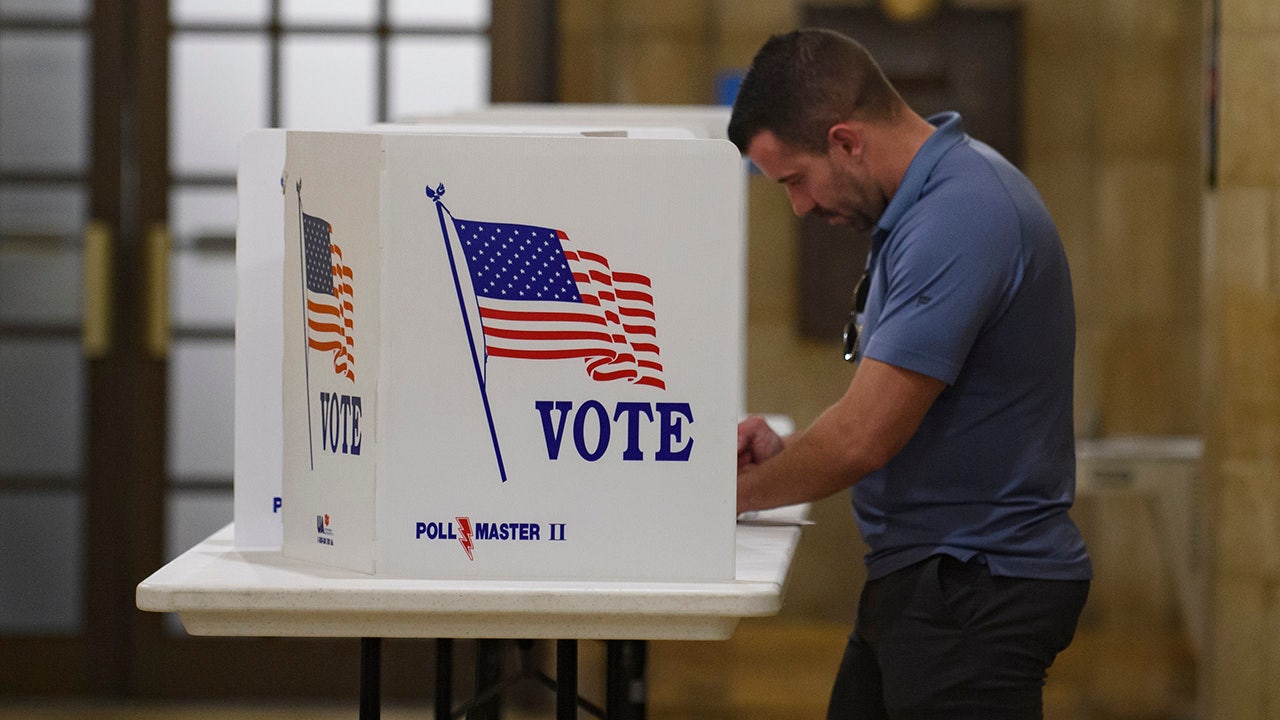
Pennsylvania’s 19 Electoral College votes are up for grabs in the 2024 presidential election with absentee voting in the Keystone State underway for some voters there.
Pennsylvania is one of the most competitive states this cycle
Pennsylvania was one of three Rust Belt states that flipped from the Democrats to former President Trump and Republicans in 2016, then back to President Biden four years later. In each case, the margin was thin with less than 100,000 votes separating the main candidates.
The state has also been critical to each president’s pathway to victory. It has the largest population and the most Electoral College votes of the seven most competitive states in the Fox News Power Rankings.
A recent Fox News survey has the race tied, with Democrat nominee Vice President Harris and Trump each receiving support from 49% of likely voters.
The bulk of the Democrat vote comes from the “bookends” of the state, Philadelphia and Pittsburgh, where Harris will likely perform well among Black and suburban voters.
Trump makes up for that with White rural and non-college-educated voters who live in the middle of the state. The former president has brought these voters out to the ballot box twice, and a Pennsylvania-heavy rally schedule shows he is looking to do that again.
Pennsylvania is ranked “Toss-Up” in the Fox News Power Rankings.
The Keystone State also has a U.S. Senate race on the ballot. Democrat Sen. Bob Casey has won three elections before, but securing a fourth will be more difficult with White working-class voters drifting away from his party. Republicans are hoping businessman Dave McCormick will connect with them. That race is ranked “Leans Dem.”
Key House races in Pennsylvania
Pennsylvania is also home to a handful of competitive U.S. House races led by:
- 7th District: Democrat Rep. Susan Wild has represented this eastern Pennsylvania district since the 2018 midterms, a wave year for House Democrats. It’s been a very close race since then, with Wild winning by 3.8 points in 2020 and two points in the most recent midterms. This time, she faces Republican state Rep. Ryan Mackenzie. This race is a “Toss-Up” in the Fox News Power Rankings.
- 8th District: In the northeast, longtime Democrat Rep. Matt Cartwright has served this district for more than a decade. His margins have also shrunk over a decade of elections and through redistricting, down to 2.4 points in the last cycle. Cartwright’s opponent is local businessman and Republican Rob Bresnahan. The district includes Scranton and Wilkes-Barre. This race is also a Power Rankings “Toss Up.”
- 10th District: Moving south to the 10th district, rural voters in Cumberland and York counties give Republican Rep. Scott Perry the edge. He has represented the region since 2013. Perry won by 7.6 points in the midterms, but Democrats hope that Perry’s deep ties to the MAGA movement will make their candidate, former local news anchor Janelle Stelson, competitive. This race is ranked “Leans GOP.”
- 17th District: Freshman Rep. Chris Deluzio kept this western Pennsylvania seat in Democrat hands by 6.8 points in 2023, but the combination of red-leaning Beaver County and parts of Allegheny County, home to Pittsburgh, make this another hard-fought battleground district. Deluzio faces Republican State Rep. Rob Mercuri in November; the district is ranked “Leans Dem.”
How to vote in Pennsylvania
This is a guide to registration and early voting. For comprehensive and up-to-date information on voter eligibility, processes and deadlines, please go to Vote.gov and the election website for Pennsylvania.
A voter fills out a mail-in ballot at the Board of Elections office in the Allegheny County Office Building on Nov. 3, 2022, in Pittsburgh. (Jeff Swensen/Getty Images)
Voting by mail/early in-person voting
Pennsylvania has what it describes as “On-Demand Mail Ballot Voting,” which allows registered voters to apply for mail ballots while at their county election office or other designated locations and then complete and submit the ballots while there.
A sign highlights efforts to sign up voters at the Bayfront Convention Center on Sept. 29 in Erie, Pa. (Jeff Swensen/Getty Images)
Mail ballots can be submitted in-person until 8 p.m. on Election Day, while the deadline to apply for one is 5 p.m. ET on Oct. 29.
Pennsylvania certified its official candidate list on Sept. 16, and counties are still “finalizing their ballots, proofreading them, and ordering printed ballots,” the state said. Mail ballots are currently available in 15 of the state’s 67 counties.
Counties were required to begin sending absentee ballots to military and overseas voters by Sept. 21.
Vice President Harris and her husband, Doug Emhoff, telephone prospective voters from a campaign field office in Rochester, Pa., on Aug. 18, 2024. (Kevin Lamarque/AFP via Getty Images)
Voter registration
Pennsylvania residents can register to vote online or by mail through Oct. 21.
Read the full article from Here


The Sox returned to Fenway with a 27-39 record, marking the first time the club has been

The death of a Haitian woman released from Immigration and Customs Enforcement custody in Pittsburgh in February has been ruled a homicide, according to the medical examiner.
The Allegheny County Medical Examiner’s Office ruled the death of 31-year-old Daphy Michel a homicide on Friday. She died three days after she was released from federal custody.
ICE released Michel in Pittsburgh on Feb. 27, the Department of Homeland Security said in a statement to KDKA-TV on Friday. She was found on March 1 on the ground at a bus shelter near Station Square. She died after being taken to a hospital.
“The opinion of the forensic pathologist in this case is that Ms. Michel was a vulnerable adult, suffering from untreated severe mental health issues and a significant language barrier when she was released from federal custody on February 27,” a statement released by the medical examiner through the Allegheny County Police Department said on Friday.
The medical examiner’s office ruled Michel’s cause of death as hypothermia, with homicide as the manner of death.
“The ruling by the medical examiner, that is a homicide, means that the death was caused by the action or omission of someone,” Pittsburgh-based immigration attorney Joseph Patrick Murphy told KDKA-TV on Friday. “That means there’s some sort of culpability.”
Murphy, who represents Michel’s family, blames ICE.
“She had mental challenges,” Murphy said. “She was arrested for at one point screaming at imaginary people, and they knew this. They just dumped her in a bus shelter — language barrier, educational barrier, and psychiatric barrier — and left her to fend for herself. The bus shelter, she never figured out how to leave. She sat there for days, and ultimately froze to death.”
Michel was born in Haiti and came into the United States legally, Murphy said. She “effectively’ overstayed her authorized period in the United States as she waited for her asylum case to be decided, Murphy added.
She was arrested in Charleroi, Washington County, Murphy said. She was booked in the Washington County Jail on Sept. 3, 2025, and remained in jail for six months before her case was dismissed. That’s when DHS said ICE took her into custody because it said she was in the country illegally.
She was taken to ICE’s facility on Pittsburgh’s South Side so she could be given an ankle monitor before her release. In a statement to KDKA-TV, DHS Acting Secretary Lauren Bis said, in part, that ICE had “nothing” to do with the woman’s death, adding that she was released from ICE custody after being issued an ankle monitor.
“She was released with all of her belongings, including a fully charged phone, in sunny weather in the middle of Pittsburgh, where public transport is readily available,” Bis’ statement said. “All illegal aliens who are processed have access to phones to call family, friends, and attorneys.”
On the day Michel was released, records show Pittsburgh’s official high was 55 degrees, with a low of 25 degrees. On the day she died, records show the high was 36 degrees, with a low of 19 degrees.
“They could have put her in an ICE car and driven right back down to Washington County and dropped her off, and they don’t need to do that with every detainee,” Murphy said. “But it was known to them that she was screaming at imaginary people and then sent for six months doing multiple psychiatric examinations.”
He called what happened to her “reckless.” From his office high up in a Pittsburgh office tower, he can see the street corner next to where Michel was found.
“It makes it more painful for me, because it’s a reminder right there of what happened to my friend,” he said, explaining it’s how he refers to people within the community he serves.
Murphy said Michel’s brother plans to hire him to file a lawsuit.
Both Allegheny County Executive Sara Innamorato and Rep. Summer Lee put out statements Friday saying Michel’s death was avoidable. They called for accountability, with Lee saying ICE must answer for the woman’s death.
Connecticut
Senator Hochadel Welcomes $581,256 State Grant for Middlefield Pedestrian Safety Project – Connecticut Senate Democrats

Sen. Jan Hochadel (D-Meriden) on Friday welcomed a $581,256 state grant to fund the Middlefield Municipal Campus Connections project, improving pedestrian safety and connectivity around the town’s municipal campus.
The funding comes through the Connecticut Department of Transportation’s Community Connectivity Grant Program, announced today by Governor Ned Lamont and Transportation Commissioner Garrett Eucalitto.
“Middlefield is a small, tight-knit community, and investments in how residents move through that community matter,” Senator Hochadel said. “Safer connections around the municipal campus make daily life better for the people who live there, and that’s what this program delivers. I’m grateful to Governor Lamont and Commissioner Eucalitto for making sure Middlefield was part of this investment.”
Since the program launched in 2019, 172 grants totaling more than $84 million have been invested in Connecticut communities.
Governor Lamont highlighted the broader impact of the program across Connecticut.
“This program cuts red tape and accelerates local infrastructure projects that make a real difference in people’s daily lives,” Governor Lamont said. “Across Connecticut with the support of this state program, communities are building accessible sidewalks, new bicycle connections, and stronger links to jobs, schools, and local businesses.”
Contact: Hugh McQuaid | Hugh.McQuaid@cga.ct.gov
Share this page:
-

 Wisconsin1 minute ago
Minnesota man convicted of ‘tree stand killings’ of 6 Wisconsin hunters dies
-

 West Virginia8 minutes ago
Electrifying 2027 RB Khamoni Williams Commits to West Virginia
-

 Wyoming11 minutes ago
‘Pride Lives Here’: Belonging, visibility, identity in Casper’s queer community
-

 Crypto16 minutes ago
South Korea Police Detain Bithumb CEO Lee Jae-won as Bribery Probe Widens After Raid
-

 Finance23 minutes ago
2 Awkward Talks to Have With Your Kids Before They’re 18 (Not ‘That’ One)
-

 Fitness26 minutes ago
Best Fitness Trackers 2026 | Trainer Tested – Forbes Vetted
-

 Movie Reviews38 minutes ago
TODAY Film Critic Gene Shalit Dies After ‘100 Years of an Amazing Life’
-

 World46 minutes ago
Kristin Scott Thomas Receives Crystal Nymph From Prince Albert II at Monte-Carlo Television Festival Opening

