Northeast
On this day in history, May 20, 1927, Charles Lindbergh departs for first solo nonstop flight across Atlantic

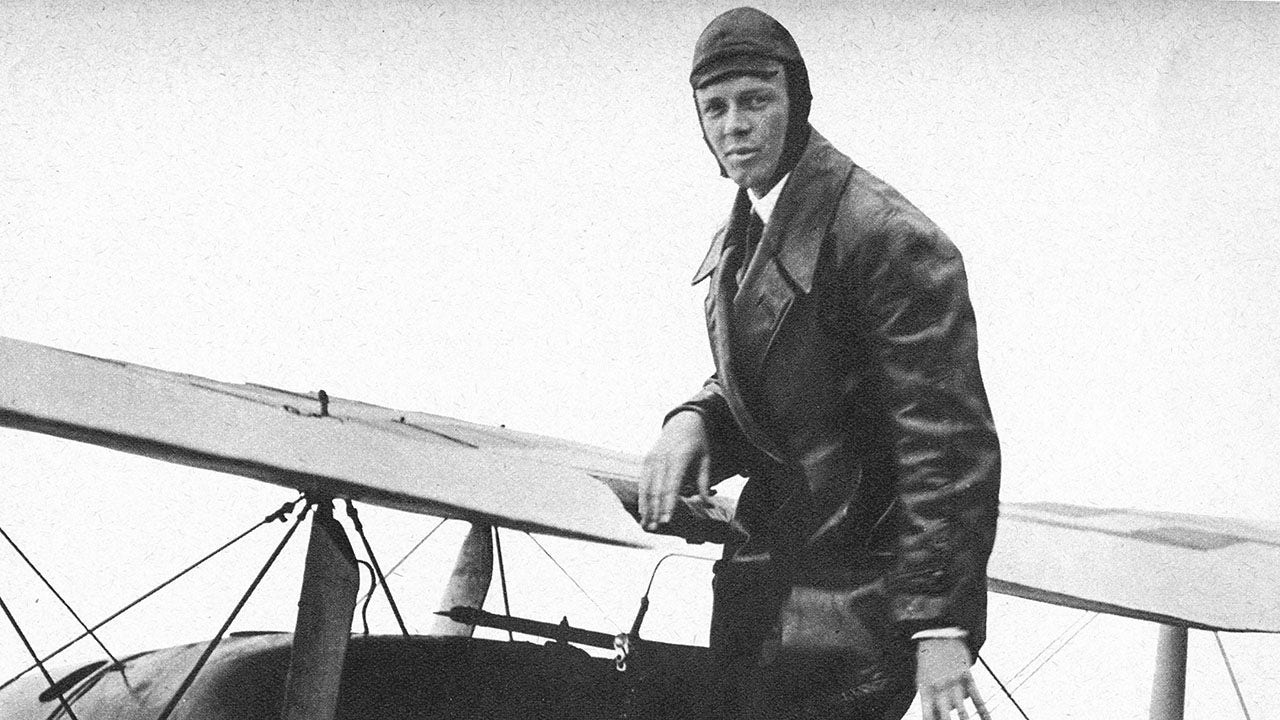
Aviator Charles Lindbergh began his historic solo transatlantic flight on this day in history, May 20, 1927.
Departing from Roosevelt Field on Long Island, New York, just before 8 a.m. on May 20, Lindbergh would spend the next 33-and-a-half hours in the air before landing safely at Le Bourget Airdrome, Paris, at 10:22 p.m. local time on May 21, according to the Smithsonian National Air and Space Museum’s website.
A sizable crowd in France was waiting for Lindbergh’s arrival.
ON THIS DAY IN HISTORY, MAY 19, 1994, JACQUELINE KENNEDY ONASSIS, WORLDWIDE STYLE ICON, PASSES AWAY IN NYC
“The crowd surged on the Spirit of St. Louis, and Lindbergh, weary from his 33 1/2-hour, 3,600-mile journey, was cheered and lifted above their heads,” noted the History Channel website.
While Lindbergh was the first person to make a solo nonstop flight across the Atlantic, the first transatlantic flight occurred in May 1919, that site also said.
Charles Lindbergh in his flying kit standing in the Spirit of St Louis. (Getty Images)
Inspired by the 1919 aeronautic feat, a Frenchman and hotel owner named Raymond Orteig created the “Orteig Prize,” offering $25,000 to the first person to successfully fly across the Atlantic Ocean in a nonstop solo flight.
Lindbergh, along with other legendary aviators of the time, took Orteig up on his offer, notes the History Channel.
ON THIS DAY IN HISTORY, JAN. 11, 1935, AMELIA EARHART IS FIRST AVIATOR TO FLY SOLO FROM HAWAII TO CALIFORNIA
Lindbergh received backing for his historic flight from nine investors from St. Louis, said the Smithsonian, and as a token of appreciation he named his airplane the Spirit of St. Louis.
The journey across the Atlantic was physically and mentally taxing.
Lindbergh did not sleep for the entire duration of the flight, and he estimated that he went more than two full days without sleeping, said the History Channel website.
Charles Lindbergh seen here posing by the Spirit of St. Louis, the plane in which he completed the first nonstop solo flight across the Atlantic. (Getty Images)
“Lindbergh went so far as to buzz the surface of the ocean in the hope that the chilly sea spray would help keep him awake, but 24 hours into the journey, he became delirious from lack of rest,” said the site.
Additionally, Lindbergh kept the windows to his plane open for the entire trip, according to the Smithsonian website.
The Spirit of St. Louis can be seen at the National Air and Space Museum in Washington, D.C.
While keeping the windows open increased drag, Lindbergh hoped that the cold air would force him to stay awake for the duration of the flight.
During the flight, Lindbergh began hallucinating, seeing “fog islands” in the sea and describing “vaguely outlined forms, transparent, moving, riding weightless with me in the plane,” said the History Channel.
These apparitions, Lindbergh said, “spoke to him and offered words of wisdom for his journey.”
Charles Lindbergh and Grover Whalen, chairman of the reception committee, in the speaker’s stand at Roosevelt Field. (Getty Images)
Lindbergh became an instant celebrity and national hero upon his safe arrival in France. He was nicknamed “Lucky Lindy” and the “Lone Eagle,” notes CharlesLindbergh.com.
President Calvin Coolidge arranged for his transport back to the United States (by boat, not by plane) and he received a ticker-tape parade in New York City and the Congressional Medal of Honor, said the History Channel website.
ON THIS DAY IN HISTORY, JAN. 15, 2009, US AIRWAYS FLIGHT MAKES MIRACULOUS LANDING IN THE HUDSON RIVER
In the citation for his Medal of Honor, Lindbergh was commended “For displaying heroic courage and skill as a navigator, at the risk of his life, by his nonstop flight in his airplane, the ‘Spirit of St. Louis,’ from New York City to Paris, France, 20-21 May 1927, by which Capt. Lindbergh not only achieved the greatest individual triumph of any American citizen but demonstrated that travel across the ocean by aircraft was possible.”
ON THIS DAY IN HISTORY, AUGUST 31, 1966, HARRIER JUMP JET MAKES FIRST FLIGHT
Today, the Spirit of St. Louis can be seen at the National Air and Space Museum in Washington, D.C.
Charles Lindbergh preparing to begin his historic flight to France. (Getty Images)
Born in Detroit in 1902, Lindbergh began flying professionally at the age of 20 as a “barnstormer” — essentially a daredevil, said CharlesLindbergh.com. He enlisted in the United States Army in 1924, aiming to become an Army Air Service Reserve pilot.
At the time, the U.S. Air Force was not yet a separate branch of the military.
Following his graduation from training in 1925, Lindbergh became a mail pilot.
A nonstop flight from New York’s JFK Airport to Paris Charles de Gaulle Airport lasts about seven hours and 30 minutes today, according to Air France. (iStock)
“The life of an aviator seemed to me ideal. It involved skill. It brought adventure. It made use of the latest developments of science. Mechanical engineers were fettered to factories and drafting boards while pilots have the freedom of wind with the expanse of sky. There were times in an airplane when it seemed I had escaped mortality to look down on earth like a God,” he said in 1927.
In 2023, a nonstop flight from New York’s JFK Airport to Paris Charles de Gaulle Airport lasted about seven hours and 30 minutes, said Air France’s website.
The return flight is just a hair longer, coming in at just about eight hours.
For more Lifestyle articles, visit foxnews.com/lifestyle.
Read the full article from Here

Powerball, Mega Millions jackpots: What to know in case you win
Here’s what to know in case you win the Powerball or Mega Millions jackpot.
Just the FAQs, USA TODAY
The Vermont Lottery offers several draw games for those willing to make a bet to win big.
Those who want to play can enter the MegaBucks and Lucky for Life games as well as the national Powerball and Mega Millions games. Vermont also partners with New Hampshire and Maine for the Tri-State Lottery, which includes the Mega Bucks, Gimme 5 as well as the Pick 3 and Pick 4.
Drawings are held at regular days and times, check the end of this story to see the schedule.
Here’s a look at July 1, 2026, results for each game:
Winning Powerball numbers from July 1 drawing
02-06-26-39-68, Powerball: 06, Power Play: 2
Check Powerball payouts and previous drawings here.
Winning Gimme 5 numbers from July 1 drawing
07-11-28-35-38
Check Gimme 5 payouts and previous drawings here.
Winning Pick 3 numbers from July 1 drawing
Day: 8-1-1
Evening: 5-4-5
Check Pick 3 payouts and previous drawings here.
Winning Pick 4 numbers from July 1 drawing
Day: 5-9-9-6
Evening: 9-4-7-5
Check Pick 4 payouts and previous drawings here.
Winning Megabucks Plus numbers from July 1 drawing
05-07-16-32-37, Megaball: 03
Check Megabucks Plus payouts and previous drawings here.
Winning Millionaire for Life numbers from July 1 drawing
23-25-29-36-48, Bonus: 04
Check Millionaire for Life payouts and previous drawings here.
Feeling lucky? Explore the latest lottery news & results
Are you a winner? Here’s how to claim your lottery prize
For Vermont Lottery prizes up to $499, winners can claim their prize at any authorized Vermont Lottery retailer or at the Vermont Lottery Headquarters by presenting the signed winning ticket for validation. Prizes between $500 and $5,000 can be claimed at any M&T Bank location in Vermont during the Vermont Lottery Office’s business hours, which are 8a.m.-4p.m. Monday through Friday, except state holidays.
For prizes over $5,000, claims must be made in person at the Vermont Lottery headquarters. In addition to signing your ticket, you will need to bring a government-issued photo ID, and a completed claim form.
All prize claims must be submitted within one year of the drawing date. For more information on prize claims or to download a Vermont Lottery Claim Form, visit the Vermont Lottery’s FAQ page or contact their customer service line at (802) 479-5686.
Vermont Lottery Headquarters
1311 US Route 302, Suite 100
Barre, VT
05641
When are the Vermont Lottery drawings held?
- Powerball: 10:59 p.m. Monday, Wednesday, and Saturday.
- Mega Millions: 11 p.m. Tuesday and Friday.
- Gimme 5: 6:55 p.m. Monday through Friday.
- Lucky for Life: 10:38 p.m. daily.
- Pick 3 Day: 1:10 p.m. daily.
- Pick 4 Day: 1:10 p.m. daily.
- Pick 3 Evening: 6:55 p.m. daily.
- Pick 4 Evening: 6:55 p.m. daily.
- Megabucks: 7:59 p.m. Monday, Wednesday and Saturday.
- Millionaire for Life: 11:15 p.m. daily
What is Vermont Lottery Second Chance?
Vermont’s 2nd Chance lottery lets players enter eligible non-winning instant scratch tickets into a drawing to win cash and/or other prizes. Players must register through the state’s official Lottery website or app. The drawings are held quarterly or are part of an additional promotion, and are done at Pollard Banknote Limited in Winnipeg, MB, Canada.
This results page was generated automatically using information from TinBu and a template written and reviewed by a Vermont editor. You can send feedback using this form.

In a stunning, franchise-shaking move, the Celtics reached an agreement Wednesday to trade Jaylen Brown to the Philadelphia 76ers, according to a report from ESPN’s Shams Charania.
In return, Boston reportedly will receive nine-time All-Star wing Paul George, two first-round picks and two second-round picks.
Brown had been the subject of rampant trade rumors in recent weeks, with Charania reporting earlier Wednesday that the Celtics were “strongly shopping” their longest-tenured player following a failed attempt to trade him and two draft picks for Giannis Antetokounmpo.
But the 76ers, who ended the Celtics’ 2022-26 season by upsetting them in the first round of the NBA playoffs, had not been mentioned as a potential suitor for Brown. He’ll now join the likes of Joel Embiid, Tyrese Maxey and VJ Edgecombe on a talented Philadelphia roster, while the oft-injured George heads to Boston.
Shipping out Brown splits up one of the NBA’s most talented and successful duos. The tandem of Jayson Tatum and Brown led Boston to five Eastern Conference finals, two NBA Finals and one championship since they joined forces in 2017.
Brown, the 2024 NBA Finals MVP, played most of this season without his longtime co-star, and he thrived, averaging 28.7 points, 6.9 rebounds and 5.1 assists — a stat line matched in Celtics history only by Larry Bird and John Havlicek — while Tatum recovered from Achilles surgery. Brown made second-team All-NBA and finished sixth in MVP voting, and the underdog Celtics far exceeded preseason expectations, posting the second-best record in the East (56-26) and the league’s fourth-best net rating.
But questions about Brown’s future began swirling after Boston blew a 3-1 series lead against seventh-seeded Philly, losing three straight — including Game 7 at home, which Tatum missed due to knee stiffness — to suffer their earliest postseason exit since 2021.
Brown, who was a minus-57 over the final three losses, made headlines after the series when he insisted that this was his “favorite season” despite Boston’s poor finish. Basketball Hall of Famer Tracy McGrady, a mentor of Brown’s, did the same when he said on his podcast that Brown had “frustration (that) lies deeply within the (Celtics) organization.”
Celtics president of basketball operations Brad Stevens said in his end-of-season news conference that Brown had expressed no such feelings to him. But Stevens admitted Boston needed to improve its roster to compete with the NBA’s elite teams (New York, San Antonio, Oklahoma City, etc.). A month later, after the Milwaukee Bucks rejected Boston’s bid for Antetokounmpo, Stevens said he wouldn’t “predict the future” when asked whether Brown would remain with the Celtics.
“Jaylen Brown is a big part of us,” Stevens said last Tuesday. “I’m never going to predict the future, but every indication, everything that I think about over the past few years has been building around those guys, right? So obviously, you never know.
“But at the same time, the one thing I want to make very clear is how valued he’s always been. He’s been amazing. He’s been an amazing teammate, a great person to be around. And whether that run ends 10 years from now when he retires, or before, there’s a lot to celebrate. We have a great relationship, an open relationship where we talk about everything. But I don’t want to predict the future.”
George has enjoyed a long and decorated career across stints with the Indiana Pacers, Oklahoma City Thunder, Los Angeles Clippers and 76ers. Over his 16 seasons, he’s averaged 20.5 points, 6.2 rebounds, 3.7 assists and 1.7 steals per game while shooting 44.0% from the field and 38.4% from 3-point range.
The 36-year-old is well past his prime, however, and has struggled to stay on the court, suiting up for more than 60 games just once in the last seven seasons. He played in 37 games this season, missing time for both injuries and a 25-game suspension for violating the NBA’s anti-drug policy.
George did give the Sixers strong minutes during their playoff series against Boston, making 55.0% of his 3-pointers across the seven games. Still, he’s a substantial downgrade from both the Celtics’ original target, two-time NBA MVP Antetokounmpo, and Brown, who is six years younger.
The Celtics will inherit the final two years of George’s contract. He’s set to make $54.1 million this coming season, then has a $56.6 million player option for 2026-27. It was not immediately clear whether Boston plans to move forward with George or flip him in a subsequent trade.
This trade marks the third time in the last four offseasons that the Celtics made major changes to their roster. Ahead of the 2023-24 season, they shipped out Marcus Smart, Robert Williams III and Malcolm Brogdon in trades for Kristaps Porzingis and Jrue Holiday — deals that helped push their Tatum/Brown-led core over the championship hump after years of near misses. Last summer, the Celtics traded Porzingis and Holiday and lost Al Horford and Luke Kornet in free agency to escape the prohibitive second apron of the NBA’s luxury tax. (A subsequent series of in-season trades pushed Boston out of the tax entirely.)
Parting ways with Brown is the boldest swing yet for Stevens.
The 29-year-old (30 in October) was Boston’s longest-tenured player, having joined the C’s as the No. 3 overall pick in the 2016 NBA Draft. He ranks 10th on the franchise’s all-time scoring list — one spot behind Tatum and two behind Bill Russell — and is coming off the best season of his career. Among active players, only Stephen Curry, Draymond Green, Devin Booker, Nikola Jokic and Antetokounmpo have appeared in more games without changing teams.
Brown, whose No. 7 likely will hang in the TD Garden rafters one day, also built a strong connection with the Boston community through his 7uice Foundation, Boston XChange initiative and other philanthropic efforts.
“I love Boston,” he said in a May 6 Twitch stream. “If it were up to me, I would play in Boston for the next 10 years.”
Brown was set to become eligible for a two-year, $140 million contract extension with the Celtics next month. His current deal, which runs through the 2028-29 season, was the richest in NBA history when he signed it in 2023 (five years, $304 million). He is set to make $57.1 million this coming season.


Forgotten frontier: How Pittsburgh shaped America’s July 4th
We take you inside Fort Pitt Museum’s “Pittsburgh’s Revolution” exhibit to show how a frontier fort became a key in America’s path to independence.
Pittsburgh’s Fourth of July traditions are rooted in centuries of American history, and Fort Pitt Museum sits at the heart of that story.
Located in Point State Park at the confluence of the city’s three rivers, the museum traces western Pennsylvania’s pivotal role in the French and Indian War, the American Revolution and the early expansion of the United States.
An exhibit you don’t want to miss
Inside, the “Pittsburgh’s Revolution” exhibit spotlights how this frontier outpost helped shape the Revolutionary War and the push for independence. Rare artifacts, detailed maps and personal stories walk visitors through a time when control of Fort Pitt meant control of the West, giving colonists a crucial foothold in the struggle against British rule. The exhibit also emphasizes the diverse communities at the Point, including soldiers, Indigenous nations, traders and settlers, whose lives intersected in ways that still echo in Pittsburgh’s identity today.
For modern visitors, the museum offers an immersive experience that connects familiar July 4 images with the realities of life on the 18th‑century frontier. Families can explore galleries that explain how supplies moved through Pittsburgh to support the Continental Army, how diplomacy unfolded with Native nations, and how everyday people navigated a world in conflict. It turns Independence Day from a single date on the calendar into an ongoing story that started along these rivers and radiated outward.
As America marks the 250th anniversary of the Declaration of Independence, Fort Pitt’s “Fourth at the Fort” programming brings that history into the present with flag ceremonies, living history encampments and hands‑on activities in Point State Park.
For Pittsburghers looking to go beyond fireworks, a visit to Fort Pitt Museum offers a reminder that Independence Day here is not only about celebration, but about standing on the ground where American history was made.
This article by Gabby Sartori was created with the assistance of Artificial Intelligence (AI). Journalists were involved in every step of the information gathering, review, editing and publishing process. Learn more.
-

 Texas1 minute ago
New date set for opening of Six Flags Over Texas’ Tormenta Rampaging Run coaster after delay
-

 Utah4 minutes ago
Wasatch Front cities running out of water called a ‘myth’
-
Vermont9 minutes ago
VT Lottery Powerball, Gimme 5 results for July 1, 2026
-

 Virginia16 minutes ago
House Bill 301 takes effect in VA, ending 50 years of limits on adoptee birth records
-

 Washington19 minutes ago
Where Texas became Texas: Washington-on-the-Brazos plans July 4 celebrations
-

 Wisconsin24 minutes ago
How much will Shawn Eichorst make as Wisconsin Badgers’ athletic director?
-

 West Virginia26 minutes ago
Moundsville police investigate pharmacy break-in, narcotics theft
-

 Wyoming31 minutes ago
Win By Colorado Socialist Could Galvanize Wyoming Independence, Says Politico

