Connect with us

Northeast

On this day in history, March 17, 1776, British troops flee Boston after dramatic 11-month siege by militia

Published

on

On this day in history, March 17, 1776, British troops flee Boston after dramatic 11-month siege by militia

British troops and loyalists fled Boston by ship for Canada in “disgrace” after nearly a decade of occupation that incited protest, bloodshed and then revolution, on this day in history, March 17, 1776.

“Surely it is the Lord’s doings and it is marvelous in our eyes,” patriot and future first lady Abigail Adams wrote of the incredible victory by the pugnacious little city over the mighty British crown. 

The humiliating flight of King George III’s forces in the face of his disloyal subjects is still celebrated each year as Evacuation Day, a civic holiday, in Boston. 

ON THIS DAY IN HISTORY, MARCH 16, 1802, UNITED STATES MILITARY ACADEMY ESTABLISHED AT WEST POINT

“It was a spectacle such as could only have been imagined until that morning,” David McCullough wrote in his “1776” epic of the most heroic year in American history.

Advertisement

“There were 120 ships departing with more than 11,000 people packed on board — 8,906 King’s troops, 667 women and 553 children, and in addition, waiting down the harbor, were 1,100 Loyalists.” 

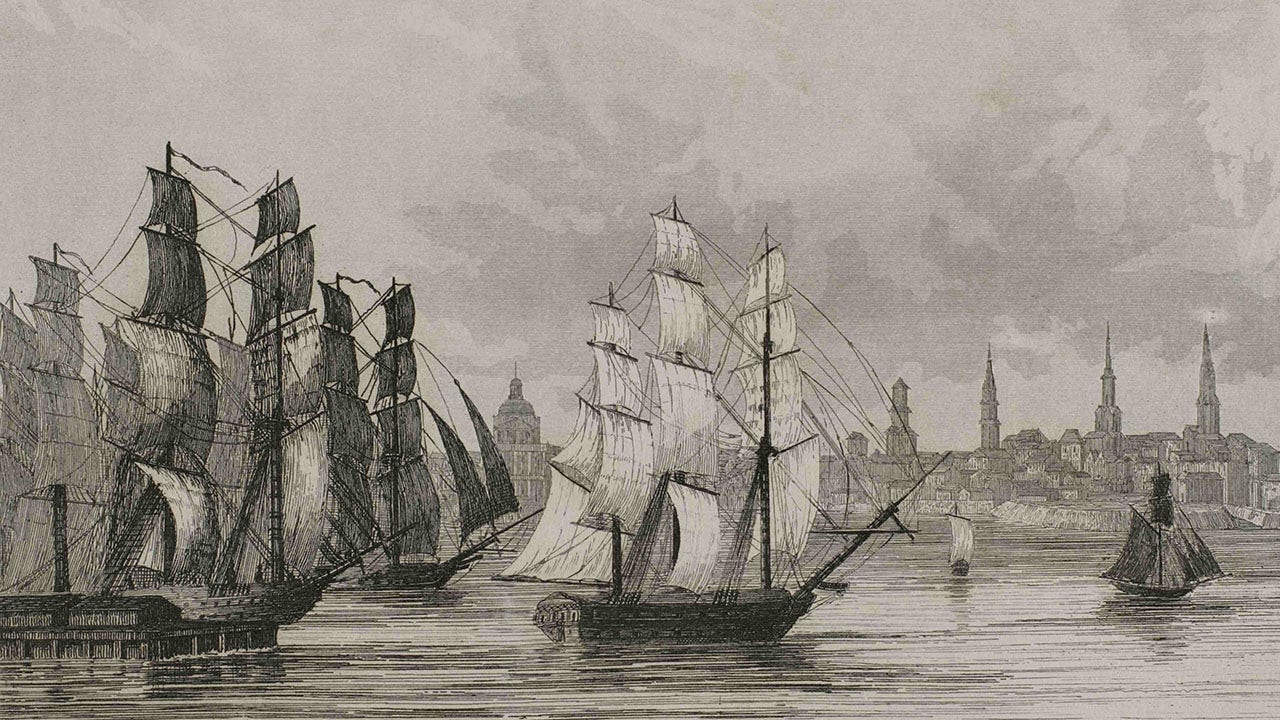
American Revolutionary War. Siege of Boston (April 19, 1775-March 17, 1776). Departure of the British fleet. On March 17, 1776, British forces were forced to evacuate the city of Boston following Gen. George Washington’s successful placement of fortifications and artillery on Dorchester Heights, which overlooks Boston from the south. Engraving by Petit. Panorama Universal. History of the United States of America, from 1st edition of Jean B.G. Roux de Rochelle’s Etats-Unis d’Amerique in 1837. Spanish edition, printed in Barcelona, 1850.  (Prisma/Universal Images Group via Getty Images)

The Massachusetts Minutemen famously routed the Redcoats at the Battles of Lexington & Concord on April 19, 1775 — the “shot heard ’round the world” and the start of open hostilities between colony and crown — and chased them all the way back to Boston. 

The Siege of Boston followed. 

“Surely it is the Lord’s doings and it is marvelous in our eyes.” — Abigail Adams

Advertisement

Thousands of militiamen from around New England left their farms, descended on Boston and launched an 11-month siege of their own port city. It was an unplanned display of resolve that shocked the British. 

The British took Breed’s Hill, north of Boston, in the Battle of Bunker Hill, in June 1775, but at shocking cost. They did not make an attempt on Dorchester Heights, south of Boston.

In a line, the Lexington Minutemen and a group of the Massachusetts Sons of American Revolution stand atop Dorchester Heights in Boston on March 17, 2022. The annual commemoration of Evacuation Day at Dorchester Heights in South Boston on Thursday, March 17, is hosted by the National Parks of Boston and South Boston Citizens Association.  (David L. Ryan/The Boston Globe via Getty Images)

The Brits were trapped inside the city. 

Gen. George Washington of Virginia arrived in Boston on July 3 to forge the militia — 16,000 men strong — into a legitimate fighting force.

Advertisement

“The siege of Boston from June 1775 to March 1776 marked Washington’s debut as commander in chief,” writes Smithsonian Magazine. 

TEXAS MOM SUFFERS QUADRUPLE AMPUTATION, CREDITS HER FAITH AND A LITTLE DOG FOR PULLING HER THROUGH

“He met many of the men who would comprise his general staff for the duration.”

One of those men was Boston bookseller Henry Knox. 

Col. Henry Knox, Washington’s chief of artillery, brings guns and mortars from Fort Ticonderoga to Boston. Hand-colored engraving by Van Ingen.  (MPI/Getty Images)

Advertisement

“Knox impressed Washington with his energy, ingenuity, determination and knowledge of artillery,” writes MassMoments.org, a repository of Massachusetts history. 

Knox proposed an audacious plan to end the stalemate: Trek more than 200 miles each way through a New England winter to Fort Ticonderoga, New York, and haul its bounty of artillery back to Boston.

“It was a spectacle such as could only have been imagined until that morning.” — David McCullough

“In less than two months’ time, Knox and his men moved 60 tons of artillery across lakes and rivers, through ice and snow to Boston,” writes MassMoments.org. 

MEET THE AMERICAN WHO ROWED WASHINGTON ACROSS THE DELAWARE ON CHRISTMAS: SAILOR-SOLDIER JOHN GLOVER

Advertisement

It’s gone down in American lore as the Noble Train of Artillery. Villagers cheered as the expedition of American patriots passed through their towns. 

Knox arrived without losing a single piece of equipment. Continental troops mounted the guns on Dorchester Heights under the cover of darkness the night of March 4 and 5 — six years to the day of the Boston Massacre. 

Engraved portrait of former U.S. Secretary of War Henry Knox standing next to a cannon, circa 1780-1800. Engraved from the original by Chappel.  (Kean Collection/Archive Photos/Getty Images)

“My God, these fellows have done more in one night than I could make my army do in three months,” British commander General William Howe reportedly exclaimed amid his shock at seeing the guns.

The British garrison, and the loyalists inside Boston, had been reduced to near starvation during the siege. 

Advertisement

Howe realized his situation was hopeless. He shipped out March 17. 

“The British were completely disgraced,” enthused the New York Constitutional Gazette.

“In less than two months’ time, Knox and his men moved 60 tons of artillery across lakes and rivers, through ice and snow to Boston.” — MassMoments.org.

“The first cheers from the American lines had been heard as early as nine that morning, when the men on Prospect Hill and Dorchester Heights saw clearly what was happening,” McCullough writes. 

“In no time small boys came running across the Neck from Boston to deliver the news that the ‘lobsterbacks’ were gone at last.”

Advertisement

The American Revolution moved elsewhere: next to New York, New Jersey and Pennsylvania, and eventually southern colonies, before the British were finally defeated at Yorktown, Virginia, in 1781. 

View of residences near Dorchester Heights Monument on April 2, 2015.  (Patrick Whittemore/MediaNews Group/Boston Herald via Getty Images)

The American Revolution was over in Boston, the city where it began and where 11-year-old Bostonian Christopher Seider was the first colonist to give his life in the cause of independence in 1770. 

Boston has not been occupied by a foreign soldier since. 

Advertisement

The victory renewed faith in American independence across the colonies. 

Spurred by leading Boston rebels John Hancock and John Adams, the Second Continental Congress declared independence four months later. 

The same road into downtown Boston is known today as Washington Street. 

Washington deferred the honor of marching into the newly liberated city on March 17 to the New England officer who led the colonial militia in its siege before his arrival. 

“In the early afternoon the first troops from Roxbury crossed the Neck and marched into Boston,” writes McCullough. “Drums beating, flags flying and led by Artemus Ward on horseback.”

Advertisement

The general from Virginia soon followed. 

The same road into downtown Boston is known today as Washington Street. 

For more Lifestyle articles, visit www.foxnews.com/lifestyle.

Advertisement

Read the full article from Here

Continue Reading
Click to comment

Leave a Reply

Your email address will not be published. Required fields are marked *

This site uses Akismet to reduce spam. Learn how your comment data is processed.

Boston, MA

Delta flight returns to Logan after smoke scare in cockpit – Boston News, Weather, Sports | WHDH 7News

Published

on

Delta flight returns to Logan after smoke scare in cockpit – Boston News, Weather, Sports | WHDH 7News


A smoke scare on a Delta Airlines flight from Boston caused it to turn around.

The flight, with more than 250 people on board, was headed to Nice, France, when the pilots reported smoke in the cockpit.

As a precaution, the flight was treated as an emergency and was given priority once it returned to Logan Airport.

The plane landed safely and the passengers were reaccommodated.

Advertisement

(Copyright (c) 2026 The Associated Press. All Rights Reserved. This material may not be published, broadcast, rewritten, or redistributed.)

Join our Newsletter for the latest news right to your inbox


Source link

Continue Reading

Pittsburg, PA

Woman accused of stealing nearly $300,000 from Penn Hills refrigeration company

Published

on

Woman accused of stealing nearly 0,000 from Penn Hills refrigeration company


A woman from Armstrong County is accused of stealing nearly $300,000 from the Penn Hills refrigeration company that she used to work for. 

The Allegheny County District Attorney’s Office announced Thursday that Ashley Apperson, 34, of Leechburg is facing multiple charges after police she say she stole nearly $300,000 from Ventec Refrigeration.

According to the criminal complaint filed by police, detectives said that Apperson worked for the company from nearly four years and was responsible for things like processing payroll and other accounting duties and was terminated last month for performance issues.

Investigators said that the alleged thefts were discovered shortly after Apperson was terminated when an employee was looking up a check in the company’s computer system when a typo led to the discovery of a non-payroll check made out to Apperson in a large amount.

Advertisement

A further search of the computer system, according to police, showed that between January 2025 and last month, approximately 88 non-payroll checks were issued to Apperson. None of these checks were authorized by the business, police said. 

Police said they obtained a search warrant for the bank account where the unauthorized checks were deposited and learned it belonged to Apperson.

In addition to the unauthorized checks allegedly being deposited into Apperson’s account, police said purchases were made by Apperson on a company credit card at places like Dave and Buster’s, PayPal, and Amazon. 

Police said that when they questioned Apperson about the alleged thefts, she admitted to using funds for online gambling and that she wanted to take responsibility for wheat was stolen.

Investigators said they determined that the approximately amount of money stolen from the company by Apperson came to just shy of $300,000.

Advertisement

According to online court records, Apperson was arraigned and released on nonmonetary bail and is set to face a preliminary hearing early next month on charges of theft by unlawful taking, receiving stolen property, access device fraud, among others.


Source link

Continue Reading

Connecticut

Opinion: More to do on gun violence prevention in CT

Published

on

Opinion: More to do on gun violence prevention in CT


When we talk about gun violence in Connecticut, we often talk about it in numbers.

We count the shell casings left on a New Haven street corner, the number of illegal firearms recovered by police, or the roll-call votes in the General Assembly.

But gun violence does not exist in a vacuum. Like a rock thrown into a pond, its ripples reverberate far beyond a single tragic night. While a headline captures the finality of a death, the living are left to carry a trauma that is constant, heavy, and deeply unfair.

Advertisement

That is why the passage of House Bill 5043 — now signed into law by Gov. Ned Lamont — is a profound victory for public safety, but also a moment that requires us to look more closely at what it actually takes to heal communities facing this ongoing public health crisis.

At its core, HB 5043 closes a dangerous gap by targeting “convertible pistols” and the illegal conversion switches that transform standard handguns into fully automatic weapons in seconds. By making the importation and sale of these convertible handguns a Class D felony, Connecticut is refusing to let the gun industry outpace our commitment to keeping families safe.

While critics argue federal laws already cover these devices, the reality on the ground is that criminals actively exploit these specific pistol designs. Ignoring this flood of easily altered firearms into our neighborhoods is like acknowledging a flood but refusing to patch the hole in the levee.

But as the Executive Director of CT Against Gun Violence, I know that legislation alone cannot be the silver bullet. Passing a law stops a specific product; it does not automatically heal a neighborhood. We need to get to the root of the problem.

Before leading CAGV, my career was rooted deeply in reentry services in New Haven and Bridgeport. I spent years working alongside justice-impacted individuals who were trying to rebuild their lives. I saw firsthand how systemic disinvestment, poverty, and a lack of baseline economic opportunity fuel the precise conditions where illegal gun markets and interpersonal violence thrive.

Advertisement

When returning citizens face hundreds of legal barriers to housing, employment, and basic stability, we are failing to address the root causes of the trauma that spills onto our streets.

True violence prevention requires a dual approach. We must advocate fiercely for common-sense, life-saving policies like HB 5043 in the halls of the General Assembly. But we must match that advocacy with unprecedented, sustained investments in community-based programs, street-level violence interrupters, and robust reentry support.

Connecticut has taken a powerful step in this direction by committing $4 million in state investment to gun violence prevention infrastructure, alongside the creation of the state’s Office of Firearm Injury Prevention. This allows us to view gun violence not just as a criminal issue but through a dedicated public health lens as an epidemic that demands deep community resources.

The passage of HB 5043 is an essential shield. It disrupts the pipeline of rapidly militarized firearms and keeps high-velocity danger out of circulation. But a shield only protects you from the blow; it doesn’t cure the underlying illness.

As this new law takes effect, let’s celebrate the political courage it took to pass it. But let’s also let it serve as a reminder of the work that remains. We must continue to build bridges, fund grassroots community intervention, and ensure that every resident in every Connecticut zip code has the safety, dignity, and opportunity they deserve. Only then will the ripples of trauma finally begin to recede.

Advertisement

Earl Bloodworth is the Executive Director of CT Against Gun Violence (CAGV).

This <a target=”_blank” href=”https://ctmirror.org/2026/06/26/more-to-do-on-gun-violence-prevention-in-ct/”>article</a> first appeared on <a target=”_blank” href=”https://ctmirror.org”>CT Mirror</a> and is republished here under a <a target=”_blank” href=”https://creativecommons.org/licenses/by-nd/4.0/”>Creative Commons Attribution-NoDerivatives 4.0 International License</a>.<img src=”https://ctmirror.org/wp-content/uploads/2023/02/cropped-CTMirror_bug_rgb-180×180.jpg” style=”width:1em;height:1em;margin-left:10px;”>

<img id=”republication-tracker-tool-source” src=”https://ctmirror.org/?republication-pixel=true&post=1171949&amp;ga4=G-9GVNVL530Q” style=”width:1px;height:1px;”><script> PARSELY = { autotrack: false, onload: function() { PARSELY.beacon.trackPageView({ url: “https://ctmirror.org/2026/06/26/more-to-do-on-gun-violence-prevention-in-ct/”, urlref: window.location.href }); } } </script> <script id=”parsely-cfg” src=”//cdn.parsely.com/keys/ctmirror.org/p.js”></script>


Source link

Advertisement
Continue Reading
Advertisement

Trending