Northeast
NYPD warns anti-Israel protesters a 'Seattle-style' occupation zone won't be tolerated

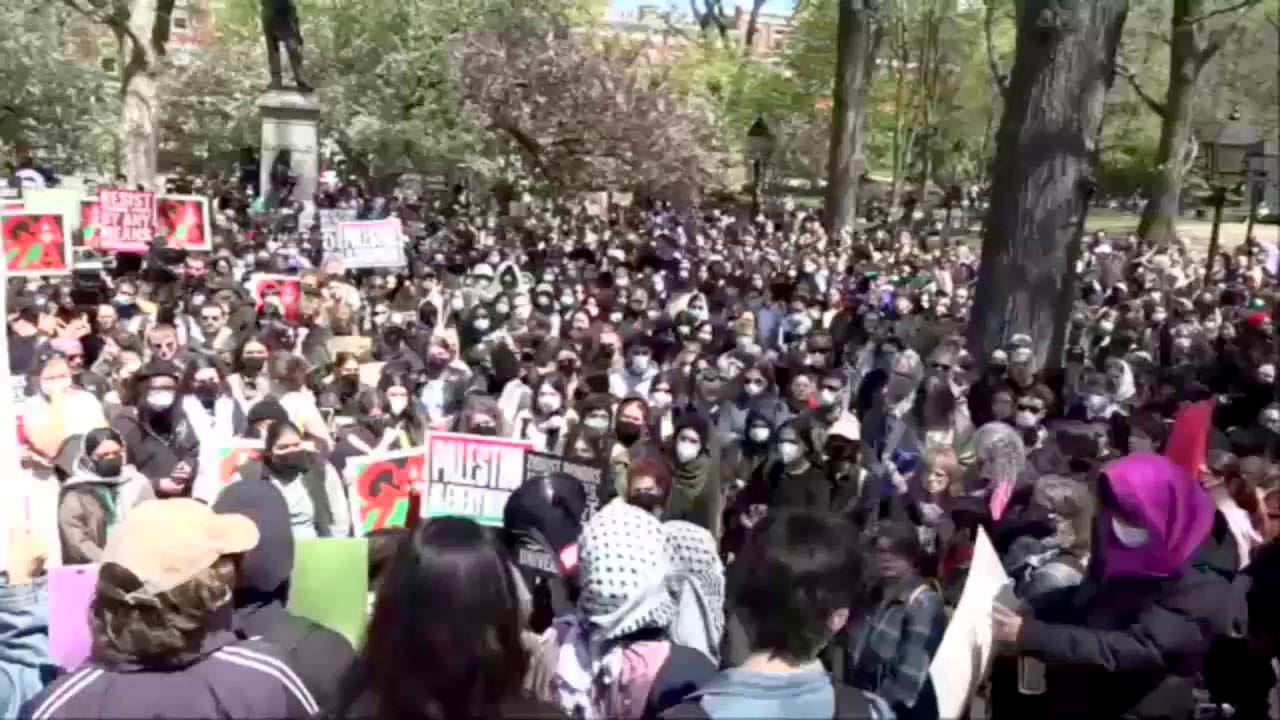
New York Police Department leaders attempted to shut down concerns Wednesday that the “liberated zones” on college campuses like Columbia and New York University could metastasize into the anarchical “autonomous zones” seen during the 2020 George Floyd riots.
On “The Story,” anchor Trace Gallagher was speaking with NYPD Chief of Patrol John Chell and NYPD Deputy Commissioner of Operations Kaz Daughtry when he reported on concerns the already raucous protests could devolve further.
Daughtry said when he worked alongside officers at NYU recently, he witnessed professors joining the student protests and ridiculing New York’s Finest for their attempts to keep the demonstrations under control.
As arrests of protesters who refused to vacate the area were being made, Daughtry heard epithets toward him and others that he said would have never been tolerated if the roles were reversed.
JEWISH COLUMBIA STUDENTS DENOUNCE CAMPUS ANARCHY AS RABBI WARNS THEM TO LEAVE
“Let’s just say, if my officers spoke how the professors and the faculty spoke to the officers — if my officers spoke like that, they would get a substantiated CCRB,” he said, referring to the city’s Civilian Complaint Review Board, through which transgressions by officers can result in loss of vacation, suspension or termination.
Gallagher noted some of the protests have evolved into being simultaneously anti-police, and that the NYPD was audibly compared to the Ku Klux Klan in some cases.
“You can see where a lot of people say they could see these areas becoming like the Seattle autonomous zone back in the George Floyd riots, where they linger and last all summer long and get bigger and more dangerous,” he said.
However, Chell appeared to immediately shut down the possibility, drawing a line between resistance and refusal to vacate.
ANTI-ISRAEL COLUMBIA STUDENTS STONEWALL, DIRECT FOX NEWS REPORTER TO ‘MEDIA TEAM’
“We will not have any Seattle-type encampments on the streets of New York City. I can guarantee you that — that would end rather quickly,” he said.
In Seattle, protesters took over a portion of the Capitol Hill neighborhood, which led to clashes between then-President Trump and Democratic then-Mayor Jenny Durkan over the handling of the zone.
Chell said there is a difference between the right to create encampments on campus quads and the right to do it in public. While the Columbia campus is zoned private, NYU-based protests have been held in places like Washington Square Park, which is public but considered part of the greater campus neighborhood.
“The fine line here is the street, the public property, which we’ll deal with, and the college is the private property,” Chell said.
“That’s why we got to strike this balance. Let me repeat, there will never be encampments on the streets of New York City while we’re in power — never going to happen.”
In Columbia’s case, the NYPD remained outside the Morningside Heights campus until President Nemat Minouche Shafik gave her blessing to have the cops raid her school’s encampment.
More than 100 people were detained and/or arrested during the April 18 operation, according to the New York Post.
Chell later said his officers made more than 200 arrests during a Tuesday night protest at Grand Army Plaza in Brooklyn, not far from Senate Majority Leader Chuck Schumer’s home, which was similarly besieged by anti-Israel demonstrators.
CLICK TO GET THE FOX NEWS APP
Near Schumer’s home, protesters held an “emergency Seder” — using a Hebrew term that at this time of year signifies the feast at the beginning of Passover — and demanded the Senate majority leader oppose U.S. “arming” of Israel, according to a statement from organizers reported by the Times of Israel.
Still, the NYPD prevented the protests from descending into chaos.
“We have done it flawlessly and we’re neutral and we know how to conduct ourselves,” Chell said. “And I think that the country’s watching on. I think our young men and women from this department and our bosses are doing a fantastic job in a very precarious situation.”
Read the full article from Here


From Delco to Chesco and Montco to Bucks, what about life in Philly’s suburbs do you want WHYY News to cover? Let us know!
Quakertown Police Chief Scott McElree is on leave after he was seen on video placing a student in a chokehold during a high school walkout earlier this month.
Borough Solicitor Peter Nelson told 6abc and other outlets Friday that McElree, who also serves as the borough manager, is currently on workers’ compensation leave. A request for comment from Nelson was not immediately returned Saturday.
The Bucks County District Attorney’s Office is currently investigating the police department’s response to a student-led protest against the Trump administration federal enforcement actions on Feb. 20.
After more than 30 students walked out of Bucks County’s Quakertown Community High School, a violent confrontation with Quakertown officers saw at least five students arrested. The students have since been charged with aggravated assault, according to The Philadelphia Inquirer.
Police claim that students threw snowballs at the responding officers on the scene and kicked their cars.

While shoveling his driveway during yet another winter storm, a man in Providence, Rhode Island found something rather unexpected—a very cold giant lizard. Fortunately, the animal rehabilitation experts at the New England Wildlife Center found that besides being very dehydrated and having frostbite on its tongue and toes, the female tegu named Frankie was doing okay.
Tegus are large South American reptiles, so how did Frankie end up in the middle of a snowstorm in New England? Tess Gannaway, a veterinarian at the wildlife center who treated Frankie, tells Popular Science that she was probably someone’s pet.
“Given their size they often roam folk’s homes like dogs or cats and there is a chance that in warmer months Frankie escaped and was surviving on her own outside until the weather got too cold for her to manage,” Gannaway explains. There’s also the more unfortunate possibility that the lizard was recently abandoned.
Either way, Frankie was likely unable to pull her tongue back into her mouth at the start of the storm, which caused the frostbite on both her tongue and her toes. The tongue frostbite is particularly notable because known cases of animals with mucus membrane related frostbite are exceedingly unusual. Because of the frostbite, Frankie no longer has the iconic reptilian V-shape in her tongue.
In fact, veterinary medicine as a whole didn’t have any published accounts of such an affliction. As such, Gannaway and her veterinary student turned to human medical literature to decide on Frankie’s best treatment option, and ultimately identified what they were looking for.
This “is really cool and an example of something in veterinary medicine and other fields we call one health, so the intersection between human and animal health,” Gannaway explained in a New England Wildlife Center video.
In the human report, a portion of a patient’s tongue had unintentionally frozen because of a medical intervention in the mouth. Doctors then removed the dead external tissue a number of times, healing the injury within three weeks.
Similarly, the team at the New England Wildlife Center aims to remove part of Frankie’s dead tongue tissue every two or three weeks. Hopefully, the tongue will heal on its own, but the good news is that tongues are rapid healers.
Gannaway says that the team is “cautiously optimistic” about Frankie’s future.
“She did great during her first debridement [the tissue removal] and has moved on from liquid to solid food. New England Wildlife Centers’ Veterinarians will keep checking her tongue every 2 weeks to see if she needs further sedation to remove more superficial tissue,” she adds.“Until then she is on pain medications and an antibiotic. Tegus can live normal lives with only part of their tongue so as long as we can get her tongue to stabilize she should be ready to live a warmer although slightly less adventurous life.”
2025 PopSci Best of What’s New


BURLINGTON, Vt. (WCAX) – We’re digging deeper into the story of Steven Tendo, an asylum seeker living in Vermont who was detained by ICE, but has been released. We spoke with his lawyer about his plan to stay in the states amidst the national immigration crackdown.
Stephen Tendo was a political activist in Uganda. He fled after he was tortured, shot in the leg, and lost two of his fingers. He sought asylum at a port of entry in Brownsville, Texas, in 2018.
In 2019, the Department of Homeland Security denied his application, and Tendo was detained for two and a half years.
The Department of Homeland Security says they denied his application for asylum because of inconsistencies.
“They had to do with his wife’s date of birth, as well as his prior visa application, which asked for all the countries that he traveled through,” said Christopher Worth, Tendo’s lawyer.
A non-profit research group found 69% of asylum applications were denied in 2019 during Trump’s first term. Tendo was released on an order of supervision in 2021, which means he could live and work in the U.S. while awaiting potential removal. Since then, he’s been a pastor and a nursing assistant in Vermont.
“Steven filed three applications for stays of removal, all of which were granted. He was scheduled for a check-in on Friday, February 6th. ICE had been notified that that’s when the stay application was being filed, but yet they took that day as the opportunity to arrest him two days before his check-in,” said Worth.
Tendo spoke with Senator Peter Welch about the conditions of the Dover detention center.
“The circumstances he described in Dover were really — very, very bad,” said Senator Welch.
A New Hampshire judge found ICE violated Tendo’s due process because the federal agency did not provide the required notice for revoking his supervised release. Tendo, who has no criminal record, walked free on February 20th.
“The pattern that we’re seeing is that ICE seems to have a quota for arrests. I’ve heard that they have to make 3,000 arrests every day, and that’s very hard to do. And so, ICE seems to be arresting everyone they possibly can, whether or not that person may be removed or not,” said Worth.
Tendo is expected to check in with ICE on March 20th at their St. Albans office. While his attorneys are hard at work trying to delay his potential removal, it’s unclear if he will be detained again before then.
Copyright 2026 WCAX. All rights reserved.

$2 million anonymous donor to Grand Forks Children’s Museum is revealed

Where does Ohio State basketball rank in latest March Madness bracketology?

Oklahoma leaders react after U.S. and Israel launch joint attack on Iran

Arizona baseball loses to Oregon in Las Vegas

Quakertown police chief on leave after clash with student protesters

Florida High School Football Rankings: Top 25 teams – Oct. 21

Cleary's 21 help Le Moyne down Central Connecticut State 69-64 in OT

How old is Bo Nix? What to know about Oregon quarterback ahead of 2024 NFL Draft

99th annual Pony Swim held in Virginia

Indiana Members Credit Union announced as new anchor tenant at Bottleworks District

2 Survivors Describe the Terror and Tragedy of the Tahoe Avalanche

Iran fires missiles at US bases across Middle East after American strikes on nuclear, IRGC sites

Israel strikes two schools in Iran, killing more than 50 people

Anthropic CEO says he’s sticking to AI “red lines” despite clash with Pentagon

ICE blasts Washington mayor over directive restricting immigration enforcement
-

 World3 days ago
Exclusive: DeepSeek withholds latest AI model from US chipmakers including Nvidia, sources say
-

 Massachusetts3 days ago
Mother and daughter injured in Taunton house explosion
-

 Montana1 week ago
2026 MHSA Montana Wrestling State Championship Brackets And Results – FloWrestling
-

 Louisiana5 days ago
Wildfire near Gum Swamp Road in Livingston Parish now under control; more than 200 acres burned
-

 Denver, CO3 days ago
10 acres charred, 5 injured in Thornton grass fire, evacuation orders lifted
-

 Technology1 week ago
YouTube TV billing scam emails are hitting inboxes
-

 Technology1 week ago
Stellantis is in a crisis of its own making
-

 Politics1 week ago
OpenAI didn’t contact police despite employees flagging mass shooter’s concerning chatbot interactions: REPORT