New Jersey
New Jersey vo-tech schools expand AI career pathways – NJBIZ


 Listen to this article
The basics:
- NJ vo-tech schools launch AI and robotics career pathways
- Mercer, Middlesex and Burlington schools partner with TCNJ, Kean and industry leaders
- Programs emphasize ethical AI use, industry credentials and real-world projects
- Districtwide initiatives train educators to integrate AI across all career programs
As artificial intelligence reshapes the global economy, New Jersey’s county vocational-technical schools are embracing a unique challenge. The schools are helping staff use AI as administrative and teaching tools as well as integrating the technology throughout their various career programs. Such broad awareness is essential among the schools that prepare students for a range of future career endeavors, from construction trades to the health sciences and even AI itself.
In early 2025, the New Jersey Department of Education awarded Mercer County Technical Schools and Middlesex County Magnet Schools each an “Expanding Career Pathways in Artificial Intelligence” grant. The funding was established to expand the state’s career and technical education (CTE) pathways to include new programs that blend AI and robotics.
Mercer County Technical Schools leveraged funding to partner with the Engineering and Computer Science departments at The College of New Jersey. The collaboration resulted in the launch of a three-course CTE sequence that is the foundation of the school’s new AI and Robotics program, with each of the courses offering students dual enrollment with TCNJ.
Charles Powell, assistant superintendent of curriculum and instruction at MCTS, said the grant supported a thoughtfully developed program that is “rigorous, relevant and directly connected to industry needs.” In addition to the professors at TCNJ, the school tapped industry experts to weigh in on the curriculum.
Curriculum development
“We simply could not have built a future-proof curriculum without deep partnerships,” Powell noted. “We collaborated with several incredible businesses and professionals who provided essential input on everything from course content to identifying industry-valued credentials (IVCs).”
Key partners have included: Moonbird.Ai; Nagy Group – MagicEdX.ai; QiMeta; and Croda, a global specialty chemical company, demonstrating AI’s broad reach beyond just tech companies.


“Professionals from these businesses helped us identify the critical knowledge gaps and future skill demands. Based on their feedback, we also selected the certifications students would pursue to ensure they graduate with credentials that are immediately valuable to employers,” Powell added.
In just their first year, MCTS AI and Robotics students can participate in the Certified Artificial Intelligence Prefect certification program. The course provides a strong foundation in AI, robotics, machine learning, deep learning, augmented and virtual reality, and Python programming. This certification equips students with the skills needed for future coursework, internships and emerging careers in AI-related fields. Students concurrently enroll in Computer Science Principles, where they explore computational thinking, data analysis, algorithms and programming, enhancing their problem-solving abilities through hands-on projects, digital portfolio creation and an in-depth understanding of computing’s impact on society.
Partners in AI
Middlesex County Magnet Schools also relied on strategic partnerships to develop a new AI and Robotics program. MCMS Director of Career and Technical Education Lee Neamand wrote the curriculum with feedback from HP, SHI and MRA International professionals. She also worked closely with Kean University’s Patricia Morreale, professor and chair of the Department of Computer Science and Technology, to focus the curriculum around the ethical and responsible use of AI.
They focused on five ethical principles: AI enhances rather than replaces human teaching and learning; educators and students maintain agency and control; AI use is transparent and explainable; student data is protected; and AI tools promote equity and access for all learners.
“AI should be a thought partner, never a substitute for critical thinking,” explained Neamand. “Using AI without critical evaluation perpetuates biases and inaccuracies. Students need both technical skills and ethical literacy.”
AI should be a thought partner, never a substitute for critical thinking.
– Lee Neamand, MCMS director of Career and Technical Education
Neamand said that the program would fail students if it simply taught them how to use AI tools and focused too much on tasks that will become automated. She emphasized, “We’re preparing students for the jobs of the future; we’re teaching them how to create AI, manipulate AI and solve problems using AI.”
Solving problems
As students progress through the program to complete four years of high school, they will finish with a capstone project that challenges them to identify a problem in the community and use AI to solve it in a systemic way. Neamand said this type of coursework can prepare students to make a real impact in their community. She offered the example of how AI tools have increasingly been used to detect cell deformity before humans can see it.

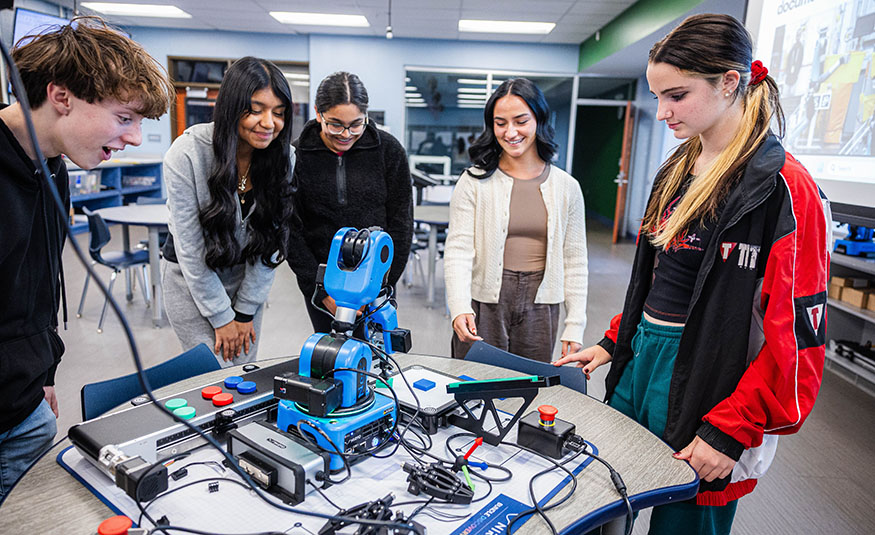
MCMS students will further benefit from opportunities throughout the program to learn from industry experts with support from an Advisory Committee that formed organically as Neamand sought input on the curriculum.
“Through these experiences, students will collaborate on real-world AI projects with business partners, allowing them to practice their technical skills and business application,” explained MCMS Superintendent Jorge Diaz. “This collaboration creates meaningful career pathways, connecting our AI-literate students with employers seeking their skills while ensuring all students, regardless of labels and zip codes, have access to emerging tech opportunities.”
Industry feedback
MCMS also will look to these business partners and its advisory committee to provide timely feedback on students’ knowledge and level of preparedness to guide program adjustments.
“Relevance is our biggest challenge moving into the future, but it’s one we planned for,” said Powell of Mercer’s AI and Robotics program. “We also established a CTE Program Advisory Committee for our Artificial Intelligence program with our business partners and TCNJ faculty. This Advisory Committee will meet on an ongoing basis to review new advancements in AI, share best practices and constantly provide recommendations to update the curriculum materials. By formalizing this feedback loop with both academia and industry, we ensure our curriculum is reflecting the state-of-the-art industry needs and preparing students not just for today’s jobs, but for the jobs of tomorrow.”
Not just for students
Powell said developing the new AI and Robotics program has prompted the district as a whole to examine its own use of AI. Starting last spring, MCTS implemented AI professional development for all instructional staff and recently completed a District Approved Policy on Acceptable Use.
“This ensures that the responsible and ethical use of AI is woven into every classroom, not just the CTE program,” Powell emphasized.
Burlington County Institute of Technology has emerged as a leader among New Jersey’s county vocational-technical schools in preparing staff for using AI professionally. At the start of this school year, BCIT launched a districtwide AI Task Force made up of educators, administrators, students and industry partners. Led by Director of Curriculum and Instruction Danielle Hartman, the group takes on a range of AI-related topics involving ethics, guidelines for use in the classroom, district policy development, and best practices for both administrative and instructional use.
“We want to help our colleagues leverage this technology as a thought partner and also a time-saver,” explained Hartman.
BCIT recently held a full day of professional development for staff led by Thomas Semko, a talent development expert, education consultant and adjunct professor at The College of New Jersey. This latest training focused on prompt engineering, guiding instructors on creating prompts using Chat GPT or Gemini to produce impactful learning opportunities for students.
Spanning industries
Hartman explained that a plumbing instructor may prompt AI to simulate a problem in the field that a student needs to troubleshoot. The instructor can input a plumbing codebook to give the AI tool specific information to pull from when both creating the problem and evaluating the student’s solution. Instructors may also prompt the AI tool to quiz students on an input codebook or safety manual.


BCIT Assistant Superintendent Eder Joseph said the district’s focus on training staff to use AI is strategic: Instructors must first become adept at using AI before they present it as another tool for students to use in their chosen career.
“Even masonry is using AI now to simulate what a job will look like before one brick is even put into place,” Joseph said.
He added, “AI will impact many of our career programs and also will change the programs we offer here at BCIT. Some careers may become obsolete, while others emerge. We’ll constantly evaluate our program offerings and how we teach these programs to best support our students.”
Ashanti Holley, superintendent of BCIT, added, “Artificial intelligence is redefining how the world learns and works, and leadership will determine whether that future creates broader access or deeper divides. At BCIT, we lead with intention and clarity so that technology expands possibilities, strengthens human potential and positions every student for meaningful success in a rapidly changing world.”
Jackie Burke is executive director of the New Jersey Council of County Vocational-Technical Schools.



NJ voter turnout hard to predict due to low response rates
Conducting surveys during elections becomes difficult due to low responses from voters, according to experts.
While this fall’s midterm election may still feel like ages away, the process has already started for potential candidates.
March 23 was the filing deadline for politically affiliated folks to get on the ballot in this June’s primary election – the stepping stone for November.
All 12 seats representing New Jersey in the House are on the ballot as well as one seat in the U.S. Senate.
The heated contest to succeed Rep. Bonnie Watson-Coleman in District 12 is going to draw much of the attention this spring.
There are more contested races as well, though only three involving incumbents.
Here’s a breakdown of who is running to represent the Garden State in Washington this year, according to the unofficial list made available by the state’s Division of Elections.
U.S. Senate
Democratic Sen. Cory Booker is running for his fourth term. He won’t face any opposition this spring. The Republicans running for a chance to represent their party this fall are Richard Tabor, Justin Murphy, Alex Zdan and Robert Lebovics.
Congressional District 1
Democratic Rep. Donald Norcross is running unopposed in the primary. Republican Damon Galdo will also run unopposed.
Congressional District 2
Republican Rep. Jeff Van Drew is running unopposed in the primary. There are four Democrats running, Tim Alexander, Terri Reese, Zack Mullock and Bayly Winder.
Congressional District 3
Democratic Rep. Herb Conaway is running unopposed in the primary. Three Republicans will face off to represent their party. They are Justin Barbera, Jason Culler and Michael McGuire.
Congressional District 4
Republican Rep. Chris Smith is running unopposed in the primary. Two Democrats, John Blake and Rachel Peace, will face off in their party’s primary.
Congressional District 5
Democratic Rep. Josh Gottheimer is running unopposed in the primary. Republicans Sean Kirrane and John Aslanian will square off to represent their party.
The story continues below the gallery.
Congressional District 6
There are three challengers running against Rep. Frank Pallone in the Democratic primary. They are Katie Bansil, Hillary Herzig and John Hsu.
Congressional District 7
Republican Rep. Tom Kean is running unopposed in the primary. There are four Democrats squaring off to run against him this fall. They are Rebecca Bennett, Michael Roth, Tina Shah and Brian Varela.
Congressional District 8
For the Democrats, Rep. Rob Menendez will face off against Mussab Ali, a former Jersey City school board member.
Congressional District 9
Democratic Rep. Nellie Pou is running unopposed in the primary. Republicans Tiffany Burress and Rosie Pino will square off in their primary.
Congressional District 10
Rep. LaMonica McIver is facing one challenger in the Democratic primary, Lawrence Poster. Carmen Bucco is running unopposed for the Republicans.
Congressional District 11
The story continues below the gallery.
This seat is currently vacant after Gov. Mikie Sherrill resigned to run the state. Democrat Analilia Mejia won a special primary in February and is on the ballot for a special election in April to fill her seat. Mejia is running in the primary in June against Justin Strickland, Donald Cresitello and Joseph Lewis. Republican Joe Hathaway, who is also on the ballot in April, is running unopposed in the June primary.
Congressional District 12
There are 13 people running in the Democratic primary to fill the seat being left by Bonnie Watson Coleman, who announced earlier this year that she would retire at the end of her term.
They are Assemblywoman Verlina Reynolds-Jackson, Brad Cohen, Squire Servance, Samuel Wang, Sue Altman, Sujit Singh, Adrian Mapp, Adam Hamawy, Elijah Dixon, Kyle Little, Jay Vaingankar, Matt Adams, Shanel Robinson and Gregg Mele.

NewJerseyDevils.com is the official web site of the New Jersey Devils, a member team of the National Hockey League (“NHL”). NHL, the NHL Shield, the word mark and image of the Stanley Cup and NHL Conference logos are registered trademarks of the National Hockey League. All NHL logos and marks and NHL team logos and marks as well as all other proprietary materials depicted herein are the property of the NHL and the respective NHL teams and may not be reproduced without the prior written consent of NHL Enterprises, L.P. Copyright © 1999-2025 New Jersey Devils and the National Hockey League. All Rights Reserved.

Ranney School student plays music for Monmouth Medical Center patients
Ava Silva Costa, a sophomore at the Ranney School in Tinton Falls, has started Arturo Healing Hearts, bringing her violin music to area hospitals.
Hospitals are an important need in the world.
And finding a facility with high-quality medical care that’s reliable is also important.
Newsweek, the premier news magazine and website, has partnered with Statista to release a dependable guidance list of the World’s Best Hospitals – United States for 2026.
In it’s eight year, these ranking highlights the leading hospitals around the globe so readers can find information tailored to their needs and location the report stated.
Each hospital was reviewed and given a score based on four data sources: recommendations from medical experts; hospital quality metrics, existing patient experience data and Statista’s Patient-Reported Outcome Measures Implementation Survey.
In typical New Jersey fashion, the Garden State makes the list among the 2,500 hospitals that were evaluated this year.
Nine hospitals from the Garden State made the list with one representing Monmouth County. With an overall score of 61.79% and the Infection Prevention Award, Monmouth Medical Center in Long Branch made the top 9 list for roster in World’s Best Hospitals 2026 from Newsweek.
World’s Best Hospitals 2026 in New Jersey
- No. 53: Atlantic Health Morristown Medical Center in Morristown; overall score: 70.74%
- No. 56: Hackensack University Medical Center in Hackensack; overall score: 70.07%
- No. 134: The Valley Hospital in Paramus; overall score: 65.36%
- No. 186: Atlantic Health Overlook Medical Center in Summit; overall score: 64.42%
- No. 254: Englewood Hospital and Medical Center in Englewood; overall score: 63.13%
- No. 320: Robert Wood Johnson University Hospital in New Brunswick; overall score: 62.26%
- No. 364: Newark Beth Israel Medical Center in Newark; overall score: 61.82%
- No. 366: Penn Medicine Princeton Medical Center in Plainsboro; overall score: 61.80%
- No. 367: Monmouth Medical Center in Long Branch; overall score: 61.79%

Sunday Puzzle: Vowel Renewals

Red Rooms makes online poker as thrilling as its serial killer

Over 2 dozen children among 33 bodies pulled from Kenyan mass grave: authorities

Scathing report claims nation’s oldest labor union ‘betrayed’ MAGA members through ‘shocking’ spending

Cases of ‘white plague’ rising in US as doctors warn of ‘rebound effect’

Florida High School Football Rankings: Top 25 teams – Oct. 21

How old is Bo Nix? What to know about Oregon quarterback ahead of 2024 NFL Draft

Cleary's 21 help Le Moyne down Central Connecticut State 69-64 in OT

99th annual Pony Swim held in Virginia

Indiana Members Credit Union announced as new anchor tenant at Bottleworks District
Scathing report claims nation’s oldest labor union ‘betrayed’ MAGA members through ‘shocking’ spending

Republican US lawmaker demands Congress vote on any Iran troop deployment

So you went to a No Kings protest. Now what?

JD Vance says he was ‘obsessed’ with UFOs, believes aliens are actually ‘demons’
The EU's recipe for trade deals : easy on beef, tough on wine
-

 Sports1 week ago
IOC addresses execution of 19-year-old Iranian wrestler Saleh Mohammadi
-

 New Mexico7 days ago
Clovis shooting leaves one dead, four injured
-

 Miami, FL3 days ago
Jannik Sinner’s Girlfriend Laila Hasanovic Stuns in Ab-Revealing Post Amid Miami Open
-

 Tennessee6 days ago
Tennessee Police Investigating Alleged Assault Involving ‘Reacher’ Star Alan Ritchson
-

 Minneapolis, MN3 days ago
Boy who shielded classmate during school shooting receives Medal of Honor
-

 Technology1 week ago
YouTube job scam text: How to spot it fast
-

 Science1 week ago
Record Heat Meets a Major Snow Drought Across the West
-

 Politics1 week ago
Schumer gambit fails as DHS shutdown hits 36 days and airport lines grow