New Jersey
New Jersey vo-tech schools expand AI career pathways – NJBIZ


 Listen to this article
The basics:
- NJ vo-tech schools launch AI and robotics career pathways
- Mercer, Middlesex and Burlington schools partner with TCNJ, Kean and industry leaders
- Programs emphasize ethical AI use, industry credentials and real-world projects
- Districtwide initiatives train educators to integrate AI across all career programs
As artificial intelligence reshapes the global economy, New Jersey’s county vocational-technical schools are embracing a unique challenge. The schools are helping staff use AI as administrative and teaching tools as well as integrating the technology throughout their various career programs. Such broad awareness is essential among the schools that prepare students for a range of future career endeavors, from construction trades to the health sciences and even AI itself.
In early 2025, the New Jersey Department of Education awarded Mercer County Technical Schools and Middlesex County Magnet Schools each an “Expanding Career Pathways in Artificial Intelligence” grant. The funding was established to expand the state’s career and technical education (CTE) pathways to include new programs that blend AI and robotics.
Mercer County Technical Schools leveraged funding to partner with the Engineering and Computer Science departments at The College of New Jersey. The collaboration resulted in the launch of a three-course CTE sequence that is the foundation of the school’s new AI and Robotics program, with each of the courses offering students dual enrollment with TCNJ.
Charles Powell, assistant superintendent of curriculum and instruction at MCTS, said the grant supported a thoughtfully developed program that is “rigorous, relevant and directly connected to industry needs.” In addition to the professors at TCNJ, the school tapped industry experts to weigh in on the curriculum.
Curriculum development
“We simply could not have built a future-proof curriculum without deep partnerships,” Powell noted. “We collaborated with several incredible businesses and professionals who provided essential input on everything from course content to identifying industry-valued credentials (IVCs).”
Key partners have included: Moonbird.Ai; Nagy Group – MagicEdX.ai; QiMeta; and Croda, a global specialty chemical company, demonstrating AI’s broad reach beyond just tech companies.


“Professionals from these businesses helped us identify the critical knowledge gaps and future skill demands. Based on their feedback, we also selected the certifications students would pursue to ensure they graduate with credentials that are immediately valuable to employers,” Powell added.
In just their first year, MCTS AI and Robotics students can participate in the Certified Artificial Intelligence Prefect certification program. The course provides a strong foundation in AI, robotics, machine learning, deep learning, augmented and virtual reality, and Python programming. This certification equips students with the skills needed for future coursework, internships and emerging careers in AI-related fields. Students concurrently enroll in Computer Science Principles, where they explore computational thinking, data analysis, algorithms and programming, enhancing their problem-solving abilities through hands-on projects, digital portfolio creation and an in-depth understanding of computing’s impact on society.
Partners in AI
Middlesex County Magnet Schools also relied on strategic partnerships to develop a new AI and Robotics program. MCMS Director of Career and Technical Education Lee Neamand wrote the curriculum with feedback from HP, SHI and MRA International professionals. She also worked closely with Kean University’s Patricia Morreale, professor and chair of the Department of Computer Science and Technology, to focus the curriculum around the ethical and responsible use of AI.
They focused on five ethical principles: AI enhances rather than replaces human teaching and learning; educators and students maintain agency and control; AI use is transparent and explainable; student data is protected; and AI tools promote equity and access for all learners.
“AI should be a thought partner, never a substitute for critical thinking,” explained Neamand. “Using AI without critical evaluation perpetuates biases and inaccuracies. Students need both technical skills and ethical literacy.”
AI should be a thought partner, never a substitute for critical thinking.
– Lee Neamand, MCMS director of Career and Technical Education
Neamand said that the program would fail students if it simply taught them how to use AI tools and focused too much on tasks that will become automated. She emphasized, “We’re preparing students for the jobs of the future; we’re teaching them how to create AI, manipulate AI and solve problems using AI.”
Solving problems
As students progress through the program to complete four years of high school, they will finish with a capstone project that challenges them to identify a problem in the community and use AI to solve it in a systemic way. Neamand said this type of coursework can prepare students to make a real impact in their community. She offered the example of how AI tools have increasingly been used to detect cell deformity before humans can see it.

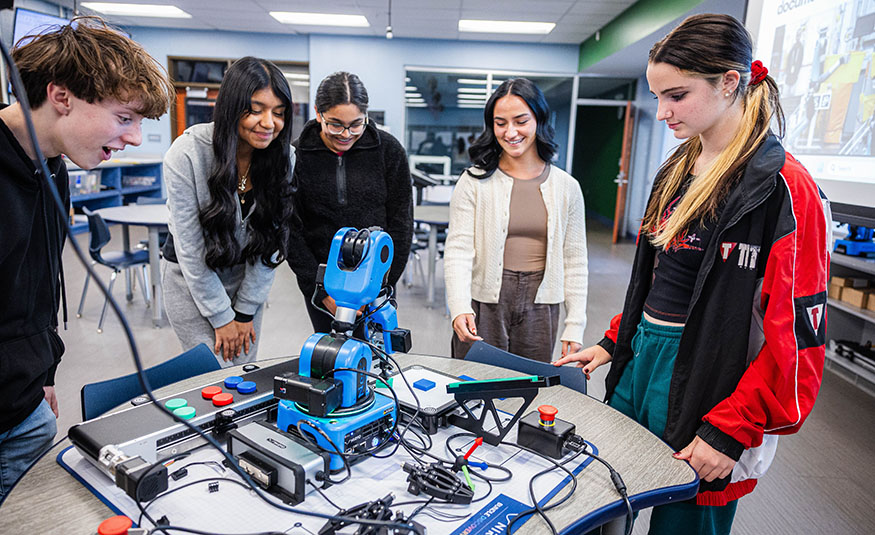
MCMS students will further benefit from opportunities throughout the program to learn from industry experts with support from an Advisory Committee that formed organically as Neamand sought input on the curriculum.
“Through these experiences, students will collaborate on real-world AI projects with business partners, allowing them to practice their technical skills and business application,” explained MCMS Superintendent Jorge Diaz. “This collaboration creates meaningful career pathways, connecting our AI-literate students with employers seeking their skills while ensuring all students, regardless of labels and zip codes, have access to emerging tech opportunities.”
Industry feedback
MCMS also will look to these business partners and its advisory committee to provide timely feedback on students’ knowledge and level of preparedness to guide program adjustments.
“Relevance is our biggest challenge moving into the future, but it’s one we planned for,” said Powell of Mercer’s AI and Robotics program. “We also established a CTE Program Advisory Committee for our Artificial Intelligence program with our business partners and TCNJ faculty. This Advisory Committee will meet on an ongoing basis to review new advancements in AI, share best practices and constantly provide recommendations to update the curriculum materials. By formalizing this feedback loop with both academia and industry, we ensure our curriculum is reflecting the state-of-the-art industry needs and preparing students not just for today’s jobs, but for the jobs of tomorrow.”
Not just for students
Powell said developing the new AI and Robotics program has prompted the district as a whole to examine its own use of AI. Starting last spring, MCTS implemented AI professional development for all instructional staff and recently completed a District Approved Policy on Acceptable Use.
“This ensures that the responsible and ethical use of AI is woven into every classroom, not just the CTE program,” Powell emphasized.
Burlington County Institute of Technology has emerged as a leader among New Jersey’s county vocational-technical schools in preparing staff for using AI professionally. At the start of this school year, BCIT launched a districtwide AI Task Force made up of educators, administrators, students and industry partners. Led by Director of Curriculum and Instruction Danielle Hartman, the group takes on a range of AI-related topics involving ethics, guidelines for use in the classroom, district policy development, and best practices for both administrative and instructional use.
“We want to help our colleagues leverage this technology as a thought partner and also a time-saver,” explained Hartman.
BCIT recently held a full day of professional development for staff led by Thomas Semko, a talent development expert, education consultant and adjunct professor at The College of New Jersey. This latest training focused on prompt engineering, guiding instructors on creating prompts using Chat GPT or Gemini to produce impactful learning opportunities for students.
Spanning industries
Hartman explained that a plumbing instructor may prompt AI to simulate a problem in the field that a student needs to troubleshoot. The instructor can input a plumbing codebook to give the AI tool specific information to pull from when both creating the problem and evaluating the student’s solution. Instructors may also prompt the AI tool to quiz students on an input codebook or safety manual.


BCIT Assistant Superintendent Eder Joseph said the district’s focus on training staff to use AI is strategic: Instructors must first become adept at using AI before they present it as another tool for students to use in their chosen career.
“Even masonry is using AI now to simulate what a job will look like before one brick is even put into place,” Joseph said.
He added, “AI will impact many of our career programs and also will change the programs we offer here at BCIT. Some careers may become obsolete, while others emerge. We’ll constantly evaluate our program offerings and how we teach these programs to best support our students.”
Ashanti Holley, superintendent of BCIT, added, “Artificial intelligence is redefining how the world learns and works, and leadership will determine whether that future creates broader access or deeper divides. At BCIT, we lead with intention and clarity so that technology expands possibilities, strengthens human potential and positions every student for meaningful success in a rapidly changing world.”
Jackie Burke is executive director of the New Jersey Council of County Vocational-Technical Schools.



Trump rolls out Freedom Fuel gas stations, what are they?
Trump’s Freedom Fuel is selling gas at $3.47/gal in Pennsylvania and New Jersey.
President Donald Trump is touting a new fuel option for motorists: Freedom Fuel, advertising gas at a discount price to local consumers.
When the network was opened and announced on July 7, it advertised $3.47 per gallon regular gas at the pumps, a noticeable difference from national and state averages in Pennsylvania and New Jersey.
But is the gas actually as cheap as the 47th President says?
According to some gas tracking platforms, it may not be.
On GasBuddy, a website tracking gas prices across the country with a pricing heat map based on user submissions, some of the Freedom Fuel locations’ pricing appeared to have risen.
Some still sporting the names of what appeared to be their previous sites, like a Gas N Go on Island Ave, the following addresses on GasBuddy match those listed as one of Trump’s 25 gas stations.
The pricing, however, varies:
- 2200 Island Ave, Philadelphia, Pennsylvania – $3.57 as of July 8
- 400 Baltimore Pike, Springfield, Pennsylvania – $3.57 as of July 9
- 6243 Chestnut St., Philadelphia, Pennsylvania – $3.57 as of July 9
- 6800 E. Baltimore Ave, Lansdowne, Pennsylvania – $3.57 as of July 9
- 6801 Tilton Rd., Egg Harbor Township, New Jersey – $3.89 as of July 8
- 6501 Delilah Rd., Egg Harbor Township New Jersey – $3.57 as of July 9
Much about the gas station network remains unknown, like how long they’ll be operating or where stations could be popping up next.
Administration officials told USA TODAY on July 8 that the federal government has no role in the Freedom Fuel Network, nor is it providing it with funding.
The White House also said that “no other entity or person” is subsidizing the cost of gasoline.
Contributing: Michelle Del Rey USA TODAY NETWORK
Kaitlyn McCormick is a Philadelphia-based reporter writing all things trending, breaking and city-related for USA TODAY’s Philadelphia Metro Connect Team.

JERSEY CITY, N.J. — Mile marker 113.3 on the eastern spur of the New Jersey Turnpike in Secaucus will forever be an incredible memory for one family, who scrambled to deliver their baby boy right on the side of the road.
Kristen Fast was in labor last week, with her husband driving her to the hospital on the turnpike, but when they got to the mile marker, baby Archer couldn’t wait any longer and had to be delivered on the highway.
Archer insisted on arriving three days before he was due, and maybe it was because his lovely big sister, 4-year-old Zelda, was waiting for him.
He was in such a hurry, he didn’t even let mom and dad get to the hospital for him to be born, although they tried.
“The doula said, ‘pull over, hang up, call 911.’ So we did that. We called 911. The operator started walking him through what to do,” said Archer’s mother, Kristen Fast.
“Next thing I know, I get in the back seat, and we’re making sure she’s comfortable, and I look down, and that baby is ready to go,” said Archer’s dad, Alex Fast.
New Jersey State Trooper Freddie Guacamaya responded to Alex’s 911 call.
“Cop comes, puts on his gloves, and he was fantastic,” Alex Fast said.
“I said, ‘Are you the EMT?’ And he didn’t answer. So I said, ‘You are not an EMT. I’m in danger.’ But he was fine, he was being very calm,” Kristen Fast said.
“They said, ‘you got to clamp that cord right away. If you have anything, if you have a string.’ So I panicked and just looked in the front and we just had an iPhone cable. So we just clamped the cord with an iPhone cable,” Alex Fast said.
“The EMTs came, and they said, ‘What is this?’” Kristen Fast said.
The loving, kind courtesies extended to the family just continued, helping to make their emergency experience flawless.
“There were three policemen who showed up. I said, ‘I’d love to be with her in the ambulance.’ And they were amazing. They drove our car to the hospital for us, which was so nice. They paid for our valet,” Alex and Kristen Fast said.
They were all welcomed to Hackensack University Medical Center with a healthy baby and a hearty story, backed by Archer’s exact birthplace, recorded accurately: New Jersey Turnpike I-95, mile marker 113.
“Archer’s healthy. He’s thriving. He’s a Jersey boy through and through. I don’t think you get more Jersey than being born on the New Jersey Turnpike,” Kristen Fast said.
New Jersey
What to know about Freedom Fuel Network as Trump urges cheaper gas prices in Pennsylvania, NJ

PHILADELPHIA (WPVI) — There are 25 new Freedom Fuel Network gas stations opening across the Philadelphia area and South Jersey as Americans closely watch gas prices.
This comes after President Trump announced the privately-owned network on social media last week, saying it will help drivers save money at the pump.
There are 25 new Freedom Fuel gas stations opening across the Philadelphia area and South Jersey as Americans closely watch gas prices.
The first location in Dresher, Montgomery County, opened on Friday, with the price of $3.47 per gallon.
This cost was a nod to President Trump serving as the nation’s 47th president.
However, that price has already started to rise after the president announced new U.S. strikes, sending oil and gas prices higher.
Some of those locations with gas stations participating in the Freedom Fuel Network include Lansdowne, Bensalem and Pottstown in Pennsylvania; and Marlton in New Jersey.
Gas Calculator: Find out how much it costs to fill your tank
A White House official told ABC News the administration is not involved with the company and is not providing any funding or subsidies.
Instead, the company says it is cutting its own profit margins to offer lower prices.
Some drivers are applauding this move while others, including gas analysts, are skeptical.
“$3.47 a gallon is a Godsend, honestly,” said one consumer. “Great price because this was a Sunoco before and prices were a lot higher.”
“I want Americans to be asking, ‘Where is that money coming from? Why are corporations and businesses willing to subsidize gas 50-cents a gallon for people, to make President Trump look good,” said another consumer.
Trump is also encouraging other gas retailers to lower their prices. He has not identified the company behind Freedom Fuel, saying only that it’s a private retailer.
Action News is still working to learn how long these lower prices will last and whether more stations will open.
Copyright © 2026 WPVI-TV. All Rights Reserved.
-

 Rhode Island4 minutes ago
Our Favorite Write-Ins From the 2026 Best of Rhode Island Readers’ Poll – Rhode Island Monthly
-

 South-Carolina11 minutes ago
South Carolina National Guard lifts suspensions for pilots in July Fourth flyover
-

 South Dakota14 minutes ago
South Dakota T. rex could bring $30 million or more at auction
-

 Tennessee19 minutes ago
Rescue teams pull kayakers and dog from Red River in Tennessee
-

 Texas26 minutes ago
Fetus found deceased along Lewisville Lake shoreline was discarded intentionally, police say
-

 Utah29 minutes ago
Tyler Robinson preliminary hearing expected to wrap up Friday – KSLNewsRadio
-
Washington34 minutes ago
Bengals 2026 Opponent Preview: Washington Commanders
-

 Vermont34 minutes ago
Beau Welling’s Stowe Country Club Revamp Signals New Vermont Golf Era


