Connect with us

New Hampshire

Meet the people behind the loon cam, a New Hampshire-bred YouTube sensation

Published

on

Meet the people behind the loon cam, a New Hampshire-bred YouTube sensation


On a busy day, the corner of YouTube run by the New Hampshire’s Loon Preservation Committee gets hundreds of visitors.

Viewers come for the close-up views of loons: striking black and white feathers, ruby red eyes. But they stay for the drama, as the birds mate, lay eggs and protect their nests. And the day everyone’s waiting for, when a chick hatches.

Editor’s note: We strongly recommend listening to this piece by hitting the “listen” button above.

Advertisement


Sara Plourde


NHPR

The loon cam has an enthusiastic fandom. But the channel has humble beginnings. A decade ago, it started sort of as a science project, in an effort to figure out why almost half of loon eggs don’t end up hatching.

“Sometimes these things fail in the blink of an eye. And so unless you have somebody who’s watching that loon nest at the instant a wave crashes over that nest, or a gull or an eagle comes down and snatches the egg, you’re often just not going to know,” said Harry Vogel, the head of the Loon Preservation Committee.

The committee was started in 1975, as loon populations were plummeting. The birds were facing new challenges as humans built dams and vacation homes, and warmed up the atmosphere.

Advertisement

The committee does research and raises money. They help loons escape from icy lakes, if they don’t migrate fast enough. And they put out dozens of pre-made nests every year for loons to use if they can’t build one of their own.

“We are essentially trying to right a wrong that we have done to our loons,” Vogel said.

The loon live streams have helped add to biologists’ understanding of the birds for a decade. Anecdotes pile up over the years, showing different facets of loon behavior. The microphones have picked up cooing noises not previously recognized as loon sounds.

Advertisement

But Vogel says the birds are also a powerful force for conservation. They get people to care. In part, that’s because their calls are hard to forget.

“Then you add a little chick riding up on the back of a parent, and you’ve hooked a fair proportion of your human population,” he said.

Vogel says his team figured, if they were already filming the loons, they might as well share the livestreams with the public. But running a loon cam is hard work.

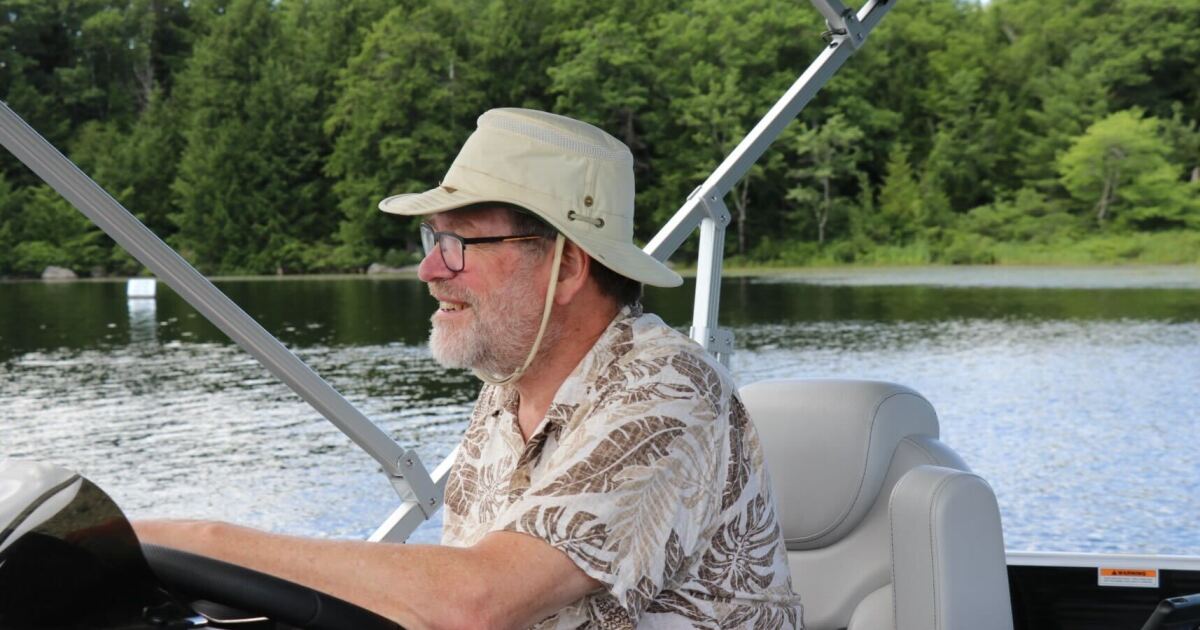
Enter: Bill Gassman.

About ten years ago, a Loon Preservation Committee biologist recruited Gassman to help out while he was working at a lobster festival. After a 40-year career in technology, he figured he’d be able to help out.

Advertisement

Now, in his retirement, he spends May through July fixated on loons: one eye on the birds, and another on the fast-moving YouTube chat. When chicks are hatching, he’s especially glued to the stream.

“I can’t not watch at all times because I might miss something. You never know when something’s going to happen,” he said.

Gassman’s dedication to his volunteer job as loon cam operator, or L-C-O as he’s affectionately called by viewers, is intense. The birds are the first thing he thinks about when he wakes up.

Advertisement

“The light starts at 4:00. I usually check it to see what’s going on, and I keep it really close overnight in case something attacks an egg. So I’ll usually pull the camera back and go back to sleep,” he said with a laugh.

Gassman controls the loon cam – a security camera attached to a post in the water – with his laptop or phone. He’s skipped parties to attend to loon cam duties, pulled over while driving to catch a big moment, even run the loon cam from the audience at a wedding.

His devotion to the loons extends to his tech setup. He’s fine-tuning it year after year, often to protect it from wildlife. A goose pecked a microphone to death, so now the mics are protected. This year, a bear was suspected of unplugging power cords. Turtles have chewed through cables several times.

“We’re going to put the microphone cable inside a garden hose next year,” he said. “So it’s going to have to chew through that first.”

Gassman says he didn’t know loons that well before his retirement gig. But watching them so closely every summer, he gets why they have so many fans.

Advertisement

“They’re mystical, right? They’re prehistoric. They were around when the dinosaurs were around. They’re beautiful birds. The closer you look, you see how intricate they are,” he said. “The sounds are very haunting.”

He knows of people in New York City who turn on the livestream when they go to sleep, to drift off to the sounds of the lake. Viewers on different time zones leave notes in the chat about what happened overnight.

A small community of viewers – chatters, as they call themselves – come back year after year. And they’re not just fellow YouTube travelers. They’re friends.

Carol Horn DiLernia is one of them. Her family knows her as a loon fanatic. Other livestream viewers know her by her screen name, Tailfeather. She reads about loons, researches them, and loves to talk to other people about their behavior.

Advertisement

When chicks begin to hatch, the viewership on the Loon Preservation Committee's livestreams jumps.

When chicks begin to hatch, the viewership on the Loon Preservation Committee’s livestreams jumps.


Screenshot, Loon Preservation Committee LoonCam

“We bounce things off of one another. We think out loud on the cam. And if I do that at a cocktail party, people will walk away from me, you know,” she said with a laugh.

She’s been watching since the cam’s early days. She watches all kinds of livestreams – red tailed hawks, ospreys. She had an eagle cam phase. But the loons are always on.

Seeing the chicks hatch is a treat, but Horn DiLernia says she also likes to watch the birds bonding and sitting on their eggs.

Advertisement

Often it’s not so idyllic. Eagles attack. Loons accidentally crush their own eggs, or sometimes they abandon them, if they don’t seem viable. This year, out of four eggs in the two nests being live streamed, only one chick hatched.

Horn DiLernia says she tries not to attribute human characteristics to the birds. But she does connect to them.

“I feel for them deeply,” she said. “I also find that they do their grieving process, and then it’s another day and they pick up where they left off.”

In the chat, Horn DiLernia is something like an unofficial moderator, especially when the chicks are hatching. That’s when the chat gets newcomers, and sometimes on YouTube, she says, people make uninformed observations.

“That’s all you need for a group that doesn’t really know what’s going on, and then panic ensues. And it’s like, ‘Stop it!’” she said.

Advertisement

But ultimately, viewers seem to respect her interpretation of what they’re seeing on the cam. And that’s part of why she stays.

“I think it’s important for everybody to champion something. I think that that’s what part of life is, is being a champion to something or someone,” she said. “I think that that’s what I try to do on the cam. I try to give people the education that they’re looking for when they come.”

The loon cam is over for the season. But next spring, the loons will come back. And, unaware they’re being watched, they’ll give another show for their fans.

Copyright 2024 New Hampshire Public Radio

Advertisement


Source link

New Hampshire

Three seriously injured in head-on crash on I-293 in Hooksett, N.H. – The Boston Globe

Published

on

Three seriously injured in head-on crash on I-293 in Hooksett, N.H. – The Boston Globe


Three people suffered injuries in a two-vehicle collision early Tuesday morning in Hooksett, New Hampshire.Courtesy of New Hampshore State

Three people suffered serious injuries Tuesday in a two-vehicle crash in Hooksett, N.H., police said.

The head-on collision happened around 5:40 a.m. on Interstate 293 northbound, State Police said.

Police said that Timothy Hubbard, 43, of Rome, Maine, was traveling south when he lost control of his car and crossed the median into oncoming traffic, police said.

Hubbard, his passenger, and the other driver were taken to hospitals to be treated for serious injuries, police said. The injures were not believed to be life-threatening.

Advertisement

Police said speed was believed to be a factor in the crash, which is under investigation.


Hannah Goeke can be reached at hannah.goeke@globe.com.


Source link

Continue Reading

New Hampshire

Sara Doherty – Concord Monitor

Published

on

Sara Doherty – Concord Monitor


Sara Doherty

Franklin, NH – Sara Jane (Sanford) Doherty, 79, of Franklin, New Hampshire, passed away peacefully at her home on June 11, 2026. A beloved wife, mother, grandmother, and friend, Sara was born on June 5, 1947, in Hanover, New Hampshire, to Harold and Sadie (Pettengill) Sanford.

As the daughter of a U.S. Army Corps of Engineers employee, Sara spent her childhood moving throughout New England, living in New Hampshire, Massachusetts, and Connecticut. She graduated from high school in Hudson, Massachusetts, and later returned to New Hampshire, eventually settling in Franklin, where she made her home for more than forty years.

Sara built a successful career in the textile industry. She worked as a seamstress at Howland Originals before joining Star Specialty Knitting, where she began as a stitcher and, through hard work and determination, advanced to Plant Manager. She retired in 2003, and one of the greatest joys of her retirement was caring for several of her grandchildren, whom she adored.

Advertisement

Sara was a remarkably talented and creative artisan. She sewed clothing for her children when they were young and later created outfits for her grandchildren and their dolls. She was a gifted painter and artist whose extraordinary drawings and paintings brought joy to those around her. An accomplished seamstress, knitter, crocheter, cake decorator, and musician, Sara had an exceptional ability to create beauty in many forms. Her handmade gifts and treasured creations will be cherished by her family for generations to come.

Her talent for cake decorating blossomed into a successful side business that spanned more than thirty years. Sara created hundreds of stunning and imaginative cakes, including wedding and birthday cakes for her own children and grandchildren. Her passion for baking was so well known that for many years her license plate proudly read “CAKES+.”

Sara also had a remarkable gift for bringing people together. She hosted countless family reunions, each one more creative than the last. With elaborate themes, games, prizes, delicious food, and endless laughter, she created memories that her family will treasure forever. She was also known for her generous holiday gatherings, often welcoming more than thirty family members and friends into her home for Thanksgiving and Christmas celebrations. Summers brought cherished Fourth of July cookouts by Webster Lake, where Sara delighted in decorating the waterfront and gathering loved ones to enjoy the annual boat parade.

Sara’s love of giraffes was known by all who knew her. She spent years collecting hundreds of them, giving each a special “G” name. Before her passing, she shared one of her favorites, “Geebri,” with her granddaughter Sydni, who is expecting Sara’s first great-grandchild.

Her warmth, creativity, generosity, and love of family touched everyone who knew her. To say she will be missed is a vast understatement. She was truly the heart of her family.

Advertisement

Sara leaves behind her devoted husband of 43 years, Joel Doherty; her sons, Todd (Michelle) Chapman of Sanbornton, New Hampshire, and Paul (Cheryl) Chapman of Northfield, New Hampshire; her stepdaughters, Ali (Oliver) Frates of Amherst, New Hampshire, and Kate Hodge of Durham, New Hampshire; and her beloved grandchildren, Shelby, Sydni, Morgan, Owen, Duncan, Calum, Macy, and Elyse, and Step-grandchildren, Matthew, Jennifer, Eric, & Kevin.

Sara was predeceased by her parents.

Sara’s family would like to express their heartfelt thanks to Franklin VNA for their rapid and seamless response in setting up hospice, and to The Payson Center for their dedication and care, which gave us more precious time with her.

A graveside service will be held on Tuesday, June 30, 2026 at 11:00 AM in Franklin Cemetery, Thompson Park in Franklin.

For more information or to leave the family an online condolence, please visit www.smartmemorialhome.com.

Advertisement

Click here to sign the guest book or honor their memory with flowers, donations, or other heartfelt tributes


Source link

Continue Reading

New Hampshire

New NH law requires statewide ‘best practices’ for pig scrambles starting in 2027

Published

on

New NH law requires statewide ‘best practices’ for pig scrambles starting in 2027


A staple of many New Hampshire town fairs, the pig scramble may soon look a little different.

A bill signed into law by Gov. Kelly Ayotte last week requires the commissioner of the state Department of Agriculture to create best practices for any event in which people compete to capture a pig. Those guidelines will be published before the 2027 fair season, so they won’t be in place for any fairs with pig scrambles this year, such as the upcoming Deerfield Fair in the fall.

Generally, a pig scramble involves people of the same age competing to capture pigs that have been let loose in a large pen. Contestants have to catch the pig in a drawstring bag, and the first one to do so can take the pig home.

Rep. Cathryn Harvey, a Democrat from Spofford, is the prime sponsor of the bill. She said each fair has different rules for their pig scrambles, meaning some can be more humane than others. One aspect of the events she hopes will change is the bags pigs are captured in.

Advertisement

“They’re putting an animal in a plastic bag on a hot summer day,” Harvey said. “It isn’t a great idea.”

Although some fairs already use more breathable bags out of burlap, Joan O’Brien, president of the New Hampshire Animal Rights League, said she’s also seen pigs being kept in plastic bags for long periods of time after the event. Not only would a burlap bag improve the pig’s ability to breathe in the heat, she said, but she also wants fairs to require participants to bring an animal carrier for the trip home. Her organization was ultimately in favor of the legislation.

“If you don’t have a carrier, you should not be allowed to leave your pig lying in a bag,” O’Brien said, adding that some fairs already ask contestants to bring carriers. “You should be taking them right home.”

The Deerfield Fair has implemented another rule that O’Brien and Harvey hope becomes part of statewide best practices — having parents supervise their child in the pen. O’Brien once witnessed a child hang a pig upside down by its legs and then lower it headfirst into the bag.

“In the heat of the moment, the kids get excited and they just do whatever it takes to get the pig in the bag,” O’Brien said. She said parents should work with the event referee to make sure their kid is handling the pig humanely.

Advertisement

Harvey’s bill originally called for pig scrambles to be banned around the state, but both she and O’Brien feel that universal guidelines for fairs would still make the experience better for the animals. Even seemingly small things, Harvey said, like giving the pigs water after the scramble, would be an improvement to the current situation for them.

“I think that the bill will embolden people to speak up at these events,” O’Brien said. “If they think a pig is being mistreated, they’ll be able to say to themselves, ‘I know that there’s supposed to be a rule, so I’m going to say something.’ So I think that would be a good outcome.”


Source link

Advertisement
Continue Reading
Advertisement

Trending