Connect with us

Northeast

Missing grandma believed to have fallen in sinkhole while searching for lost cat: 'Never came back'

Published

on

Missing grandma believed to have fallen in sinkhole while searching for lost cat: 'Never came back'

Pennsylvania authorities are desperately searching for the grandmother who may have fallen into a massive sinkhole while looking for her missing cat.

Elizabeth Pollard, 64, was last seen in Marguerite, Pennsylvania, on the evening of Dec. 2. She parked her car outside a restaurant to look for her lost cat, Pepper.

Her 5-year-old granddaughter, who was later found safe, was left in the car at the time. Pollard’s family alerted authorities at 1 a.m. on Tuesday to report that she was missing.

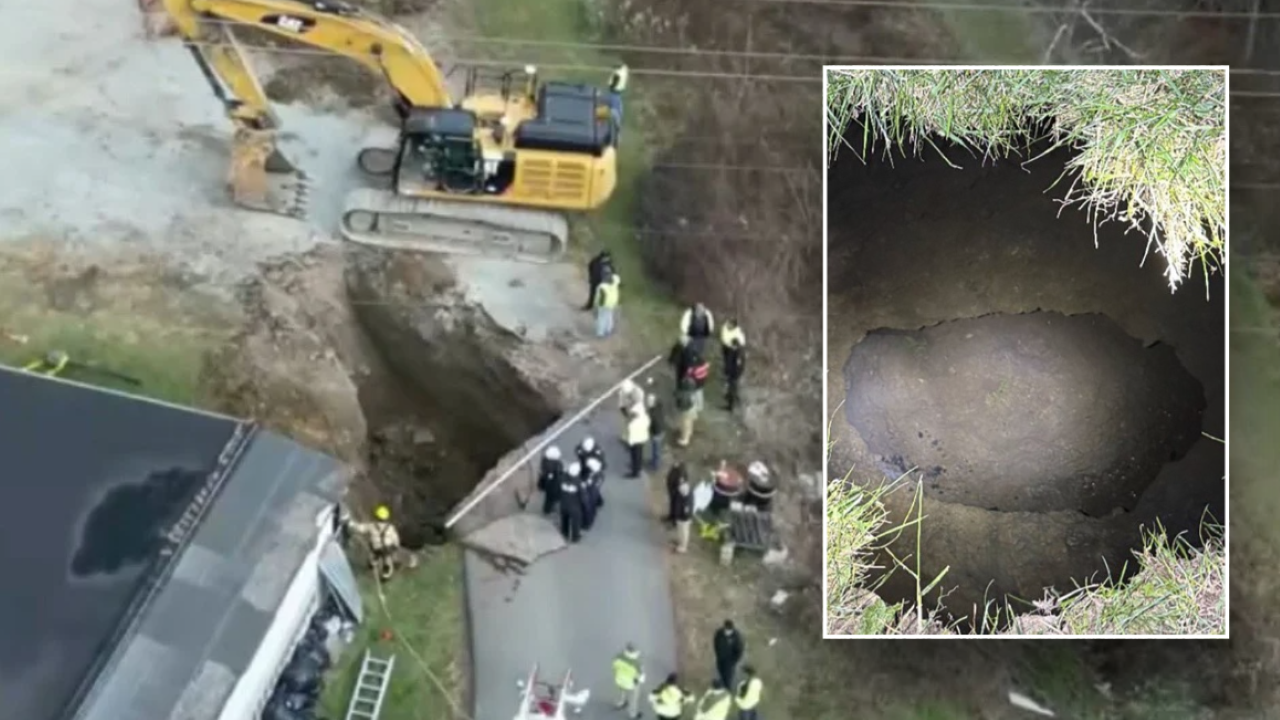
When officials arrived at the scene, they discovered a gaping sinkhole within the vicinity of her car. It is unknown how deep the hole is, but crews found what appeared to be a shoe around 30 feet underground.

CHILD DIES AT HALLOWEEN ATTRACTION DURING PRANK GONE WRONG: ‘HORRIFIC ACCIDENT’

Advertisement

Elizabeth Pollard, 64, may have fallen into an enormous sinkhole while searching for her lost pet. (KDKA / Pennsylvania State Police via AP)

Pennsylvania State Trooper Steve Limani told journalists that it was possible the hole opened up on Pollard while she stood and looked for Pepper, whose whereabouts are unknown.

“[Her granddaughter] nodded off in the car and woke up,” Limani said. “Grandma never came back.”

“It almost feels like it opened up with her standing on top of it.”

Temperatures in Marguerite were freezing overnight. Authorities also lowered a pole camera with a sensitive listening device into the sinkhole on Tuesday, but did not detect any sign of Pollard. 

Advertisement

MAN DIES IN FREAK ACCIDENT INVOLVING FROZEN HAMBURGERS: ‘DIFFICULT TO HEAR’

This Tuesday, Dec. 3, 2024. image provided by the Pennsylvania State Police shows the top of a sinkhole in the village of Marguerite, Pa., where rescuers were searching for a woman who disappeared. (Pennsylvania State Police via AP)

Local restaurant workers and hunters did not report or notice a sinkhole before Pollard went missing, leading authorities to believe that the hole may have swallowed the missing woman.

Marguerite, a western Pennsylvania village that had once been a coal town, is susceptible to sinkholes due to past mining activity.

The Pennsylvania Department of Environmental Protection responded to the Marguerite sinkhole and found that it was likely caused by work in Marguerite Mine, which has not been in operation since 1952.

Advertisement

A possible shoe was found around 30 feet deep in the sinkhole. (KDKA)

Authorities are actively investigating the incident. No additional details are known at this time.

The Associated Press contributed to this report.

Advertisement

Read the full article from Here

Continue Reading
Click to comment

Leave a Reply

Your email address will not be published. Required fields are marked *

This site uses Akismet to reduce spam. Learn how your comment data is processed.

Maine

See 3 historic riverfront mills in Maine that offer modern apartment living

Published

on

See 3 historic riverfront mills in Maine that offer modern apartment living


They were built decades ago in some of the most picturesque spots across Maine — manmade mountains of granite and brick, concrete and steel, rising beside rivers that powered the state’s booming textile industry through the 1800s and 1900s.

Now, these old mills are increasingly being converted to housing and other purposes. In Biddeford’s sprawling mill district, a variety of housing projects have been completed or are underway, including 154 apartments in the former Pepperell Mill that are being leased or sold as condominiums.

Two of the most recent conversions are Picker House Lofts, a mixed-income rental property in Lewiston, and The Spinning Mill, a housing and commercial project in Skowhegan. Both opened last year.

The Spinning Mill, including 41 apartments, a boutique hotel and a restaurant, received a 2026 Honor Award from Maine Preservation for excellence in historic preservation and rehabilitation.

Advertisement

Here’s a look at those three mill conversions.

The Spinning Mill

Location: Skowhegan, Somerset County
Waterfront: Kennebec River
Year built: 1922
Year renovated: 2025
Number of units: 41
Monthly rent: $1,510-2,750, utility and amenity fees vary

In its peak years, the Maine Spinning Co. employed 300 people and produced 2 million pounds of wool yarn annually in the heart of the downtown district, closing in 2005. High Tide Capital of Bangor purchased the site in 2019 and began a $20 million residential and commercial redevelopment project.

The conversion suffered a major setback in December 2023, when the storm-churned Kennebec fooded the first floor, causing more than $3 million in damage. An economic recovery grant from the state helped the developers clean up and continue.

Advertisement

The adaptive reuse respected the building’s history, preserving wooden floors and high ceilings, oversized windows and exposed brick walls. Modern plumbing, electrical, heating and cooling systems were installed, along with stainless steel appliances and granite countertops.

The four-story building includes studio through three-bedroom units, ranging from 630 to 1,300 square feet. Amenities include a fitness center, mini movie theater, coworking space, resident lounge and art studio. The property also includes The Skowhegan, a 20-room boutique hotel, and the Biergarten, a German-themed restaurant and event space with riverside patio.

Contact: Yates Murphy, The Spinning Mill, 207-951-6475

Picker House Lofts

Location: Lewiston, Androscoggin County
Waterfront: Androscoggin River
Year built: 1855
Year renovated: 2025
Number of units: 72
Monthly rent: $1,495-2,000 (26 market-rate units); $801-1,332 (46 subsidized); heat, hot water and basic Wi-Fi included

Part of the 7-acre Continental Mill complex, Picker House Lofts is a 79,000-square-foot, mixed-income rental property developed by The Szanton Co. of Portland. The remaining 481,000 square feet of former factory space is being developed to include more than 300 additional apartments along with office, retail and light industrial uses by Chinburg Properties of Newmarket, New Hampshire. 

Advertisement

Named for its original function, the five-story building is where workers called “pickers” removed seeds, twigs and other debris from raw cotton before it was woven into cloth.

It includes one-, two- and three-bedroom units, with 46 reserved for households with incomes at or below 60% of the area median income, which ranges from $35,880 for a single person to $51,240 for four people, according to MaineHousing.

The developers preserved historic features where possible, including wood floors, huge operable windows and 13-foot ceilings with exposed overhead carrying beams, while adding modern fixtures, utilities and appliances.

Amenities include a fitness center, indoor bike storage, landscaped courtyard with picnic tables and a communal lounge with adjoining roof deck that overlooks the Androscoggin River. It’s located downtown near a farmers market, museums and a park with a fitness court.

Contact: Saco Falls Management, 207-228-8800

Advertisement

Pepperell Mill

Location: Biddeford, York County
Waterfront: Saco River
Year built: 1845
Year renovated: 2008
Number of units: 154
Monthly rent: $1,695-2,995, utilities and wifi included

Originally converted by local developer Doug Sanford, apartments in the Pepperell Mill Campus retain many historic features from its textile-weaving past, including 10- to 18-foot ceilings, exposed brick walls and beams, and honey-colored maple floors.

Now owned and managed by Texas-based Presidium, the property is available to lease or purchase residential units as they come on the market, providing what the company calls a “try before you buy” opportunity. It’s part of a 17-acre complex in the heart of a downtown that includes a variety of small businesses, artists, restaurants, breweries and coffee shops.

Apartments range from economical studios to luxury two-bedroom, two-bathroom units that include washer-dryer hookups. Available condos are priced from $325,000 to $1.5 million, according to Portside Real Estate Group.

Units feature modern finishes and oversized, industrial-style windows, many with views of the Saco River. Amenities include smart laundry facilities, green spaces with seating areas and gas grills, riverside picnic areas and a dog-washing station.

Advertisement

Contact: Pepperell Mill Campus, 207-282-5577, Ext. 201


Source link

Continue Reading

Massachusetts

Thousands join Walk for Hunger in Boston: ‘Critical response to rising food insecurity’

Published

on

Thousands join Walk for Hunger in Boston: ‘Critical response to rising food insecurity’


Thousands joined Project Bread’s 58th annual Walk for Hunger on Sunday to combat what organizers called a critical and rising problem of food insecurity in Massachusetts.

“There is no reason any person in Massachusetts should not be able to put food on the table,” said Project Bread President and CEO Erin McAleer. “And yet, more people are struggling now than ever. Every one of us has a role to play in making a difference, and the Walk for Hunger is the perfect opportunity to do just that.”

The walk — representing the nation’s oldest continually running pledge walk, according to Project Bread — raised the targeted $1 million in funds to fight hunger in the state as participants made their way around the family-friendly and accessible 3-mile loop around Boston Common.

Project Bread, which organizes the fundraiser along with over 600-member Make Hunger History Coalition, noted that the walk is an “immediate opportunity” for people to take action as food insecurity rises in Massachusetts.

Advertisement

In Massachusetts, 40% of households are experiencing food insecurity, the organization said, and “rising food prices and potential changes to federal nutrition programs, including SNAP, threaten to deepen the challenge.” Local organizations in Greater Boston are continuing to prepare for additional strain, they added.

Project Bread joined food aid organizations and public officials to meet an “impossible task” as the government shutdown temporarily cut off SNAP benefits last November, at the same time as an estimated 3.5 million have lost SNAP benefits nationwide due to policy changes under the Trump administration last July.

The 3,500 participants Sunday represented 216 towns across Massachusetts, while additional walkers from 23 states and five countries participated virtually, organizers said. The event featured live music, food vendors, games, a cooking demonstration, and remarks from local leaders on the Common.

The funds raised support Project Bread’s “comprehensive approach to food security,” tackling areas like policy advocacy, prevention strategies and more, as well as supporting the work of 68 anti-hunger organizations who participate in the event and keep 60% of the funds they generate.


Source link

Continue Reading

New Hampshire

Only a handful of New Hampshire farms are as old as the nation. Their endurance has relied on adaptability – Concord Monitor

Published

on

Only a handful of New Hampshire farms are as old as the nation. Their endurance has relied on adaptability – Concord Monitor


Five major dairy farms populated the half-mile stretch of Upper City Road in Pittsfield where Tom Osborne’s childhood unfolded.

As he matured into young adulthood in the 1960s and 70s, the golden years of New England dairy were quietly waning in his backyard. All but one of those farms — enjoying the upward swing of technological progress in mechanical milking and refrigeration made during earlier decades — have deserted dairy, including the Osborne family, which sold its dairy cows in 1986.

Hours were long, and the work was unforgiving. Returns paled in comparison to those investments: The price of milk fluctuated with little predictability while investment grew costlier, often outweighing revenue. Towards the end of the lifetime of their dairy operation, Osborne remembers his late father, David, straining to eke out a third milking from their cows every day, one more than standard.

Advertisement

Resting on their shoulders was the endurance of a business already more than 200 years old. Now, the farm, founded in 1775, is marking its semiquincentennial, looking very different than how it did in the past.

“Over the years, we’ve had to evolve and not always do what we’ve always done. I think sometimes that’s a hard thing,” Osborne said. “You kind of feel like, ‘Hey, this is what we’ve always done, let’s keep doing what we do and what we know.’ But I think we’ve had to just learn.”

Young Tom Osborne in his 4H jersey, pictured circa 1982. Credit: Courtesy of Tom Osborne

In 1976, the New Hampshire Department of Agriculture, Markets and Food listed 56 legacy farms as enduring within the same family of owners for 200 years. As the nation now marks its semiquincentennial, 250 years since the signing of the Declaration of Independence, only a fraction of those farm enterprises remain, pastoral gems scattered across the state.

To shoulder the caprices of the industry, most have learned to adapt.

In 1938, a hurricane made landfall in Lebanon, tearing through Ascutney View Farm, razing a four-story chicken barn Susan Cole’s father had just built. When the storm subsided, family legend tells that there were chickens stranded in trees.

Advertisement

“Sometimes Mother Nature decides for us,” Cole said Friday morning, representing her family farm, founded in 1771, at the New Hampshire Farm, Forest and Garden Exposition. “You have to be a flexible mind.”

Her father passed away at 102, having worked their 1,100 acres of forested and pasture land his whole life. The 100 dairy cows Cole remembers showing as a child through 4H were gradually sold, and today, the family keeps 60 sheep and taps 2,100 maple trees. Her husband manages the brunt of the manual labor, but without her full-time work in real estate, Cole said the farm would not be viable.

“Having no outside income is not an option,” she said.

Their family’s approach isn’t altogether uncommon. In 2022, farmers in New Hampshire whose primary occupation was one other than farming outnumbered farmers who made their income primarily from their land, according to the U.S. Department of Agriculture. Nearly 60% had an off-farm job that they listed as their main source of income.

For the Osbornes, bifurcating the family business proved to be a more enduring shield against the financial riptides of the industry.

Advertisement

While his brother Paul maintains the farm, Tom Osborne inherited from his father an expanding retail chain, Osborne’s Farm and Garden Centers, with locations in Concord, Hooksett and Belmont.

The year after the family sold its cows, they opened their first Osborne’s Agway Store, selling farm supplies. The farm continued to see changes: Their small horticultural operation has plateaued over the years; land that used to sprout corn has been seeded for hay.

Left to right: Heidi Bundy, Susan Cole and Tom Osborne, all owners of generational farms, speak at a panel at the New Hampshire Farm, Forest and Gardens Expo on Friday. Credit: REBECA PEREIRA / Monitor staff

Osborne cultivates 25,000 hay bales each season and resells more from other producers in his stores, but even the crop’s relative success hasn’t insulated the farm from uncontrollable, unpredictable challenges. The last two summers have yielded the best hay seasons in recent memory — for them and for their neighbors and competitors.

Hiring has rebounded in Osborne’s stores since COVID, but labor challenges still cast a long shadow over farm operations, especially for Heidi Bundy at Tomapo Farm in Lebanon.

Bundy knows the history of their land, inexorably entwined with the history of her family: In the mid 1800s, the family owned hundreds of sheep as wool boomed. They shifted to dairy with a herd of Jersey cows, which were displaced by black-and-white Holsteins by the time she was a child.

Advertisement

In 1970, her father and grandfather, by then equal business partners, reckoning with the decline of dairy, reached an impasse: either stay in or get out. They chose the latter.

During the ten years her grandfather, Howard Townsend, served as the state’s commissioner of agriculture, her father ran the farm himself, logging alone in the woods for months at a time. “We diversified, and we’ll probably continue to have to be diversified,” Bunday said.

That decisive hour came for the Osbornes’ dairy operation two years later. Around 1972, Osborne said, his father questioned whether to throw in the towel on dairy, choosing instead to prolong the inevitable.

“I think my dad, in his later years, regretted taking on more debt to stay afloat,” he said.

Their farms, generational bulwarks, have lived continuous evolutions.

Advertisement

The future approaches with greater uncertainty.

Of Bundy’s five children, she said none feel compelled to take on the farm. She’s promised her parents a place to live out the remainder of their days, and she’s going to “keep on doing what I can do” to ensure that she honors her word.

“If I have to leave the farm, I can do it,” she reflected. “I won’t be happy about it, though.”


Source link

Advertisement
Continue Reading
Advertisement

Trending