Northeast
Meet the American who first planted apples in the colonies: William Blaxton, eccentric settler

This fall, tip your basket to William Blaxton when you pluck a plump apple from a tree, bob for apples on Halloween or cherish your grandmother’s amazing apple pie on Thanksgiving.
Reverend Blaxton, among other claims to fame, planted the first seeds that would fuel a pioneering nation and give apples an image of all-American wholesomeness.
A bookish and eccentric loner, the early English settler nurtured what historians believe were the first apple orchards in what’s now the U.S. in present-day Boston in the 1620s. His name Blaxton is often modernized as Blackstone.
A true pioneer, he settled Boston five years before the Puritans — and Rhode Island a year before Roger Williams.
MEET THE AMERICAN WHO COOKED UP FROZEN FOODS: ADVENTURER AND INNOVATOR CLARENCE BIRDSEYE
“There may be historical characters who did more than he did for apples in America, but he was certainly the first — and at least the first known — to bring this exotic crop to our shores,” said John Bunker, an American apple expert, grower and author.
“That’s a pretty awesome legacy,” added the New England apple enthusiast, who spoke to Fox News Digital while “tracking down ancient trees” in the woods of rural Maine.
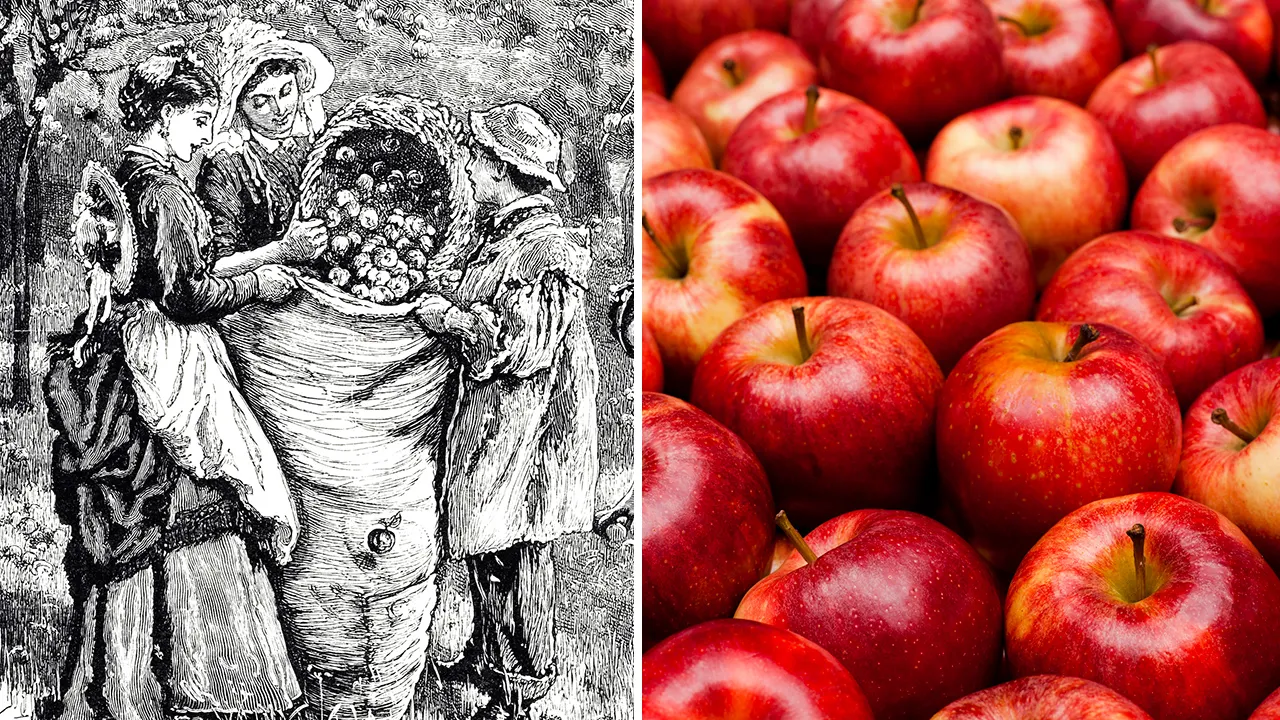
On the left, an engraving depicts fruit pickers collecting apples for cider, dated 19th century. On the right, gorgeous red apples. (Getty Images; iStock)
Our national heritage is flavored with references to the sweet, juicy fruit. America’s biggest city is called the Big Apple. Wholesome institutions are as “American as apple pie.” Johnny Appleseed created an American legend spreading the gospel and the apple across the heartland.
Yet the fruit is native to Central Asia, likely Kazakhstan.
APPLES QUIZ! HOW MUCH DO YOU KNOW ABOUT THIS DELICIOUS FRUIT?
It had reached Europe at least by the time of Ancient Greece and Rome.
Apples arrived in the Americas only after the explorations of Christopher Columbus sparked the greatest period of food fusion and cultural integration in world history.
“I looked to have dwelt with my orchards and my books in undisturbed solitude.”
The people of the New World, in addition to apples, soon savored Old World foods such as rice, onions and coffee. Europeans, Asians and Africans discovered Western Hemisphere flavors such as corn, potatoes and tomatoes.
Julius Caesar never tasted tomato sauce, as one observer noted of the Roman diet before the Genoa-born Columbus landed in America.
Apples in an orchard at Cider Hill Farm in Amesbury, Massachusetts, on Sept. 7, 2020. (Craig F. Walker/The Boston Globe via Getty Images)
The restless Blaxton moved often and typically lived alone, though he married at age 64. By age 65, he had a son, John.
He apparently preferred the acquaintance of his apple trees and his books to the company of people.
“I looked to have dwelt with my orchards and my books in undisturbed solitude,” reads a memorial to him today in Cumberland, Rhode Island, near the Blackstone River.
Abandoned in the New World
William Blaxton is believed to have been born on March 5, 1595, in Lincolnshire, England to John and Agnes (Hawley) Blaxton.
Edwin Whitefield, Homes of our Forefathers in Boston, Old England, and Boston, New England. A drawing conjectured to be of William Blaxton’s home. (Boston: Damrell & Upham, 1889) (Public Domain)
His mother died when he was boy.
He was ordained by the Church of England in 1621, then lost his father the following year.
Left on his own as a young man, and with news of English settlements in Jamestown and Plymouth trickling back to Britain, Blaxton set off for the New World as chaplain aboard the ship “Katherine.”
MEET THE AMERICAN WHO INVENTED THE DONUT
“William brought with him to the New World a large collection of books, approximately 186 in various languages,” wrote Nathaniel Brewster Blackstone in a biography of the settler and his descendants.
Blaxton arrived in Wessagusset, in what is now Weymouth, Massachusetts, just south of Boston in 1623. It was an ill-fated settlement.
Captain Richard Gorges, who led the expedition, hastily returned to England.
A person takes a photo of a blooming tree on Boston Common in Boston on April 27, 2022. William Blaxton planted America’s first apple orchard along what is now Boston Common. It became America’s first public park in 1634, just before Blaxton left for Rhode Island. (David L. Ryan/The Boston Globe via Getty Images)
Blaxton stayed behind and ventured a few miles north to the Shawmut Peninsula, the site of present-day downtown Boston, in 1625.
The Puritans, led by John Winthrop, arrived five years later.
“For several years before Winthrop came in 1630, William Blaxton constituted the entire population of this peninsula … to which attached the name of Boston,” the Bostonian Society claimed in an 1860 presentation.
“He was kind of an eccentric,” Russell Steven Powell, executive director of the New England Apple Association, told Fox News Digital. Powell has written two books about the fruit, “America’s Apple” and “Apples of New England.”
Colorized illustration (after a wood engraving circa 1854) of English Puritan and founder of the Massachusetts Bay Colony John Winthrop (circa 1588-1649). (Science Source/Photo Researchers History/Getty Images)
There are several accounts, he said, of Blaxton “riding a bull through the streets, throwing flowers and apples to his friends.”
The staid Puritan reformers and the oddball Anglican minister did not hit it off.
So, for the third time in 12 years, Blaxton (or Blackstone) started a new life on his own.
AMERICA THE BEAUTIFUL: 50 MUST-SEE LANDMARKS THAT TELL OUR NATIONAL STORY
“Because of theological and territorial disagreements with his new neighbors, Blackstone moved west in 1635 to enjoy the solitude and tranquility of a place he called ‘Study Hill’ in the Lonsdale section of Cumberland, on the east bank of the river that now bears his name,” writes the Rhode Island Heritage Hall of Fame.
For several years before Winthrop came in 1630, William Blaxton constituted the entire population of Boston.
“This move gave him the unique distinction of being present-day Rhode Island’s first permanent English settler.”
Perfect food for pioneers
Blaxton spent his days in Boston planting roots before uprooting his own.
“When Governor Winthrop found William in 1630, he had had ample time to have built his home, plant his orchard, and was living quite comfortably,” reported Brewster Blackstone in his biography.
Illustration of Johnny Appleseed making a speech, circa 1820. A legendary figure in American history, he spread apples and goodwill through the Midwest. (Fotosearch/Getty Images)
“As for the apple seeds he used to develop his orchards, it is probable that he was foresighted enough to retrieve and save every apple core (which naturally contains seeds) he could find, or otherwise come by,” said the same source.
“Certainly most ships were stocked with apples along with other foodstuffs, therefore, it is doubtful that he brought them with him in 1623 because this kind of living was most likely not his original intention. He would have probably only brought with him his ministerial necessities.”
Apple experts say the earliest known American varieties likely descended from Blackstone’s Boston fruit trees.
Blaxton’s first orchard was planted at the corner of what’s now Beacon and Spruce streets, in the heart of Boston, between Beacon Hill and Boston Common.
That’s according to Amy Traverso, Yankee Magazine food editor and author of “The Apple Lover’s Cookbook,” who shared that with Fox News Digital.
Illustration of pioneers crossing the plains by Henry Bryan Hall, Jr. after Felix Octavius Carr Darley. (© CORBIS/Corbis via Getty Images)
“I love to imagine Beacon Hill covered with all those apple trees,” she said.
Blackstone planted his apple orchards from seed, according to all reports, while controlled varietals are grown by grafting.
So the types of apples he grew is unknown. But apple experts say the earliest known American varieties likely descended from Blackstone’s Boston fruit trees.
Lowell Johnson of Apple Jack Orchard in Delano, Minnesota, gave Children of Tomorrow Daycare of Waconia a tour of his apple orchard. (Bruce Bisping/Star Tribune via Getty Images)
The Roxbury russet, named for a Boston neighborhood, is the earliest known American apple variety, and is traced to 1635, the year Blaxton left for Rhode Island.
Heirloom apples — Rhode Island greening and yellow sweeting — also likely came from his first orchards.
“Apples teach us what it means to be alive and joyful on earth.” — Apple expert and author John Bunker
The Roxbury russet is an “excellent old cider apple, a fine keeper and good for eating fresh out of hand,” writes Trees of Antiquity.
Added the website New England Apples, “Its crisp and spicy sweet-tart flesh is as good for fresh-eating as it is for making a fine cider … It keeps well in storage.”
A quote attributed to William Blaxton (Blackstone) at a memorial park in his honor in Cumberland, Rhode Island. “I looked to have dwelt with my orchards and my books in undisturbed solitude,” it reads. (Visit Rhode Island)
Apples could be also be dried, baked, distilled into vinegar — or, most commonly in colonial times — fermented into cider.
They proved perfect food for the pioneers who were spreading across the continent.
They also gave the Europeans who arrived in America, and eventually the Americans who settled new homes across the continent, a much-needed reminder of home.
‘Alive and joyful on earth’
William Blackstone died on May 26, 1675, in Cumberland, the Rhode Island town he first settled in 1635.
The name Blackstone remains common throughout Massachusetts and Rhode Island.
A monument to William Blackstone in Cumberland, Rhode Island. He was the first European settler of both Boston, Massachusetts, and the state of Rhode Island. He died in Cumberland in 1675. (Visit Rhode Island)
The land he sold to the Puritans became Boston Common, founded in 1634, just before he left the Shawmut Peninsula.
It is the oldest public park in America today. It predates Central Park in New York City, for example, by 224 years.
Boston has a downtown Blackstone Street, a Blackstone Grill and a Blackstone Elementary School.
Apples quickly became a symbol of American bounty.
The Blackstone River, which meanders through both Massachusetts and Rhode Island, is named for him. It became a critical power provider in the early days of the Industrial Revolution.
The Blackstone River National Historical Park was created under President Obama in 2015.
Rhode Island features numerous memorials, including a William Blackstone Memorial Park in Cumberland.
The city of Pawtucket, an old mill town on the Blackstone River, introduced a monument to Blackstone in 2021. It features him reading a book upon a bull, reflecting one of the tales of his eccentricity.
Fall color reflections at the Blackstone River in Whitinsville, Massachusetts. (Essdras M Suarez/The Boston Globe via Getty Images)
Apples quickly became a symbol of American bounty.
When British troops invaded Brooklyn during the American Revolution in 1776, the British were stunned by the splendor of the orchards.
To read more stories in this unique “Meet the American Who…” series from Fox News Digital, click here
The redcoats “regaled themselves with the fine apples, which hung everywhere upon the trees in great abundance,” wrote author David McCullough in “1776,” an epic work of history.
Bunker, the Maine apple expert, said apples symbolize the breadth of the American experience, born overseas but rooting themselves deeply in the soil of the New World.
“Apples are just like us,” the apple romantic said. “They come in many colors, many sizes and many shapes. They are well rooted, just like we all want to be. They are collaborative, communicative — and they gift us with beautiful fruit.”
For more Lifestyle articles, visit www.foxnews.com/lifestyle
Apples, he also said, “teach us what it means to be alive and joyful on earth.”
Read the full article from Here

Boston, MA
Chickadee, the popular Mediterranean restaurant in Seaport, is shutting down – The Boston Globe

An Instagram post that announced their closure on Tuesday evening did not point to any reason for the closure, and requests for comment were not immediately returned.
“Eight years ago, we opened our doors at the Innovation and Design Building with a simple hope: to bring you honest, delicious food and a warm place to share it,” read the post. “What we found instead was a community – regulars who became friends, first dates that turned into anniversaries, celebrations, quiet lunches, and everything in between. You made this restaurant so much more than a place to eat.”
Globe Food Critic Devra First awarded Chickadee 3.5 stars in October 2018, where she wrote how some meals “are magic, everything cooked perfectly, making you swoon.”
At the time, it was also considered one of the earliest restaurants to have opened in the still-industrial far reaches of the Seaport, which was home to ship-repair facilities and cutting-edge design firms, seafood wholesalers, and biotech companies. In terms of location, some said it was ahead of its time.
DaSilva, a three-time James Beard Best Chef: Northeast semifinalist, has led some of the top restaurants across the Greater Boston area. Aside from Barbara Lynch’s flagship No. 9 Park, he opened Spoke Wine Bar in Somerville in 2013. During his time at Spoke, he received a number of accolades and was named one of Zagat’s “30 Under 30” for Boston and earned the title “Rising Star Chef” from StarChefs.
Kilpatrick, who also left Lynch’s group in 2014, worked for the team behind O Ya to help open restaurants in New York. According to his LinkedIn, he started a new job as a regional operations manager for Lark, a boutique hotel management company, in April.
Alexa Gagosz can be reached at alexa.gagosz@globe.com. Follow her @alexagagosz and on Instagram @AlexaGagosz.
Pittsburg, PA
Parent group claims Pittsburgh Public Schools’ closure plan violates children’s civil rights

The Pittsburgh Public Schools board of education has been under intense scrutiny since its “Future Ready Plan” was first introduced — and then eventually approved — in late May. But a group of parents has filed a complaint with the Pennsylvania Human Rights Commission in an effort to prevent it from being carried out.
Advancement Project, a national civil rights organization, along with 412 Justice and the Education Rights Network, have filed a complaint against the school board on behalf of five PPS students, claiming the plan, which will close or repurpose several district buildings across the city, violates those students’ civil rights.
Those students represented in the complaint attend Miller Pre K-5 in the Hill District, Manchester Pre K-8 on the North Side and Woolslair Pre K-5 in Bloomfield, all of which would close under the plan, with the students relocating.
“This is part of what we’ve seen across the country, this national school closure crisis,” said Adaku Onyeka-Crawford, a staff attorney and director of education justice for Advancement Project. “We’ve seen it play out in urban, suburban and rural communities, affecting Black and brown children, and it has come to Pittsburgh.”
The complaint is calling for an investigation into the plan and for the district and school board to act in good faith during that investigation. They hope it will lead to a preliminary injunction, allowing the commission to get a court order for the district to stop the implementation of the plan.
One of the main claims in the complaint is that the school board “based school closure decisions on utilization (enrollment divided by building capacity), despite being notified that doing so would disproportionately close schools in Black neighborhoods. Black students make up 62% of students that will lose their schools, but only 49% of students district-wide.”
“Utilization has no ties to education quality at all,” said Onyeka-Crawford. “In fact, smaller class sizes are tied to better outcomes for students. Community members had flagged that relying on this metric would disproportionately harm Black students.”
Onyeka-Crawford said alternatives were presented to the school board, some that have had success in other cities, but the district went forward with their own plan instead.
“We need to ask: who is Pittsburgh Public Schools and the board accountable to?” she said. “It’s the parents and families, and if this is what parents and families are asking for, it’s up to them to be accountable to those communities, and give parents and students the education and resources that they need.”
KDKA reached out to the district, but it said it will not comment on pending litigation.

UNCASVILLE, Conn. (WTNH) — Aaliyah Edwards came off the bench to score a game-high 21 points as the Connecticut Sun defeated the Portland Fire, 90-87, during Camp Day on Tuesday morning at Mohegan Sun Arena.
Thousands of kids were in attendance to watch the Sun hold on to a fourth-quarter lead as the Fire attempted to rally. Connecticut led by 10 at halftime and saw its lead cut to one in the final period.
Brittney Griner added 20 points for the Sun, who ended their three-game homestand with a victory. Olivia Nelson-Ododa went 8-for-8 from the foul line en route to 16 points and Leila Lacan chipped in 14.
Carla Leite led the Fire with 18 points.
The Sun visit Phoenix on Friday for the first of two games with the Mercury.
-

 World9 minutes ago
US says latest Iran strike wave over, IRGC claims damage to US Naval HQ
-
 News39 minutes ago
Supreme Court Justices give chilling accounts of threats to their safety
-

 Los Angeles, Ca2 hours ago
Stabbing at Chino Hills liquor store ends in attempted murder arrest
-

 Detroit, MI3 hours ago
A small group of citizens rally for mental health coverage in Detroit
-

 San Francisco, CA3 hours ago
1 dead, 2 missing after boat capsizes near Alcatraz in San Francisco Bay
-

 Dallas, TX3 hours ago
Death penalty off the table for man accused of beheading Dallas motel manager, prosecutors say
-

 Boston, MA3 hours ago
Chickadee, the popular Mediterranean restaurant in Seaport, is shutting down – The Boston Globe
-

 Denver, CO3 hours ago
Denver Nuggets 7-Year NBA Veteran Gets Honest On Peyton Watson

