Massachusetts
Old mills are hard to turn into apartments. But could they help solve the state’s housing crisis? – The Boston Globe


“What makes the project relevant now is the need for housing,” he told the Globe.
Projects such as these are far from new, but the repurposing of vacant mills into residential properties has taken on a fresh urgency. Massachusetts needs to build nearly a quarter of a million new homes over a decade to address a severe housing shortage in the state, developers and municipal leaders say.
“The housing crisis is increasingly acute. It’s bigger now than it was five, 10, 20 years ago. So we have a capital C crisis,” said Larry Curtis, chairman of Boston-based WinnDevelopment, which has converted nearly two dozen mills in Lowell, Holyoke, and elsewhere in Massachusetts over the last four decades.
Old mills, though difficult to develop, have some built-in benefits. They offer available building stock, in a state where land for big, new projects can be hard to come by. And repurposing long-vacant buildings into residential or commercial properties can skirt the kind of NIMBY community opposition that can sometimes derail new construction, according to Curtis.
Jessica Rudden-Dube, executive director of Preservation Massachusetts, said that some of the easier mill projects have already been converted. But improved incentives from the state have encouraged developers to repurpose those that still remain.
For her organization, the projects are a way to preserve history and build new housing at once. “It’s sort of a no-brainer if that space is historic and can be preserved in its historic character but serve a new purpose,” she said.
Two decades ago, New Bedford conducted an inventory of about a 100 of its mills and changed zoning laws to permit their development into housing or mixed uses, said Jennifer Carloni, director of city planning. A lot of them have found new uses, such as the Kilburn Mill that overlooks Clarks Cove. It’s now home to artists, antique vendors, a cafe, and a bookshop, along with yoga studios, gyms, and other small businesses.
But a few New Bedford mills remain untouched, awaiting builders with enough wherewithal — and deep enough pockets — to tackle challenging environmental conditions.
“We have the policies and the procedures in place that are ready to go when any one of those properties wants to be developed,” Carloni said.
The housing shortage in the state is making some developers take on even complicated projects, according to Quentin Ricciardi, CEO of real estate firm Acorn Inc., whose company has repurposed mills in New Bedford.
“With so much demand, some of these mill properties are now coming back into focus,” he said.
Glassman bought his power plant building in 2019 for $350,000. It will be, to put it mildly, challenging to make apartments out of a boiler room at the back of his building, a turbine room in the middle, and office spaces at the front. But there are high ceilings and wide windows that open up to the view of the Acushnet River.
Glassman and his partner in the project, Lisa Serafin, are looking into state and federal tax credits for historic rehabilitation projects, and will take out a loan against expected rent revenues. They hope to secure financing and permits soon, then begin construction next year.
Glassman owns two other former mills in New Bedford. An old leather lamination plant now houses Darn It, his apparel repair business, and a warehouse operation. A few minutes away is Hatch Street Studios, a 130,000-square-foot old yarn-spinning mill that has become a working space for sculptors, painters, woodworkers — even a clown school.
“There’s so much history with these buildings and in the city of New Bedford,” Glassman said, ”it would be a shame if people started knocking these down to build up something else.”
“We’re a community that is ever changing, always taking our assets and making the most of them,” New Bedford’s Carloni said.

WinnDevelopment has completed historic reuse projects across Massachusetts. They include the repurposing of mills in Lowell, such as at the historic Boot Mill Complex, that have created nearly 600 units of housing in all. In January, the firm finished transforming an alpaca wool mill in downtown Holyoke into 88 units of senior housing.
The largest such project in Taunton, the Whittenton Mills, involves 42 acres that was vacant for more than a decade. Work has finally begun after years of trying to attract developers, said Jay Pateakos, executive director of the Taunton office of economic and community development.
The plan is to create 390 apartments, as demand has grown with the arrival of a new commuter rail and new residents relocating to Taunton, after being priced out of elsewhere in the state.
“Housing is number one, especially affordable housing,” Pateakos said. “A lot of these mills make excellent apartments, so we look at it, and we try to create some housing opportunities.”

In Fall River, officials say renovating the old mills can have a multiplier effect on the local economy by creating jobs for people working on the projects and by attracting deep-pocketed new residents to live in the city.
Mayor Paul Coogan acknowledged that it is tough work. But developers regularly come to the city inquiring about them.
“They’ve had good success here, and they come back and they [say] ‘Look, what else do you have?’” he said.
“Some people that are holding on to these old mills want more money than I think they’re worth, and that a developer is willing to commit to,” he added. “But if we can put together a deal … it turns around a neighborhood.”
Omar Mohammed can be reached at omar.mohammed@globe.com. Follow him on Twitter (X) @shurufu.


Trombetta’s Farm, at 655 Farm Rd., is listed as a Central Massachusetts stop on the Massachusetts Ice Cream Trail, a state-backed guide launched in 2024 to promote ice cream shops, farm stands, and dairy farms that use Massachusetts dairy products, according to GBH.
The trail features more than 100 destinations across Massachusetts and is managed by the Massachusetts Department of Agricultural Resources. The map includes dairy farms with ice cream stands, farms selling packaged ice cream, and shops selling Massachusetts ice cream products, according to the tourism office.


Medford native Maria Menounos hosting ‘Heal Squad Day of Reset’ in Yarmouth
Medford native and celebrity Maria Menounos is hosting ‘Heal Squad Day of Reset’ at Red Jacket Beach Resort & Spa in Yarmouth.
Looking for a beach where fellow beachgoers have good manners?
Travel website Exoticca conducted a survey and found the beach with the best beach etiquette in each state, including Massachusetts, so you can know the place where Bay Staters treat both the beach and each other with the most respect.
“We surveyed 3,011 Americans to find out where beachgoers are seen as having the best etiquette, and the results say quite a lot about what people actually want from a beach vacation,” Exoticca said.
In Massachusetts, voters said to head to the North Shore.
Crane Beach — Ipswich, Massachusetts
The extremely popular Crane Beach in the North Shore town of Ipswich was voted the best for beach etiquette by Exoticca’s readers.
Exoticca said that the places that scored the highest in positive beach etiquette were places where people focused on the clarity of the water and the beautiful scenery rather than external distractions like seaside restaurants or shops on the boardwalk, where “everyone around seems to understand that nobody wants the place spoiled.”
Crane Beach is known for its white sand and conservation. It’s one of the nesting places for piping plovers, according to The Trustees.
“To protect threatened shorebirds during your visit, we ask that you avoid the fenced nesting areas and the wrack, the line of washed-up organic debris where the birds feed and hide,” the Trustees said.
Despite having 350,000 people visit annually, according to the Trustees, Crane Beach still achieved the top spot of beach etiquette.
How to visit Crane Beach
Barring going on Martin Luther King Jr. Day or on Veterans’ Day for families with veterans, visitors do have to buy tickets for vehicle entry and parking. Tickets are cheaper if visitors arrive via motorcycle, biking, or walking.
“Strict rules apply: no drop-offs, re-entry for nonmembers, or outside food delivery; dogs and horses are not allowed April 1–September 30,” the ticket selection webpage said.
Rin Velasco is a trending reporter. She can be reached at rvelasco@usatodayco.com.
Massachusetts
Mass stranding of bottlenose dolphins off Cape Cod said to be largest in Massachusetts history

Rescuers were working to save around 30 bottlenose dolphins that got stranded off the coast of Cape Cod early Monday morning. It is the largest known stranding of bottlenose dolphins off Massachusetts, according to the International Fund for Animal Welfare (IFAW).
The dolphins had become stranded between First Light and Ellis Landing in Brewster at about 5:30 a.m. when they came in with the tide. A woman noticed the animals and reported it. The IFAW quickly responded to the area, but five to six of the marine mammals died before help arrived.
The IFAW worked throughout the day on Monday to get the mammals away from the shoreline before the next low tide at 5:13 p.m. They said late Monday afternoon that they were still successfully being steered away.
“Our team remains in the area to monitor and herd the animals away from shore,” an IFAW spokesperson said. “We know these events can sometimes repeat in the coming hours and days, but we remain hopeful.”
The organization said it had seen an uptick in bottlenose dolphins becoming stranded off Cape Cod in the last few years.
“Bottlenose dolphins are typically an offshore species,” the spokesperson said.
They asked that anyone who encounters a stranded or distressed marine mammal not get close and never drag or push the animal back into the water.
“Similar to a person involved in a car accident, dolphins can become injured and exhausted during a stranding event,” the IFAW said.
Instead, they recommend calling their IFAW stranding hotline at 508-743-9548.
-
 Business1 minute ago
Commentary: Trump greenlights California’s dumbest water project
-
 Entertainment7 minutes ago
‘Hail Satan? Not me.’ Charley Crockett fires satanic duo Twin Temple, so Jack White hires them
-
 Lifestyle13 minutes ago
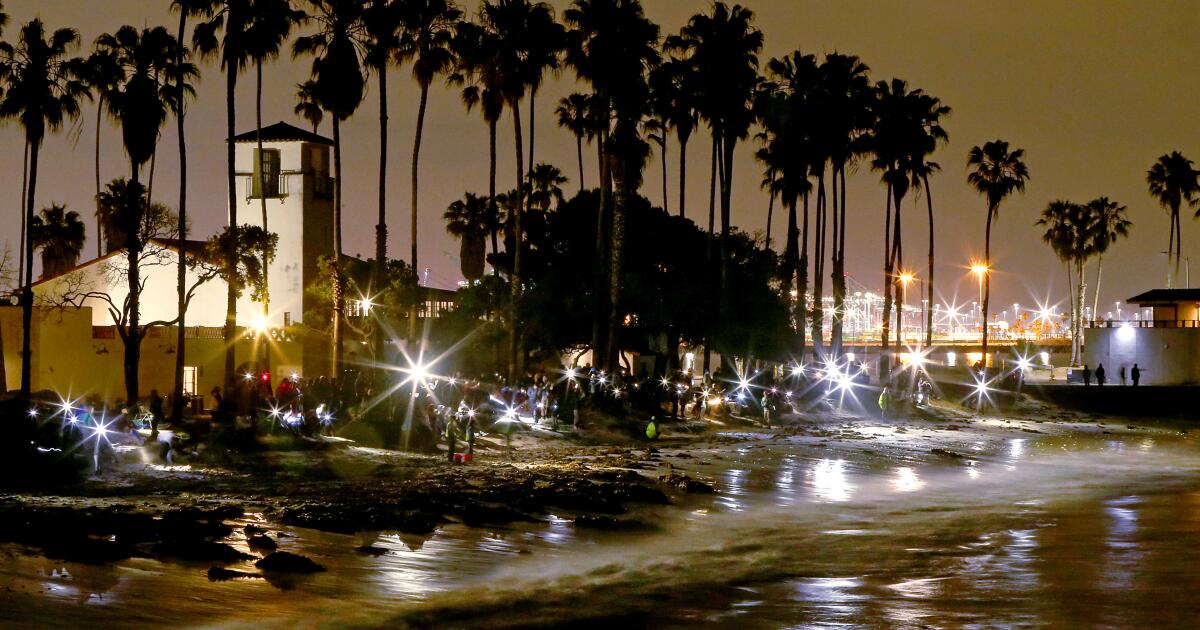
It’s time for the night trip to the beach — the grunion are running
-
 Politics19 minutes ago
After lawsuit, ICE pauses construction of Bay Area detention facility
-
 Science25 minutes ago
Anger grows in Boyle Heights as warehouse fire leaves stench, flies and vermin in its wake
-
 Sports31 minutes ago
Spain delivers surprise rout of France, clinches berth into World Cup final
-

 World43 minutes ago
US says latest Iran strike wave over, IRGC claims damage to US Naval HQ
-
 News1 hour ago
Supreme Court Justices give chilling accounts of threats to their safety

