Massachusetts
Mass. is getting more granny flats. But it’s still hard to build them. – The Boston Globe


Massachusetts took a big step in 2024 when the Legislature legalized so-called “accessory dwelling units” statewide as part of an effort to rein in the state’s housing crisis. More than a year later, it’s clear that the law is working — but that it also needs tweaks before accessory units can meet their full potential.
These small units, nicknamed “granny flats,” can be constructed in someone’s backyard, or they can simply be renovated third floors, garages, or basements. They’re a popular option for seniors seeking to downsize and families looking for some rental income.
Prior to the state law, some communities allowed accessory units, but many did not. Even among those cities and towns that did tolerate accessory dwelling units, zoning often varied from one municipality to the next, making it difficult for builders who needed to decode each municipality’s rules. Some towns also included unreasonable restrictions, like requiring that only a homeowner’s family members could live in the accessory units.
Housing advocates viewed allowing accessory dwelling units statewide as a “low-hanging fruit” policy — a way to add housing that was relatively cheap and avoided some of the cost and political obstacles that housing measures often encounter. The state legislation also overrode some zoning restrictions, including those that limited accessory units to family, while leaving some other local rules intact.
One year after the law went into effect, this approach has proved fruitful: Towns across the state have approved 1,200 ADU permits and seen even more applications, in some cases up to a threefold increase from previous years.
A study published last week by Boston Indicators (the research branch of the Boston Foundation) and Abundant Housing Massachusetts found that forcing the hand of municipalities on accessory dwelling units accomplished more in one year than 50 years of zoning reform efforts at the local level.
The problem, though, is that municipalities retained too much power. As the study recommends, there should be clear, uniform state regulatory standards for ADUs, with minimal opportunities for municipal-level variation.
“A comprehensive agenda is needed to address regulatory barriers to housing production, spanning building, fire, energy, septic system, wetlands, and stormwater rules,” the study’s authors wrote. “The barriers include the fragmented complexity of the regulatory system itself.”
Making standards more uniform doesn’t have to mean lowering them — it just means moving away from patchwork rules that make it harder for companies to build accessory units at scale.
Chris Lee at Backyard ADUs, a company that designs and builds modular dwelling units in New England, says the report’s findings make sense. The inconsistent interpretations across 350 towns and cities cause builders and engineers to “struggle to design work for the town that will be accepted,” he said. (The state’s 351st municipality, Boston, isn’t covered by the law.)
The potential is significant. The report calculates that if just 2 percent of single-family homes in Massachusetts added an accessory unit, the state would see more than 30,000 new homes that advocates say are generally more affordable. Building an accessory dwelling unit inside a pre-existing house can cost between $75,000 and $100,000; and a detached unit usually runs between $250,000 to $350,000, making them much more affordable than purchasing a single-family home in most regions of the country.
“For developers of missing middle housing to benefit from an economy of scale, they have to undertake many projects, across jurisdictional lines,” according to the study. “The ADU case study has shown just how challenging this is.”
Lee estimated that he could reduce up to $30,000 of preconstruction costs such as surveying and architecture if his company could work with consistent regulations across towns, which he said could enable them to double their production.
Streamlining permitting for accessory dwelling units isn’t a panacea. Landlords still must be willing to actually build them and rent them to long-term residents. Retirees must believe it’s worth downsizing to one. But the fact that so many have been permitted over the last year point to the clear demand and makes the case for policy makers to keep refining the law.
There is precedent. California, for example, had an equally ambitious goal but has blown past it, going from only 1,300 permits approved its first year to more than 30,000 nine years later. “It is important to understand that California did not accomplish its ADU outcomes with one legislative reform,” the study’s authors wrote. “California’s success required sustained legislative attention.”
Massachusetts should be able to realize those kinds of results too. Conversely, if even the “low-hanging fruit” of zoning reform falters in the Commonwealth because of local red tape, then the state has bigger problems ahead to solve its housing crisis.
Editorials represent the views of the Boston Globe Editorial Board. Follow us @GlobeOpinion.

Massachusetts
Meteor over Massachusetts causes explosion reports, sightings from Delaware to Montreal

Reports of an explosion from people across New England Saturday afternoon sent police agencies and others scrambling to understand what caused a double boom that shook buildings in Massachusetts and Rhode Island.
The American Meteor Society said that the booms heard about 2:30 p.m. were actually caused by a meteor about 3 feet (nearly 1 meter) wide entering the atmosphere around the New Hampshire border with Massachusetts, north of Boston.
Fire program monitor Robert Lunsford said the society received dozens of reports from Delaware to Montreal with people either hearing the double boom, feeling the ground shake or seeing the fireball — which he said looked like a shooting star in the daytime sky.
“It was definitely bigger than a normal fireball, about a yard wide,” he said.
But Lunsford said it’s unlikely the meteor struck the ground.
“We would need more information about the trajectory the speed and other aspects to know for sure if it hit the ground, but if it didn’t burn up, then it would have landed in the ocean,” he said. “Most of them do burn up before they hit the ground.”
People in a handful of states posted on social media about feeling the buildings they were in shaking. Several videos on the X platform captured what sounded like two quick booms, with no fire, smoke or other visual causes.
Several people filed reports with the U.S. Geological Survey, registering the shaking they felt with the National Earthquake Information Center, agency spokesman Steve Sobie confirmed.
The agency opened an event page, based on the number of “Did you feel it?” reports it received on its website. But Sobie said there was no event registered on the agency’s seismographs. meaning the shaking was not due to an earthquake.

A Greenfield, Massachusetts family of four were among the five killed when a bus plowed into vehicles on a Virginia highway early Friday morning. A 25-year-old woman from Worcester was also killed in the crash.
It comes as investigators are trying to piece together what happened in the collision that injured dozens more.
There is profound sorrow in the Greenfield community. Heartbroken family members say Dmitri Doncev, 45, his wife Ecterina, 44, their 13-year-old daughter Emily and 7-year-old son Mark all died after a charter bus slammed into their car and others on I-95. The Worcester woman who was killed was in another SUV struck by the bus.
They Doncev family were devoted members of a Russian Baptist Church who were heading to a wedding in South Carolina.
The heartbroken family sent WBZ a statement saying, “Today, words cannot adequately express the pain and sorrow felt by their family, friends, church community, coworkers, classmates, and all who had the privilege of knowing them. Their absence leaves a void that can never be filled, but their memories, their love, and the countless lives they touched will remain forever in our hearts.”
“Though their time with us was far too short, the legacy of kindness, faith, perseverance, and love that they leave behind will continue to inspire all who knew them,” the statement said.
Providence Christian Academy said the children attended the school saying in a statement, “The Doncev family was a cherished part of our school community, and their loss is being felt deeply by our students, families, faculty, and staff.”
Greenfield Mayor Greenfield Mayor Virginia DeSorgher also said in a statement:
“To the families, friends, and neighbors of those we lost: there are no words that can fully ease the weight of this sudden and unimaginable grief. Please know that you are not walking through this dark time alone. The Greenfield community stands with you, mourning alongside you, and we extend our absolute deepest condolences and prayers.”
Investigators say the bus did not slow down in a work zone, hitting several cars in front of it. Passengers on the bus woke up to chaos.
“It was horrible,” said bus passenger Wayne Tobin. “It was just like blood everywhere; it was people holding their head. Their heads were bleeding.”
In all, about 44 people were rushed to area hospitals.
State police identified the bus driver as 48-year-old Jing Dong. He could be facing charges in the crash.
Transportation Secretary Sean Duffy said on X that Dong was an American citizen originally from China who got his commercial driver’s license two years ago in New York.

A bus crashed into vehicles slowing for a work zone on Interstate 95 in Virginia early Friday, killing five people and injuring dozens, including the driver, authorities said.
The crash happened at about 2:35 a.m. on southbound I-95 in Stafford County, near Quantico. All five of the people who died were in vehicles hit by the bus, and 44 people were taken to hospitals, including three in critical condition, police said.
“The preliminary investigation indicates that traffic was slowing southbound for an upcoming work zone,” state police said in a news release. “A bus failed to slow for traffic and struck six vehicles.”
Police said there were “approximately” 34 passengers on the bus.
“We’ve got patients in multiple hospitals. We’ve got the driver at a hospital here,” said Peyton Vogel, a Federal Transit Administration spokesperson who was on the scene. “I’ve got to say, this is one of the most tragic things I’ve ever seen. Absolutely tragic.”
Four of the fatalities were in one car, which caught fire. State police said the victims were a 45-year-old male, a 44-year-old female, a 13-year-old female and a 7-year-old male, all from Greenfield, Massachusetts. The fifth victim, a 25-year-old female from Worcester, Massachusetts, was in an SUV that was struck by the bus.
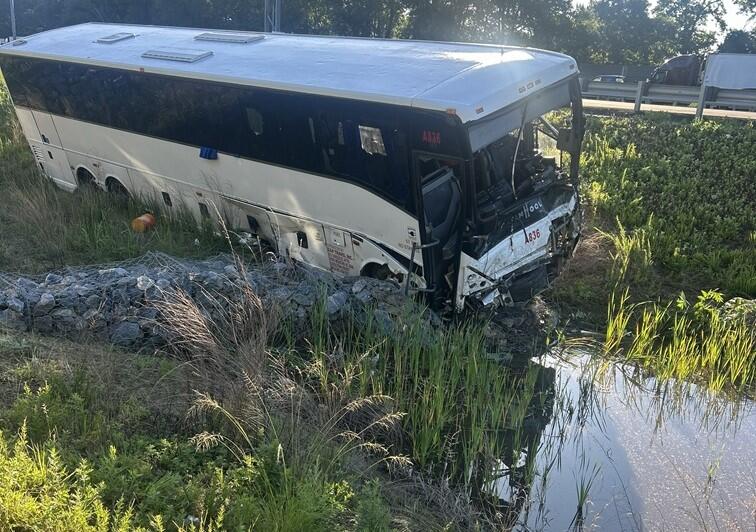
Virginia State Police Virginia State Police The aftermath of a deadly bus crash on I-95 in Virginia’s Stafford County on Friday, May 29, 2026.
Reaction to the deadly crash in Massachusetts
The mayor of Greenfield, Virginia Desorgher, issued a statement on the deaths of four city residents in the crash.
Our entire community is shocked and profoundly heartbroken by the tragic news coming out of Virginia. Early this morning, a horrific crash took the lives of five people, and we have received the painful confirmation that four of those individuals were residents of Greenfield.
To the families, friends, and neighbors of those we lost: there are no words that can fully ease the weight of this sudden and unimaginable grief. Please know that you are not walking through this dark time alone. The Greenfield community stands with you, mourning alongside you, and we extend our absolute deepest condolences and prayers.
We are also holding the dozens of others who were injured in this crash in our thoughts, wishing them a full and swift recovery.
The City of Greenfield is fully committed to supporting those affected by this horrible loss. In the coming days and weeks, we will work to ensure that the grieving families have access to the resources, care, and comfort they need. I ask all Greenfield residents to wrap your arms around our neighbors with the compassion, kindness, and unity that defines our community.”
Update on investigation in Virginia
State police identified the bus driver as Jing S. Dong, 48, of Staten Island, New York. Charges are pending, authorities said.
Mary Washington Healthcare said it received 19 patients from the crash. It posted online that seven of the patients were taken to its trauma center in Fredericksburg, where four were being discharged and three remained in treatment — one in serious condition and two in critical condition. Twelve were taken to its hospital in Stafford, where they were later discharged in good condition.
The National Transportation Safety Board posted online that it was sending a “go-team” to conduct a safety investigation into the crash and that it would have a spokesperson at the scene.
The southbound lanes had reopened by noon, but traffic was still backed up for a couple of miles, according to a state transportation advisory.
Bus company had satisfactory record
The bus was operated by E&P Travel Inc., based in Kings Mountain, North Carolina. A compliance snapshot from the Federal Motor Carrier Safety Administration showed only one injury accident involving the company’s vehicles in the previous two years and listed its safety rating as “satisfactory.”
The company was incorporated Nov. 24, 2023, by Shuo Liu, according to records from the North Carolina Secretary of State’s office. Liu is also listed as the registered agent. The FMCSA site said the company operated four vehicles and had 11 drivers.
While it is too soon to say what caused Friday’s crash, federal authorities have been grappling with interstate passenger bus safety issues for decades.
Following a series of passenger bus crashes in 2008 that killed 41 people, the U.S. Department of Transportation published a Motorcoach Safety Action Plan.
The NTSB investigated 16 fatal motorcoach crashes between June 1998 and January 2008, finding that driver-related problems such as fatigue, medical condition and inattention accounted for 56 percent of the accidents. The agency said driver-related problems were responsible for 60 percent of the fatalities in those crashes.
Among the actions recommended were creation of a pre-employment driver history screening program and a national drug- and alcohol-testing database “to enable motorcoach operators to determine if drivers have a history of violating DOT alcohol or drug rules.”
-

 Indianapolis, IN5 minutes ago
Pleasant stretch continues with dry days into midweek | May 30, 2026
-

 Pittsburg, PA8 minutes ago
I Need a Pridefest Buddy – Pittsburgh Lesbian Correspondents
-

 Augusta, GA13 minutes ago
Documentary premiere sheds light on Augusta homelessness, poverty
-

 Washington, D.C20 minutes ago
How the Supreme Court is reshaping the US midterm elections
-

 Cleveland, OH23 minutes ago
1 dead, 1 in critical condition after Cleveland shooting: EMS
-

 Austin, TX28 minutes ago
Texas Baseball Proved It’s a Legit Contender In The Race To Omaha Against Tarleton State
-

 Alabama35 minutes ago
Tennessee football will be chasing different teams for SEC supremacy | Adams
-

 Alaska38 minutes ago
Reporting From Alaska- Elstun W. Lauesen II

