Maine
These Maine students are sinking to the bottom

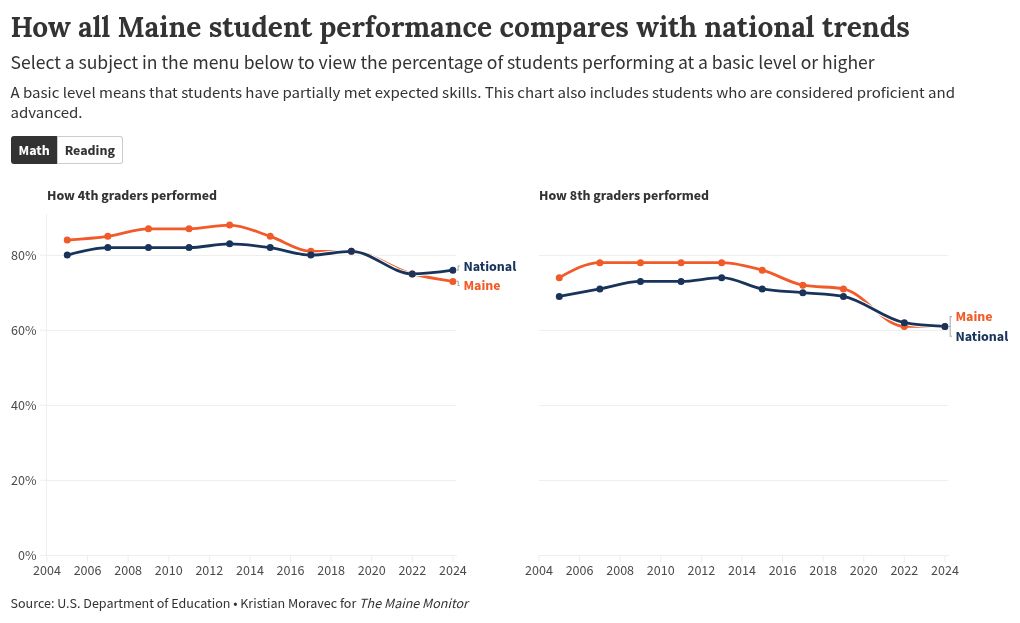
Maine, once a national competitor in student achievement, now sits at or below the national average for standardized test performance.
While scores nationwide have dropped since the COVID-19 pandemic, Maine student performance has been sliding for more than a decade.
And a Maine Monitor analysis of 20 years of student test scores on the National Assessment of Educational Progress, or NAEP, showed that some students are sinking to the bottom faster than others. Low-income students and children with disabilities saw peak test scores on the NAEP starting around 2007. Then these students started to see huge losses.
Between 2007 and 2024, the portion of all Maine students reaching at least a partial, basic level of understanding of reading and math fell more than 14 percent.
But the percentage of students with disabilities reaching the same, bare-minimum performance level or higher fell more than 32 percent — in some subjects more than 40 percent. The group of low-income students meeting that level, meanwhile, fell more than 23 percent.
The percentage of Maine test takers performing at a basic level or more is lower than the national average. (The NAEP results are only presented as percentages, not total numbers, and the exact loss in performance depends on the subject and grade level.)
The Maine Monitor ran the data by two education researchers to confirm that children with disabilities and from low-income households were sliding significantly.
Students with disabilities have plans that provide accommodations for learning; they may have autism, dyslexia and more.
Economically disadvantaged students include children who come from low-income households, are homeless, or may qualify for programs such as free and reduced lunch.
Other groups of students have been struggling as well. Black students saw significant losses in test scores, as did English language learning students, though data collection for both of these groups has been inconsistent over the years given their small numbers.
On the NAEP test, students can score at four levels. If they meet the basic level, it means they showed some, but not a complete, understanding of the fundamental things kids usually know at their grade level.
For instance, in reading, fourth graders meet the basic level if they can at least make simple inferences from text, and eighth graders meet it if they can answer specific questions about the text.
At the proficient level, or the level that the National Assessment Governing Board describes as the goal for all student performance, children show a solid understanding of challenging math and reading skills. The percentage of students performing at the proficient level in Maine started to decline between 2013 and 2017 across grade levels and subjects.
Advanced-level students, meanwhile, have mastered math and reading skills. As a whole, between 2 and 10 percent of Maine students perform at an advanced level across grade levels and subjects. This range for the top tier of performance has stayed fairly consistent over time.
Students fall into a fourth category of performance, called “below basic,” when they cannot demonstrate even fundamental knowledge in reading or math.
The Monitor analysis showed that the percentage of students performing at this lowest level has grown since 2007. For instance, about 59 percent of fourth graders with disabilities tested below the basic level on reading in 2007. By 2024, about 78 percent of these students did.
In the same subject in 2007, 41 percent of low-income fourth graders tested at the below basic level. In 2024, 59 percent of these students did.
This story was originally published by The Maine Monitor, a nonprofit civic news organization. To get regular coverage from The Monitor, sign up for a free Monitor newsletter here.




PORTLAND (WGME) — Wednesday afternoon, Tassel Top Park officials posted on social media, reporting the beach was temporarily closed to swimming after routine testing found elevated levels of E. coli in the water.
Anna Goodnik, a visitor at the park, says she was disappointed to learn she could not swim.
“It’s a beautiful lake. I feel so sorry, it’s too bad this happened,” Goodnik said.
She says she drove from Portland to visit the park.
“Very sad because I came from Portland, I drove 40 minutes,” Goodnik said.
Goodnik says she has been coming to Tassel Top Park for 15 years and that while the park remained open, she was hoping to get in the water.
“The water is so smooth right now, I would just like to swim in it,” Goodnik said.
Raymond Town Manager Glenn Michalowski said in a statement that the Portland Water District provides weekly test results for 18 locations around Sebago Lake. Tassel Top Beach was closed for swimming because E. coli levels exceeded state water quality standards.
Michalowski said testing indicated the presence of waterfowl in the area, which can contribute to elevated bacterial levels. The statement also noted that high E. coli counts after rain events and in areas with waterfowl activity are a normal occurrence across Maine beaches and recreational water areas.
Ben Peierls, research director at the Lakes Environmental Association, says warmer water can lead to more bacterial growth.
“When water gets warmer, there’s more growth of bacteria,” Peierls said.
Peierls says E. coli can come from animals such as birds, dogs and other wildlife, or from human waste. He says this time of year can bring rain and runoff that carries contaminants into lakes.
“This time of year, there’s lot of rain and runoff materials coming into lakes, and it’s coming from sources where there may have been that fecal material, and it gets washed into lakes and it shows up in places people could be recreating,” Peierls said.
Tassel Top is not the only location reporting elevated bacteria levels. Ferry Beach in Scarborough and East End Beach in Portland also reported results above Maine’s safety threshold for enterococci in marine waters.
Town officials say Tassel Top Beach will reopen once retesting confirms the water has returned to safe levels, and residents will be notified when the closure is lifted. Swimming can resume once weekly testing confirms water quality is back within safe limits.
To check the status of all beaches in the state, click here.

HARPSWELL (WGME) — The Maine State Fire Marshal’s Office says a person was hospitalized after a shed fire Wednesday night.
Firefighters were called to 23 Smokehouse Road in Harpswell for a shed fire around 7 p.m.
Crews quickly put out the fire and kept it from spreading into the woods.
An unhoused person who had been living in the shed suffered burns and smoke inhalation.
They were taken to Maine Medical Center for treatment.
Investigators believe the fire may have been electrical in nature.
BE THE FIRST TO COMMENT
The fire remains under investigation.

Three tornadoes have been confirmed across New England so far in 2026, and remarkably, all of them have occurred in Vermont.
Two of those tornadoes touched down during severe thunderstorms on June 18, when a potent weather system swept across the region.
Vermont tornadoes in 2026 (WGME).
The National Weather Service confirmed an EF-1 tornado in Lincoln with peak winds of 105 mph and another EF-1 tornado in Woodstock with winds reaching 100 mph.
Earlier this spring, an EF-1 tornado struck Williamstown on April 16 with estimated winds of 90 mph.
This week’s Climate Chronicles question comes from Kate:
With severe weather last week, how often do we actually see tornadoes touch down in Maine?
Maine tornado activity (WGME).
Historically, Maine averages about two tornadoes each year, with most occurring between June and August.
Most storms develop during the late afternoon and early evening, typically between 3 and 9 p.m., when hours of sunshine have heated the ground and created the instability needed for thunderstorms to form.
The last confirmed tornado to touch down in Maine was in 2023.
Average amount of tornadoes that touch down in each New England state per year (WGME).
Massachusetts and Connecticut also average about two tornadoes per year, with many occurring across the flatter terrain of western portions of both states.
In Massachusetts, the broad Connecticut River Valley stretching through Springfield has earned the nickname “New England’s Tornado Alley” due to its history of tornado activity.
Vermont, on the other hand, typically averages just one tornado annually. With three confirmed tornadoes already in 2026, the state has already exceeded its yearly average by two, making this an unusually active year for tornadoes in the Green Mountain State.
Maine’s tornado history (GoSanAngelo, WGME).
Since 1950, Maine has recorded 140 tornadoes. None have been rated stronger than an EF2 on the Enhanced Fujita Scale, the system used to classify tornado intensity based on the damage they cause.
Unlike hurricanes, tornadoes are not assigned ratings while they are occurring. Instead, National Weather Service survey teams assess damage after the storm has passed, examining impacts to homes, buildings, trees, and other structures.
From that damage, meteorologists estimate the tornado’s wind speeds and assign an EF rating ranging from EF0 to EF5.
While Maine has experienced its share of tornadoes over the decades, the state has never recorded a violent EF4 or EF5 tornado.
Do you have any weather questions? Email our Weather Authority team at weather@wgme.com. We’d love to hear from you!
-

 Los Angeles, Ca50 minutes ago
Woman ambushed, violently attacked by robber in downtown Long Beach
-

 Detroit, MI1 hour ago
Where to watch Houston Astros vs Detroit Tigers: TV channel, start time, streaming for June 26
-
San Francisco, CA1 hour ago
I own a Turkish Restaurant in San Francisco. Turkey’s World Cup match here has changed my business.
-

 Dallas, TX1 hour ago
Australia advances at World Cup, how to buy Australia soccer tickets
-

 Miami, FL1 hour ago
2 detained after police pursuit ends with bailout, neighborhood search in NW Miami-Dade – WSVN 7News | Miami News, Weather, Sports | Fort Lauderdale
-

 Boston, MA2 hours ago
Delta flight returns to Logan after smoke scare in cockpit – Boston News, Weather, Sports | WHDH 7News
-

 Denver, CO2 hours ago
Pat Surtain II Gets More Bad News Amid Broncos’ Uncertainty
-

 Seattle, WA2 hours ago
The World Cup 2026 Pride Match between Egypt and Iran that Seattle hopes can ‘unite football community’


