Maine
Maine snowbirds may want this new Florida bird identification book


I don’t usually review books, but this is a rare exception.
I was asked to review a recently published guidebook, Kristen Hine’s “Birds of Florida.” It’s part of the Helm Wildlife Guides series, offered by Bloomsbury Publishing.
Frankly, I’ve never heard of Hine, Helm or Bloomsbury.
But I’ve heard of Florida. And birds. This could be fun, I thought. Writing a bird guide is a uniquely difficult challenge. I should know. I wrote one.
Most books are species identification guides, covering a broad geographic area. Nearly everyone who enjoys birding has a comprehensive guide to the birds of North America on the bookshelf — or one each for eastern and western species.
In 2000, David Sibley published one of the most famous — “The Sibley Guide to Birds.” It’s a large, heavy reference book, too big to fit in a pocket, or even a backpack. Because of that, the book was republished as two books for portability: “Sibley Birds East” and “Sibley Birds West.”
Naturally, as a bird nerd, I own all three. I also bought the Sibley app for my smartphone.
Other books are location guides. These explain where to look for birds, rather than how to identify them. They are typically limited to small geographic areas. On a trip to Tucson last May, I relied on my “Birds of Southeastern Arizona” guidebook. It had been sitting on my bookshelf since I bought it in 2010.
There are several good location guidebooks for Maine. The newest book came out last year: “Field Guide to Birds of Maine,” written by Nick Lund. The second edition of “Birdwatching in Maine: The Complete Site Guide,” edited by Derek Lovitch, was published earlier this year.
My own book, “Maine Birding Trail: The Official Guide to More Than 260 Accessible Sites,” debuted in 2009.
Here’s my personal experience: is there anything worse than pouring your heart into writing a bird guide, then watching it go slowly out-of-date? Much has changed In just 15 years. Boreal chickadees could be found along the Maine coast as far south as Vinalhaven when my book came out. Since that time, they’ve vanished all the way to the Canadian border.
Bank swallows have nearly disappeared from Maine altogether. Cliff swallows are likely right behind them. Even barn swallows are declining precipitously.
Meanwhile, southern birds continue to push north as the climate warms. Red-bellied woodpeckers and Carolina wrens are routinely surprising birders north of Bangor. The tufted titmouse was a southern Maine bird when I wrote the book. Now it nests in my yard.
So, could this “Birds of Florida” guide pull off the difficult feat? In just 224 pages, could it help the reader both identify and locate Florida birds? I’ve been birding in most of Florida. I’ve seen all of Florida’s nesting species. I figure I’m qualified to judge.
I think the guide works, for a couple of easily overlooked reasons. Foremost, it emphasizes habitat. The best way to find birds is to know where to look. Birds are picky about habitat. Each species has a preference. Before the book mentions a single bird or site, it describes the 10 major habitat groups in the state. Next, it goes on to describe the top 17 birding sites aligned with those habitats.
When the book finally starts describing each species, it takes only one paragraph to describe where to look.
Secondly, the book is concise. It covers the basics of identifying each bird, while resisting the temptation to over-describe it. An identification-based guidebook points out all the basic field marks, as well as plumage variations that occur with age and season.
Such detailed complexity is beyond the scope of this book. It seeks to be a handy pocket guide to the birds most likely to be encountered in Florida.
Likewise, the book does not waste pages on rarities. It describes a few Caribbean birds that regularly stray into Florida, and that’s all that’s necessary. It also doesn’t squander pages on rare migrants passing through to the tropics.
In short, it’s the kind of guide that a Mainer might find useful during a Florida vacation this winter. Snowbirds might keep a copy in the RV.
Experienced birders may miss having identification details for immature offseason birds. They may want more specific information on where to find particularly difficult species or rare wanderers. But there are other resources for that.
When I seek a bird I’ve never seen before, I lean heavily on eBird. I confess that’s how I got my last Florida lifer — a bird I had seen and identified for the first time in my life.



A Massachusetts photographer was seriously injured when he was stabbed during a wedding reception last month in Raymond, Maine.
Donald Halsing, 26, was hospitalized for five days after the stabbing on May 23. NBC affiliate News Center Maine reported that 26-year-old Andrew Manderson was arrested and charged with elevated aggravated assault.
Still recovering, Halsing told NBC10 Boston the attack came out of nowhere — one moment, he was snapping photos on the dance floor, while the next, he was searching for help as blood spilled onto his camera.
“I was sitting there in that chair thinking, ‘There’s a real possibility I could die here,’” Halsing said. “Immediately, I put my hand on my chest here to try and stop the bleeding, get some pressure on it, and started yelling for help.”
Halsing was working at the reception at the Kingsley Pine Campgrounds. He took his last photo at 9:01 p.m., minutes before the stabbing.
“One of the wedding guests came up to me and started asking questions about our business,” he said.
Halsing said it was nothing out of the ordinary, and he tried to explain his photography business to the inquiring guest through the pulse of the DJ booth and celebrating guests.
“I thought he was going to reach in his back pocket for his phone, and instead, he didn’t pull out his phone — he pulled out a pocket knife and stabbed me,” he said.
Manderson, who faced a judge days later, is a cousin of the bride.
“There was this look in his eyes that he wasn’t quite all there,” Halsing said.
Halsing’s fiancée, Ashley Wall, was feet away as he struggled to stay awake. She has been his photography partner for eight years since they met at Framingham State University, and she was helping him work the wedding.
“People who were around me, they asked, ‘What can we do to help you? What do you need?’ And I said, ‘Please go check on Ashley. Please go check on my fiancée,’” he recalled.
Halsing spent five days in the hospital suffering from two lacerations to his liver, ultimately developing a blood clot in his left leg. But the road to recovery exceeds his physical wounds as he contemplates his mental state when he resumes photography next year.
“I’m also worried about what lingering effects there might be,” he said. “If we get out on the dance floor and I start remembering what happened, I don’t know how I’m going to react.”
Halsing still doesn’t know why he was attacked.
Manderson was released on $50,000 bail and is due back in court in October.
When BDN shines a light, policymakers act. Make a gift to help our reporters keep Maine’s leaders informed. Make a donation now.
This story will be updated.
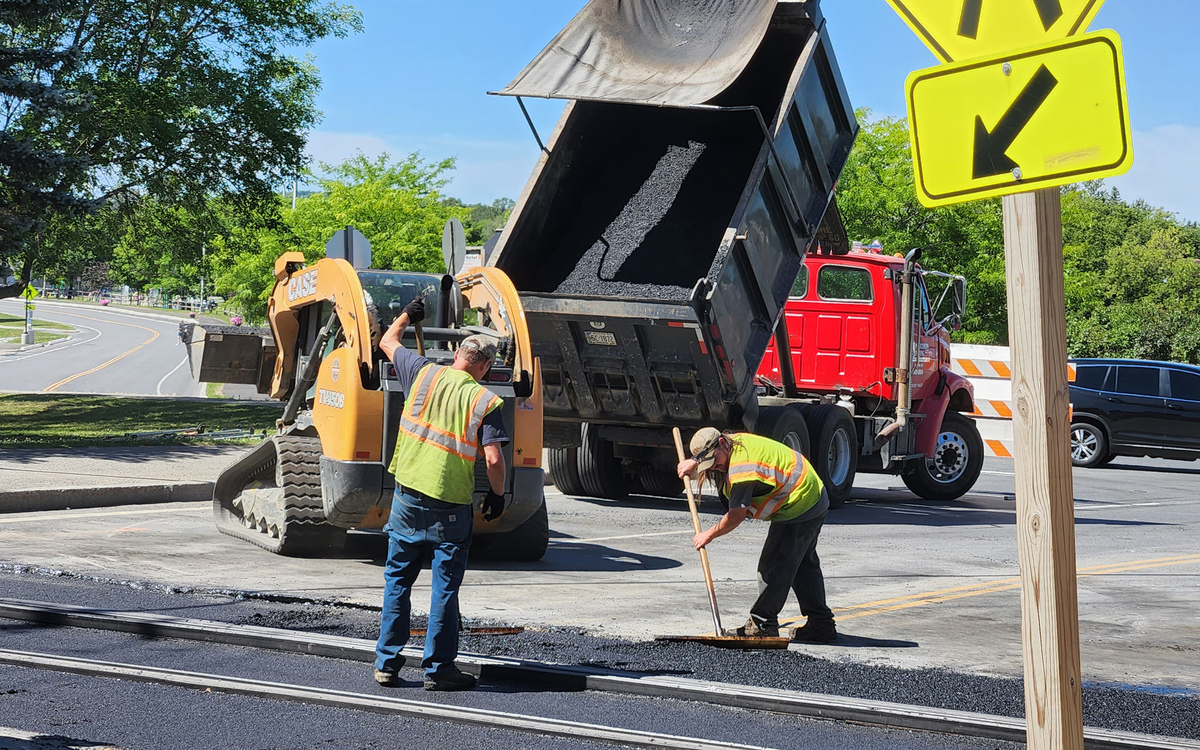
The Maine Department of Transportation is moving to slash up to $400 million in projects from its agenda, a shocking and abrupt cutback that is rattling the state’s construction industry at the start of building season.
Roughly $50 million across six pavement projects have already been delayed, according to a memo exclusively obtained by the Bangor Daily News. The agency plans to cut or delay another $150 million in bridge, highway, intersection and multimodal projects later this month. A further $200 million or more in cuts are planned in the next three-year work plan.
Those figures were outlined by Transportation Commissioner Dale Doughty in the May 18 memo to Gov. Janet Mills that has since circulated widely in the transportation sector, which has been getting drip-by-drip details on the wide scope of the cuts over the past three weeks.
It comes at the beginning of the state’s relatively narrow construction season. Companies have hired workers and ordered materials for projects they expected to begin this summer. The severity of the transportation budget problems was not raised to lawmakers during the 2026 legislative session.
Kelly Flagg, executive director of the Associated General Contractors of Maine, called the shortfall “deeply troubling” in a statement.
“We stand ready to work with policymakers, stakeholders, and industry partners to identify both immediate and long-term solutions,” Flagg said. “Maine cannot afford to fall further behind.”

Insiders saw this first.
This story was broken in Maine Politics Insider, the BDN’s daily premium newsletter for the most ardent political news followers. If you are a new BDN subscriber, you can sign up here. Current subscribers can contact our customer service team to upgrade.
The cuts stem from a structural funding gap of at least $130 million in the state’s current work plan, according to Doughty’s memo. Losses are magnified because state money from the gas tax and other revenue sources is matched by federal funds. Lawmakers have long grappled with politically difficult long-term problems with the state’s transportation budget.
A Mills spokesperson said Wednesday morning that the administration was working on a response to questions from the BDN. The department says it needs roughly $240 million more in state capital funding annually to maintain the existing system, and that anything less than $200 million will erode it over time.
Doughty’s memo the only near-term solution is a series of bonds beginning as soon as possible. Lawmakers would have to return to Augusta to authorize that if one is going to appear on the November ballot.

The BDN Opinion section operates independently and does not set news policies or contribute to reporting or editing articles elsewhere in the newspaper or on bangordailynews.com
Michael Capeci is the former chairman of the Bangor GOP.
Let’s be honest about Maine’s current state.
For many families, the cost of living has become unsustainable. Housing is out of reach for many young people. Energy bills keep rising. Many small businesses are struggling under taxes and regulations that make it harder to grow. Rural hospitals are under strain and despite years of increased state spending, the results are not showing up in people’s daily lives.
Concurrently, Maine continues to lose young workers to other states. That is not a statistic, it is a warning sign.
To me, the question in this Republican primary for governor is not about slogans. It is whether we continue with a political approach that has failed to reverse these trends, or whether we nominate someone with new ideas. I think that someone is Owen McCarthy.
Owen is not a political insider. He is an entrepreneur from Patten, a small town where opportunity is not assumed, it is built. He grew up in a working-class family, became the first in his family to graduate from college graduating from the University of Maine, and founded MedRhythms, a healthcare technology company focused on neurological treatment.
He didn’t just talk about opportunity. He built it. That distinction matters, because Maine’s problem is not a lack of debate it is a lack of results. We have seen the trajectory: higher costs, slower growth, and a steady outmigration of young workers. I believe Owen McCarthy represents a break from that pattern.
His Maine 2040 plan focuses on creating 50,000 new jobs in sectors where Maine has real advantages — maritime and defense, advanced forest products, and life sciences. These are export-driven industries tied directly to Maine’s workforce, geography, and institutions. What sets Owen apart is not only what he proposes, but how he approaches governing.
He prioritizes modernizing permitting so projects do not stall. He supports using technology to reduce costs and increase efficiency. He focuses on making it easier to build, hire, and expand in Maine.
That same practical mindset extends to healthcare. Expanding telehealth, strengthening EMS systems, improving provider flexibility, and shifting toward earlier intervention are not abstract reforms. They are system upgrades designed to improve access while controlling costs.
Maine voters consistently respond to competence. They reward candidates who understand problems and present plans to solve them. I believe they are tired of rhetoric that does not translate into results, and skeptical of politics that prioritizes messaging over execution.
Owen’s approach is grounded in solving the issues that shape daily life — affordability, healthcare access, job creation, and government efficiency. That is not just policy positioning. It is a governing model that speaks directly to voters.
Some will point to his lack of political experience. But I believe Maine’s core problems are not the result of insufficient political experience; they are the result of policies that have failed to deliver measurable improvement. Experience inside a broken system, by itself, is not a solution.
If Republicans want to win, this primary must be taken seriously. From my perspective, it is not about choosing a nominee for governor who can energize the base. It is about selecting someone who can compete in a broader electorate that is frustrated and looking for change.
That requires a candidate who can speak beyond the base, not by abandoning principles, but by demonstrating competence and a credible plan to address Maine’s challenges. I believe Owen McCarthy offers that combination. He represents a shift away from managed decline and toward economic execution.
This is not just another primary. It is a decision about whether Republicans position themselves to win Maine or whether they remain trapped in a cycle of repeating the same strategies and expecting different outcomes.
If Republicans want to compete for Maine’s future, they cannot afford to nominate a candidate who only motivates part of the electorate. They need someone who expands it.
I believe Owen McCarthy is that candidate.
And if the goal is to win Maine, then the choice should be unmistakable
-
 Michigan5 minutes ago
2 historic Michigan lighthouses to split $120K in preservation grants
-

 Massachusetts12 minutes ago
Karen Read files lawsuit against Massachusetts State Police and Canton Police
-

 Minnesota15 minutes ago
School bus company’s inspection history in question after kids hurt in Hamline University crash
-

 Mississippi20 minutes ago
Ferris, West to discuss Mississippi folk artists at UM Museum – The Oxford Eagle
-

 Missouri27 minutes ago
American Shaman agrees to suspend kratom sales in Missouri
-

 Montana30 minutes ago
Montana Supreme Court Decides International Child Custody Case – Transnational Litigation Blog
-

 Nebraska35 minutes ago
Big Ten coaches give strange quotes about Nebraska football
-

 Nevada42 minutes ago
Nevada wins preliminary injunction to block Polymarket

