Northeast
Eric Adams defense hinges on Supreme Court ruling in heartland trucking case

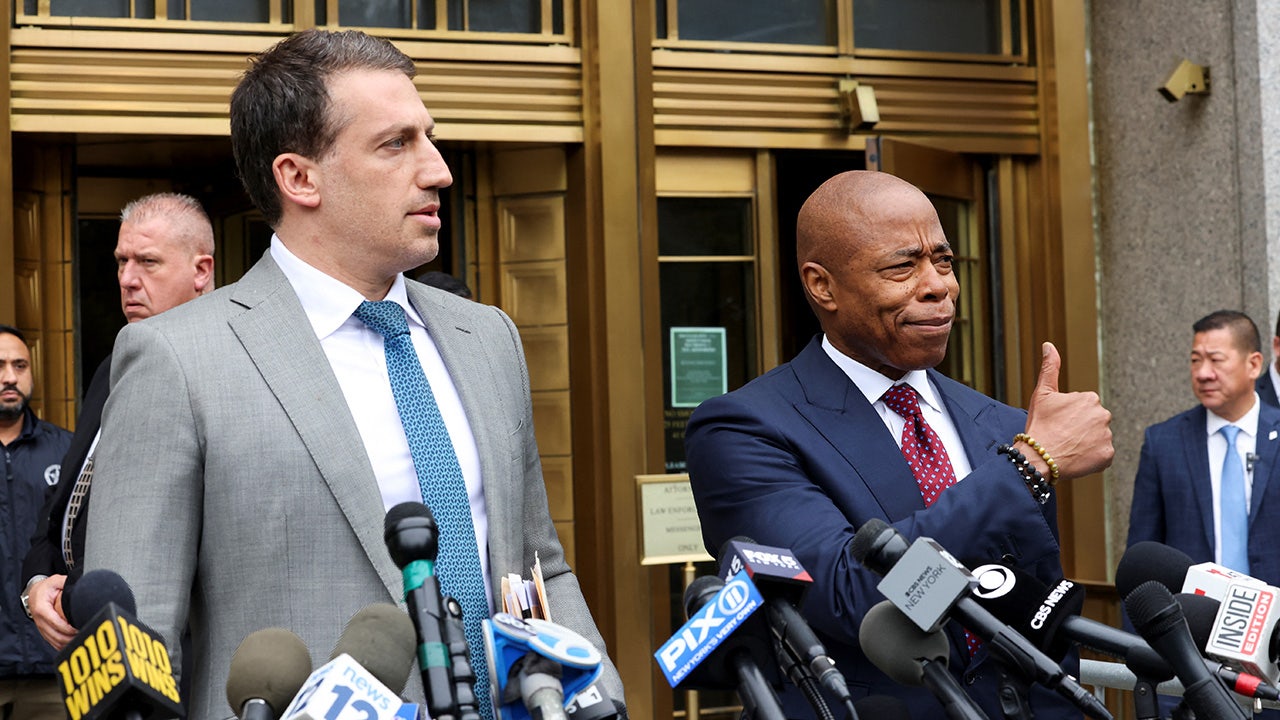
Months after the Supreme Court sided with an Indiana mayor who took payment from a Peterbilt dealer in a small-town bribery case, New York City Mayor Eric Adams is relying on the precedent as he revs up the fight against his own federal corruption charges.
But some experts say the effort may run out of gas before it picks up speed.
Federal prosecutors rely on a law known as Section 666 to take down corrupt officials who accept bribes, but they have also been accused of trying to blur the definition of a bribe. They also have to prove an “official act” took place in exchange for whatever the allegedly corrupt politician was raking in.
NYC MAYOR ERIC ADAMS PLEDGES TO ‘REIGN’ NOT RESIGN
Mayor Eric Adams, right, is shown beside his lawyer, Alex Spiro, on the day of his arraignment outside federal court in New York City on Sept. 27, 2024. (REUTERS/Caitlin Ochs)
In 2016, the Justice Department filed corruption charges against James Snyder, former Republican mayor of Portage, Indiana, under the Section 666 rule.
He oversaw a $1.1 million deal to buy garbage trucks for the city from Great Lakes Peterbilt in 2013, according to court filings. In 2014, he received a $13,000 check from the dealership.
The FBI and federal prosecutors accused him of taking the money as a kickback for the truck sales. Snyder said it was payment for consulting services in a state where public officials are allowed to have outside employment.
Former Portage Mayor James Snyder and his family arrive at federal court in Hammond for his sentencing on Oct. 13, 2021. He later succeeded in his appeal to the Supreme Court. (Kyle Telechan/Post-Tribune/Tribune News Service via Getty Images)
He was convicted at trial, but his legal saga continued for years. After successfully seeking a retrial, he wound up convicted again and then lost his first appeal.
But in a 6-3 opinion written by Justice Brett Kavanaugh, the Supreme Court ruled in his favor, explaining that anti-bribery laws don’t make all payments illegal, especially if they come after the fact without any evidence of a corrupt agreement.
Read Eric Adams’ latest court filing:
FEDS SEIZE ERIC ADAMS’ PHONE AFTER NYC MAYOR’S INDICTMENT
Snyder accepted a “gratuity,” not a bribe, the court found.
The court described gratuities as two forms of payment, neither of which met the definition of a bribe. The first is something given as a “thanks,” anything from a fancy lunch to a framed photograph. The second are gifts designed to “curry favor” but not in exchange for anything specific.
In a dissent by Justice Ketanji Brown Jackson, the court’s liberal wing countered that there was still evidence of corruption that would have made Snyder’s payment unlawful. Kavanaugh wrote that the gratuities were not a federal crime but could still violate state and local ethics rules. Snyder was not accused of any crimes at the state level.
ADAMS’ OFFICE LASHES OUT AT FBI EMPLOYEE WHO MIGHT HAVE ‘IMPROPERLY LEAKED DETAILS’ OF CORRUPTION PROBE
New York City Mayor Eric Adams arrives at federal court for his arraignment in Lower Manhattan on Sept. 27, 2024. Adams faces five federal charges, including alleged conspiracy, wire fraud, two counts of solicitation of a contribution by a foreign national and bribery. (Rashid Umar Abbasi for Fox News Digital)
Kavanaugh also warned that if a federal law did crack down on gratuities, it could unlawfully infringe on states’ right to regulate interactions between their own officials and constituents.
Adams’ lawyers are arguing that the mayor never accepted any bribes and never took any actions in his official capacity to make good on a quid quo pro.
Anthony Capozzolo, a former federal prosecutor who handled public corruption cases in a neighboring district, said prosecutors clearly spelled out the alleged quid quo pro in Adams’ indictment but that the mayor could have a better chance proving he made no “official act.”
“This issue about him not being the mayor at the time, and what is the official act? That may get more scrutiny from the court,” Capozzolo told Fox News Digital.
Adams’ lawyer, Alex Spiro, wrote in the motion Monday that prosecutors failed to lay out an actual bribery case.
Mayor Eric Adams sits in federal court beside his lawyer, Alex Spiro, during his arraignment in New York City on Sept. 27, 2024. (REUTERS/Jane Rosenberg)
“The indictment in this case alleges a ‘bribery’ scheme that does not meet the definition of bribery and indeed does not amount to a federal crime at all,” Spiro wrote in a court filing revealed Monday.
“It appears that after years of casting about for something, anything, to support a federal charge against New York City Mayor Eric Adams, prosecutors had settled on a theory that depended on the Department’s longstanding view that Section 666 criminalizes gratuities, including gifts meant to curry favor with governmental officials but not linked to any specific question or matter,” Spiro wrote. “When the Supreme Court rejected that interpretation in June, prosecutors simply added a few vague allegations and called their theory bribery — ‘a far more serious offense than gratuities.’”
Adams’ defense argued that the Justice Department’s case “doesn’t work.”
“The indictment does not allege that Mayor Adams agreed to perform any official act at the time that he received a benefit. Rather, it alleges only that while serving as Brooklyn Borough President—not Mayor, or even Mayor-elect—he agreed generally to assist with the ‘operation’ or ‘regulation’ of a Turkish Consulate building in Manhattan, where he had no authority whatsoever, in exchange for travel benefits,” Spiro wrote.
U.S. Attorney for the Southern District of New York Damian Williams (U.S. Attorney for the Southern District of New York)
At issue are three text messages that prosecutors say Adams, during a past term as Brooklyn’s borough president, sent to the former FDNY commissioner, Daniel Nigro. But there is additional context and conversations surrounding the texts that may convince the court they are less innocent than they sound when read alone, Capozzolo said.
Eric Adams texts to FDNY commissioner:
- “They said they needed a letter of Defect from FDNY to DOB (Department of Buildings). They know they have some issues but according to them with the letter the DOB wi[ll] give the TCO (temporary certificate of occupancy).”
- “They really need someone . . . by today if possible. If it is [im]possible please let me know and I will manage their expectation.”
- “They said the hire (sic) ups at FDNY did not give the inspector authorization to come. The inspector indicated he needs authority to come to day (sic).”
Spiro asked the court to dismiss the bribery charge due to the Snyder precedent and argued that the rest of the charges should get tossed because they were allegedly based on “a host of false claims evidently attributable to a self-interested staffer with an axe to grind.”
NYC MAYOR ERIC ADAMS’ ELECTRONIC DEVICES SEIZED BY FBI AMID CAMPAIGN INVESTIGATION
But Capozzolo pointed to page 33 of the indictment, where prosecutors spelled out an alleged series of phone calls between Adams, a staffer and a Turkish official, in which the official told Adams it was “his turn” to repay a favor and the mayor allegedly replied, “I know.”
“That’s about as quid pro quo as you’re going to get,” Capozzolo said.
Read the Eric Adams indictment:
On the other hand, the government may have an uphill battle proving Adams actually returned the Turks a favor with an official act.
“Adams may have a chance of getting the charge dismissed as a result,” Neama Rahmani, another former federal prosecutor, told Fox News Digital.
He said the Snyder decision “significantly” weakened the federal bribery law and noted that it’s not uncommon to see convictions under the statute get overturned on appeal.
“The Supreme Court has also required an official act for a bribery conviction,” he said. “Adams was a candidate for mayor, but he was the Brooklyn borough president at the time, which means he didn’t have official authority over a building in Manhattan. The defense is using that important fact to argue that there could be no official act for the purpose of the bribery statute.”
New York City Mayor Eric Adams (Michael M. Santiago/Getty Images)
Before the Justice Department announced Adams’ indictment last week, the mayor accused federal investigators of retaliation over his criticism of President Biden and Vice President Harris for their handling of the southern border, which he said led to a migrant crisis in New York City that overloaded its shelter system. The influx of illegal immigrants coincided with a spike in robberies in the Big Apple, city police said earlier this year.
Still, the federal investigation has ensnared numerous people in the mayor’s orbit, including campaign staffers, city officials and even his former police commissioner, in an alleged corruption ring of such a scale that Capozzolo said it’s a throwback to the 1800s-era Tammany Hall and Boss Tweed.
Adams could face up to 45 years in prison if convicted of all charges, which include one count of conspiracy to receive campaign contributions from foreign nationals and commit wire fraud and bribery, one count of wire fraud, two counts of soliciting campaign contributions from foreign nationals, and one count of soliciting and accepting a bribe.
Read the full article from Here



Mother’s Day origins and how we celebrate today. Watch video
As we celebrate moms again this year, here’s a look at how Mother’s Day came to be.
May is almost here, bringing with it warmer weather, bright spring blooms and of course, Mother’s Day, this year falling on Sunday, May 10.
Looking for an activity to celebrate the women in your life outside of the house? Luckily, Connecticut has plenty of fun Mother’s Day events that mom, aunt or grandma would enjoy, all the way from a casual day of shopping at the farmers market to an elgant brunch inside a castle.
Here are eight of Connecticut’s best Mother’s Day activities to check out with mom this year.
Cruise the Connecticut River
For moms who would love a day on the water, the Connecticut River Museum hosts special Mother’s Day cruises on RiverQuest, a tour boat that explores the river’s ecology and wildlife.
On May 10, RiverQuest will offer hour-long cruises at 10 a.m., noon and 2 p.m. Tickets are $10 for mom and one child, $15 for children under 12 or $20 for other adults.
Visit a vineyard
Does mom love a good glass of wine? Treat her to an afternoon at a vineyard. On Sunday, May 10, Stonington Vineyards will host a Mother’s Day celebration full of wine, sandwiches and sweet treats, shopping from local vendors and live music. Plus, create a custom bouquet with or for mom at the onsite Bloom Bar.
Stonington’s Mother’s Day event is free to attend, with no registration required. The vineyard is located at 523 Taugwonk Road in Stonington.
Go flower picking
If mom is a fan of flowers, take her to Wicked Tulips, a flower farm with the biggest you-pick-tulip event in New England, complete with over 1.5 million blooming tulips of various colors and 75 varieties.
Admission, which includes 10 tulips, costs $5.50 for children, $24.95 for adults on weekdays or $29.95 for adults on weekends. Additional tulips can be purchased for $1.50 per stem. Online tickets for Wicked Tulips must be reserved for a specific date and time, though guests can stay as long as they want after entering. Tickets are also sold at the door, but entry is more expensive and not guaranteed.
Wicked Tulips is open from 10 a.m. to 7 p.m. Monday through Friday or 9 a.m. to 7 p.m. Saturday and Sunday from mid-April through mid-May. Located at 382 Route 164 in Preston.
Eat brunch in a castle
While Mother’s Day brunch is offered at tons of restaurants in Connecticut, one venue in Portland is hosting a special lavish brunch that will make mom feel like a queen. At Saint Clements Castle and Marina, mom can enjoy brunch in a literal castle from the 1800s, complete with lush surrounding grounds and breathtaking waterfront views of the Connecticut River.
The castle’s Mother’s Day brunch includes a gourmet buffet of decadent desserts and chef-inspired dishes, including a personalized omelet station, sliced prime rib and a cheesecake station. Tickets to the brunch cost $70 for adults or $30 for children ages 4-12. Reservations can be made online for 10:30 a.m. or 1 p.m. p.m. on Sunday, May 10.
Attend a craft festival
If mom is the creative type, take her to the New England Spring Craft Festival at Mohegan Sun this Mother’s Day weekend. This unique festival blends creativity with culinary excellence in a showcase featuring over 275 artisans.
Shop for the perfect gift for mom, or let her pick it our herself, from handcrafted jewelry, luxurious spa products or specialty candles, and sample a lineup of food offerings all the way from unique salsas to handmade chocolates.
Online tickets cost $13 for one day or $18 for the whole weekend, and children ages 14 and under enter for free.
The festival will take place from 9 a.m. to 6 p.m. on Saturday, May 9 and 9 a.m. to 5 p.m. on Sunday, May 10. Mohegan Sun Earth Expo & Convention Center is located at 1 Mohegan Sun Blvd. in Uncasville.
Enjoy afternoon tea
Pamper mom with an elegant afternoon tea service aboard the Essex Steam Train. The train’s “Mommy & Me Tea” event takes guests on a scenic 90-minute train ride through the Connecticut River Valley in a restored 1920s era Pullman Dining car. Dress in your Sunday best, listen to comforting classical music and take in the scenery while enjoying an assortment of teas, finger sandwiches and pastries.
Mommy & Me Tea is offered from 11:30 a.m. to 1 p.m. on Saturday, May 9, with tickets starting at $59.99.
Go to the farmers’ market
For the moms who love to shop, head over to Bozrah Farmer’s Market on Saturday, May 9 for a special Mother’s Day Market full of handmade clothing, fresh baked pastries, unique crafts, flowers, plants and plenty of other goods from local vendors. From 11 a.m. to 2 p.m., enjoy a day of shopping, food trucks and live music with mom.
The market will take place at Maples Farm Park, located at 45 Bozrah St. in Bozrah.
Run a 5K
If you and mom are the active type, consider running a race together on Mother’s Day. This year, the annual Bridgeport Hospital Mother’s Day 5K will start at 7:45 a.m. on Sunday, May 10, starting and ending at the hospital’s Milford Campus.
The event not only consists of a 5K, but fitness options for the whole family: a timed 5K run and walk, a 3K walk and a kid’s fun run for ages nine and under. Registration for the races costs $40 for adults or $20 for students ages 10-18, while the kid’s fun run is free to enter. Prizes will be distributed to the top runners, as well as the fastest mother-daughter and mother-son teams.

The BDN Opinion section operates independently and does not set news policies or contribute to reporting or editing articles elsewhere in the newspaper or on bangordailynews.com
Kaitlyn Cunningham Morse is founder of Maine Aging Partners, a Maine-based consulting firm that helps families navigate aging and long-term care decisions.
In the coming election, Maine candidates will talk about housing. They will talk about workforce shortages, affordability, economic development and the future of our state.
What many will not do is confront the force tying those issues together: Maine is aging faster than our systems are adapting.
That omission matters.
Too much of our public conversation around aging still proceeds as though this is a manageable strain on an otherwise functional system — something that can be solved with another grant, another pilot program, another commission, or simply more patience.
But if that approach were working, it would be working by now.
Instead, we continue discussing the downstream effects of aging as if they are separate and unrelated problems.
We debate labor shortages. We debate housing shortages. We debate burnout. We debate economic stagnation.
All while ignoring the quiet reality unfolding behind closed doors across this state.
Somewhere in Maine, an older couple is beginning to struggle. One has fallen twice. The other is forgetting medications. The home that served them for 40 years no longer serves them now. And when no clear path exists — when there is no accessible support, no plan, no obvious next step — that problem does not stay within their household.
It lands downstream.
It lands in front of the daughter leaving work early because her father cannot be left alone. It lands in front of the employer wondering why a once-reliable manager is suddenly distracted. It lands in front of the small business losing a key employee to caregiving demands. It lands in front of the hospital trying to discharge someone with nowhere appropriate to send them. It lands in front of local leaders trying to solve workforce and housing issues while more residents quietly age out of independence.
That is what Maine’s aging crisis actually looks like.
Not simply older adults needing care. But families, employers and communities reorganizing themselves around a system under mounting strain.
Maine has the oldest population in the nation. Yet we still discuss aging as though it is a niche healthcare issue rather than a defining economic fact.
It is not separate from our workforce challenges. It is not separate from our housing crisis. It is not separate from our economic future.
When enough working-age adults reduce hours, leave jobs, delay advancement, or burn out because they are managing family caregiving in a fragmented system, the consequences ripple across the entire state.
This is no longer simply an elder care issue. It is a workforce issue. An economic issue. A housing issue. A civic issue.
And until our leaders begin treating aging as a central challenge shaping Maine’s future — rather than a specialized concern delegated to familiar institutions and stakeholder groups — we will continue mistaking downstream symptoms for unrelated problems.
We cannot build a thriving Maine while ignoring the demographic reality reshaping nearly every major policy debate before us.
The future of this state depends on our willingness to finally say so.

Senate Bill 3028, under consideration by legislators, would ban the sale of dogs and cats at pet stores, closing several family-owned businesses in Massachusetts. Proponents of the legislation say that these small businesses are a necessary sacrifice in the name of finding more homes for shelter animals and combating “puppy mills,” or irresponsible dog breeders.
But as a longtime shelter animal advocate who used to advocate for bills like S. 3028, I’ve learned that these pet-sale bans simply don’t help on either front.
In theory, it might seem logical: Ban pet stores from selling dogs, and people will go to shelters instead. But in reality, that’s not what happens at all.
Families go to pet stores precisely because they are looking for dogs that aren’t at the local shelter. They often have a specific breed of dog in mind. They may need a hypoallergenic dog that doesn’t shed, or a dog with predictable temperament or behavioral traits.
If they can’t get a dog from a local store, then they’ll look elsewhere – typically on the Internet.
Go on TikTok or Craigslist, and you’ll find no shortage of people hawking puppies. Where do these dogs come from? It’s anyone’s guess, but it’s likely that many are sourced from puppy mills.
Which is ironic. Proponents of S. 3028 say banning retail pet sales will fight puppy mills. In reality, it will help puppy mills.
California gives proof to this. A Los Angeles Times investigation following the state’s ban on pet stores selling dogs found that “a network of resellers — including ex-cons and schemers — replaced pet stores as middlemen.”
Nor has California’s ban on retail pet sales reduced animal shelter overcrowding. Shelters in Los Angeles and San Francisco are struggling to deal with crowding in animal shelters more than five years after the ban was passed.
As the former head of the national ASPCA, and a former executive director of the San Francisco SPCA, I always advocate that people adopt from shelters. But I also recognize that people want choices in where to get a dog. We should make sure that these avenues are well-regulated for animal and consumer protection.
And that’s why S. 3028 is counterproductive: It drives dogs and families away from pet stores, which are regulated brick-and-mortar local businesses, and into the black market where there are essentially no regulations to protect people and animals.
If Massachusetts goes down this road, it won’t stop with dogs and cats. Activists will lobby, as they have in Cambridge, for the entire Commonwealth to ban the sale of all pets at pet stores. Fish, hamsters, guinea pigs, you name it.
Where then will people get pets?
Some families will just drive to New Hampshire, as some Bay Staters already do for other goods. But others, particularly less-advantaged people without personal vehicles, will either have to turn to shady online marketplaces or perhaps not get a pet at all.
The human-animal bond is something that all people should be able to experience and cherish. We can make the process of getting a pet both convenient and well-regulated so that animals and consumers are protected. Banning pet sales under S. 3028 would take us backwards.
Ed Sayres is the former CEO of the ASPCA and former president of the San Francisco Society for the Prevention of Cruelty to Animals, whose career in animal welfare spans four decades.
-

 California4 minutes ago
Deadly snake bites are up in California. Here’s what to do if you see one.
-

 Colorado11 minutes ago
How to buy Minnesota Wild vs. Colorado Avalanche 2026 NHL playoff tickets
-

 Connecticut17 minutes ago
Make Mother’s Day memorable with these 8 activities in Connecticut
-

 Delaware23 minutes ago
Gas prices jump nearly 30 cents in single week in Delaware, nationally
-

 Florida29 minutes ago
Lawsuits mounted against Cavo Lounge, which closed at Mercato
-

 Georgia35 minutes ago
Wild video captures elderly driver Jerry Ross, 72, crashing into group of cyclists on Georgia road
-

 Hawaii41 minutes ago
Damage reports continue to grow after Kona low storms
-

 Idaho47 minutes ago
Shed and pickup truck destroyed in Idaho Falls fire – East Idaho News