Connect with us

Northeast

Bragg’s absurd case against Trump finally gets its undeserved day in court

Published

on

Bragg’s absurd case against Trump finally gets its undeserved day in court
NEWYou can now listen to Fox News articles!

Absent an eleventh-hour reprieve from a higher court, Donald Trump will become the first U.S. president to face a criminal trial when it commences on Monday in New York.  

Let the circus begin.  

The ringmaster of the Big Top clown show is Alvin Bragg, the progressive Manhattan district attorney who campaigned — unethically — on the promise to bring down Trump. Once in office, Bragg inflated a time-barred and nominal misdemeanor into a multitude of dubious felonies by mangling evidence and contorting the law.  

TRUMP REQUEST TO DELAY HUSH-MONEY TRIAL DENIED FOR THIRD TIME

Advertisement

With a wave of his showman’s cane, Bragg transformed a singular transaction into 34 separate charges in what’s known as “count stacking” that no good prosecutor would ever do. It’s a transparent window into an otherwise opaque case.  

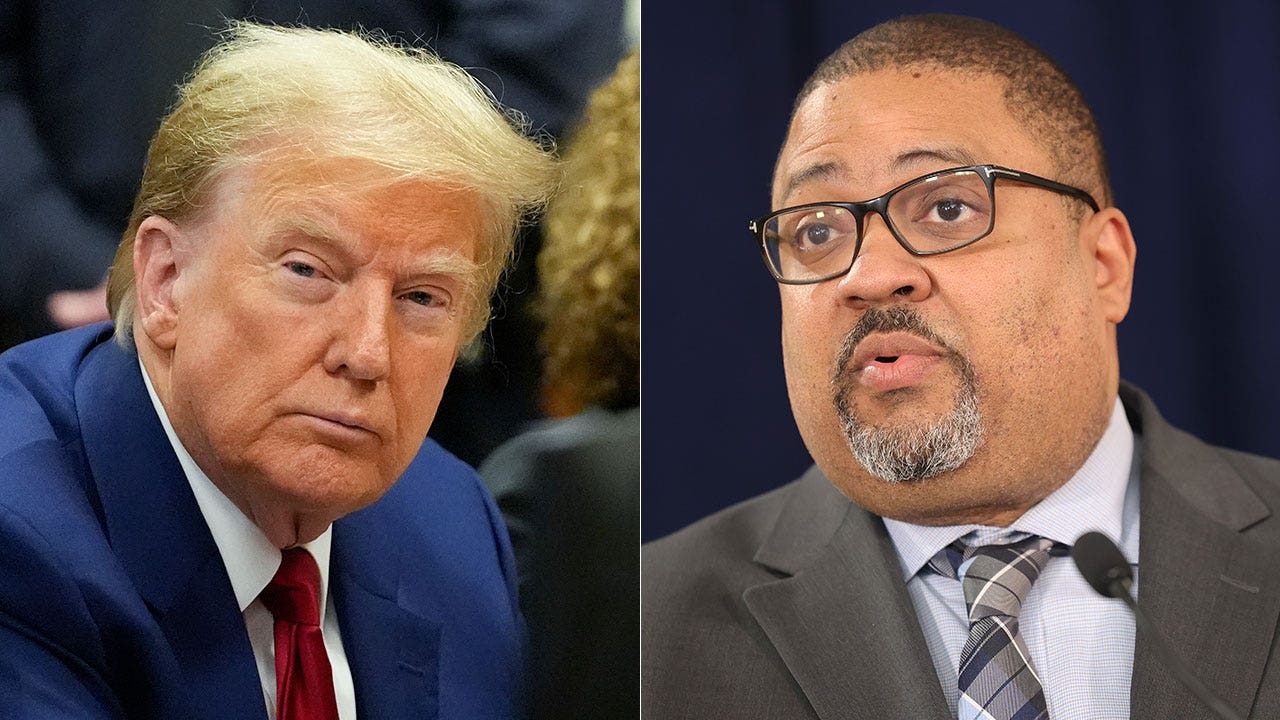
Former President Donald Trump, left, squares off against progressive Manhattan District Attorney Alvin Bragg starting April 15. Photographer: Mary Altaffer/AP/Bloomberg via Getty Images (Getty Images)

The gravamen of the indictment is that in 2016 Trump used his lawyer to pay money to Stephanie Clifford (a.k.a. Stormy Daniels) in exchange for her silence about a purported affair that occurred a decade earlier, that he incorrectly recorded the payments in business records, and that all of it violated election laws, even though it did not.  

Bragg surely knows his case is specious, at best. But it doesn’t matter. He’s counting on the sympathies of a liberal trial judge, Juan Merchan, and the venom of a jury pool destined to be dominated by Trump-hating New Yorkers. The once-respected standard of an “impartial jury” is being treated as a mere inconvenience instead of a constitutional right.  

It is self-evident to many that the charges against the former president would be brought against no one else not named Trump. The fact that he is the leading candidate for president in the upcoming election is the only reason he is being persecuted under the guise of prosecution.  

Advertisement

Even the left-leaning New York Times “could “identify only two other felony cases in Manhattan over the past decade in which defendants were indicted on charges of falsifying business records but no other crime.” This makes the DA’s legal theory not just untested, but absurd. 

It is also an archetype of unequal justice. In the same 2016 election, Hillary Clinton secretly paid for the phony Steele dossier by using a lawyer to funnel the money while misreporting it as “legal expenses.” She was fined by the Federal Election Commission (FEC), but never prosecuted. Trump, however, is a disfavored Republican, so he is treated differently.  

The most curious — and corrupt — aspect of Bragg’s case is that he still has not identified what underlying crime Trump supposedly committed. This, of course, is required under the Sixth Amendment. But no one, least of all Merchan, seems the least bit bothered by it. His honor ruled that Bragg had presented “legally sufficient evidence” to proceed. Okay, but under what law exactly?  

In his malign indictment, the DA vaguely accuses Trump of “violating election laws” without specifying which ones were transgressed. No applicable statutes are set forth. The reason for the masquerade is obvious — in a state case, a local prosecutor has no authority to charge federal crimes allegedly committed during the course of a federal election. Period.  

Stormy Daniels sat down with Piers Morgan for an interview available on Fox Nation (Fox News)

Advertisement

None of that is stopping Bragg or his sycophant judge. The DA asserts that any payments to Daniels were illegal campaign donations. Forget the fact that the FEC investigated Trump and concluded that said payments do not constitute unlawful donations. Never mind that the Department of Justice also studied the same expenditures and decided that no crimes were committed. Even Bragg’s predecessor, Cyrus Vance, chose not to charge Trump at the end of his years-long investigation. 

It is well established that money paid in exchange for non-disclosure agreements (or NDAs, as they’re known) is perfectly legal and quite common. Corporations and individuals do it every day. You can assign the pejorative term of “hush money” if you want. But it is often a normal conclusion to settlement agreements and even encouraged by judges who are motivated to resolve lawsuits that clog their courts. 

However, Bragg is insistent that since Trump’s then-attorney, Michael Cohen, pled guilty to a federal charge of making an illegal campaign contribution, then that somehow makes Trump guilty, too. It does not. There are two reasons for this. First, the plea of one person does not determine the guilt of another. Second, Cohen willingly pled guilty to a non-crime offered up by federal prosecutors to gain leniency in his sentencing for other crimes he committed, including fraud. 

In the end, Cohen was shipped off to the hoosegow for telling so many whoppers that you’d need a calculator to keep track. Yet, Bragg has no reservations in featuring an inveterate and confessed perjurer as his star witness against Trump. The same has been said of Daniels, who peddled inconsistent stories about her putative relationship while preening for cameras in numerous interviews. 

The only credible case that Bragg could bring against Trump is falsely representing an NDA reimbursement as a payment for legal services to Cohen. But even that improbable legal theory (which requires evidence of an “intent to defraud” that is difficult to prove) constitutes a mere misdemeanor.  

Advertisement

Moreover, it is barred by the statute of limitations that expired four years before the indictment. So, to circumvent the extinct statute, Bragg is cleverly twisting the law by attaching the misdemeanor to a felony that has not lapsed, but over which he has no jurisdiction. 

CLICK HERE FOR MORE FOX NEWS OPINION 

A conscientious and able judge would have long ago halted Bragg’s abusive machinations. But Merchan is neither. Instead, he is blithely enabling the district attorney’s illicit scheme to “get Trump” by ignoring fundamental rules of law, as well as his own duty to see that justice is fairly administered.  

The charges against Trump are a prime example of selective prosecution driven by political animus. It is a patently partisan attempt to interfere in a presidential election. Manipulating the legal system by bringing a slew of spurious criminal charges against an opponent to delegitimize his candidacy is reprehensible “lawfare.”

It is self-evident to many that the charges against the former president would be brought against no one else not named Trump. The fact that he is the leading candidate for president in the upcoming election is the only reason he is being persecuted under the guise of prosecution.  

Advertisement

It has gained in popularity, especially among media handmaidens who have happily embraced the righteous cause by declaring Trump guilty in the court of public opinion before any trial has ever begun.  

Will their chicanery work? I doubt it.  

What Biden Democrats and the liberal press underestimate is the intelligence of American voters. They see the dirty tricks of Alvin Bragg, Georgia DA Fani Willis, special counsel Jack Smith, and Attorney General Merrick Garland for exactly what they are — a pernicious attempt to steal an election through an abuse of our legal system. 

Instead of ruining Trump, their antics have fortified his popular support. A growing number of people see the former president not as a villain, but as a victim of unscrupulous political enemies who weaponized the law to destroy him. 

Advertisement

CLICK HERE TO READ MORE FROM GREGG JARRETT

Read the full article from Here

Advertisement
Continue Reading
Click to comment

Leave a Reply

Your email address will not be published. Required fields are marked *

This site uses Akismet to reduce spam. Learn how your comment data is processed.

Northeast

Mamdani disputes antisemitism definition amid blowback from Jewish community about Day 1 executive orders

Published

on

Mamdani disputes antisemitism definition amid blowback from Jewish community about Day 1 executive orders

NEWYou can now listen to Fox News articles!

Zohran Mamdani, the newly sworn-in mayor of New York City, suggested Friday that the widely adopted definition of antisemitism from the International Holocaust Remembrance Alliance (IHRA) does not actually protect Jewish New Yorkers. The mayor spoke amid backlash over Day 1 executive orders that have angered many Jewish and civil rights groups. 

The self-described democratic socialist also dismissed allegations that the timing of his executive orders, which came just hours after he was sworn in, were illustrative of what critics have argued is his record of hostility toward Israel and the Jewish community. 

The new mayor’s Day 1 directives included rescinding a ban on city agencies from boycotting or divesting from Israel and ending the city’s adoption of the IHRA definition on antisemitism ushered in by the former mayor, Eric Adams.  

“When we speak about the IHRA definition that you asked about, you know, protecting Jewish New Yorkers is going to be a focus of my administration, and I also know that a number, as you said, of leading Jewish organizations, have immense concerns around this definition,” Mamdani said in response to questions about his executive orders Friday afternoon in Brooklyn.

Advertisement

SOCIALIST MAYOR MAMDANI INAUGURATED ALONGSIDE BERNIE SANDERS AND AOC ON NEW YEAR’S DAY 

New York City Mayor Zohran Mamdani suggested Friday that the widely adopted definition of antisemitism from the International Holocaust Remembrance Alliance does not actually protect Jewish New Yorkers. (Reuters/Jeenah Moon and Jennifer Mitchell/Fox News Digital)

“What we will do is actually deliver on our commitment to protect Jewish New Yorkers in a manner that is able to actually fulfill that,” he added before moving on to another question. 

When asked about the criticism regarding the speed of the executive orders aimed at rescinding protections against antisemitism in New York City, Mamdani did not directly answer the question.  

“As the new mayor of a city, you have to sign a continuation of all prior executive orders or a revocation or an amendment of all of them. And, so, what we did was sign an executive order that continued every executive order that predated the moment when our former mayor was indicted, a moment when many New Yorkers lost even more faith in New York City politics and the ability of city government to actually prioritize the needs of the public,” Mamdani responded. 

Advertisement

“And what we will now do is showcase that new era to protect each and every New Yorker and to deliver for those same New Yorkers in a manner that they have not seen under prior administrations.”

Newly sworn-in Mayor Zohran Mamdani and former New York City Mayor Eric Adams  (Getty Images; AP Images)

Mamdani’s responses at Grand Army Plaza in Brooklyn came shortly after a slew of civil rights and pro-Jewish organizations doubled down on the criticism over Mamdani’s Day 1 directives affecting the Jewish community. 

ZOHRAN MAMDANI WILL BE FIRST MAYOR TO BE SWORN IN ON QURAN DURING NEW YORK CITY INAUGURATION

“We are deeply troubled that, on his first day in office, Mayor Mamdani weakened protections to fight antisemitism,” the Anti-Defamation League’s (ADL) New York and New Jersey chapter said Friday. 

Advertisement

The group, alongside a cohort of other New York-area Jewish groups, issued a joint statement against Mamdani’s executive orders. 

“Revoking these executive orders removes key tools for addressing antisemitism, including BDS-driven efforts that seek to demonize, delegitimize and isolate the world’s only Jewish state,” the ADL added.  

Zohran Mamdani has faced backlash from the Jewish community over his Day 1 executive orders affecting Jewish New Yorkers.  (Andres Kudacki/Bastien Ohier/Hans Lucas via Getty Images)

In addition to Mamdani’s executive order rescinding “all executive orders issued on or after September 26, 2024,” which included the measures affecting the Jewish community, the new mayor also unveiled a second executive order on Day 1 establishing five new deputy mayor positions in his administration.

CLICK HERE TO DOWNLOAD THE FOX NEWS APP

Advertisement

Also Friday, Mamdani unveiled another new executive order shortly after he was sworn in to establish a new “Office of Mass Engagement,” which aims to prioritize and centralize the city government’s public comment and feedback mechanisms intended to help New Yorkers stay engaged with politics in the Big Apple.

Read the full article from Here

Continue Reading

New York

Congestion pricing after one year: How life has changed.

Published

on

Congestion pricing after one year: How life has changed.

Advertisement

Since congestion pricing began one year ago, about 11 percent of the vehicles that once entered Manhattan’s central business district daily have disappeared.

This may not seem like a lot. But it has changed the lives — and bank accounts, bus rides and travel behavior — of many.

“There’s less traffic and more parking.”

“I only drive if I have to move something large or heavy.”

Sometimes I skip lunch at work to make up for the driving tax.”

Advertisement

“I visit my elderly parents less often.”

“I complain to myself every time I have to pay the fee and I’m STILL 100% in favor of it.

“I am returning my leased car six months before the lease expires.”

Advertisement

One year after the start of congestion pricing, traffic jams are less severe, streets are safer, and commute times are improving for travelers from well beyond Manhattan. Though these changes aren’t noticeable to many, and others feel the tolls are a financial burden, the fees have generated hundreds of millions of dollars for public transportation projects. And it has probably contributed to rising transit ridership.

The program, which on Jan. 5, 2025, began charging most drivers $9 during peak travel times to enter Manhattan below 60th Street, has quickly left its mark.

To assess its impact, The New York Times reviewed city and state data, outside research, and the feedback of more than 600 readers with vastly different views of the toll.

Advertisement

Some groused about high travel costs. Others cheered for a higher toll. Many shared snapshots from their lives: quieter streets, easier parking, costlier trips to the doctor.

Many findings from a Times analysis a few months into the experiment have held up. The program so far has met nearly all of the Metropolitan Transportation Authority’s goals, although more evidence is needed on some measures. And one question remains unresolved: whether a federal judge will decisively shield the program from efforts by the Trump administration to end it.

Advertisement

“Despite the threats to shut it down,” Gov. Kathy Hochul said in an interview, “the cameras are still on, and business is still up, and traffic is still down. So it’s working.”

Here’s the evidence one year in:

1. Fewer vehicles

Advertisement

About 73,000 fewer vehicles are entering the central business district each day, a number that has added up in the first year to about 27 million fewer entries. The decline, compared with traffic trends before the toll, has been remarkably stable across the year:

Advertisement

Average daily entries to the central business district

The central business district includes the congestion tolling zone and adjacent highways excluded from the tolls. Source: M.T.A.

Advertisement

All other consequences of congestion pricing flow from this one — that fewer people are choosing to enter the area by private vehicle.

Advertisement

“I never drive into the city anymore. I only take the subway. It’s a relief.”

Philip Zalon Brooklyn

Advertisement

“I’m much more aware of driving into Manhattan and avoid it unless I have to haul a lot of stuff like a car load of Girl Scout cookies.”

Advertisement

Jacob White Queens

By influencing that one decision, the policy can also affect commute times, transit reliability, road safety, street life and more (as we’ll get to below).

One clear sign that behaviors are changing: Every weekday, there is now a spike in vehicles entering the zone right before the toll kicks up to $9 at 5 a.m., and right after it declines to $2.25 at 9 p.m.

Advertisement

Personal vehicle entries into the central business district

Advertisement

Average weekday entries from Jan. 5 through Nov. 30, 2025, by 10-minute intervals. Source: M.T.A.

Advertisement

“I’ve decided to get up earlier to get the lower price.”

Eric Nehs Manhattan

Advertisement

Advertisement

“It is exhausting to plan the trip to cross the line at 9 p.m.

Paul S. Morrill Manhattan

2. Faster traffic

Advertisement

The first consequence of those fewer vehicles is that traffic is now moving faster for the drivers who remain, and for the buses that travel those same roads. And this turns out to be true inside the congestion zone, near the congestion zone, and even much farther away.

Advertisement

Change in vehicle speeds, 2024-25

Speeds from January through November of each year during peak toll hours. Source: M.T.A., HERE Traffic Analytics.

Advertisement

“Taking my kid to [doctor’s] visits in 2024 was a nightmare, every time. … After congestion pricing, it’s been noticeably less aggravating.”

Advertisement

Josh Hadro Brooklyn

Many readers, however, told us they didn’t believe they could see the benefits; the changes aren’t always easy to perceive by the naked eye. Readers also frequently said they believed the gains from congestion pricing were more apparent in the first months of the year and had waned since. The city’s speed data generally suggests that these improvements have been sustained, although some of the largest gains were recorded in the spring.

Advertisement

Average vehicle speeds in the congestion zone

Advertisement

Source: M.T.A., HERE Traffic Analytics.

But for some travelers, the speed gains have been much larger, particularly those who cross through the bridge and tunnel chokepoints into and out of Manhattan:

Advertisement

Speeds are for the inbound direction of travel. Source: M.T.A., HERE Traffic Analytics.

Advertisement

“Traffic approaching the [Holland] tunnel has saved me 15-30 minutes on the rides back to New York and given me hours of my time back.”

Salvatore Franchino Brooklyn

Advertisement

“On a typical 8 a.m. commute, there is so little traffic into the [Lincoln] tunnel that it looks like a weekend.”

Advertisement

Lisa Davenport Weehawken, N.J.

Advertisement

“I haven’t used the Lincoln Tunnel all year, probably will never use it again.”

Steven Lerner Manhattan

Improvements have also been more notable for commuters who take longer-distance trips ending in the congestion zone. That’s because those 73,000 vehicles a day that are no longer entering the zone have disappeared from surrounding roads and highways, too.

Advertisement

Commuters from farther out are seeing accumulating benefits from all these sources: faster speeds outside the congestion zone, much faster speeds through the tunnels and bridges, and then the improvements inside Manhattan. And people who travel roads outside the congestion zone without ever entering it get some of these benefits, too.

An analysis by researchers at Stanford, Yale and Google confirmed this through the program’s first six months. Using anonymized data from trips taken with Google Maps, they found that speeds improved after congestion pricing more on roads around the region commonly traveled by drivers heading into the central business district. That’s a subtle point, but one many readers observed themselves:

Advertisement

“Noticeably fewer cars driving, even way out in Bensonhurst!”

Advertisement

Charles Haeussler Brooklyn

Advertisement

Even across the river in Bergen County, I feel that we benefit.”

Michelle Carvell Englewood Cliffs, N.J.

Advertisement

“I supercommute weekly from Kingston by bus. Each week, my bus round trip is 30-60 minutes faster than it was before congestion pricing.”

Rob Bellinger Kingston, N.Y.

Advertisement

3. More transit riders

Public transit will benefit from congestion pricing as its proceeds are invested in infrastructure upgrades; in the first year, the toll is projected to raise about $550 million after accounting for expenses, $50 million more than the M.T.A. originally predicted. But transit also stands to benefit as bus speeds improve on decongested roads and as more commuters shift to transit.

Advertisement

On bus routes that cross through the congestion zone, speeds increased this year, in notable contrast to the rest of the city. These improvements follow years of declining bus speeds in the central business district coming out of the pandemic.

Advertisement

Change in bus speeds, 2024-2025

Advertisement

Local bus routes

Express bus routes

Advertisement

“The crosstown buses are faster than they used to be, even during peak commuting times.”

Advertisement

Marc Wieman Manhattan

Advertisement

“Have gratefully noticed that they’re more on-time.”

Sue Ann Todhunter Manhattan

Advertisement

“It has significantly improved my bus trips from N.J., cutting about 20 minutes of traffic each way.”

John Ruppert New Jersey

Advertisement

Paid transit ridership is up this year compared with 2024 across the subway, M.T.A. buses, Long Island Rail Road and Metro-North Railroad as transit has continued its recovery from pandemic declines. About 300,000 more people are riding the subway each day — far more than the 70,000 cars that have been taken off the road in the congestion zone. So while congestion pricing is probably contributing to rising transit ridership, it’s not the main driver of it.

All of these added transit riders do, however, help explain why congestion pricing has not dampened activity in the busiest parts of the city, as critics feared. People are still coming, just not necessarily by private car.

Advertisement

“I finally taught myself to use the subway. Between the tunnel toll, congestion pricing and parking, I’m saving an enormous amount of money, time and inconvenience.”

Advertisement

Daniel Ludwig Weehawken, N.J.

Advertisement

“It’s made using the bus for short trips a more appealing option.”

John Buckholz Brooklyn

In fact, overall visits to the business district aren’t down — they were up by about 2.4 percent over the previous year, according to the city’s Economic Development Corporation. And restaurant reservations on the platform OpenTable were up inside the zone as well, by the same amount as the increase citywide.

Advertisement

Tom Harris, the president of the Times Square Alliance, which represents 2,600 businesses, said he had initially received complaints from some businesses. But he was pleasantly surprised that they soon stopped.

“We’re thrilled we have not seen negative impacts to local businesses,” he said. “It seems like it has been absorbed.”

Advertisement

4. Better quality of life

These primary shifts — fewer cars, less congested roads, more transit riders — have in turn produced a number of other effects that might more broadly be thought of as changes to qualify of life. Readers described experiencing safer crosswalks, less stressful bike rides and what feels like cleaner air.

In city data, the number of complaints to 311 for vehicle noises like car honking has declined significantly inside the congestion zone, compared with the rest of Manhattan.

Advertisement

Change in vehicle noise complaints, 2024-25

Advertisement

From Jan. 5 to Nov. 30 in each year. Source: N.Y.C. 311 data.

Advertisement

“Sometimes it’s almost — dare I say it? — quiet.”

Daniel Scott Manhattan

Advertisement

Advertisement

“Midtown is so much quieter now.

Melanie DuPuis Manhattan/Hudson Valley

Advertisement

“It turns out that mostly when people say ‘New York is noisy’ they really mean ‘cars are noisy.’”

Grant Louis Manhattan

Advertisement

And the perception that roads have gotten safer is also borne out by crash data. The number of people who were seriously injured in a car crash decreased citywide, but the improvement was more pronounced in the congestion relief zone.

Advertisement

Change in number of people seriously injured in a crash, 2024-25

Number of people who were seriously injured in a crash from Jan. 1 through Nov. 30 of each year. Source: Sam Schwartz Transportation Research Program/Hunter College analysis of N.Y.P.D. crash data.

Advertisement

“Nobody’s trying to run me over.”

Advertisement

Alice Baruch Manhattan

Advertisement

Fewer cars honking, fewer cars running red lights, fewer cars blocking crosswalks.”

Charlie Rokosny Brooklyn

Advertisement

“The number of blocked crosswalks have gone down significantly!”

Samir Lavingia Manhattan

Advertisement

Amid these positive changes, however, other readers described distinct declines in their quality of life, often stemming from the cost of the toll. These deeply personal observations have no corresponding measures in public data. But they make clear that some of those 27 million fewer driving trips weren’t simply replaced by transit or forgone as unnecessary — they’re missed.

Advertisement

“Sadly Manhattan is no longer an option for many things we once enjoyed.”

Linda Fisher Queens

Advertisement

“Congestion pricing has made my world much smaller.”

Advertisement

Justine Cuccia Manhattan

Advertisement

“I’m more careful about choosing events to attend, so I go to fewer of them.

Karen Hoppe Queens

Advertisement

“I will not use doctors in Manhattan, limiting my health care choices.”

David Pecoraro Queens

Advertisement

One final aim of congestion pricing — improved air quality — has the potential to benefit everyone in the region. But the data remains inconclusive so far. A recent study from researchers at Cornell found a 22 percent improvement in one air quality measure over six months. But another analysis, by the Stanford and Yale authors, found little to no effect on air quality using local community sensors and comparing New York with other cities. And the M.T.A.’s own analysis of the program’s first year found no significant change in measured concentrations of vehicle-related air pollutants.

That doesn’t mean benefits won’t become clearer with more time and data. But the open questions about air quality underscore that even one year in, even with all the evidence gathered, there are still some effects we don’t fully understand.

Advertisement

“As an asthmatic, I can also palpably feel improvements in the air quality.”

Advertisement

Rob Hult Brooklyn

Advertisement

“It’s allowed me to believe that perhaps America can change for the better.”

Hanna Horvath Brooklyn

Advertisement

“As a car owner myself, I think it’s fair that the cost of driving is now being passed from city residents onto the drivers.”

Vincent Lee The Bronx

Advertisement

Advertisement

“I don’t like the cost but I also can’t deny its effectiveness.”

Jon Keese Queens

Advertisement
Continue Reading

Boston, MA

Police investigating deadly shooting overnight in Mattapan

Published

on

Police investigating deadly shooting overnight in Mattapan


Police are investigating a deadly shooting that occurred overnight in Boston’s Mattapan neighborhood.

Boston police said they responded to a report of a person shot in the area of 24 Stow Road in Mattapan around 12:12 a.m. on Monday.

When they arrived, officers found a vehicle parked in front of 24 Stow Road with a man inside suffering from multiple gunshot wounds. Boston EMS transported the man to a local hospital, where he later died.

No arrests have been announced.

Advertisement

The shooting remains under investigation, and anyone with information is being asked to call homicide detectives at 617-343-4470. Anonymous tips can be submitted by calling 1-800-494-TIPS, texting the word “TIP” to 27463 or online.


Source link

Continue Reading

Trending