Boston, MA
Celtics midseason report card: Boston checked all boxes in impressive first half


Before the NBA season tipped off, we outlined a seven-step roadmap for the new-look, Jaylen Brown-led Celtics to exceed expectations in 2025-26.
Exactly halfway through, they’ve successfully checked six of those boxes, with the seventh still pending.
The result: Boston entered the week with the second-best record in the Eastern Conference, the fifth-best in the league, and top-three rankings in point differential (third), offensive rating (first) and net rating (second). Joe Mazzulla’s club has been, by almost any all-encompassing metric, one of the best in the NBA through 41 games.
Ahead of Monday night’s marquee matchup against the Detroit Pistons — No. 1 vs. No. 2 in the East — here’s a closer look at how Boston stacks up against those seven preseason benchmarks:
1. “Jaylen Brown looks like a legit No. 1”
“Boston’s clearest path to competitiveness involves Brown playing at an All-NBA level.”
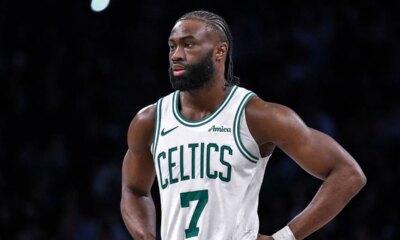
Brown, who’d said for years that he could thrive as a No. 1 option if given the chance, has aced this test thus far, playing his way into the NBA MVP conversation while Jayson Tatum recovers from Achilles surgery. Owning the NBA’s second-highest usage rate behind Luka Doncic, he’s the league’s fourth-leading scorer (29.7 points per game) and is on pace for a career high in assists (4.8).
Though the 3-pointer has been the centerpiece of Boston’s offense under Mazzulla, Brown has found success by becoming one of the premier 2-point maestros, taking more shots per game from inside the arc than any other NBA player. He’s also averaging a career-best 7.3 free throws per game — despite frequent gripes about what he considers unfair officiating.
Simply put, he’s been exactly what this Celtics team needs.
2. “The most important players stay healthy”
“This current Celtics roster does not have (the) luxury (of proven depth). Losing a key player like Brown or White for any significant length of time could tank their season.”
Brown, who failed to reach the 65-game threshold for postseason awards last year, has appeared in all but three of Boston’s 41 games, sitting out two due to illness and one with back spasms. Starters Derrick White, Payton Pritchard and Sam Hauser have missed one game apiece. Top center Neemias Queta has missed two. That’s a total of eight DNPs for Boston’s current, Tatum-less starting five.
The Celtics’ key reserves have been regularly available, too. Sixth man Anfernee Simons has appeared in every game, and Jordan Walsh, Hugo Gonzalez, Luka Garza and Baylor Scheierman have been sidelined for a total of two (not including their occasional DNP-CDs).
Outside of Tatum, the only player on the roster who’s missed extended time is wing Josh Minott, who sat out the last six games with an ankle sprain. But Minott fell out of Mazzulla’s rotation in late December and wasn’t seeing meaningful minutes when he suffered his injury.
For context, at this point last season, Brown had missed seven games, Tatum three, Hauser seven, Jrue Holiday six, Luke Kornet six, Al Horford eight and Kristaps Porzingis 23.
3. “Anfernee Simons becomes a playable defender”
“Simons can score. Everyone knows that. … But can he be at least respectable on the defensive end? That’s the big question facing the 26-year-old guard.”
It was telling that, after Simons scored 39 points off the bench last Thursday in a come-from-behind win over the Miami Heat, Mazzulla spent much of his postgame news conference praising the guard’s improved defense.
Simons has gone from liability to legitimately impactful at that end since joining the Celtics over the summer, and those improvements have helped turn him into one of Boston’s most valuable contributors. After an uneven start to the season as he adjusted to his new bench role, the former Portland Trail Blazers starter owns the NBA’s fourth-best plus/minus since the beginning of December.
The big question surrounding Simons now is whether Boston’s front office views him (and his $27.7 million expiring contract) as a trade chip or an asset worth retaining. We’ll find out by the Feb. 5 trade deadline.
4. “The frontcourt exceeds its low expectations”
“The move from Kristaps Porzingis, Al Horford and Luke Kornet to Neemias Queta, Luka Garza, Chris Boucher and Xavier Tillman is an enormous downgrade on paper. The Celtics will need career years from at least one of these big men to field even a league-average frontcourt.”
The Celtics essentially took a “we’ll see how it goes and hope for the best” approach at the center position this past offseason — and so far, it’s worked.
Queta has been more than solid as a first-year starter (10.2 points, 8.2 rebounds, 1.2 blocks per game), and Garza, after being exiled to the end of the bench for much of December, has been a consistent difference-maker off the bench, excelling as a screener and on the offensive glass while shooting a team-best 48.9% from three. It hasn’t mattered that Boucher and Tillman — the Celtics’ two most experienced bigs — have hardly played.
Even Boston’s rebounding — an unsurprising early-season issue for a team that lost its top three big men and its leading rebounder (Tatum) from last year’s squad — has become a strength of late. With help from their crashing wings, the Celtics rank sixth in defensive rebounding rate and fourth in offensive rebounding rate since the start of December, and seventh in overall rebounding rate this season.
Still, trade rumors have linked the Celtics to several established big men, so they could make a move to bolster this group in the coming weeks.
5. “Multiple depth wings become reliable rotation players”
“Jordan Walsh? Baylor Scheierman? Josh Minott? Hugo Gonzalez? With no proven depth on the wing behind Brown and Hauser, the Celtics will need at least half of those inexperienced backups to play real roles this season.”
How about all four?
Gonzalez, an instant contributor as a 19-year-old rookie, boasts the NBA’s second-best individual net rating. The Celtics went 15-5 with Walsh — who’s having by far the best season of his three-year career — in their starting lineup. Scheierman has become an everyday rotation player, earning his playing time through deflections, drawn charges and the occasional timely 3-pointer. Even Minott has been a net positive, starting 10 games and playing big minutes as a small-ball center before falling down the pecking order. All four have swung games with their chaotic energy and hustle plays.
6. “The East is as wide-open as expected”
“Any argument for the Celtics remaining competitive this season should start with the quality of their conference.”
Seven Eastern Conference teams — from the second-ranked Celtics to the No. 8 Heat — entered the week with between 22 and 26 wins. The New York Knicks, Cleveland Cavaliers and Orlando Magic have underachieved relative to preseason hype, and the defending conference champion Indiana Pacers have cratered amid a tidal wave of injuries.
The Pistons sit comfortably atop the East standings, carrying a 4 1/2-game cushion into Monday night’s matchup. But is a franchise that’s won just two postseason games since 2008 an NBA Finals shoo-in? Hardly. The Celtics should be viewed as real conference contenders, especially if…
7. “Jayson Tatum returns for the stretch run (and looks like himself)”
“If Brown and Co. can scrap their way into the thick of the Eastern Conference playoff race, they couldn’t ask for a more helpful midseason addition than a healthy Tatum.”
By all accounts, Tatum is on or ahead of schedule in his Achilles rehab. The Celtics have insisted they will not rush him back, but a midseason comeback appears realistic. If he returns and looks like Tatum, even in a reduced role, watch out.





Boston, MA
Massachusetts State Police trooper ‘relieved of duty’ after drunken driving arrest in Boston

A State Police trooper who was allegedly found “slumped over” in his car at around 5 a.m. in the South End with an open container of High Noon vodka has been “relieved of duty.”
Mass State Police confirmed to the Herald Wednesday night that Trooper Donovan Preston, 31, arrested for alleged drunken driving in Boston this past weekend, “has been relieved of duty.” Preston’s base pay is listed as $80,213.
A Boston Police report states that police arrived at Herald Street on Saturday to see Preston “stopped in lane 2 of the road” with his brake lights on. The suspect was slumped over “with his eyes closed,” the report adds.
“The officer observed that the car was on and in drive. The officer observed an open container of alcohol (High Noon) in the cupholder,” according to the report. The BPD officer then knocked on the window “for approximately 10 seconds before the suspect lifted his head up.”
Once he picked his head up, police said he appeared “confused and he looked around. The suspect’s vehicle began to roll to which the officer announced, ‘Boston Police. Open the Door.’ ”
Preston stopped on the three-lane, outbound road with his black BMW in the middle of two lanes.
A State Police spokesman said in an email: “Trooper Donovan Preston was relieved of duty and will be subject to a department discipline process.” All other comments were directed toward the police report.
That report, provided to the Herald Wednesday night, added that State Police were notified after Preston’s arrest.
The can of High Noon was logged into the evidence book.
This latest OUI case comes as State Police Sgt. Scott Quigley is being investigated in an alleged drunken driving fatal crash in Woburn in 2023 that killed a disabled passenger in a van.
In the Quigley case, his blood alcohol level reportedly tested at a .114 at the hospital following the crash (the legal limit is .08). That detail came out in a wrongful death suit filed by the victim Angelo Schettino’s family.
‘Unless he’s s###-faced, I’m not worried’: Mass State Police dash cam catches aftermath of deadly cruiser crash [+video]

TSA wait times are still painfully long at airports across the country because of the partial government shutdown. Even if you avoid the problem by leaving Logan Airport in Boston, you will likely run into it when you fly home.
Exhausted travelers flying into Boston from George Bush Intercontinental Airport in Houston, said they spent several hours in TSA lines before getting on their flights Tuesday.
Nay Dedrick of Dorchester was to supposed to arrive in Boston at 6 p.m. Monday, but said she missed her flight after waiting “6 to 8 hours” in the long security line in Houston.
“TSA was only 2 people working,” she said. “The line started downstairs and went all the way down to the basement, and then it goes all the way back up to the third floor.”
So, she slept at the airport and tried again on Tuesday.
“It’s very frustrating. I’m very tired,” Dedrick said after finally arriving home in Boston Tuesday afternoon.

Mary Jo Kane of Jamaica Plain arrived at the airport in Houston nearly six hours before her 7 a.m. flight to Boston Tuesday.
“I got there at 2-2:15 (a.m.) and then you go to the TSA and it’s kind of like Disney World during school vacation week,” she said.
One thing these travelers had in common is sympathy for TSA agents.
“I commend them,” Dedrick said.
“These people came in here, they’re not getting paid. Maybe their pay is deferred, but would you come into work?,” Kane said.
TSA agents have now gone 40 days without pay since the Department of Homeland Security stopped getting funding from the government.


BostonBruins.com is the official website of the Boston Bruins. Boston Bruins and BostonBruins.com are trademarks of Boston Professional Hockey Association, Inc. (BPHA). NHL, the NHL Shield, the word mark and image of the Stanley Cup and NHL Conference logos are registered trademarks of the National Hockey League. All NHL logos and marks and NHL team logos and marks as well as all other proprietary materials depicted herein are the property of the NHL and the respective NHL teams and may not be reproduced without the prior written consent of NHL Enterprises, L.P. Copyright © 1999-2025 Boston Professional Hockey Association, Inc. and the National Hockey League. All Rights Reserved.

Umatilla, Morrow counties establish Young Republicans of Oregon chapter – East Oregonian

Teen boys in Pennsylvania get probation after using AI to create fake nude photos of classmates

Rent control won’t solve Providence’s steep rental prices – The Boston Globe

South Carolina’s Raven Johnson carries her grandfather’s legacy into Sweet 16

Plaque unveiled at South Dakota Capitol for 100-year-old Medal of Honor recipient

Florida High School Football Rankings: Top 25 teams – Oct. 21

How old is Bo Nix? What to know about Oregon quarterback ahead of 2024 NFL Draft

Cleary's 21 help Le Moyne down Central Connecticut State 69-64 in OT

99th annual Pony Swim held in Virginia

Indiana Members Credit Union announced as new anchor tenant at Bottleworks District

Video: Jury Rules Against Meta and YouTube for Addictive Features

New Jersey Gov Sherrill signs law barring ICE agents from wearing face coverings to shield identities

Escalation in the Middle East – Not Europe’s war? MEPs in the Ring

War with Iran disrupts fertilizer exports as U.S. farmers prepare for planting season

White House unleashes on Raskin for clinging to ‘deranged’ Jack Smith ‘lies’ in latest Trump docs flare-up
-

 Detroit, MI1 week ago
Drummer Brian Pastoria, longtime Detroit music advocate, dies at 68
-

 Georgia1 week ago
How ICE plans for a detention warehouse pushed a Georgia town to fight back | CNN Politics
-

 Movie Reviews1 week ago
‘Youth’ Twitter review: Ken Karunaas impresses audiences; Suraj Venjaramoodu adds charm; music wins praise | – The Times of India
-
 Science1 week ago
Industrial chemicals have reached the middle of the oceans, new study shows
-

 Science1 week ago
How a Melting Glacier in Antarctica Could Affect Tens of Millions Around the Globe
-

 Culture1 week ago
Test Your Memory of Great Lines From Classic Irish Poems
-

 Sports5 days ago
IOC addresses execution of 19-year-old Iranian wrestler Saleh Mohammadi
-

 New Mexico4 days ago
Clovis shooting leaves one dead, four injured