Northeast
Attempted Trump assassin seen walking around Pennsylvania rally hours before opening fire


Chilling new video has been released showing Thomas Matthew Crooks casually walking through a crowd in Butler, Pennsylvania, nearly two hours before he opened fire on former President Donald Trump and attendees at a campaign rally.
The short clip, released by the clothing company Iron Clad USA, shows Crooks at 4:26 p.m. dressed in shorts and a “Demolitia” T-shirt walking past a line of vendors selling Trump merchandise ahead of the July 13 rally.
He was wearing the same T-shirt when he opened fire on Trump and is not carrying anything in the eerie video.
The owner of the video, Joe Tomko of Iron Clad USA, told Fox News Digital that he and his family and friends were promoting some new merchandise in an area of the rally dubbed “vendors row,” which he described as “an asphalt lane located parallel to the local airport runway.”
TRUMP ASSASSINATION ATTEMPT SPARKS INVESTIGATION OF SECRET SERVICE DEI POLICIES: ‘COMPROMISED ITS MISSION’
Chilling new video has been released showing Thomas Matthew Crooks casually walking through a crowd in Butler, Pennsylvania, nearly two hours before he opened fire on former President Trump and attendees at a campaign rally. (Anna Moneymaker/Getty Images, main, and Iron Clad USA, inset.)
“This was the area we spent the day promoting our hats and speaking to wonderful people, as a majority of attendees parked their cars in a connected large grass field, exited their vehicles, and walked past vendors row to the security entrance,” Tomko said.
Around 4:15, most people were inside the rally perimeter, Tomko said, and for the next 15-or-so-minutes, he and his family and friends “began to document the colorful scene of vendors row with a video, as the flags blowing in the wind appeared very patriotic.”
They took three videos and planned to upload one to Iron Clad USA’s social media pages. It wasn’t until a week later that Tomko and his friends and family were looking through their photos when they realized they had captured the shooter himself.
“I felt shock, disbelief, and sadness, realizing I had a video of this man on my phone.”
Thomas Matthew Crooks crawling on a roof moments before he attempted to assassinate former President Donald Trump. (DJ Laughery (background))
“I felt shock, disbelief, and sadness, realizing I had a video of this man on my phone,” Tomko said. “I personally reached out to law enforcement to share the video hoping it could help build a timeline of events from that day, and was later questioned by them. We then decided to post a video on social media (7/23/24) in an effort to gain awareness and potentially assist others in the timeline of their investigation. Initially, our video did not get much attention, and it wasn’t until a few days ago … it went viral.”
After Crooks opened fire around 6:11 p.m., Tomko’s sister called him at 6:14 p.m.
“Trump was shot,” she said. “Leave immediately, get out of there now.”
Tomko saw people running away from the venue and called his son-in-law, who was inside the rally perimeter, at 6:16 p.m. to make sure he was okay.
WATCH: VIDEO SHOWS TRUMP SHOOTING VICTIM’S POV
“After what felt like eternity, I got a text message from him at 6:21pm, letting me know he was physically okay,” Tomko said. “I then learned my son-in-law was standing on the same bleacher section as Mr. Corey Comperatore and his family, and unfortunately witnessed the absolutely devastating shooting. Our family was horrified to hear this took place, and that he was so close to where it happened.”
He extended his sympathies to the Comperatore family and the families of the other victims impacted by the assassination attempt.
“Terrifying moment… looking back on my videos from the PA Butler Trump rally on 7/13/24,” the company’s owner wrote on the TikTok version of the video. “We were there just trying to sell our patriotic hats from my small business.”
Crooks later climbed onto the roof of the nearby AGR building and fired eight shots, with one bullet grazing Trump’s right ear. One attendee, Corey Comperatore, was fatally struck, while two others were also hit and suffered serious injuries.
Pictures of Thomas Mathew Crooks taken by a sniper. (Sen. Ron Johnson’s Office)
“The U.S. Secret Service is aware of and reviewing a variety of footage from July 13 as part of our mission assurance review,” the Secret Service said in a statement in response to news of the new footage being released.
“The U.S. Secret Service is committed to examining the processes, procedures, and factors that led to this operational failure, so that we can ensure it never happens again.”
CLICK TO GET THE FOX NEWS APP
A preliminary report released by Rep. Clay Higgins, R-La., last week found that all eight shell casings were recovered and are in proper possession of the FBI. Higgins said that Crooks’ position on the roof of the AGR building provided him with excellent concealment from the northern counter-sniper team due to the foliage and branches of two trees.
One shot was fired by a Butler SWAT operator from the ground, about 100 yards away from the AGR building. The shot hit Crooks’ rifle stock and fragged his face and shoulder area from the stock breaking up, Higgins said.
Police standing over Thomas Crooks after he was shot (Butler Township Police Department)
Higgins believes this shot damaged the buffer tube on Crooks’ rifle, meaning that the rifle would not have fired after his eighth shot.
The report also states that the FBI released Crooks’ body for cremation just 10 days after he was killed. Higgins said he became aware of this after he tried to view the body.
An FBI spokesperson tells Fox News Digital that Crooks’ body was released to his family after coordination with the coroner’s office as well as state and local law enforcement partners “in keeping with normal procedures.”
Read the full article from Here



Is Your Child Ready to Stay Home Alone? Summer Safety Guide
As summer vacation approaches, many parents wonder if their children are ready to stay home alone. Here are some recommendations to help you decide.
With warm weather here, families are setting their sights on cooling off in the water.
If you want to switch up your weekends and trade the beach for a water park, here are some options around the region offering fun for the whole family.
Killens Pond State Park, near Felton
Killens Pond State Park, named after the 66-acre Killens Pond, was once home to the Lenape people. It now houses a variety of fish, like crappies and sunfish, and is frequented by guests looking for an afternoon of serenity or recreation, according to Delaware State Parks.
The park offers watercraft rentals and features the popular Pondside Loop Trail and a water park.
The water park features four water slides and designated baby, toddler and main pool areas with water jets, a lily pad walk and more. The largest slide at the park begins 54 feet off the ground.
The water park is open for two sessions per day – 9:30 a.m. to 1:30 p.m. and 2 p.m. to 6 p.m. – Memorial Day through Labor Day. Guests can stay the full day if they purchase tickets for both sessions.
While you’re in the area, be sure to check out what else the state park has to offer. Other activities at Killens Pond include:
- Visiting the park’s nature center to see live animal exhibits
- Playing on the playground
- Playing sports like baseball, volleyball and disc golf
5025 Killens Pond Road, Felton, (302) 284-4526; destateparks.com/PondsRivers/KillensPond.
Great Wolf Lodge Maryland – Perryville, Maryland
The largest Great Wolf Lodge water park, which opened in 2023, is located just off I-95 at 1240 Chesapeake Overlook Parkway in Perryville, Maryland, less than half an hour from Newark.
The water park covers more than 126,000 square feet of the resort, which boasts more than 700 rooms. There are 22 individual slides varying in intensity, along with a lazy river, hot springs and other water attractions.
Indoor and outdoor cabanas are available, but they cannot be reserved unless a stay has been booked. No matter the length of your stay, a pass includes access to the water park from open to close, life jackets and towels as needed, among other perks.
If you aren’t staying overnight, day passes are offered and allow guests to enjoy the indoor water parks (with towels included). All-day passes are valid from open to close, which is 9 a.m. to 8 p.m. Half-day passes are valid from 4 p.m. to close.
If waterpark access isn’t all you’re looking for, the day pass bundle includes access to attractions like MagiQuest and arcade games. Attractions and dining packages cannot be added to regular day passes.
1240 Chesapeake Overlook Parkway, Perryville, Maryland; greatwolf.com/maryland.
Kalahari Resorts & Conventions – Pocono Manor, Pennsylvania
Kalahari Resorts, in the Pocono Mountains of Pennsylvania, is known for its sprawling water park and its entertainment options for the not-so-water-borne adults.
Kalahari has over 250,000 square feet of water parks, dining areas and entertainment areas like arcades and spas. The water park has over 20 different water slides, a water basketball court, lazy river and a swim-up bar.
The resort is a roughly two-hour drive from Wilmington. Day passes are available for a quick trip, and additional options are available for early waterpark access or passes to skip the lines on some of the biggest rides.
250 Kalahari Blvd., Pocono Manor, Pennsylvania, (877) 535-2427; kalahariresorts.com.
Viking Golf & Thunder Lagoon Water Park – Fenwick Island
The Fenwick Fun site, located just blocks away from Ocean City, Maryland, is not your average outdoor water park. A 19-hole mini golf course, go-kart track, theme park and boardwalk are all in the same campus as the Thunder Lagoon water park, perfect for guests of all ages and interests to enjoy.
Thunder Lagoon is open 10 a.m. to 6 p.m. daily, weather permitting. The water park includes six water slides, a 400-foot tropical lazy river, pools for various ages and the “legendary” tipping Viking ship.
Tickets for the water park are sold in two-hour and four-hour blocks. Visitors can also purchase multi-day passes to save on visits, which is a great option for a week on vacation
38960 Island St., Fenwick Island, (302) 539-1644; fenwickfun.com.
Camelback Resort – Tannersville, Pennsylvania
Located a two-hour drive from Wilmington in Tannersville, Pennsylvania, Camelback Resort’s Aquatopia water park has 13 water slides, one of which holds the title as the longest indoor water coaster slide in the world.
The 125,000-square-foot water park lights up at night and has a transparent roof so guests can get their vitamin D fix during the day. Aquatopia also has a wave pool, lazy river, a toddler area, a simulated surfing area and a swim-up bar.
Aside from water park activities, the resort also has 170,000 square feet of indoor games for the whole family, as well as over 450 suites available for an extended stay.
Aquatopia is open Sundays through Thursdays from 10 a.m. until 8 p.m. and on Fridays and Saturdays from 10 a.m. to 9 p.m. Bookings can be made online through the Camelback Resort website.
193 Resort Drive, Tannersville, Pennsylvania, (570) 629-1661; camelbackresort.com.
Dorney Park & Wildwater Kingdom – near Allentown, Pennsylvania
Dorney Park & Wildwater Kingdom near Allentown, Pennsylvania, is around an half and a half drive from Wilmington.
Beyond the roller coasters at Dorney Park and the large collection of kiddie rides at Planet Snoopy, Wildwater Kingdom is brimming with water fun to help you cool off on a hot day.
Wildwater Kingdom has 16 water attractions, including wave pools, rivers for tubing and a variety of variety slides. Poolside dining is available, along with cabanas for reservation.
This year’s season opens with a reimagined Lightning Falls and Cascade, the new 21° and Colder bar experience and updates to the Tradewinds retail location. Also new this summer is the SPLASH! Water Parade, which brings “an interactive, water-themed spectacle to the park,” including floats, live performers and surprises.
4000 Dorney Park Road, Allentown, Pennsylvania;www.sixflags.com/dorneypark.
Splash Mountain Water Park – Ocean City, Maryland
Jolly Roger Splash Mountain in Ocean City, Maryland, has been a mainstay at the beach for over 50 years.
Attractions at Splash Mountain include the thrilling Aqualoop, a water slide that catapults riders down a near-vertical drop before sending them around a loop that makes normal roller coasters; and Stealth, a half pipe ride with a 45-foot vertical ramp.
For the less adrenaline-rush-driven people, the park’s wave pool, lazy lagoon and rainforest play area are equally popular attractions.
Various passes are available for Splash Mountain.
2901 Coastal Highway, Ocean City, Maryland; (410) 289-3477; splashmountainoc.com.
Got a tip or a story idea? Contact Krys’tal Griffin at kgriffin@delawareonline.com.
Rhode Island
New bilingual school blocked from opening under R.I.’s new charter school ban – The Boston Globe

LaPlante and the school’s board chair, Carol Aguasvivas, had pleaded with lawmakers not to include the bilingual school in the three-year charter school ban, since it had already received an initial approval from the state in January. They met with McKee and asked him to veto it, citing his longstanding support for charter schools. He signed the bill the next day.
“I didn’t think that we were going to have to fight this hard for dual language,” Aguasvivas said. In the workforce, she noted, “Everyone wants you to be bilingual. But how are we going to prepare these children for the future when we’re not giving them the basics to be able to do that?”
The school leaders said they are exploring their options, including litigation, now that it’s been blocked from opening.
De La Comunidad was planning to open in Providence with 140 students in kindergarten through second grade to start, and then expand over nine years into a K-12 school with more than 600 students from Providence, Pawtucket, and Cranston.
The school would have taught both native English and Spanish speakers, with classes taking place in both languages throughout the school day. The goal is for students to become fluent in both languages.
“The only population that’s being affected here are the children,” Aguasvivas said. “Because the school was definitely going to make a difference. And the doors were shut on us before we could even open.”
The school had the backing of state education commissioner Angélica Infante-Green, and its leaders argued it was meeting the needs of Rhode Island’s exploding population of multilingual learners, the term for students learning English as a Second Language.
“We are responsible to going back to those families and telling them that they no longer have a choice,” Aguasvivas said.
The fierce opposition to De La Comunidad was not necessarily about the school itself, or any of its planned bilingual programming. Officials in Cranston and Pawtucket argued another charter school serving their cities would pull even more resources from strained public school budgets. Both cities sued to try and block the school from opening after it received preliminary state approval. (The lawsuit is still pending.)
The teachers unions that pushed for the charter ban also did not cite any specific issues with De La Comunidad’s curriculum or programming, but said local school districts simply cannot afford to send any more money to charter schools.
“They’re laying off large numbers of teachers in some districts,” said Maribeth Calabro, the president of the Rhode Island Federation of Teachers and Health Professionals, one of two major unions. “It’s time for a thoughtful pause of charter expansion, period, full stop.”
“The dual language is absolutely not the issue,” Calabro added.
Tuition at charter schools is paid by the school district where the child lives.
Aguasvivas said she understood the need for a charter pause, but said it should not have applied to a school that was already in the pipeline to open.
“De La Comunidad Bilingual School was not going to be the one school that was going to take away so much funding that it was going to cripple the entire system,” she said.
Brand new charter schools require two approvals by the Rhode Island Council on Elementary and Secondary Education. After an application and hearing process, the preliminary approval allows them to prepare to open, including getting a lease for premises and posting jobs. Once the school is ready to launch, they go back for final approval.
Existing charter schools that are expanding require only one vote of the council, which is why the Greene School in West Greenwich — which got a favorable vote from the council on the same day as De La Comunidad — will be allowed to move forward with its plans to open a new middle school during the moratorium.
Aguasvivas and LaPlante noted that most children in Rhode Island don’t have access to dual language programs. In the three communities they planned to serve, Providence has dual language programming available to about 10 percent of the total school population, Cranston doesn’t have any, and Pawtucket has only a limited program.
“District schools should have dual language programs,” LaPlante said. “But we’re at 30 years of the same conversation, and they’re not there.”
Cranston Superintendent Jeannine Nota-Masse told the Globe the district doesn’t have the money to start a program, and charter schools are making it harder.
“Frankly, I would love to start a dual language program,” Nota-Masse said. “I have to cut programs, and I have to cut staff, because of the financial problems municipal districts have. I don’t have the program because I can’t afford it.”
She said Cranston lost $8.7 million last school year to charters.
“It’s not about that school in particular,” Nota-Masse said of De La Comunidad. “No matter the charter school, the way the funding formula works, every single opportunity a charter has to pull kids away from Cranston, I have to be concerned.”
No families were officially enrolled in De La Comunidad yet, as it was slated to be part of Rhode Island’s annual charter school lottery in the spring. But many parents had expressed interest, Aguasvivas said.
One of them was Marlena Stachowiak, also a city councilor in Pawtucket, who was hoping to sign her youngest son Truman up for kindergarten at De La Comunidad next fall.
“It was definitely something we were looking forward to,” she told the Globe. She hoped to enroll her two older children once the school expanded to middle and high school.
One of her sons, 9-year-old Braelyn, had been enrolled in a dual language program in Pawtucket from kindergarten until second grade at Nathanael Greene Elementary School, but he lost access when the program was cut and moved to Baldwin Elementary, she said.
The family only speaks English at home, but Braelyn was learning Spanish and using it around friends and neighbors.
“It abruptly stopped,” Stachowiak said. “He was really enjoying it. It’s been over two years and it’s slipping away,” she said.
Pawtucket Superintendent Randy Buck said the reason the district could not maintain dual language programs at both schools was because of staffing. There are not enough teachers certified in bilingual/dual language to meet the demand, he said.
Infante-Green, an enthusiastic supporter of dual language programs who recommended the approval of De La Comunidad’s application last year, did not respond to requests for comment.
When her department was considering the application, it received 1,778 letters of support, 99 percent of which were in favor of the school, according to RIDE.
The school had been approved for startup funding from the state and other grants worth about $1 million that it now must forfeit, LaPlante said.
Another $70,000 in funds came from the Rhode Island Education Collective, an education nonprofit where LaPlante also works.
Victor Capellan, the founder and CEO of the collective, said the group’s funding comes from local and national backers including the Papitto Opportunity Connection, Bank Newport, Centreville Bank, The City Fund, Bloomberg Philanthropies, and individual donors.
McKee had years ago vowed to veto a charter moratorium. After signing it into law last month, he told the Globe the situation had changed; public school enrollment is dropping, causing serious funding issues.
He confirmed that he met with De La Comunidad leaders the day before he signed the bill, but they didn’t change his mind.
“If they feel strongly that they have support in the General Assembly, they should go back in the next session,” McKee said. “Go deliver your case.”
Steph Machado can be reached at steph.machado@globe.com. Follow her @StephMachado.

Mountain bike enthusiasts have been working for years on an ambitious 485-mile multi-use trail known as the Velomont that will span the length of Vermont.
When finished, the collaborative project will knit together existing trail networks, connect 27 communities, and include 30 new huts and five downtown hostels for overnight stays.
New trail construction is finally ramping up after years spent on permits, plans and public input. And organizers say they’re focused on ensuring the Velomont is accessible for everyone.
“For us, it’s not a huge lift to just be mindful when we’re trying to build trail or improve trail to think about the adaptive rider,” said Angus McCusker, the Velomont trail director with the nonprofit Vermont Huts and Trails.
McCusker is referring to the growing number of athletes with disabilities who mountain bike with specially designed equipment.
“The challenge,” he said, “is we’re connecting to existing trail networks that were never intended for adaptive bikes. So, where we can, we’re trying to do adaptive assessments.”
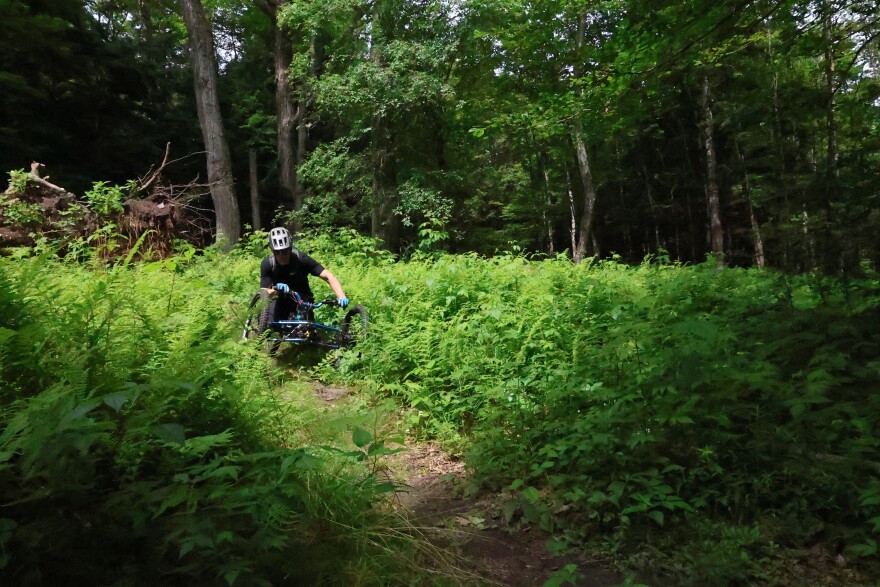
Louis Arevalo of Essex Junction is one of several adaptive athletes helping with that, most recently on some slightly overgrown trails in the Randolph Town Forest.
Zoe McDonald
/
Vermont Public
Arevalo was paralyzed in a skiing accident six years ago. An avid mountain biker before, he now rides a recumbent-style three wheeler that sits low to the ground. Arevalo pedals and steers with his arms, and gets a boost from an electric motor.
“Once you realize what these bikes are capable (of) or this equipment actually opens up, it kind of blows your mind,” he said.
But adaptive rigs like Arevalo’s are wider and heavier than regular mountain bikes, and not all trails are user-friendly.

Zoe McDonald
/
Vermont Public

Zoe McDonald
/
Vermont Public
Nick Bennette, who tested a different type of adaptive bike that day, got hung up on several tight turns.
Bennette is executive director of the Vermont Mountain Bike Association, another nonprofit spearheading efforts around the Velomont. He and others involved in the assessment have been taking detailed notes on ways to make the trails more accessible.
“Just scalloping out a bit of material on the outside of that corner,” said Bennette, pointing to the area the bike got caught. “That will allow adaptive bikes to make that corner without really changing the way the trail rides.”
This type of work is not just happening on the trails. Organizers are also trying to reduce barriers at overnight accommodations along the network.

Zoe McDonald
/
Vermont Public
This summer, contractors are turning an old office building near the trail in downtown Randolph into an ADA accessible hostel. And two remote huts along the trail in Stratton and Chittenden will have locked sheds with off-road wheelchairs so bikers don’t have to haul their own.
At the Chittenden Brook Hut, McCusker highlighted a new ramp and wider driveway.
“So if you’re an adaptive rider, you can imagine rolling right up here and you can transfer to your chair that’s available here, and then roll down the ramp and go down to the fireplace, to the privy, to make your meal,” he said.

Zoe McDonald
/
Vermont Public
Louis Arevalo stayed at the hut last summer with other adaptive riders — his first camping trip since his accident.
“It was really refreshing to have easy access to a beautifully built hut that was easy to navigate, and then have these world-class trails right out the door,” he said. “And with these Velomont trails, I can actually plan a hut-to-hut trip with other people.”
Jeff Alexander is counting on it. He’s director of strategic partnerships with Vermont Adaptive Ski and Sports, a nonprofit that helps people with disabilities access outdoor recreation.
An economic impact analysis the group commissioned estimates their programming generated more than $10 million last year.
“So the adaptive community has money, they travel, they want to travel and they want to play with everybody,” Alexander said. “We just need to level the playing field so that everyone can play together.”
Zoe Mcdonald
/
Vermont Public
-

 North Dakota17 seconds ago
Berry Survives Restart For North Dakota Prize – SPEED SPORT
-

 Ohio5 minutes ago
Northeast Ohio Weather: More thunderstorms today
-

 Oklahoma12 minutes ago
Oklahoma teen reported as endangered missing person
-

 Oregon15 minutes ago
Former corrections officer sentenced in major Oregon poaching case spanning multiple counties
-

 Pennsylvania20 minutes ago
Want to cool off at a water park this summer? Check out these 7 parks
-

 Rhode Island27 minutes ago
New bilingual school blocked from opening under R.I.’s new charter school ban – The Boston Globe
-

 South-Carolina30 minutes ago
What triggers a heat advisory in South Carolina?
-

 South Dakota35 minutes ago
Water hampers growth near Sioux Falls but solution near

