Northeast
$380M from DHS to be given to states, NGOs in support of migrants

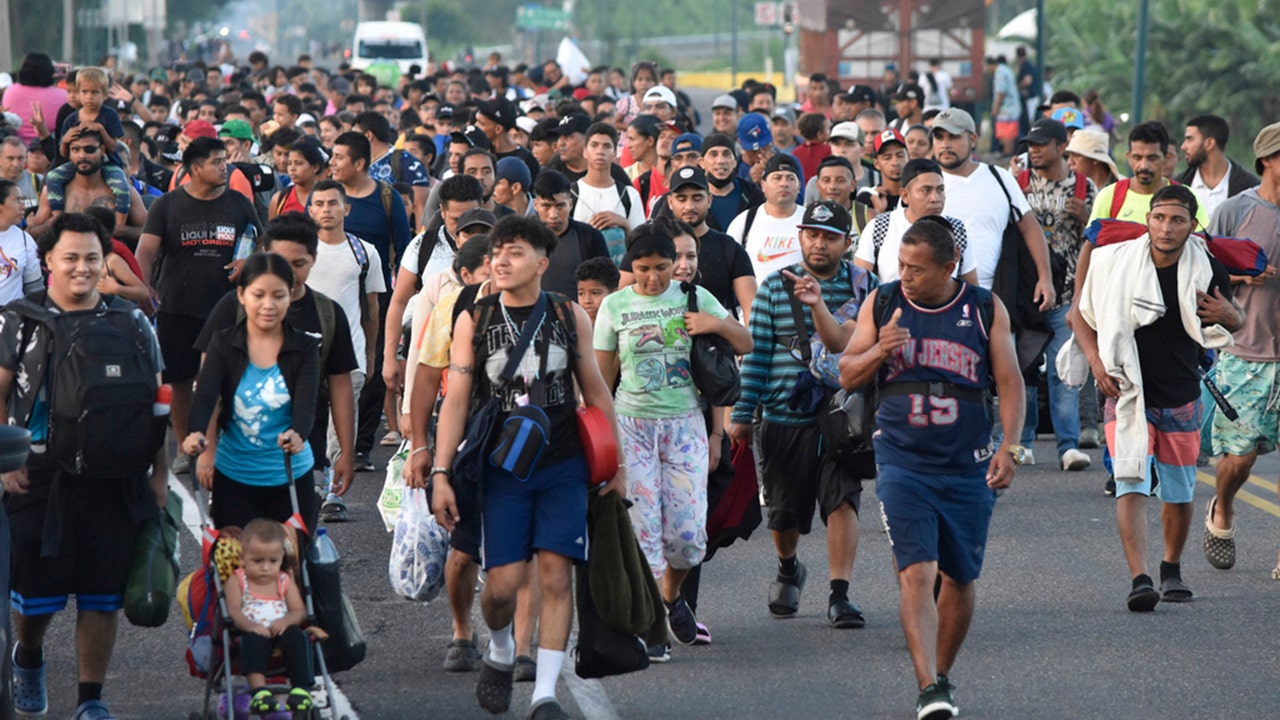
The Biden administration announced last week that it’s providing $380 million to nonprofits and local governments to cover some of the costs associated with taking care of migrants once they’ve been released by the Department of Homeland Security (DHS) at the southern border.
The huge sum is being awarded by DHS via its Shelter and Services Program (SSP), which aims to provide “critical support” for migrants by way of offering them food, shelter, clothing, acute medical care, and transportation while they await their immigration court proceedings.
DHS says the money helps prevent overcrowding at short-term Customs and Border Protection (CBP) holding facilities and enables non-federal entities to “off-set allowable costs incurred for services associated with noncitizen migrant arrivals in their communities.”
MAYORKAS FORCED TO ADMIT MORE MIGRANTS HAVE CROSSED US BORDER UNDER BIDEN THAN TRUMP: ‘SEVERAL MILLION PEOPLE’
Migrants walk along the highway through Suchiate, Chiapas state, in southern Mexico, on Sunday, July 21, 2024, during their journey north toward the U.S. border. ( AP Photo/Edgar H. Clemente)
The $380 million grant comes just four months after the agency disseminated a tranche of $259.13 million in SSP grants, bringing the total this year to nearly $640 million.
In fiscal year 2023, more than $780 million was awarded to organizations and cities across the country which are inundated with migrants who have nowhere to live and are unable to work.
The influx has overwhelmed social and health services across many big cities, and local governments have used taxpayer money to put migrants up in hotels or shelters. Under the Biden administration there were more than 2.4 million migrant encounters in fiscal year 2023, and that mark could be broken by the end of fiscal year 2024, although DHS says monthly numbers have decreased.
The $380 million grant is being divided between a total of 50 nonprofits, municipalities and government entities.
The biggest beneficiary of the allotment is New York City, a sanctuary city, which is being given nearly $22.17 million via its Office of Management, while Los Angeles is taking $21.84 million and Arizona is in line for $19.25 million.
Maricopa County and Pima County, both in Arizona, are splitting nearly $38 million in funds.
FOX NEWS POLL: VOTERS SAY THE US-MEXICO BORDER IS A BIG PROBLEM
Migrants are seen at the southern border on May 23, 2024. (Bill Melugin/Fox News)
In terms of nonprofit organizations, Jewish Family Service San Diego is being awarded $22.1 million, the Catholic Charities Diocese of San Diego is set to get $21.6 million, while Catholic Charities Archdiocese of San Antonio in Texas is getting $19.26 million.
Massachusetts Gov. Maura Healey lauded the fact that her state is securing $15.4 million in competitive funding and $4.9 million in reserve funding.
“Massachusetts ‘wins’ $20 million in federal funding to support family shelter costs,” an Aug. 28 press release from Healey reads.
“This is the largest award Massachusetts has won from this program to date, as the state and city previously won a total of $9 million.”
Healey says the money will help Boston manage costs for sheltering migrants and praised the Biden-Harris administration for reducing illegal border crossings.
“The Biden-Harris administration has taken important steps to address this federal problem in light of Congress’s failure to act, and they are seeing results with illegal border crossings down significantly,” Healey said in the statement. “But more needs to be done. Congress needs to step up and pass the bipartisan border security agreement.”
Massachusetts Gov. Maura Healey pauses to look at the Army cots set up on the gym floor as state and local officials toured the Melnea A. Cass Recreational Complex, which was used as a temporary migrant shelter in May 2024. (Getty Images)
DHS says that Border Patrol encounters in July dropped 32% compared to June, the lowest monthly total along the southwest border since September 2020. July’s total numbers between ports of entry are also lower than July 2019, and lower than the monthly average for all of 2019, the last comparable year prior to the pandemic, DHS says.
The agency says the dip follows a June 4 Presidential Proclamation by President Biden, which temporarily suspended the entry of certain noncitizens at the southern border once the number of average border encounters exceeds 2,500 a day over seven days.
But the DHS funding will not plug the massive hole in city coffers decimated by illegal migration.
In Massachusetts, Republicans say the state has spent $1 billion “in secret migrant crisis spending” and have called Healey to provide a detailed cost breakdown of the toll that the migrant crisis has caused for the state’s residents.
In New York, the comptroller estimated that the migrant crisis will cost state taxpayers $4.3 billion through 2025, and New York City taxpayers $3 billion in fiscal year 2024 alone, according to the New York Post.
It also doesn’t account for the $4 billion the Biden administration announced it was sending to Central America in March to “address the root causes” of illegal immigration.
Meanwhile, a study by the Federation for American Immigration Reform (FAIR) estimated the net cost of illegal immigration for the United States – at the federal, state, and local levels – was at least $150.7 billion at the start of 2023.
FAIR arrived at the figure by subtracting the tax revenue paid by illegal immigrants – just under $32 billion – from the gross negative economic impact of illegal immigration, $182 billion.
Read the full article from Here


AMHERST, Mass. (WWLP) – The Massachusetts Department of Conservation and Recreation (DCR) has announced the return of its Pride Hikes, a series of guided walks across several state parks in celebration of the LGBTQ+ community.
These events will take place throughout June to create welcoming outdoor experiences for all communities during Pride Month. Each of the six hikes will be held at a different DCR property, with the events varying in length, terrain, and level of difficulty.
Participants are welcome to dress in Pride colors and are encouraged to bring necessary hiking supplies, including sturdy footwear, water, bug spray, and sunscreen.
“Our public lands and open spaces belong to everyone, and our Pride Hikes are a chance to celebrate the beauty of our landscapes and of each other,” said DCR Commissioner Nicole LaChapelle. “We’re welcoming members of the LGBTQIA+ community, their families, friends, and allies into our parks to enjoy the outdoors together and strengthen connections to nature and one another. We’re grateful to our partners across the state for helping create welcoming spaces where people can celebrate Pride, build community and experience a sense of belonging.”
The DCR is partnering with Queer Men of the Berkshires, the Stonewall Center at UMass Amherst, OUT MetroWest, and the Greater Boston and Franklin-Hampshire chapters of Parents, Families and Friends of Lesbians and Gays to host this series of hikes, with additional support from volunteers with Mass Audubon and RiverCulture.
This year’s Pride Hikes will take place at the following DCR properties:
- Great Falls Discovery Center, Montague
- Sunday, June 14, 10 a.m. to 2 p.m.
- Wachusett Reservoir, Clinton
- Saturday, June 20, 7:30 to 9:15 p.m.
- Mount Holyoke Range State Park, Amherst
- Saturday, June 27, 10 a.m. to 12 p.m.
- Riverfront State Park, Lawrence
- Saturday, June 27, 1 to 3 p.m.
- Douglas State Forest, Douglas
- Saturday, June 27, 2 to 4 p.m.
- Bristol Blake State Reservation, Norfolk
- Sunday, June 28, 11 a.m. to 12 p.m.
The hikes are subject to cancellation in the event of inclement weather. To learn more about each Pride Hike location, visit mass.gov.
All facts in this report were gathered by journalists employed by WWLP. Artificial intelligence tools were used to reformat information into a news article for our website. This report was edited and fact-checked by WWLP staff before being published.
Local News Headlines
WWLP-22News, an NBC affiliate, began broadcasting in March 1953 to provide local news, network, syndicated, and local programming to western Massachusetts. Download the 22News Plus app on your TV to watch live-streaming newscasts and video on demand.

Craft cocktails and local brews are the foundation for the Granite State, so grab a cold glass and toast to the best bars, breweries, wineries and brewpubs in NH
Editor’s Picks
Stormy Brews
Black Cloud Brewing in Keene has rolled into town with sharper flavor, louder energy and zero apologies. Each of their brews rotate seasonally and have weather-inspired names, including “Surge” and “Bluebird Day.” They also have a menu of pretzels made from the grains from the brewery, pizzas and salads. blackcloudbrewing.com
Beer of the Brave
Pints with a Mission, a collaboration between Bedford nonprofit Swim with a Mission and Londonderry’s 603 Brewery, helps support the needs of New Hampshire veterans. Mission Forward IPA “is more than a beer — it’s our way of giving back to the men and women who gave so much.” Find it at Common Man Roadside and Tuscan Market locations. SWAM.org
Readers’ Poll Winners
Best Beer Store
Littleton Food Co-op
Littleton
littletoncoop.com
Best Breweries
Brewery – Concord Area
Northwoods Brewing Company
Northwood
www.northwoodsbrewingcompany.com
Brewery – Dartmouth/Lake Sunapee Region
Flying Goose Brew Pub
New London
www.flyinggoose.com
Brewery – Great North Woods Region
Copper Pig Brewery
Lancaster
www.copperpigbrewery.com
Brewery – Lakes Region
Kettlehead Brewing Company
Tilton
www.kettleheadbrewing.com
Brewery – Manchester Area
603 Brewery and Beer Hall
Londonderry
www.603brewery.com
Brewery – Monadnock Region
Post & Beam Brewing
Peterborough
www.postandbeambrewery.com
Brewery – Nashua Area
Spyglass Brewing Company
Nashua
www.spyglassbrewing.com
Brewery – Salem Area
Kelsen Brewing Company
Londonderry
www.kelsenbrewing.com
Brewery – Seacoast Region
Stoneface Brewing Co.
Newington
www.stonefacebrewingco.com
Brewery – White Mountains Region
Schilling Beer Co.
Littleton
www.schillingbeer.com
Best Brewpub
Woodstock Inn Brewery
North Woodstock
www.woodstockinnnh.com
Best Distillery
Flag Hill Distillery & Winery
Lee
www.flaghill.com
Best Restaurant With Best Beer List
Thirsty Moose Tap House
Merrimack, Manchester, Exeter
www.thirstymoosetaphouse.com
Best Restaurant With Best Wine List
Bedford Village Inn & Restaurant
Bedford
www.bedfordvillageinn.com
Best Restaurant With Best Cocktails (tie)
Copper Door
Bedford and Salem
www.greatnhrestaurants.com
Americus Restaurant at Labelle Winery
Amherst
labellewinery.com
Best Wine Shop
Wine on Main
Concord
www.wineonmainnh.com

An investigation is underway after police said a teen girl was shot in Atlantic City, New Jersey.
According to the Atlantic City Police Department, on June 2, 2026, around 11:43 p.m. officers responded to the 600 block of New York Avenue after receiving a report about a shooting.
When officers got to the scene, police said they found a 16-year-old girl shot. She was taken to a nearby hospital for treatment.
Police said anyone with information about this incident is urged to contact the Atlantic City Police Department Violent Crimes Unit at 609-347-5858 or to submit an anonymous text tip to tip411 (847411), begin the text with ACPD.
-

 Maryland2 minutes ago
A Maryland family struggled with their child’s hidden seizures. New technology gave them answers.
-

 Michigan7 minutes ago
Michigan’s deadliest tornado killed 116 in Flint 73 years ago today
-

 Massachusetts14 minutes ago
DCR announces return of Pride Hikes at Massachusetts state parks
-

 Minnesota16 minutes ago
Vance Boelter will not face death penalty in Minnesota lawmaker shootings, DOJ says
-

 Mississippi22 minutes ago
Huskies Hosting Yet Another Mississippi Player
-
 Missouri29 minutes ago
Missouri Supreme Court declines to hear case about tax issue on August ballot, just before deadline
-
 Montana31 minutes ago
Job Posting: Montana State Seeks Assistant Coach
-

 Nebraska37 minutes ago
Iowa women’s basketball to play Nebraska twice

