News
When judges get free trips to luxury resorts, disclosure is spotty


Many federal judges receive free rooms and subsidized travel to luxury resorts for legal conferences. NPR found that dozens of judges did not fully disclose the perks they got.
Chelsea Beck for NPR
hide caption
toggle caption
Chelsea Beck for NPR

Many federal judges receive free rooms and subsidized travel to luxury resorts for legal conferences. NPR found that dozens of judges did not fully disclose the perks they got.
Chelsea Beck for NPR
Dozens of federal judges failed to fully disclose free luxury travel to judicial conferences around the world, as required by internal judiciary rules and federal ethics law, an NPR investigation has found. As a result, the public remained in the dark about potential conflicts of interest for some of the United States’ top legal officials.
Federal judges — occasionally with family members or even their dog in tow — traveled to luxury resorts in locations as far-flung as London; Palm Beach, Fla.; Bar Harbor, Maine; and the outskirts of Yellowstone National Park for weeklong seminars. The judges received free rooms, free meals and free money toward travel expenses, together worth a few thousand dollars.
At one event, a far-right German politician with a history of racially inflammatory and anti-immigrant statements made a presentation to dozens of judges. At others, judges heard from an advocacy group that uses lawsuits in federal court to change environmental policy, as well as from corporate CEOs in the oil and pharmaceutical industries.
For almost two decades, the federal judiciary has recognized that the combination of apparent luxury and ideological content can present the appearance of undue influence on the courts. In response, the judiciary has required more transparency in the form of public disclosure.
An NPR investigation found that the disclosure systems often fail to give the public timely information about the outside benefits that judges receive and from whom.
As a result, judicial ethics experts say, people with cases before these judges lack important information about a judge’s potential biases. That information, if received in time, could be used to request that a judge recuse from a particular case.
“It also matters to the public, even if someone never shows up in a courtroom, to believe in the integrity of our judiciary and to trust in the decisions that are issued by judges,” said Renee Knake Jefferson, a professor at the University of Houston Law Center. “Having disclosures of judicial financial interests goes directly to the public having confidence in the outcomes of the decisions — that they are free of any bias or influence.”
Many judges defend these events as helpful forums to discuss important issues, and they reject criticism that a stay at a fancy hotel could influence their decisions. Critics call them “junkets” and glorified vacations that reward ideological allies.
Both sides agree that disclosure is needed.
There are two primary ways the public can view information about judicial education events and see which judges attended: One disclosure is filed soon after the event, and the other is submitted much later.
First, within 30 days of an event, judges are required to file a form that details the host of the event and the entities that provided funding, as well as the speakers and topics of discussion. This form, called a “Privately Funded Seminar Disclosure Report,” is posted on every federal court’s website.
Second, federal law requires that judges report the reimbursements they received for the events on an annual financial disclosure report. That report also includes information like alternate sources of income (such as a book deal or teaching job) and what stocks a judge might own. Those reports are eventually posted on a centralized online database maintained by the Administrative Office of the U.S. Courts.
By closely examining the portion of these events subject to public records laws, NPR identified problems with both systems.
In nearly 40 instances, judges attended events at luxury resorts but failed to properly file a report within 30 days. In fact, the forms were uploaded months or even years late and only after NPR began asking questions.
In 13 cases, NPR found that judges failed to declare the benefits they received on their annual financial disclosure forms.
NPR contacted all those judges for comment.
And in another dozen cases, judges’ financial disclosures for 2021 or 2022 were simply unavailable to the public. By all accounts, judges are filing those annual disclosure reports on time. The Administrative Office of the U.S. Courts bears responsibility for posting those reports online and has acknowledged delays in getting the system up to date.
There is no indication that the judges intentionally withheld information in order to deceive the public. And the office that administers the annual financial disclosure website told NPR that it struggles to work through a backlog of reports, as well as requests for redactions to protect judges’ safety, but is making progress.
Ethics experts said delays and omissions in these reports undermine the entire purpose of the transparency rules.
“That information loses most of its value if it’s a year and a half later,” said Kedric Payne, the senior director of ethics at the nonprofit watchdog Campaign Legal Center. “It’s just too distant from the potential conflict of interest.”
Regardless of intention, the result is that the public is kept in the dark. And NPR’s findings likely represent an undercount of the larger problem.
Events with ideological presentations and a side of luxury
Nonprofits, legal organizations and private universities all host judicial education events around the world. But those groups are generally not subject to public records laws. As a result, their full attendee lists are shielded from public scrutiny.
When it comes to the hosts of these events, George Mason University in Fairfax, Va., is exceptional in two ways.
George Mason University’s campus in Fairfax, Va., in 2018.
Education Images/Universal Images Group via Getty Images
hide caption
toggle caption
Education Images/Universal Images Group via Getty Images
George Mason University’s campus in Fairfax, Va., in 2018.
Education Images/Universal Images Group via Getty Images
For one, GMU — particularly the university’s conservative-leaning Law & Economics Center — has long stood out as one of the most prolific hosts of judicial education events. Collectively, hundreds of judges have attended the university’s events at luxury resorts over the years. GMU is quick to point out that the events are paid for by private donors. The Law & Economics Center’s website lists donors that include major corporations like Amazon, Pfizer, Google and Facebook, as well as the business lobby group the U.S. Chamber of Commerce. According to the New York Times, conservative activist Leonard Leo helped gather $30 million in donations to rename the law school after late Supreme Court Justice Antonin Scalia.
GMU is a public university in Virginia, which means it is subject to the state’s Freedom of Information Act. NPR requested attendee lists for eight of its judicial education events from 2021 to 2023. By comparing attendee lists with the publicly available records, NPR was able to identify dozens of missing disclosures.
That missing information may be relevant to both the public at large and people with cases in front of these judges.
For example, dozens of judges took part in a 2022 event that featured a speaker from the far-right Alternative für Deutschland (Alternative for Germany) political party. Germany has been rocked by massive protests in recent months over revelations about AfD’s ties to right-wing extremism. A regional AfD leader is facing charges in Germany for allegedly using Nazi slogans, which he denies.
Gunnar Beck, a member of the European Parliament and an AfD member, spoke to the group of American federal judges about “European Jurisprudence.” Beck has a history of anti-immigrant and racially inflammatory statements.
In 2021 — the year before his presentation to the judges — Beck took multiple photos of Black families, including young children in strollers, and posted them on social media. In one of the posts, he used the photo to criticize what he called the Afrikanisierung (Africanization) of Germany. (This post was deleted after NPR contacted Beck.) In another, Beck wrote that due to immigration, “Germany has no future as an industrial and cultural nation, but it does have a future as a welfare office.”
Beck told NPR in an email that “each country and its people have a right to control their border with a view to safeguarding their maintenance of their national culture and identity” and that “I do not think these views are either fascist or racist.”
The GMU events have also featured presentations from a nonprofit that says it uses lawsuits to promote a pro-market, as opposed to pro-regulation, approach to environmental policy; the CEO of a U.K.-based pharmaceutical company; and the CEO of an energy company that is currently suing the federal government over financial regulations.
One recent event included a reading assignment on the “worst decisions ever handed down by the Supreme Court” as defined by conservative and libertarian legal scholars. Roe v. Wade, which established a constitutional right to abortion, was No. 2. Landmark cases establishing rights to same-sex marriage and the use of birth control also appeared among the top 10 “worst” decisions.
Given the power of judges to affect Americans’ lives on issues from guns to abortion, the environment and crime, transparency about these events is critical, said Gabe Roth of the nonprofit watchdog group Fix the Court.
“The public has a right to know whether or not its top legal officials have any potential conflicts going into hearing cases,” said Roth. “Sometimes they’re small bore, but a lot of the times they have major national impact.”
The agendas for the GMU events showed that the event programming often ended around noon, followed by a five- or six-hour “study break.” In some instances, the agendas leave days completely free.
It’s unclear exactly how judges spent that time. But attendees had the opportunity to enjoy the Ritz-Carlton’s clay tennis courts, the Alyeska Resort’s Nordic Spa or the short walk to Buckingham Palace from the May Fair Hotel in London. The agenda for GMU’s 2022 Bar Harbor Colloquium in Maine reserved 90 minutes for a wine tasting.
The Alyeska Resort in Girdwood, Alaska, in 2009.
John Greim/LightRocket via Getty Images
hide caption
toggle caption
John Greim/LightRocket via Getty Images
The Alyeska Resort in Girdwood, Alaska, in 2009.
John Greim/LightRocket via Getty Images
A spokesperson for GMU did not respond to NPR’s specific questions for this story.
“Topics are selected based on foundational concepts in the economic analysis of law relevant to judges and other areas of interest to the judiciary,” wrote Ken Turchi, associate dean of GMU’s Antonin Scalia Law School, in an email. “Every judge who attends has the option to complete and submit a disclosure form detailing expenses incurred and reimbursed.”
Which judges have disclosure problems?
Problems plagued the paperwork for judges appointed by presidents of both major parties going back decades, including Presidents Ronald Reagan, George H.W. Bush, Bill Clinton, George W. Bush, Barack Obama and Donald Trump.
And the judges who failed to fully comply with the disclosure requirements include some notable names.
In this screenshot, Aileen Cannon speaks during a Senate Judiciary Committee nomination hearing to be a U.S. district judge for the Southern District of Florida on July 29, 2020. She was appointed to the position later that year.
U.S. Senate via AP
hide caption
toggle caption
U.S. Senate via AP
In this screenshot, Aileen Cannon speaks during a Senate Judiciary Committee nomination hearing to be a U.S. district judge for the Southern District of Florida on July 29, 2020. She was appointed to the position later that year.
U.S. Senate via AP
Judge Aileen Cannon of the Southern District of Florida is presiding over former President Donald Trump’s criminal trial for allegedly mishandling classified documents. Cannon, herself a Trump appointee, attended two seminars at a luxury resort in Montana, but the privately funded seminar disclosures for both events were not posted online until NPR began making inquiries. Clerk of court Angela Noble told NPR in an email that the absence of the disclosures was due to technical issues and that “Any omissions to the website are completely inadvertent.”
Judge Robert Conrad is the director of the Administrative Office of the U.S. Courts.
U.S. Courts
hide caption
toggle caption
U.S. Courts
Judge Robert Conrad is the current director of the Administrative Office of the U.S. Courts, which implements the policies of the federal judiciary. Conrad, who was appointed by George W. Bush to the Western District of North Carolina, attended three privately funded seminars from 2021 to 2023. He later included the events on his annual financial disclosure but did not file a publicly available disclosure for any of those events within the required 30-day time limit. “He inadvertently did not make the additional disclosure in the separate system for private seminar attendance,” said Peter Kaplan, a spokesperson for the Administrative Office. “Judge Conrad appreciates your bringing this oversight to his attention.”
Judge Leslie Gardner of the Middle District of Georgia, who is the sister of prominent Georgia Democrat Stacey Abrams, also failed to file a privately funded seminar disclosure on time. Additionally, NPR found that Gardner omitted the reimbursements she received for lodging, meals and travel on her annual financial disclosure. In a phone call to NPR, clerk of court David Bunt said that Gardner, an Obama appointee, was updating her annual financial disclosure and privately funded seminar disclosure, which were incomplete due to an “oversight.”
“I don’t have really an excuse for it, and I’m going to correct it”
Judges contacted by NPR largely described the issues with their disclosures as the result of an “inadvertent oversight” or an “accident.” In a handful of cases, court clerks blamed technical issues with the online system for uploading paperwork. One judge appeared to be unaware of the requirement to file a disclosure report within 30 days. Several judges thanked NPR for contacting them and prompting them to update their disclosure reports.
“It looks like we blew it,” said Judge Philip Gutierrez of the Central District of California in a phone call to NPR. Gutierrez failed to file a disclosure within 30 days of attending a judicial seminar at The Breakers, a resort in Palm Beach, Fla., in 2021. “I apologize. It’s important. I’m embarrassed.”
Gutierrez immediately uploaded the missing disclosure.
Judge Gary Fenner of the Western District of Missouri attended the same GMU 2021 seminar in Palm Beach but failed to file a privately funded seminar disclosure and omitted the event from his annual financial disclosure that year.
“I am really surprised that I did not report that,” said Fenner, an appointee of Bill Clinton, in a phone message to NPR. “I’m going to rectify it. I’m embarrassed about the fact that somehow that was overlooked by me. But I don’t have really an excuse for it, and I’m going to correct it.”
Judge Keith Starrett of the Southern District of Mississippi, a George W. Bush appointee, said he had thought he marked his attendance at GMU’s seminar at the Park Hyatt Beaver Creek Resort and Spa in Colorado in 2021 on his annual financial disclosure. He acknowledged that it was missing from the forms due to an “oversight.”
“I’m going to do whatever I need to do to get it right,” he said by phone.
In the District Court for the Southern District of Texas, NPR found three judges — Jeffrey Brown, Andrew Edison and Charles Eskridge — who had not filed the required privately funded seminar disclosure forms. After NPR contacted the court, the judges uploaded the forms, and clerk of court Nathan Ochsner said in an email, “At the direction of Chief Judge Randy Crane, my office will routinely remind all [Southern District of Texas] judges of this reporting requirement.”
Meanwhile, the delays in getting access to annual financial disclosure reports appear to be the result of the time limits built into the transparency laws, as well as a combination of long processing times for redactions requested by judges and, in some cases, security concerns.
The law requires that judges file their annual financial disclosure reports for the previous year on May 15. Many judges request and receive a 90-day extension, pushing that deadline to mid-August. Judges can then request that the judiciary redact “personal or sensitive information that could directly or indirectly endanger” the judge or the judge’s family, but then a committee has to review the request.
“So if you’re a judge that asked for a 90-day extension and then, on top of that, you’re asking for redactions,” said Roth, of Fix the Court, the public release of the annual disclosure is “already well into the following year.”
Former federal Judge Jeremy Fogel, who is now the executive director of the Berkeley Judicial Institute, evaluated some of these redaction requests when he served on the judiciary’s Committee on Financial Disclosure.
“I don’t think that the problem you described is one where the judiciary doesn’t want to share the information,” said Fogel. “I think the problem is that they have not been able to put the resources in place to get the information online and available to the public in a timely manner.”
The Thurgood Marshall Federal Judiciary Building in Washington, D.C., houses the Administrative Office of the U.S. Courts.
Andrew Harnik/AP
hide caption
toggle caption
Andrew Harnik/AP
The Thurgood Marshall Federal Judiciary Building in Washington, D.C., houses the Administrative Office of the U.S. Courts.
Andrew Harnik/AP
NPR sent a list of judges to the Administrative Office of the U.S. Courts and asked why their annual financial disclosures for 2021 or 2022 were still unavailable. Kaplan, the Administrative Office spokesperson, said he “could not comment on specific judges’ filings.” In general, Kaplan blamed missing disclosures on backlogs in the system and reviews of filings for possible security issues.
“Currently, nearly all filings from 2021 and more than 80% of the filings from 2022 are available on the database,” said Kaplan. “We are continuing to cut into the backlog of reports.”
An ongoing debate over judges and luxury trips
Even if judges universally filed their disclosure reports on time and if the federal judiciary sped up the release of information, it would likely not end the ongoing debate over judges getting thousands of dollars in free perks, especially at ideologically slanted conferences.
Fogel said that in his time as a judge, he tended to avoid events that might be perceived as ideological.
“I wouldn’t go so far as to say that it’s unethical,” said Fogel. “But I think it’s better — it’s a best practice — for judges to avoid programs that have a particular philosophical or ideological viewpoint.”
Judge Starrett, of the Southern District of Mississippi, has attended five GMU legal events in the last three years and even brought his German shepherd to one of them.
He rejected the idea that his views could be swayed by a certain speaker’s agenda or free perks.
“I’ve been called a liberal judge. I’ve been called a conservative judge. I’ve been called a son of a bitch. That comes with the territory,” said Starrett. “I pay close attention to speakers that are politically biased one way or another. I listen to them, and I challenge some of them. I ask pointed questions.”
Judge Gutierrez, of the Central District of California, has attended three GMU events in the last three years.
“Certainly, I think people have a slant. But for the most part, I found them to be interesting and educational,” he said. He added that a group of federal judges will always tend to ask tough questions and get into spirited debates — whether in court or in a legal seminar.
“We want our judges out in the world learning and teaching. And we want our judges to have friendships. We want our judges to be able to travel,” said Jefferson, the legal ethics expert at the University of Houston Law Center. “It’s the disclosure that matters.”
Nick McMillan and Hilary Fung contributed reporting and visuals, with graphic editing by Alyson Hurt. This story was edited by Barrie Hardymon with research by Barbara Van Woerkom. Photo editing by Emily Bogle.

The U.S. Supreme Court
Tasos Katopodis/Getty Images
hide caption
toggle caption
Tasos Katopodis/Getty Images
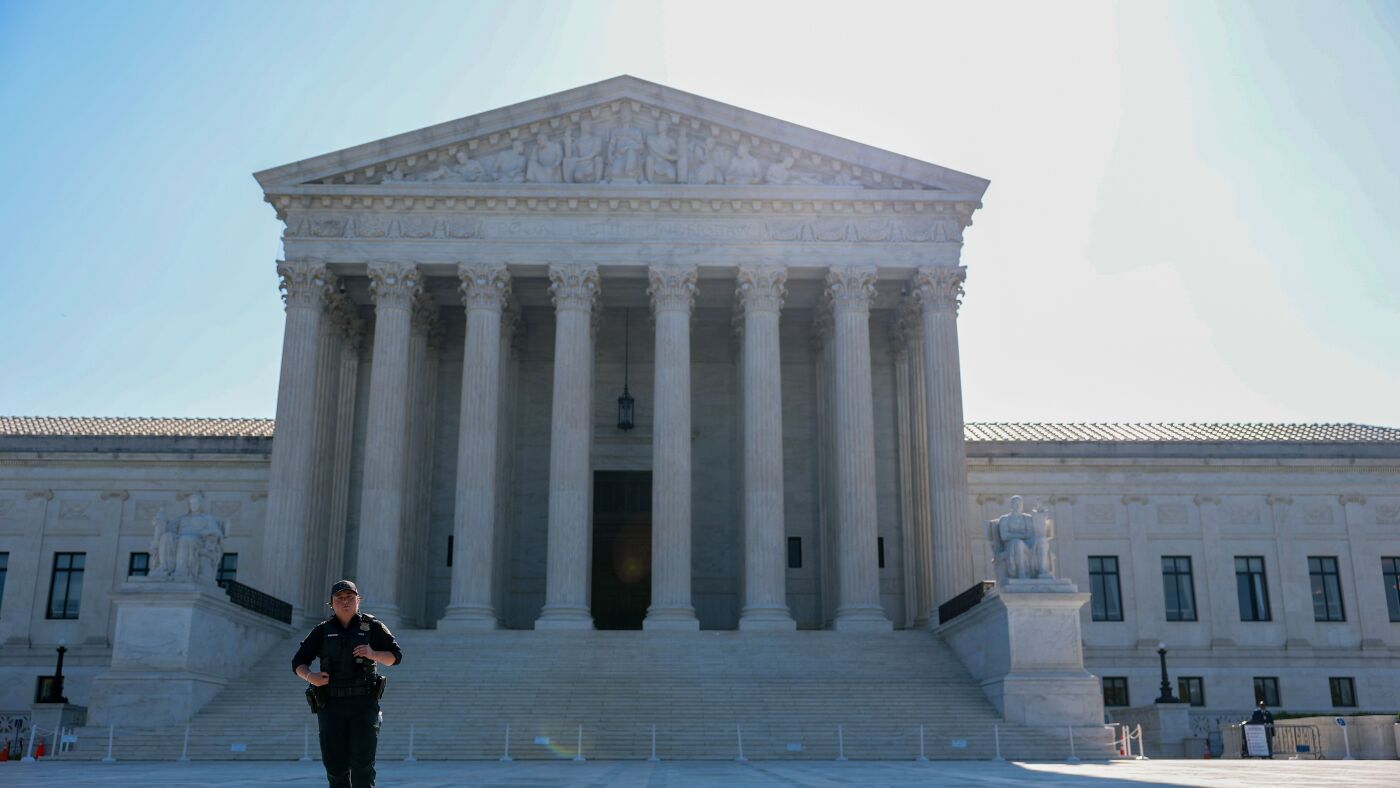
The Supreme Court Tuesday upheld the long-established right of children born on U.S. soil to automatic American citizenship, regardless of their parents’ immigration status. In so doing, the court rejected President Trump’s most aggressive attempt to limit immigration in the United States.
Writing for the court majority, Chief Justice John Roberts traced birthright citizenship back to the founding of the nation. Just as the colonists demanded “the rights of Englishmen” more than 250 years ago, he said, Congress, after the Civil War, amended the Constitution to specify automatic citizenship for any child born on U.S. soil.
“Citizenship then and now was the right to have rights”—and the framers of the 14th amendment extended that promise to every free born person in this land. He concluded: “We keep that promise today.”
The vote was 6-to-3, depending on how you count it. Altogether, five justices signed on to the Roberts’ majority opinion. A sixth, Justice Brett Kavanaugh, agreed only that federal legislation enacted in the 1950s grants automatic citizenship for children born in the U.S.
Justice Clarence Thomas wrote the lead dissent, a 91-page opus that agreed with Trump’s assertion that the 14th amendment only applied to former slaves and their descendants. The Thomas dissent added ominously that he “was not sure that “today’s opinion will stand the test of time.” The dissent was joined by Justice Neil Gorsuch, with Justice Samuel Alito writing a separate dissent.
Justice Ketanji Brown Jackson, who, like Thomas is African American, responded to some of the themes in the Thomas dissent.
“Despite his longstanding endorsement of a colorblind society,” she wrote, “Justice Thomas now surprisingly suggests that the citizenship clause was a race-conscious remedial measure relating only to freed slaves.”
Cecillia Wang, legal director of the ACLU, who successfully argued the case at the Supreme Court, said President’s Trump failed attempt to limit birthright citizenship was transparent.
“A majority of the court saw through what the president was trying to do in spinning birthright citizenship as something that can flex and retract and expand depending on what the administration in power thinks about immigration policy,” she said.
Wang sees birthright citizenship as “much more fundamental than that.”
“It is part of how our country rejected caste distinctions and championed freedom and equality,” she said.
Yale law professor Akhil Amar called the court’s opinion a classic example of the court sticking to the original meaning of the Constitution. The text of the 14th Amendment, he said, “is about the child. It doesn’t say anything about parents.”
University of Virginia law professor Amanda Frost, however, was surprised and saddened that the court was so closely divided.
“The very length of the opinion,” she told NPR, plus “the fact that you had four justices say the Constitution does not require near universal birthright citizenship, which had been the understanding, that suggests that this is a fringe argument that the Trump administration has succeeded in moving into the mainstream, even though it has not succeeded in the end of the result.”
The issues in the birthright case focused in large part on the longstanding, and as of Tuesday, still standing, meaning of the 14th Amendment, which was enacted after the Civil War. It guarantees birthright citizenship to almost all persons born or naturalized in the United States. Chief Justice Roberts pointedly said the only exceptions written into the amendment were for certain Indian tribes, which were not subject to the laws of the United States at the time, and the children of foreign diplomats. That understanding was so well accepted that even in World War II, when Japanese citizens were confined to internment camps, their children, born in those camps, were automatically deemed to be American Citizens.
The Supreme Court’s decision Tuesday was the second time the justices have upheld birthright citizenship. The court’s previous decision came in 1898 in the case of Wong Kim Ark, born in the U.S. to Chinese parents. His great grandson, Norman Wong, issued a statement today saying, “My great grandfather, Wong Kim Ark, never set out to become a symbol. He was one man, only a cook, and yet he stood up for what was right, and I believe that it has made a difference. As a result, he stood up for the rights of all of us Americans – it just so happens that I am related to him. Today’s ruling shows that his victory remains as important now as it was in 1898.”
The high court also issued opinions in two other cases on Tuesday. In a 6-to-3, ideologically divided vote, the court upheld state laws that prevent transgender athletes from playing on women’s sports teams. Writing for the conservative majority, Justice Brett Kavanaugh said that the laws violate neither federal statutes nor the 14th Amendment. States, he said, have a legitimate interest in protecting the safety of sports, which he suggested could be compromised if transgender girls or women are allowed to play on female teams. Similarly, he said transgender athletes could also compromise fairness in athletic competition.
Sitting in the court chambers Tuesday when Kavanaugh summarized his opinion were not only his wife and mother, but his two daughters, whose athletic teams their father has long coached.
Justice Sonia Sotomayor, joined by her liberal colleagues, issued a partial dissent. She agreed with the majority that the benefits of sports are “immense,” but she wrote that these laws unconstitutionally deny transgender athletes the opportunity to play with their peers.
In a third ideologically divided case Tuesday, the Court struck down decades-long limits on the amount of money political parties can spend on candidates. The limits were challenged by the Republican National Committee. The decision may well increase by millions of dollars the amount of money that will pour into campaigns.

Rep. Thomas Kean Jr., R-N.J., arrives at the U.S. Capitol with his wife Rhonda Kean on June 30.
Anna Moneymaker/Getty Images
hide caption
toggle caption
Anna Moneymaker/Getty Images
New Jersey Republican Thomas Kean Jr. said it was struggles with depression that kept him away from Congress for nearly four months with no explanation to his constituents.
Kean last voted on March 5th, missing numerous votes and other appearances on Capitol Hill since. In April, House Speaker Mike Johnson told reporters he had spoken to Kean and that he was dealing with an undisclosed medical issue. Kean was not spotted until recently at his New Jersey home.
Speaking from the House floor on Tuesday, the second term lawmaker said he had checked into a hospital for testing several months ago after health concerns, and was subsequently diagnosed with depression.
“Talking about myself has never come naturally,” Kean said. “But I believe that I owe an explanation to the people of New Jersey’s seventh district, to my colleagues in this chamber and to the American people for my absence.”
Kean said he originally did not think his diagnosis would result in a long-term absence. Doctors recommended he remain in the hospital to address the illness, and it was his fastest route to recovery, he said.
“It is physical. It is emotional,” he said. “And until you experience it yourself, it is difficult to fully understand how powerful this illness could be.”
Kean said he miscalculated how long he would be away, estimating it would be a matter of weeks. However, he said like the roughly 48 million Americans who have battled the illness, he learned there is no timeline for recovery.
“I am grateful that I accepted help,” Kean said. “Today I stand before you healthier, stronger and excited to return to the work that I love.”
Kean’s absence proved a struggle for House Republicans, who contend with a razor thin majority to pass party priorities. For weeks, Kean and his office declined to share additional details on why he was away, feeding rumors and speculation and raising interest in a member known for his privacy.
Despite his absence, Kean won the GOP primary earlier this month to defend his seat in Congress in this fall’s midterm elections. He will face Democrat Rebecca Bennett, a former U.S. Navy helicopter pilot and healthcare executive.
Bennett has targeted Kean’s absence in her campaign. Democrats have said Kean’s 7th congressional district is a top target to flip in their pursuit of taking back the majority.
“Tom Kean Junior, wherever you are, you have failed this district,” Bennett told supporters at an event last week.
In a statement after Kean’s remarks on Tuesday, Bennett said she was relieved he was well and wished him good health.
“But let’s be clear: I got into this race because Tom Kean Jr. was failing our community long before this absence,” she said.
Kean is not the first member of Congress in recent years to speak publicly about their struggles with depression. Sen. John Fetterman, D-Pa., took leave from the Capitol in 2023 after he was diagnosed with the illness. In Fetterman’s case, his office announced the news within days of his starting treatment.
Kean was elected to Congress for his first term beginning in 2023, flipping a district that was represented by former Democratic Congressman Tom Malinowski.
He comes from a long line of politicians: His father, former New Jersey Gov. Thomas Kean Sr., was appointed by former President George W. Bush as a chair of the 9/11 Commission. Kean’s grandfather and great grandfather also served in Congress.

Members of the National Guard stand in front of a large image of U.S. President Donald Trump that hangs from the the Robert F. Kennedy Department of Justice Building on May 18, 2026 in Washington, D.C.
Andrew Harnik/Getty Images North America
hide caption
toggle caption
Andrew Harnik/Getty Images North America
WASHINGTON, D.C. — In a strongly worded letter to the head of Michigan’s National Guard, Gov. Gretchen Whitmer reiterated troops from her state are only to be used for operations surrounding America 250 celebrations in Washington, D.C., and not for President Trump’s long-running — and controversial — joint task force to fight crime. She said that she would pull her troops from the city if that is not the case, in the letter obtained by NPR.
“Please take all necessary measures to ensure the Michigan National Guard is only supporting the narrow and limited America 250 Mission and is in no way supporting the D.C. Safe and Beautiful Mission,” wrote Gov. Whitmer, referencing the official name for the federal task force.
Trump deployed hundreds of troops to Washington, D.C., in August of 2025, in what experts said was a stunning departure from governing norms. He said he did so to address rampant crime, despite declining crime rates at the time. The number of troops in the city has increased over time to more than 4,800 from Washington, D.C. and almost two dozen states, which until recently were exclusively Republican-led.
Michigan — which has 161 guard members currently in the city — is one of four Democratic-led states that sent members of their National Guard to D.C. in recent weeks, ahead of an influx of tourists for America 250 celebrations. North Carolina and Kentucky each sent one member of their guard, while Minnesota sent more than a hundred last week.
Kentucky confirmed to NPR Monday that it had recalled its one guard member over the weekend, after that member was “diverted to the task force by the federal government without the knowledge or consent of Gov. Beshear of the Kentucky Guard,” Scottie Ellis, a spokesperson for Gov. Beshear, wrote to NPR in an email.
When contacted by NPR, spokespeople for each respective Democratic governor’s office made it clear that their guard members were sent to help specifically with America 250, not for law enforcement purposes as part of the larger ongoing federal joint task force operation. All four states have been clear about their opposition to the Trump administration’s ongoing deployment of National Guard troops to D.C., filing an amicus brief in support of litigation challenging it as recently as May.
But in recent days, a video of troops identifying themselves as Michigan National Guard members patrolling the Georgetown waterfront — an upscale neighborhood more than a mile away from any official America 250 celebrations — began circulating on social media. NPR has authenticated the video. Whitmer’s office did not immediately respond to NPR’s request to verify that the troops were Michigan members.
All state guard members are currently in D.C. under Title 32 status, which essentially means that the federal government pays for the deployment, but the state governors maintain control and command of their troops. But former National Guard officials say it’s impractical for states to play a role in day-to-day activities in a complex national mission like what’s happening in D.C.
“If the National Guard has defined the America 250 Mission to extend beyond direct support for events celebrating the nation’s 250th anniversary, please let me know so we can ensure the Michigan National Guard’s efforts are carefully limited,” Gov. Whitmer’s letter reads.
It goes on to say that if that can’t be ensured, then Gov. Whitmer will “end Michigan’s support for the America 250 mission.”
Legal experts, like those at the Brennan Center for Justice who have closely been watching Trump’s ongoing deployment to D.C., worry that drawing a distinction between the America 250 celebration and the general mission of the joint task force in the city will prove difficult. The joint task force is largely carrying out high visibility presence patrols in residential neighborhoods, public parks and metro stations.
Troops from all four Democratic-led states are listed as part of the official federal joint task force numbers released to the public. Gov. Whitmer said the Michigan troops should not be included in that count.
The offices for other Democratic governors NPR reached out to about that list also said their guard members shouldn’t be included.
When asked about the confusion, a spokesperson for the joint task force told NPR that it is overseeing all guard members in D.C. for organizational purposes, but being on the list “does not change their specific mission.” The joint task force did not immediately respond to NPR’s request for comment as to why Michigan guard members were apparently in Georgetown, and if that was part of the America 250 operations.
-

 Technology4 minutes ago
Warehouse robots move packages without human handoff
-
 Business11 minutes ago
Disneyland to offer $59 evening tickets next month
-
 Entertainment14 minutes ago
After Amazon drops OpenAI movie ‘Artificial,’ film finds new home at Neon
-

 Lifestyle19 minutes ago
ICICLE: Capturing Interest in Chinese Brands
-
 Politics26 minutes ago
Newsom signs off on 100% California tax for money from Trump’s $1.8-billion ‘slush fund’
-
 Science29 minutes ago
After bold pledge, EPA shelves microplastics testing in U.S. drinking water
-
 Sports34 minutes ago
Walter Alston, Dave Roberts and everyone in between: The 10 managers in L.A. Dodgers history
-

 World44 minutes ago
World’s oceans experience hottest June ever, scientists say more heat ahead

