News
Wednesday briefing: Just how bad was the White House accidentally leaking military plans over Signal?


Good morning. Look, it could happen to anyone: I well remember, for example, the time I added my mum to a thread with my siblings discussing what to get her for Christmas. On the other hand, I don’t have a secure communications facility in my house for when I need to get something out on the family group chat. Also, we rarely digress from pictures of cute kids to setting out war plans for an imminent set of airstrikes on the Houthis in Yemen.
So perhaps the latest Trump administration hullabaloo isn’t that relatable, after all. Two days after the Atlantic’s Jeffrey Goldberg revealed that he had been mystifyingly added to a thread on Signal – an encrypted WhatsApp-like instant messaging app – in which vice-president JD Vance, defence secretary Pete Hegseth, and a host of others chatted about a highly sensitive operation, there are as many questions as answers. How on earth did Goldberg get added in the first place? Why didn’t anybody realise the error? Are White House officials doing this all the time? And how vulnerable are their communications to interception from America’s adversaries?
Today’s newsletter explains this absolute dumpster fire of a story, and why it matters. Here are the headlines.
Five big stories
-
Spring statement | Rachel Reeves will make additional welfare cuts in her spring statement on Wednesday after the Office for Budget Responsibility rejected her estimate of savings from the changes announced last week. The chancellor is expected to announce an additional £500m in benefits cuts to make up part of the £1.6bn shortfall.
-
Ukraine | Russia and Ukraine have agreed to “eliminate the use of force” in the Black Sea, though the Kremlin said it was conditional on sanctions relief for its agricultural exports. The warring parties also agreed to implement a previously announced 30-day halt on attacks against energy networks.
-
Assisted dying | The introduction of assisted dying in England and Wales is likely to be pushed back by a further two years in a delay that supporters fear could mean the law never comes into force. The delay marks the latest major change to the proposals, which have proven deeply contentious in the Commons and beyond.
-
Gaza | Press freedom organisations have condemned the killing of two journalists in Gaza on Monday by the Israeli armed forces. Hossam Shabat, a 23-year-old correspondent for the Al Jazeera Mubasher channel, and Mohammed Mansour, a correspondent for Palestine Today, died in separate targeted airstrikes.
-
Society | Non-monogamous people are just as happy in their relationships as those with only one partner but are not “significantly” more sexually satisfied, research suggests. The authors of a new study said their findings challenged what they called a prevailing “one-size-fits-all approach to relationships”.
In depth: How a journalist got a front row seat to US military planning
“This is going to require some explaining,” Jeffrey Goldberg writes at the beginning of his Atlantic story about how Pete Hegseth ended up messaging him about an imminent attack on Yemen, and he’s absolutely right.
In brief: Goldberg was added to a Signal thread by Michael Waltz, Donald Trump’s national security adviser, who presumably confused his contact with someone else’s. Goldberg was allowed to lurk on the thread for several days as senior officials – here’s a rundown of the dramatis personae – discussed the timing of the strike against the Houthis, fulminated against European “free-loading”, and celebrated the operation’s success with fire emojis. Eventually, Goldberg removed himself, and then wrote a story about it. Since then, all hell has broken loose.
Here’s what else you need to know about the significant issues raised by this fiasco – and, as a bonus, the best quote from the fallout so far: “Everyone in the White House can agree on one thing: Mike Waltz is a fucking idiot.” (Donald Trump said he was “doing his best”, but the two aren’t mutually exclusive.)
What’s the problem with having national security discussions on Signal?
The most glaring issue is the lack of adequate security protocols for discussions about US military operations – even if, hilariously, Hegseth sent a message to the group saying “we are currently clean on OPSEC” while Goldberg was still in it.
Such conversations are meant to be held in enclosed areas called sensitive compartmented information facilities, or Scifs, which have reinforced physical defences against eavesdropping, tight controls on access, and shields against electronic surveillance. Many senior government officials have Scifs installed at their homes; failing that, they are meant to use secure government-issued devices. Peter Beaumont has more on what America’s adversaries might have learned.
To state the most obvious point: if the discussion had been held under such conditions, a journalist would not have been accidentally added. But even if Goldberg hadn’t been included, significant issues would remain.
While the messaging app Signal is a more secure way to exchange messages than ordinary texting, it is a rung below official government communication channels. One aspect of the risk is that it is possible to download messages to a desktop, which lacks the layers of security in the app itself. The Pentagon warned its employees against using Signal last week.
It is also possible that the participants were using their own devices. In this Politico piece, a former White House official warns: “Their personal phones are all hackable, and it’s highly likely that foreign intelligence services are sitting on their phones watching them type the shit out.”
Is it possible the participants broke the law?
By holding sensitive national security discussions on a commercially available app, the participants may well have violated the US espionage act. Kevin Carroll, a national security lawyer, told the Washington Post: “I have defended service members accused of violating the Espionage Act through gross negligence for far, far less. If these people were junior uniformed personnel, they would be court-martialed.”
Vance, Hegseth and their colleagues may also have been in breach of federal records law – which mandates that messages about official acts be preserved. Many former officials have said that for that reason, they confined their use of platforms like Signal to bland logistical discussions or as a way to direct others to a more secure channel.
That is not what happened here – and because Waltz switched on Signal’s “disappearing messages” function, the discussions might have vanished for ever barring Goldberg’s accidental inclusion. Yesterday, CIA director John Ratcliffe, another participant, claimed that the decisions taken in the group were also formally recorded.
What did we learn about the Trump administration’s view of Europe?
One thing the leak makes absolutely clear: when Vance expresses his disdain for Europe in public, he isn’t putting it on. Part of the discussion about the timing of a strike against the Houthis was focused on the idea that by protecting a trade route used by European shipping, Washington was giving EU countries a free ride.
Vance, who expressed his reluctance to conduct the operation immediately, eventually said: “If you think we should do it let’s go. I just hate bailing Europe out again.” In reply, Hegseth agreed: “I fully share your loathing of European free-loading. It’s PATHETIC.”
The discussion concluded with a suggestion that “we soon make clear” that Europe should contribute to the cost of the operation.
In Brussels yesterday, all of that was greeted with weary dismay. “Horrific to see in black and white,” one European diplomat told the BBC. “But hardly surprising.”
Are there any awkward historical precedents which the protagonists have expressed strong opinions about?
Funny you should ask! After the story broke, CNN put together a montage that showed just some of the times that those involved in the message thread took a stern line on the notorious row over Hillary Clinton’s use of a private email server while in office.
“If it was anyone other than Hillary Clinton, they’d be in jail right now,” Hegseth said on Fox News in 2016. Marco Rubio said in the same year that “nobody is above the law – not even Hillary Clinton.” And Ratcliffe said in 2019 that “mishandling classified information is still a violation of the espionage act”.
Later, Trump’s consigliere Stephen Miller tweeted that because of Clinton’s “illegal” behaviour, “foreign adversaries could easily hack classified ops & intel in real time from other side of the globe.” With that uncompromising line, the White House must be hoping Stephen Miller never hears what Stephen Miller’s been up to.
The administration steered well clear of addressing that aspect of the story. Hillary Clinton didn’t, though: “You have got to be kidding me,” she wrote on X, along with an eyeballs emoji.
How have Trump’s supporters fought back?
The White House has admitted the thread “appears to be authentic”. Still, that didn’t stop Hegseth turning to a familiar strategy in response: attack the media.
“Nobody was texting war plans,” he said, although Goldberg reported that Hegseth himself texted “operational details of forthcoming strikes on Yemen”.
after newsletter promotion
Hegseth also sought to discredit Goldberg, among the most eminent journalists in the United States and one with no obvious track record of dishonesty: “You’re talking about a deceitful and highly discredited so-called journalist who’s made a profession of peddling hoaxes.” Later, Trump called him a “total sleazebag”. Waltz, for his part, called him “bottom scum” and suggested he could have got himself added to the group “deliberately” because he “wasn’t on my phone”, a fairly head-scratching claim.
All of that aligned closely with the approach taken by presenters on Fox News. Sean Hannity dismissed it as “the state-run legacy media mob” being “obsessed with an accidentally leaked text”.
Another Will Cain, found a silver lining: “After years of secrecy and incompetence, if you read the content of these messages, I think you will come away proud that these are the leaders making these decisions in America.”
But the idea that there’s nothing to see here doesn’t seem to have landed with everyone. At a hearing before the Senate intelligence committee yesterday, John Ratcliffe and Tulsi Gabbard, the director of national intelligence who was also on the thread, faced intense questioning about their roles, and found it tricky to agree on a strategy: immediately after Gabbard refused to confirm her participation in the thread, Ratcliffe confirmed he had done so and said it was permissible.
“What you’re saying didn’t make sense,” said Democratic senator Mark Warner. Somewhere in Washington, a Republican was probably sending an eyeroll emoji.
What else we’ve been reading
-
Lorenzo Tondo spoke to witnesses about the brutal assault on Oscar-winning Palestinian director Hamdan Ballal by settlers, who handed him over to the military, bruised and bleeding. The attack on Ballal, who was subsequently detained, “might be their revenge on us for making the movie. It feels like a punishment,” said Basel Adra, another of No Other Land’s directors. Nimo
-
The Guardian’s blockbuster invertebrate of the year prize continues with Patrick Barkham singing the praises of the “twerking pollinator with a bum-bag”: it is, of course, the dark-edged bee-fly. Slightly alarmingly, they “use false legs to bumble into a bee burrow and scoff the pollen left for the bee babies”. Archie
-
Rashid Khalidi is searing in his response to Columbia University’s “capitulation” with the Trump administration’s sweeping policy changes last week. “Columbia barely merits the name of a university, since its teaching and scholarship on the Middle East, and soon much else, will soon be vetted by a ‘senior vice-provost for inclusive pedagogy’, in reality a senior vice-provost for Israeli propaganda,” he writes. Nimo
-
The bleak sight of Conor McGregor visiting the White House on St Patrick’s Day has not gone down well with most people in Ireland, writes Justine McCarthy – but his putative presidential run risks galvanising the country’s “small but vocal minority on the hard right”. Archie
-
For those who are mourning the end of Severance (me), Claire Cao has a great antidote: the film Triangle (pictured above) will scratch the “puzzle box” sci-fi plot itch that the Ben Stiller thriller has left. Nimo
Sport
Football | Real Madrid are close to completing a deal to sign Trent Alexander-Arnold on a free transfer this summer. The Liverpool right-back has long been a target for the European champions and there is now a widespread expectation that he will join Carlo Ancelotti’s side when his contract expires at the end of the season.
Football | David Brooks scored in the sixth minute of injury time to rescue a point for Wales in their World Cup qualifier against North Macedonia. The game had been 0-0 until Bojan Miovski’s goal as normal time expired.
Tennis | As Emma Raducanu enjoys her best run of form since her 2021 run to the US Open title, she now comes up against Jessica Pegula in the quarter final of the Miami Open. The match is just reward for her persistence, writes Tumaini Carayol: “to her credit she kept on rolling with the punches and showing up.”
The front pages
“Fears of further tax rises as Reeves promises to ‘secure Britain’s future’” is the splash on the Guardian today, while the Financial Times says “Reeves to leaven grim spring outlook with £2.2bn defence spending boost.” The spring statement is also previewed in the Daily Mail, which has “Don’t shift blame for economy’s woes, voters tell Reeves,” and the Mirror, which runs an interview with Rachel Reeves under the headline “My mission.”
“Victims must see ‘sense of justice being served’” is the lead story on the Express, while “Mortal blow to assisted dying Bill” is the focus in the Telegraph. “JD Dunce hates Britain, hates Europe and hates Ukraine…And could be president at any moment,” says the Star, and the Metro: “Trump backs chump.” The Sun covers a row over the pricing of Oasis tickets with the headline “Definitely Shady”.
Today in Focus
The arrest that plunged Turkey into turmoil
Protesters took to streets after President Erdoğan had his rival arrested. What will happen next? Sami Kent and Ruth Michaelson report
Cartoon of the day | Rebecca Hendin
The Upside
A bit of good news to remind you that the world’s not all bad
In Grenada, the persistent issue of sargassum seaweed, which has long plagued the island’s shores, is being reimagined as an opportunity rather than a burden. While the decaying seaweed causes bad smells and disrupts fishing and tourism, innovative solutions are emerging. The Grenadian government, in collaboration with the EU, is exploring ways to turn sargassum into a valuable resource, including clean energy, bioplastics, and fertiliser.
Companies such as Seafields are developing methods to farm the seaweed and harness its potential, which could boost the economy. A bioenergy project is already converting sargassum into biogas and organic fertiliser. “They use diesel to generate electricity 1742975300, which is very expensive for the local population. We are providing a reliable, cost-effective and sustainable alternative,” Benjamin Nestorovic, who works for the Grenada-based bioenergy company SarGas, says, adding that the company plans to expand across the Caribbean.
Bored at work?
And finally, the Guardian’s puzzles are here to keep you entertained throughout the day. Until tomorrow.





The bombing of an Iranian elementary school that killed some 165 people, many of them schoolgirls, included more targets near the school than has been initially reported, a review of commercial satellite imagery by NPR has found.
The images suggest that the school was hit on Saturday as part of a precision airstrike on a neighboring Iranian military complex — and that it may have been struck as a result of outdated targeting information.
The new images come from the company Planet and are of the city of Minab, located in southeastern Iran. They show that a health clinic and other buildings near the school were also struck. Three independent experts confirmed NPR’s analysis of the additional strike points.
The strike points “look like pretty clean detonation centroids,” said Corey Scher, a postdoctoral researcher at the Conflict Ecology laboratory at Oregon State University.
“These certainly appear like detonation sites,” agreed Scher’s colleague, Oregon State associate professor Jamon Van Den Hoek.
Jeffrey Lewis, a professor at Middlebury College who specializes in satellite imagery, said the imagery was consistent with a precision airstrike.
The images show “very precise targeting,” Lewis told NPR. “Almost all the buildings [in the compound] are hit.”
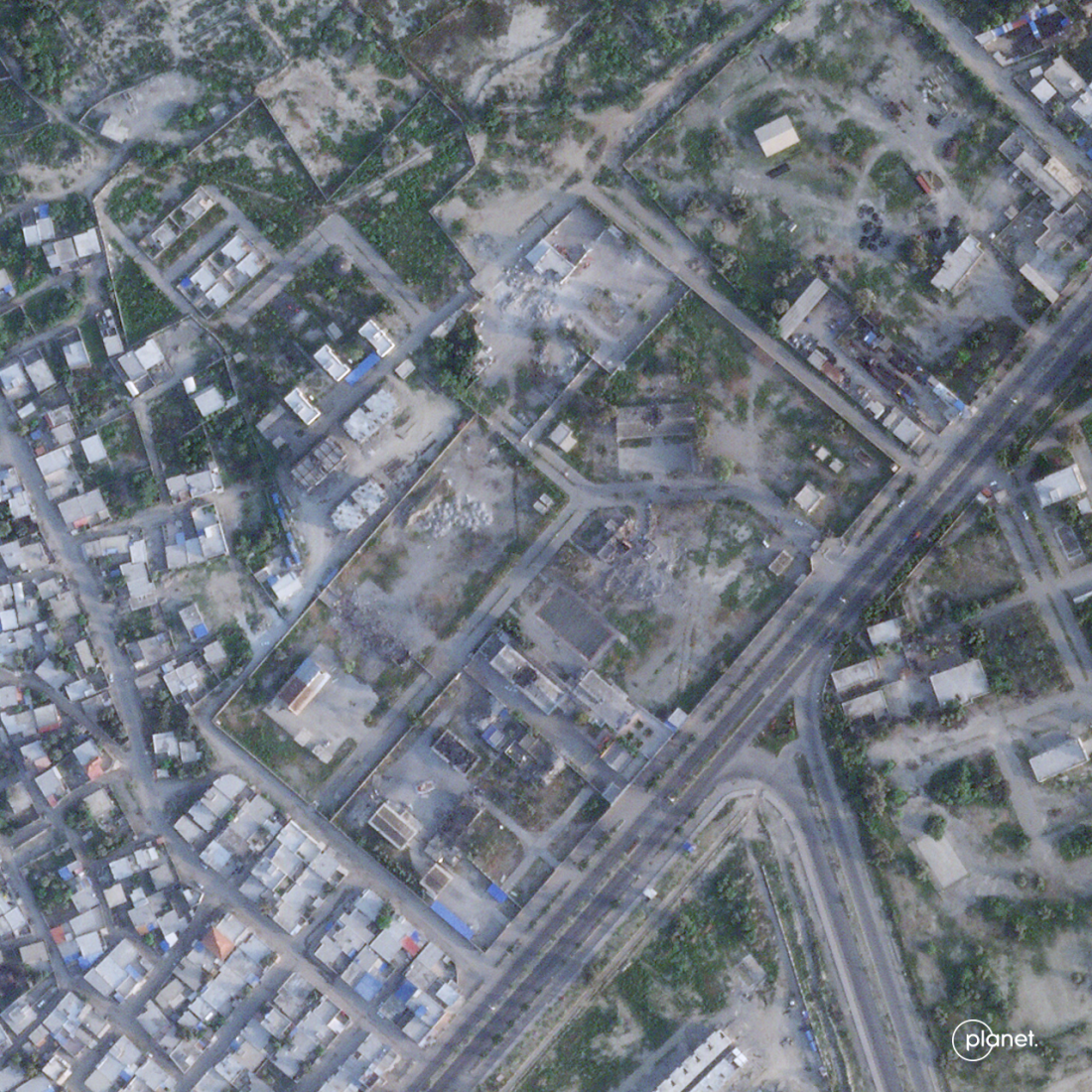
A satellite image of an Iranian Revolutionary Guard compound taken on March 4, several days after an airstrike destroyed a school on the edge of the compound. The image reveals that half a dozen other buildings in addition to the school were struck.
Planet Labs PBC
hide caption
toggle caption
Planet Labs PBC
Iranian state media said 165 people died in the bombing, which struck a girls’ school. The school was located within less than 100 yards of the perimeter of an Iranian Revolutionary Guard naval base, according to satellite images and publicly available information. The clinic was also located within the base perimeter, although both facilities had been walled off from the base.
Israel has denied involvement. “We are not aware at the moment of any IDF operation in that area,” Israel Defense Forces spokesperson Nadav Shoshani told NPR on Monday. “I don’t know who’s responsible for the bombing.”

At a press conference Wednesday morning, U.S. Defense Secretary Pete Hegseth said that the U.S. is looking into what happened at the school. “All I know, all I can say, is that we’re investigating that,” Hegseth said. “We, of course, never target civilian targets.”
Given Minab’s location in the southeastern part of Iran, Lewis believes it’s more likely the U.S. would have conducted the strike than Israel. As one gets farther south and east in Iran, “a strike is much more likely to be a U.S. strike than an Israeli strike because of the type of munitions and the geographic location,” he said.
Esmail Baghaei, the spokesman for Iran’s Foreign Ministry, called the strike “deliberate” and said that the U.S. and Israel bombed the school in part to tie up Iranian forces in the region with rescue efforts. “To call the attack on the girls school merely a ‘war crime’ does not capture the sheer evil and depravity of such a crime,” he said.
But Lewis said it’s more likely that the strike was the result of an error. Satellite images show that the school and clinic buildings were both once part of the base. The school was separated from the base by a wall between 2013 and 2016. The clinic was walled off between 2022 and 2024.
Lewis believes it’s possible American military planners had not updated their target sets.
“There are thousands of targets across Iran, and so there will be teams in the United States and Israel that are responsible for tracking those targets and updating them,” he said. “It’s possible that the target didn’t get updated.”
The Pentagon did not immediately respond to NPR’s request for additional information about the strike.
NPR’s Arezou Rezvani and NPR’s RAD team contributed to this report.

Mojtaba Khamenei, the second son of the assassinated Ali Khamenei, is being heavily tipped to succeed his father as supreme leader of Iran, which would pitch a hardliner into the task of steering the Islamic republic through the most turbulent period in its 48-year history and offer a powerful signal that, for now, it has no intention of changing course.
No official confirmation has been given and the announcement may be delayed until after the funeral of Ali Khamenei, which was on Wednesday postponed.
His son is believed to have been the choice of the Islamic Revolutionary Guard Corps (IRGC), and the Israeli defence minister, Gideon Saar, has warned he will be assassinated.
Ayatollah Seyed Khatani, a member of the Assembly of Experts, the body that chooses the new supreme leader, said the assembly was close to selecting a leader.
Rigid in his anti-western views, Mojtaba Khamenei is not the candidate Donald Trump would have wanted. Marco Rubio, the US secretary of state, said on Tuesday that Iran was run by “religious fanatic lunatics” – and Khamenei’s appointment is hardly likely to dispel that opinion.
The choice of supreme leader is made by the 88-strong Assembly of Experts, who in this case are picking from a field of six possible candidates. His election would be a powerful if unsurprising symbol that the government is not looking to find an accommodation with America.
Trump has said the worst-case scenario would be if Khamenei’s successor was “as bad as the previous person”.
There has been speculation for more than a decade that he would be his father’s successor, which grew when Ebrahim Raisi, the elected president and favourite of Khamenei, was killed in a helicopter crash.
Mojtaba Khamenei was born in 1969 and studied theology after graduating from high school. At the age of 17, he went to serve in the Iran-Iraq war, but it was not until the late 1990s that he came to be recognised as a public figure in his own right.
After the landslide defeat of Khamenei’s preferred candidate, Ali Akbar Nategh Nuri, in the 1997 presidential election, where he won only 25% of the final vote, various conservative Iranian groups realised the need to make changes to their structures and Mojtaba Khamenei was central to that project.
He was also seen as instrumental by reformists in suppressing the protests in 2009 that came after allegations the presidential election had been rigged, with his name chanted in the streets as one of those responsible. Mostafa Tajzadeh, a senior member of Iran’s reformist parties who was imprisoned after the vote, alleged that his and his wife, Fakhr al-Sadat Mohtashamipour’s, legal case was under the direct supervision of Mojtaba Khamenei.
In 2022 he was given the title of ayatollah – essential to his promotion. By then he was a regular figure by his father’s side at political meetings, as well as playing an influential role in the Islamic Republic’s Broadcasting Corporation, the government’s official media outlet often criticised for churning out dull political propaganda that many Iranians reject in favour of overseas satellite channels. He has also played a central role in the administration of his father’s substantial financial empire.
His closest political allies are Ahmad Vahidi, the newly appointed IRGC commander; Hossein Taeb, a former head of the IRGC’s intelligence organisation; and Mohammad Bagher Ghalibaf, the current speaker of the parliament.
His rumoured appointment and its hereditary nature has long been resisted by reformists. The former prime minister Mir Hossein Mousavi, referring to the long history of rumours about Mojtaba Khamenei succeeding his father as leader, wrote in 2022: “News of this conspiracy have been heard for 13 years. If they are not truly pursuing it, why don’t they deny such an intention once and for all?”
The Assembly of Experts, in response, denounced “meaninglessness of doubts” and said the assembly would select only “the most qualified and the most suitable”.
Israel on Tuesday struck the building in the Iranian city of Qom, one of Shia Islam’s main seats of power, where the assembly was scheduled, but the building was empty, according to IRGC-affiliated media.

new video loaded: Senators Question Kristi Noem on ICE Immigration Tactics
transcript
transcript
Senators Question Kristi Noem on ICE Immigration Tactics
Homeland Security Secretary Kristi Noem repeatedly refused to apologize for suggesting that Alex Pretti and Renee Good, two U.S. citizens shot and killed by agents, were domestic terrorists.
-
What we’ve seen is a disaster under your leadership, Ms. Noem. A disaster. What we’ve seen is innocent people getting detained that turn out are American citizens. I could talk about the culture that’s been created here. After the killings of Renee Good and Alex Pretti, when I spoke to Alex’s parents, they told me that you calling him a domestic terrorist — this was directly from them — the day after he was killed, a nurse in our V.A., Alex — one of the most hurtful things they could ever imagine was said by you about their son. Do you have anything you want to say to Alex Pretti’s parents? Ma’am, I did not call him a domestic terrorist. I said It appeared to be an incident of — I think the parents saw it for what it was. In a hearing — recent hearing before the HSGAC committee, C.B.P. and ICE officials testified under oath that their agencies did not inform you that Pretti was a domestic terrorist — during that hearing, stated during that hearing, I was getting reports from the ground, from agents at the scene, and I would say that it was a chaotic scene. How did you think that calling them domestic terrorists at that scene was somehow going to calm the situation? The fact that you can’t admit to a mistake, which looks like under investigation, it’s going to prove that Ms. Good and Mr. Pretti probably should not have been shot in the face and in the back. Law enforcement needs to learn from that. You don’t protect them by not looking after the facts.

By Christina Kelso and Jackeline Luna
March 3, 2026

Nancy Guthrie’s abductor may have returned to the crime scene, left critical clues at tribute: expert

Trump, BBC agree on mediator for $10 billion lawsuit over Jan 6 documentary editing controversy

Rhode Island teacher accused of sexting, kissing high school boy

Detroit Tigers 2026 roster prediction 2.0: Is Kevin McGonigle ready?

Latest California-based gig work app lets people book content creators, editors

Florida High School Football Rankings: Top 25 teams – Oct. 21

Cleary's 21 help Le Moyne down Central Connecticut State 69-64 in OT

How old is Bo Nix? What to know about Oregon quarterback ahead of 2024 NFL Draft

99th annual Pony Swim held in Virginia

Indiana Members Credit Union announced as new anchor tenant at Bottleworks District

DHS defends McLaughlin against allegations husband’s company profited millions from ad contracts: ‘Baseless’

Fareed Zakaria’s takes on Trump and the collapse of nuclear stability

Sánchez defies Trump in political gamble as Madrid say no to war
Satellite images show Iran school strike hit more buildings than earlier reported

US submarine sinks Iranian warship by torpedo in a first since World War II
-

 World1 week ago
Exclusive: DeepSeek withholds latest AI model from US chipmakers including Nvidia, sources say
-

 Massachusetts1 week ago
Mother and daughter injured in Taunton house explosion
-

 Wisconsin3 days ago
Setting sail on iceboats across a frozen lake in Wisconsin
-

 Maryland4 days ago
AM showers Sunday in Maryland
-

 Denver, CO1 week ago
10 acres charred, 5 injured in Thornton grass fire, evacuation orders lifted
-

 Florida4 days ago
Florida man rescued after being stuck in shoulder-deep mud for days
-

 Massachusetts2 days ago
Massachusetts man awaits word from family in Iran after attacks
-

 Oregon6 days ago
2026 OSAA Oregon Wrestling State Championship Results And Brackets – FloWrestling