Your guide to what the 2024 US election means for Washington and the world
“I think the president-elect is having a bit of fun”. That was how the Canadian ambassador to Washington reacted to Donald Trump’s first suggestion that her country should become the 51st American state.
The menacing “joke” is one of Trump’s preferred methods of communication. But the incoming president has now spoken at such length about his ambition to incorporate Canada into the US that Canadian politicians are having to take his ambitions seriously, and reject them in public.
The Canadians have the small solace that Trump ruled out invading their country and is instead threatening them with “economic force”. But he has refused to rule out military action to achieve his ambitions to “take back” the Panama Canal and take over Greenland, which is a self-governing Danish territory.
Advertisement
More light-hearted banter? The chancellor of Germany and foreign minister of France took Trump’s threats seriously enough to warn that Greenland is covered by the EU’s mutual defence clause. In other words — at least in theory — the EU and the US could end up at war over Greenland.
Trump’s defenders and sycophants are treating the whole thing as a huge joke. The New York Post proclaimed a new “Donroe Doctrine” — the 19th-century message to Europeans not to meddle in the western hemisphere — with Greenland relabelled as “our land”. Brandon Gill, a Republican congressman, smirked that the Canadians, Panamanians and Greenlanders should be “honoured” at the idea of becoming Americans.
But the rights of small nations are not a joke. The forcible or coerced takeover of a country by a larger neighbour is the biggest alarm bell in world politics. It is a signal that a rogue state is on the march. That is why the western alliance knew it was crucial to support Ukraine’s resistance to Russia. It is also why the US organised an international alliance to eject Iraq from Kuwait in the early nineties.
Attacks on small countries triggered the first and second world wars. When the British cabinet agonised in 1914 over whether go to war with Germany, David Lloyd George, who later became prime minister, wrote to his wife: “I have fought hard for peace . . . but I am driven to the conclusion that if the small nationality of Belgium is attacked by Germany all my traditions . . . will be engaged on the side of war.”
Britain and France infamously refused to protect Czechoslovakia from Nazi Germany in 1938. But within a year, they had recognised their error and extended a security guarantee to Poland — the next small neighbour on Germany’s hit list. The invasion of Poland triggered the start of conflict.
Advertisement
Trump’s supporters bitterly resent any comparison between his rhetoric and that of aggressors from the past or present. They argue that his demands are actually aimed at strengthening the free world, for a struggle against an autocratic China and possibly Russia too. Trump has justified his expansionist ambitions for Canada, Greenland and Panama on grounds of national security.
Another argument is that Trump’s bluster is simply a negotiating tactic. His supporters sometimes claim that he is just putting pressure on allied nations to do what is necessary, for the greater good of the western alliance. And after all, they say, aren’t many of Greenland’s 55,000 inhabitants seeking independence from Denmark? Are Canadians not tiring of the incompetent “woke” elite who run their country?
But these are feeble arguments. It would be legitimate for Trump to try to persuade Greenlanders that they might be better off as Americans. But threatening to use military or economic coercion is outrageous. His claims that many Canadians would love to join the US are also delusional. The idea was rejected by 82 per cent of Canadians in a recent poll.
As for grand strategy — the reality is that Trump’s threats to Greenland, Panama and Canada are an absolute gift to Russia and China. If Trump can claim that it is a strategic necessity for the US to take over Greenland or the Panama Canal, why is it illegitimate for Putin to claim that it is a strategic necessity for Russia to control Ukraine? If Gill can claim it is America’s “manifest destiny” to expand its frontiers, who could object when Xi Jinping insists it is China’s manifest destiny to control Taiwan?
Both Russia and China have long dreamt of pulling apart the western alliance. Trump is doing their work for them. Just a few weeks ago, it would have been beyond the Kremlin’s wildest dreams to see Canada’s main news magazine running a cover story on “Why America can’t conquer Canada”. The idea of European leaders invoking the EU’s mutual-defence clause against the US — not Russia — would also have seemed like fantasy. But these are the new realities.
Advertisement
Even if Trump never makes good on his threats, he has already done enormous damage to America’s global standing and to its alliance system. And he is not even in office yet.
It does seem unlikely Trump would order an invasion of Greenland. (Although it once seemed unlikely that he would attempt to overthrow an election.) It is even less probable that Canada will be intimidated into surrendering its independence. But the very fact that the incoming president is ripping up international norms is a disaster. Any sniggering at Trump’s “jokes” is misplaced. What we are witnessing is a tragedy — not a comedy.
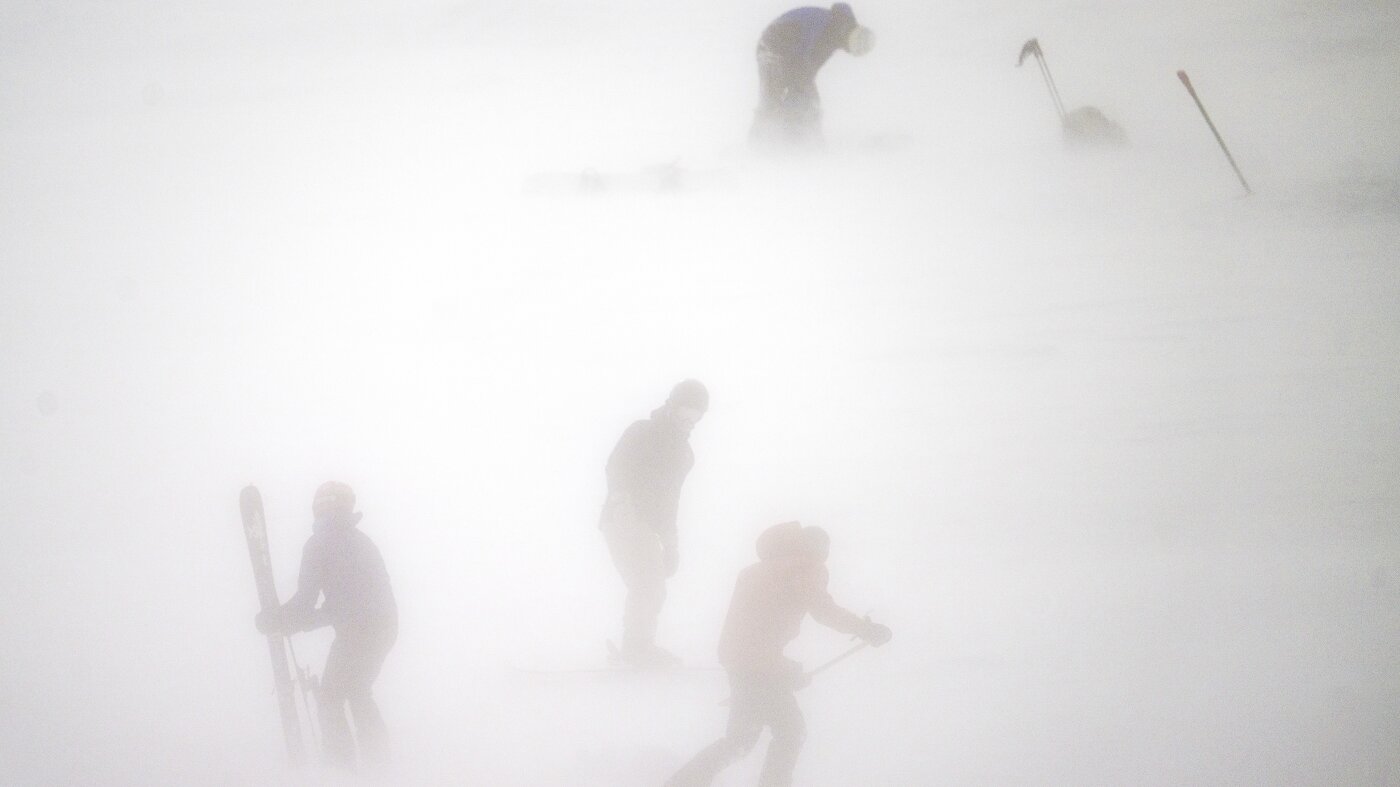
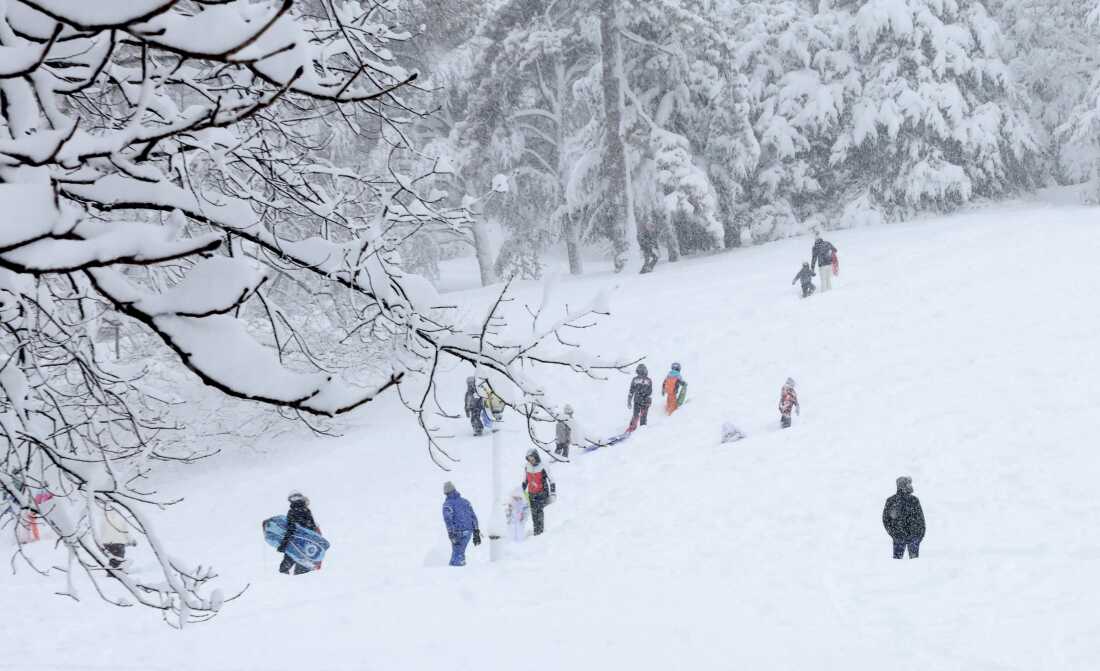
A collection of snow sport enthusiasts brave blowing snow and 20-degree temperatures to ski Horsebarn Hill in Mansfield, Ct. on Monday afternoon as the snow squalls pass from a storm that dropped more than a foot of snow across the state on Feb. 23.
Mark Mirko/Connecticut Public
hide caption
toggle caption
Advertisement
Mark Mirko/Connecticut Public
A powerful winter storm hit the northeast U.S. on Monday, leaving millions stranded at home, prompting travel bans — which were lifted by midday— and flight cancellations throughout New York, New Jersey, Massachusetts, and Connecticut.
According to Connecticut Public, some parts of the state got as much as two feet of snow, while some neighborhoods throughout New York recorded as much as 24 inches of snow. Thousands of residents in New York and New Jersey also reported power outages, with nearly 40,000 customers in New Jersey still without power as of early this evening.
Here are images of the areas affected by the winter storm:
Advertisement
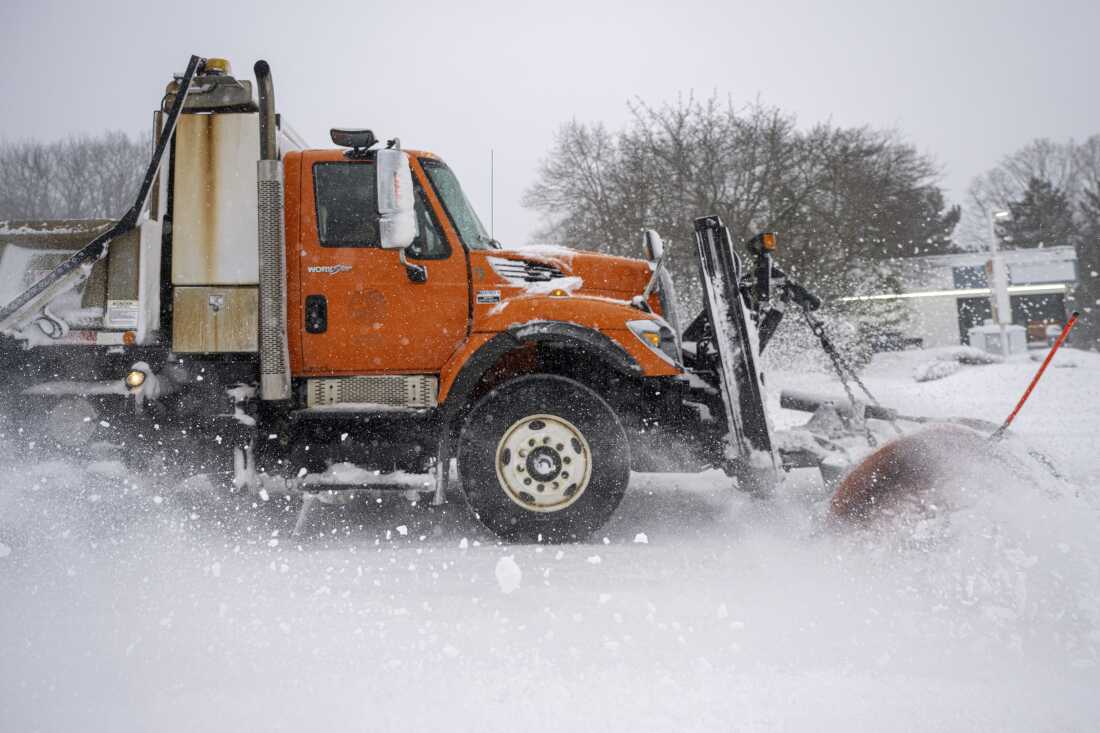
A plow clears Silver Lane between East Hartford and Manchester, Ct. on Feb. 23.
Tyler Russell/Connecticut Public
hide caption
toggle caption
Tyler Russell/Connecticut Public
Advertisement
A person makes a recording while laying in the snow in lower Manhattan during a snow storm on Feb. 23 in New York.
Seth Wenig/AP
hide caption
toggle caption
Advertisement
Seth Wenig/AP
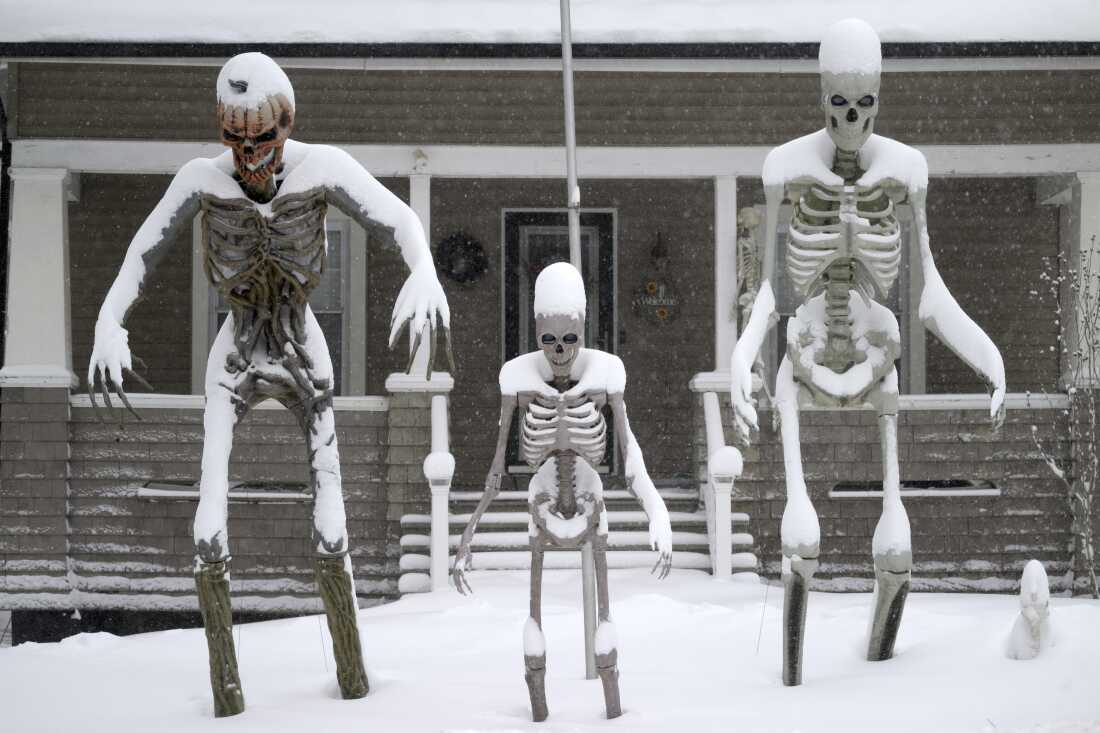
A trio of yard decorations in Willington, Conn. are coated with snow on Feb. 23, during a nor’easter that pounded the state with up to two feet of snow in some areas.
Mark Mirko/Connecticut Public
hide caption
Advertisement
toggle caption
Mark Mirko/Connecticut Public
Residents shovel snow in East Boston, Mass., on Feb. 23.
Elena Eberwein/NHPR
hide caption
Advertisement
toggle caption
Elena Eberwein/NHPR
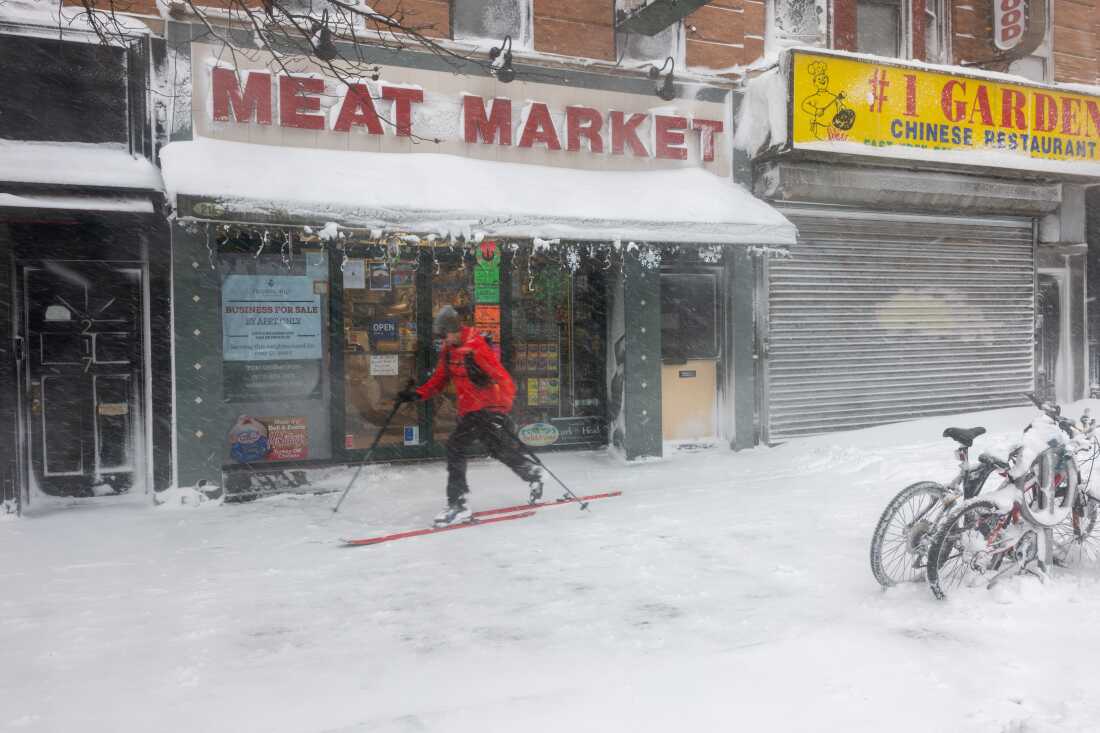
A person skis through the streets of Brooklyn as blizzard conditions continue on Feb. 23 in New York City.
Spencer Platt/Getty Images
Advertisement
hide caption
toggle caption
Spencer Platt/Getty Images
Advertisement
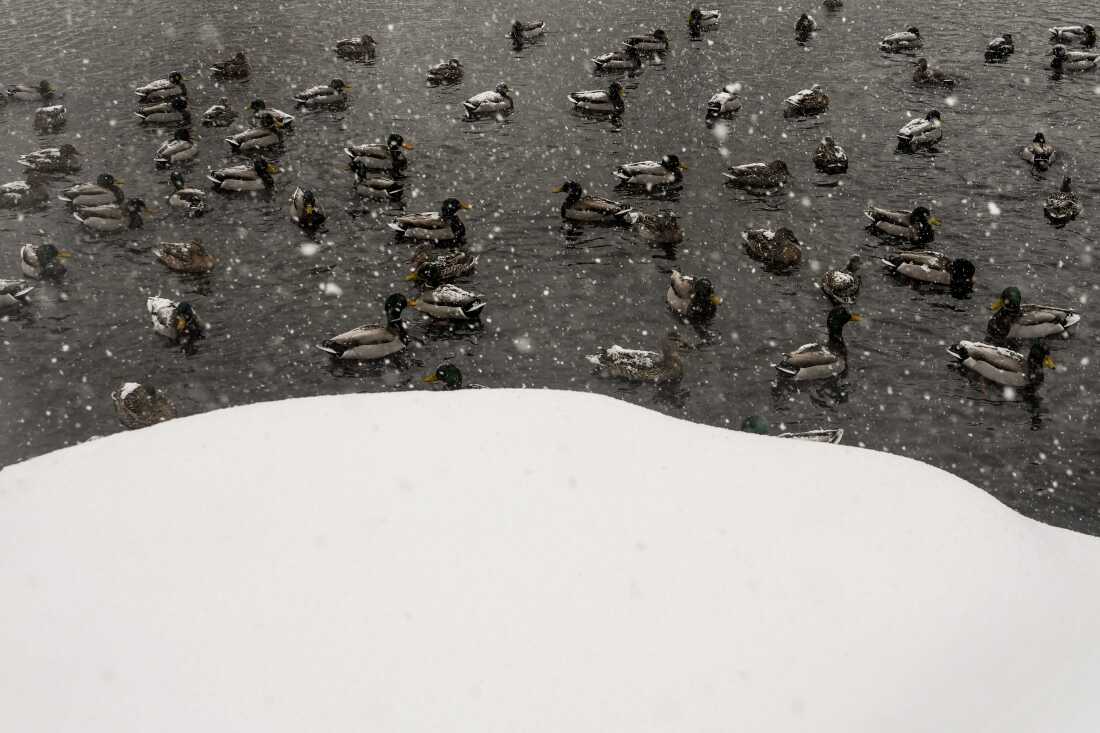
Ducks swim in The Pond during snowfall in Central Park on Feb. 23 in New York City.
Ryan Murphy/Getty Images
hide caption
toggle caption
Ryan Murphy/Getty Images
Advertisement
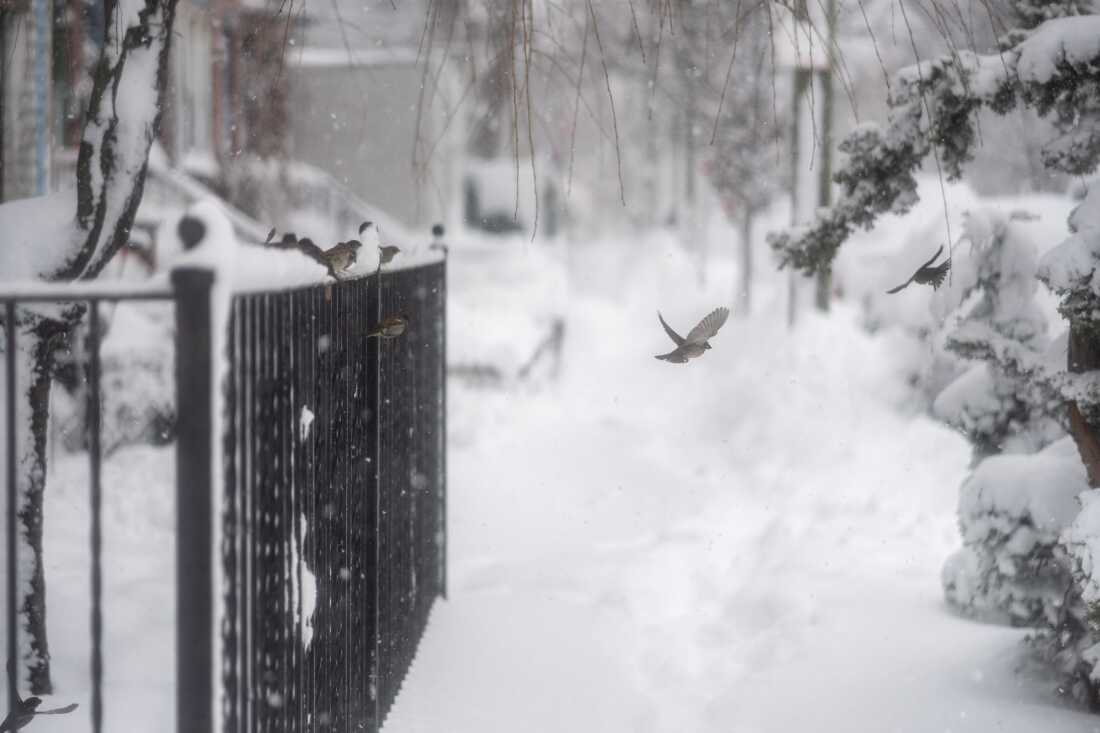
Birds fly between a tree and a railing amid heavy snow on February 23, 2026 in Brooklyn, New York.
Jeremy Weine/Getty Images
hide caption
toggle caption
Advertisement
Jeremy Weine/Getty Images
Children sled on Cedar Hill in Central Park in New York on Feb. 23 during a snow storm.
Timothy A. Clary/AFP via Getty Images
hide caption
Advertisement
toggle caption
Timothy A. Clary/AFP via Getty Images
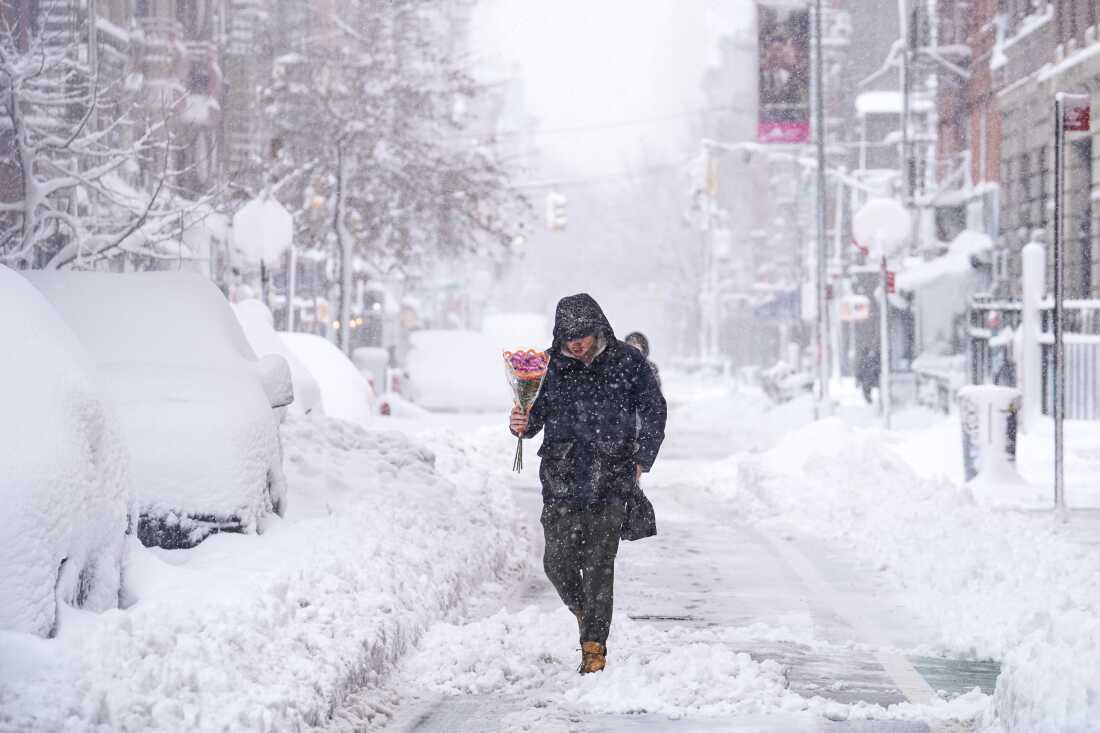
A person carrying flowers walks through the snow in the Lower East Side on February 23, 2026 in New York City.
Suspected gunman was ‘very quiet’ and came from a family of ‘big Trump supporters’, cousin says
The New York Times is reporting that Austin Tucker Martin graduated from Union Pines High School in Cameron, North Carolina, in 2023, and started an artwork company last June that specialised in handmade drawings of golf courses.
According to its website, Fresh Sky Illustrations:
Is an artwork company that mainly focuses on bringing to life the hopeful feeling of being on a golf course by illustrating golf course scenes and providing framed copies of handmade works in various golf course gift shops while handling personal commissions on the side.
Combining the aesthetics of the sunny outdoors, and old digital aesthetics from the mid 2000s, Fresh Sky Illustrations hopes to awaken a sense of hope and comfort with this handcrafted webpage design.
Advertisement
Austin Tucker Martin was described by his cousin as quiet, afraid of guns and from a family of avid Trump supporters. Photograph: Social Media
Martin, who lived in a part of North Carolina renowned for its golf courses, was a registered voter, although state voting records indicate he wasn’t affiliated to a particular party.
The 21-year-old was described by his cousin Braeden Fields as “very quiet” and inexperienced with guns.
“He doesn’t even know how to use a gun. He’s never used a gun,” Fields, 19, told ABC station WTVD hours after Martin had been killed.
Fields said the family are “big Trump supporters” and that Martin has an older brother in the military.
Martin “never really talked about … he didn’t want to get into politics,” Fields said, adding that Martin worked at a golf course, preparing it for the season, and liked to send his paychecks to charity.
Advertisement
“We grew up together, practically,” Fields said. “I never, I wouldn’t believe that he would do something like this. Mind-blowing.”
Key events
Advertisement
Sara Braun
Advertisement
Major institutions of higher education in the US are reckoning with the latest release of the Epstein files after discovering the disgraced financier Jeffrey Epstein’s relationships with board members, professors and administrators on campuses across the country.
In some cases, professors have been placed under review, research centers closed or conferences canceled. Students and staff have responded in different ways, including petitions, open letters and campus forums.
The Guardian spoke with students, employees and alumni at some of the universities implicated.
On 9 February, faculty at Barnard College, the private women’s liberal arts’ college affiliated with Columbia University, published an open letter signed by more than 70 faculty members calling on the university to “acknowledge and investigate” recently released correspondence between Epstein and Francine LeFrak, a prominent donor and member of the school’s board of trustees. LeFrak appears in the Epstein files 15 times, according to reporting from the Barnard Bulletin.
In one appearance, LeFrak asked – in 2010 – to join a close friend and Epstein during “the holidays”; in another, later that year, she invited Epstein “as her guest” to a trip to Rwanda, where she founded an initiative that provides occupational training and employment for female survivors of that country’s genocide.
Advertisement
The letter notes that the connection between Epstein and LeFrak is “repugnant”, particularly since the interaction took place following Epstein’s 2008 conviction of soliciting prostitution from a minor.
Trump launches new attack on ‘ridiculous, dumb’ supreme court ruling
President Donald Trump has launched a fresh attack on the US supreme court following its decision to strike down his tariffs.
Writing on Truth Social, he crowed that the court had “accidentally and unwittingly” given him “far more powers and strength” as a result of its ruling.
He said that other tariffs can be used in a “much more powerful and obnoxious way”.
In his typical rambling style, Trump wrote:
Advertisement
The supreme court (will be using lower case letters for a while based on a complete lack of respect!) of the United States accidentally and unwittingly gave me, as President of the United States, far more powers and strength than I had prior to their ridiculous, dumb, and very internationally divisive ruling.
For one thing, I can use Licenses to do absolutely “terrible” things to foreign countries, especially those countries that have been RIPPING US OFF for many decades, but incomprehensibly, according to the ruling, can’t charge them a License fee – BUT ALL LICENSES CHARGE FEES, why can’t the United States do so? You do a license to get a fee! The opinion doesn’t explain that, but I know the answer! The court has also approved all other Tariffs, of which there are many, and they can all be used in a much more powerful and obnoxious way, with legal certainty, than the Tariffs as initially used.
Our incompetent supreme court did a great job for the wrong people, and for that they should be ashamed of themselves (but not the Great Three!). The next thing you know they will rule in favor of China and others, who are making an absolute fortune on Birthright Citizenship, by saying the 14th Amendment was NOT written to take care of the “babies of slaves,” which it was as proven by the EXACT TIMING of its construction, filing, and ratification, which perfectly coincided with the END OF THE CIVIL WAR. How much better can you do than that?
But this supreme court will find a way to come to the wrong conclusion, one that again will make China, and various other Nations, happy and rich. Let our supreme court keep making decisions that are so bad and deleterious to the future of our Nation – I have a job to do.
Alex Daniel
Donald Trump’s administration has said it will stop collecting tariffs the supreme court ruled were illegal as they were imposed using emergency powers, as investors attempted to digest the US president’s latest volley of replacement levies.
Advertisement
The US dollar slumped 0.4% against a basket of other currencies on Monday after the US Customs and Border Protection (CBP) agency said it would deactivate all tariff codes associated with International Emergency Economic Powers Act (IEEPA) related orders as of Tuesday at midnight (5am UK time).
Gold jumped 0.6% to $5,135 an ounce, its highest level since the end of January, as investors flocked to the safe haven asset, while bitcoin dropped as much as 4.8% to $64,300 before recovering some ground, at $65,734. Futures tracking the US S&P 500 stock market slipped 0.5% on Monday morning.
The supreme court ruled last week that Trump had overstepped his legal authority to impose his “liberation day” measures last year, plunging financial markets into a new phase of uncertainty over where US trade policy will land.
Trump retaliated over the weekend with a new flat-rate global tariff of 15% under a separate legal authority to replace the tariffs that had been struck down. The new levies will come into force on Tuesday and could last for up to 150 days under separate powers.
The European Union is poised to freeze the ratification process of its trade deal with the US and is seeking more details from president Donald Trump’s administration on its new tariff program, Bloomberg News reported on Monday.
Advertisement
Zeljana Zovko, the lead trade negotiator in the European People’s Party group on the US deal, told Bloomberg in an interview that the EU has “no other option” but to delay the approval process to seek to clarity on the situation.
The center-right EPP group is the largest political bloc in the European parliament.
Donald Trump is yet to respond to the incident but the White House press secretary, Karoline Leavitt, wrote in a post on X on Sunday:
In the middle of the night while most Americans were asleep, the United States Secret Service acted quickly and decisively to neutralize a crazy person, armed with a gun and a gas canister, who intruded President Trump’s home.
Federal law enforcement are working 24/7 to keep our country safe and protect all Americans. It’s shameful and reckless that Democrats have chosen to shut down their Department.
Richard Luscombe
Richard Luscombe is a reporter for Guardian US based in Miami, Florida
Investigators believe the suspect left North Carolina and headed south, picking up a shotgun along the way, Secret Service spokesperson Anthony Guglielmi said.
The box for the gun was recovered in his vehicle, Guglielmi said. The man drove through the north gate of Mar-a-Lago as another vehicle was exiting, and he was confronted by Secret Service agents and was fatally shot …
Advertisement
Sunday’s episode has parallels with a 2019 incident in which a Chinese woman carrying multiple cellphones and a computer thumb drive bearing malware gained access to the main lobby of Mar-a-Lago, having evaded security.
A Palm Beach County Sheriff Office vehicle patrols a road block near the Mar-a-Lago club in West Palm Beach, Florida, on 22 February 2026. Photograph: Cristóbal Herrera-Ulashkevich/EPA
That was one of a number of incidents during Trump’s first term in office that drew accusations of lax security at the club, which he has often called his “winter White House”.
In July, 2024, Trump was wounded during an assassination attempt as he spoke at a rally for supporters in Butler, Pennsylvania, during the presidential election campaign. A bullet grazed his ear and some spectators were killed.
Then on 15 September of the same year a man with a rifle was captured after waiting near Trump’s golf course in West Palm Beach while the president played a round. He appeared to be pointing the weapon through a perimeter fence. He was sentenced to life in prison earlier this month.
Last Wednesday, police in Washington arrested a man from Georgia who was armed with a loaded shotgun and sprinted towards the west side of the US Capitol building.
Advertisement
Investigators are continuing working to compile a psychological profile and establish a motive. Asked by journalists yesterday whether the suspect was previously known to law enforcement, Palm Beach county sheriff Ric Bradshaw said “not right now”.
Martin’s family had reported him missing on Sunday morning – sheriff’s office
The Moore County Sheriff’s Department in North Carolina said a relative of Martin’s reported him missing early on Sunday morning.
In a statement posted to Facebook, the Moore County Sheriff’s Office wrote:
The Moore County Sheriff’s Office confirms that on February 22, 2026, at approximately 1:38 a.m., a relative of 21-year-old Austin Tucker Martin approached a deputy at a local business and reported him missing. He was subsequently entered into a national missing person database.
Following that report, federal authorities informed the Sheriff’s Office that they are conducting an active investigation in Florida involving Martin. At their request, the missing person case information has been turned over to federal investigators.
The Moore County Sheriff’s Office had no prior history involving Martin before the missing person report.
Suspected gunman was ‘very quiet’ and came from a family of ‘big Trump supporters’, cousin says
The New York Times is reporting that Austin Tucker Martin graduated from Union Pines High School in Cameron, North Carolina, in 2023, and started an artwork company last June that specialised in handmade drawings of golf courses.
Advertisement
According to its website, Fresh Sky Illustrations:
Is an artwork company that mainly focuses on bringing to life the hopeful feeling of being on a golf course by illustrating golf course scenes and providing framed copies of handmade works in various golf course gift shops while handling personal commissions on the side.
Combining the aesthetics of the sunny outdoors, and old digital aesthetics from the mid 2000s, Fresh Sky Illustrations hopes to awaken a sense of hope and comfort with this handcrafted webpage design.
Austin Tucker Martin was described by his cousin as quiet, afraid of guns and from a family of avid Trump supporters. Photograph: Social Media
Martin, who lived in a part of North Carolina renowned for its golf courses, was a registered voter, although state voting records indicate he wasn’t affiliated to a particular party.
The 21-year-old was described by his cousin Braeden Fields as “very quiet” and inexperienced with guns.
“He doesn’t even know how to use a gun. He’s never used a gun,” Fields, 19, told ABC station WTVD hours after Martin had been killed.
Advertisement
Fields said the family are “big Trump supporters” and that Martin has an older brother in the military.
Martin “never really talked about … he didn’t want to get into politics,” Fields said, adding that Martin worked at a golf course, preparing it for the season, and liked to send his paychecks to charity.
“We grew up together, practically,” Fields said. “I never, I wouldn’t believe that he would do something like this. Mind-blowing.”
Suspected gunman identified after being shot dead inside Mar-a-Lago perimeter
Good morning and welcome to our live coverage of US politics.
The armed man who US Secret Service agents killed yesterday after allegedly breaching the secure perimeter of Donald Trump’s Mar-a-Lago estate in Florida has been identified in media reports as Austin Tucker Martin, a 21-year-old illustrator from Cameron, North Carolina.
Although the US president often spends weekends at the oceanfront resort, he was at the White House in Washington during this incident,as was first lady Melania Trump.
At a press conference on Sunday morning, Ric Bradshaw, the sheriff of Palm Beach county, said that the suspectwas carrying a gas canister and a shotgun.
Advertisement
Palm Beach sheriff says armed man killed after breaching Mar-a-Lago perimeter – video
Bradshaw later confirmed Austin’s identity after initially withholding it until officials could notify his family, according to the Washington Post.
Austin’s family in North Carolina had reported him missing in the early hours of Sunday morning, according to the Moore County Sheriff’s Office.
As my colleague Richard Luscombe notes in this story, Bradshaw told reporters that two Secret Service agents and one of his deputies went to the north gate of the property at about 1.30am ET (06:30 GMT) after a security detail alerted them that a person was within an inner perimeter.
map
There, they confronted a white male carrying a shotgun and a gasoline can, Bradshaw said.
Advertisement
“He was ordered to drop those two pieces of equipment that he had with him, at which time he put down the gas can (and) raised the shotgun to a shooting position,” the sheriff said.
“At that point in time, the deputy and the two Secret Service agents fired their weapons and neutralized the threat. He is deceased at the scene.”
A motive has not beeen determined by investigators, who are being led by the FBI. The security breach follows two assassination attempts against Trump during his 2024 presidential campaign.
A US Secret Service security tower at Donald Trump’s Mar-a-Lago resort in Florida on 22 February 2026. Photograph: Marco Bello/Reuters