News
Team USA dominated the Paralympics on both ice and snow. Check out the highlights

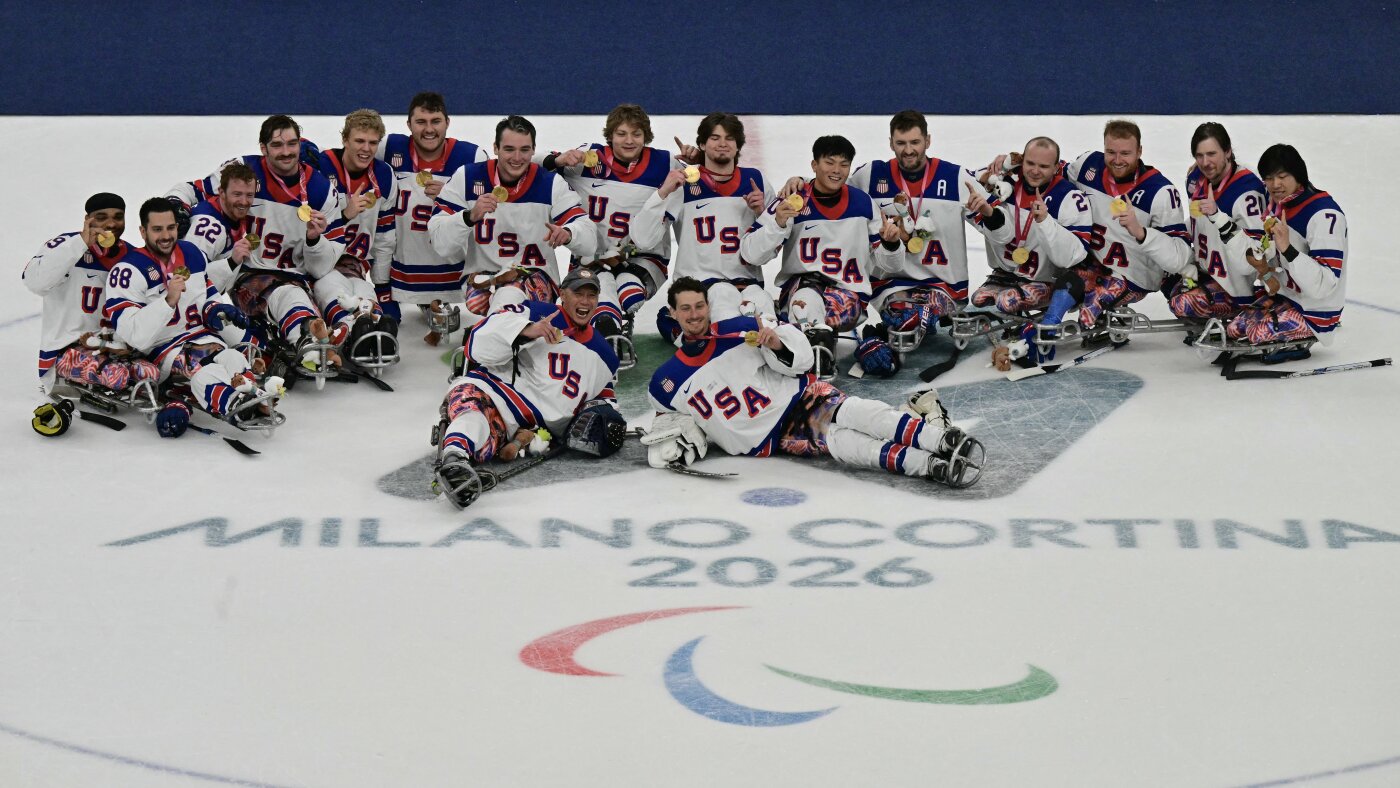
The U.S. men’s sled hockey team celebrates after winning its fifth straight Paralympics gold medal on Sunday.
Stefano Rellandini/AFP via Getty Images
hide caption
toggle caption
Stefano Rellandini/AFP via Getty Images
Team USA finished second in the overall Paralympics medal count, after 10 days of competition in which American athletes made dazzling debuts, defended titles and cemented legacies.
One of the many made-for-TV moments came just hours before the closing ceremony on Sunday, when the U.S. sled hockey team defeated rival Canada to claim its record fifth gold medal in a row.
“You don’t ever start out and try to be the only five-time gold medalist in the sport,” said captain Josh Pauls after personally achieving that very feat. “But to be with these guys, to lead them and kind of pass on that tradition, it’s the ultimate honor.”

The day — and the Games — ended with the closing ceremony in Cortina d’Ampezzo, featuring performances, speeches and the extinguishing of the Paralympic flame. American skiers Kendall Gretsch and Andrew Kurka, who are both leaving Italy with new medals, carried the flag for Team USA.
“I’ve been involved in four Games and have only been able to go to two closing ceremonies: in PyeongChang, where I won my gold and silver, and this year, where I won my bronze,” said Kurka, who medaled in men’s super-G. “It’s been a career filled with ups and downs, but even the small victories count for me.”
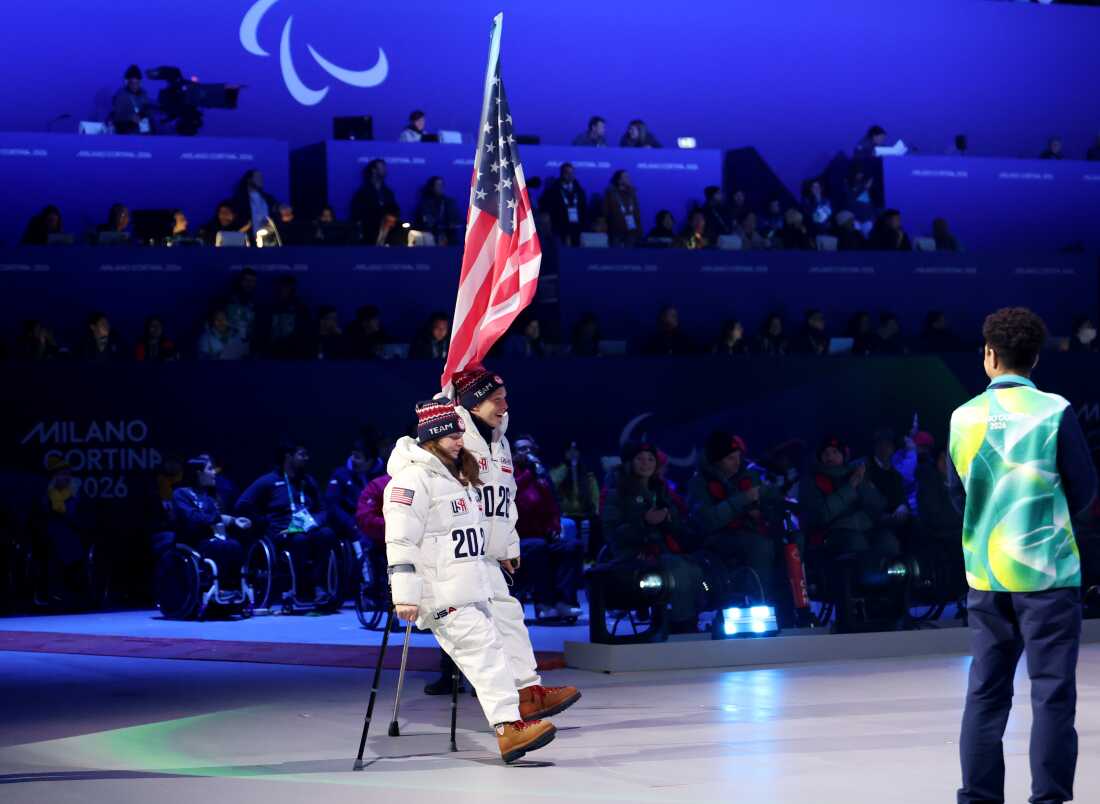
Andrew Kurka and Kendall Gretsch carry the U.S. flag during the Milano Cortina 2026 Winter Paralympic Games closing ceremony in Cortina on Sunday.
Mattia Ozbot/Getty Images
hide caption
toggle caption
Mattia Ozbot/Getty Images
At the ceremony, International Paralympic Committee (IPC) President Andrew Parsons declared the Games — the 50th anniversary of the Winter Paralympics — officially over, and a success: “The biggest and most beautiful Winter Paralympics with more athletes, more nations, more women and more global broadcast and digital coverage than ever before.”
A record 611 athletes from 55 countries competed in 79 medal events across six sports.
China topped the medal count for the second Winter Games in a row, with 44 total medals (15 gold), followed by the U.S. with 24 total medals, including 13 gold. The U.S. improved on its fifth-place standing from 2022. This is the same number of gold medals it won in 2018, in what officials are calling its “strongest gold-medal showing in the last 20 years.”
A total of 28 American Paralympians and two guides reached the podium this year. Six of them won medals for the first time, and six of them earned multiple medals, according to the U.S. Olympic and Paralympic Committee (USOPC).
In third place — both overall and in gold medals — was Russia, which was allowed to participate under its own flag for the first time since 2014 despite its ongoing war in Ukraine. Ukrainian athletes boycotted both the opening and closing ceremonies in protest.
But even in a moment of intense geopolitical upheaval, amid conflicts in Europe and the Middle East, the IPC’s Parsons said the Paralympics offered “proof that sport can unite us through respect, fairness and human achievement.”
“Paralympians, you rose above pressure, expectation and global tension to keep the focus where it belongs: on you and your sport,” he said. “You expanded the imagination of the world. You have shown that excellence is universal and that determination knows no boundaries.”
Parsons passed the proverbial torch to the next Winter Paralympics host: the French Alps for 2030. Those will follow the 2028 Summer Olympics and Paralympics in Los Angeles.
Team USA highlights
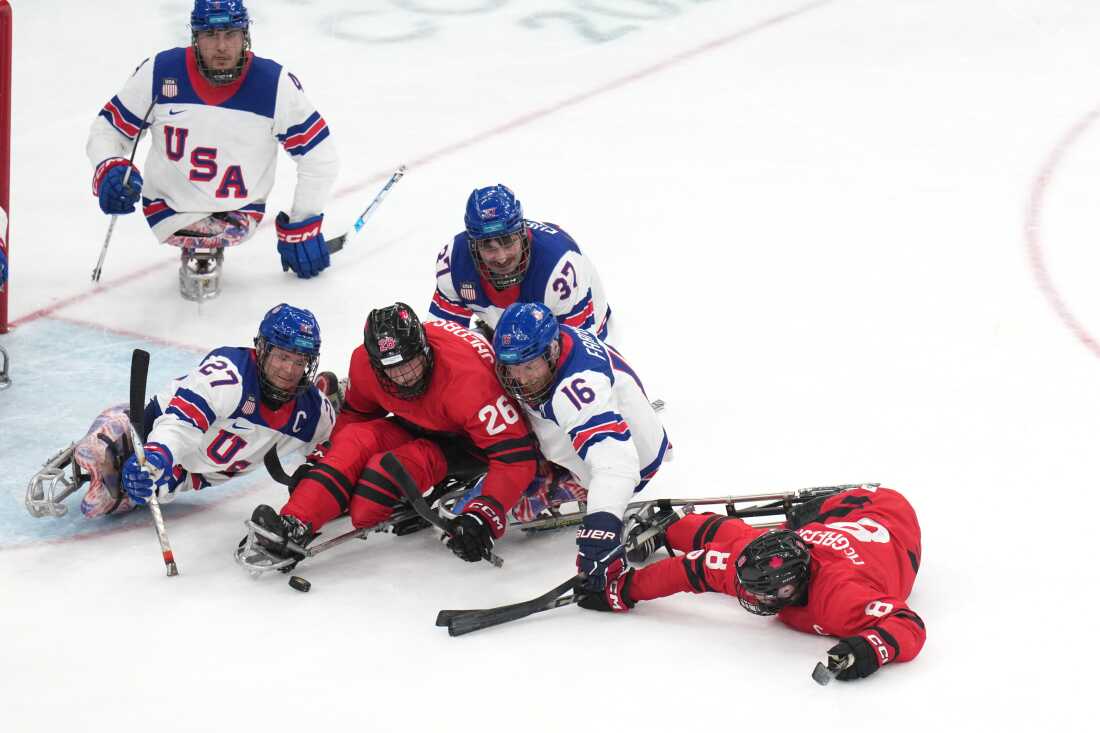
Team USA’s Declan Farmer, center, fights for the puck during the gold-medal match against Canada.
Antonio Calanni/AP
hide caption
toggle caption
Antonio Calanni/AP
On the ice:
The U.S. sled hockey team got off to a strong start in an early-round match against Italy, when it beat the host nation 14-1 — the largest margin of victory in the sport’s U.S. history.
It stayed dominant, outscoring opponents 46-6 throughout the tournament before becoming the first Paralympic or Olympic team to win five consecutive winter gold medals.
“You are going to enjoy something like this, for sure,” Coach David Hoff said afterward. “But I don’t know if it’s just the wins. It’s so much more than that. They just love playing together.”
Team USA beat Canada 6-2 on Sunday, thanks to a hat trick from Jack Wallace — who was named “best defender” of the tournament — and goals by Kayden Beasley, Brody Roybal and four-time Paralympian Declan Farmer.
Farmer, the top scorer and official MVP of these Games, scored 15 goals and 26 points throughout the tournament to become the all-time leading scorer in Paralympic sled hockey history at just 28 years old. But he was quick to share the credit with his teammates.
“A lot of the guys stepped up and had their best games of the tournament, and we just carried each other,” said Farmer. “I’m just so happy for the guys, we earned it together.”

You’re forgiven if you have deja vu from last month: This win makes the U.S. the first country to sweep all three Olympic and Paralympic hockey tournaments in one year.
Team USA also made history in wheelchair curling, with Steve Emt and Laura Dwyer finishing fourth in the brand-new mixed doubles event. That’s the United States’ best-ever Paralympic finish in the sport.
“In the two years we’ve been together, we’ve shown the world what we’re capable of doing and we’re going to go home, take some time off, relax, re-group and come back even better next year,” said Emt, the most decorated Paralympic curler in U.S. history.
In Para Nordic Skiing (cross country and biathlon):

Oksana Masters competes in the para cross-country skiing 20km in Tesero, Italy, on Sunday.
Luke Hales/Getty Images
hide caption
toggle caption
Luke Hales/Getty Images
Eight-time, dual-season Paralympian Oksana Masters, the most decorated Winter Paralympian in U.S. history, is leaving Italy with four new gold medals and a bronze in biathlon and cross-country skiing events, bringing her career total to 24 medals.
That’s despite a concussion, infection and injury that almost kept her from competing in the first place.
“I think that is what makes it so special, because nothing is guaranteed,” Masters told NPR on Saturday. “A win’s not guaranteed, and the podium’s not guaranteed, and so that’s been a really great motivator for this whole … year so far.”
Four-time Paralympian Jake Adicoff, with guides Reid Goble and Peter Wolter, won four gold medals in four visually impaired skiing events to set a new record for the most Para cross-country golds won by a Team USA athlete in a single Games.

Joshua Sweeney, Oksana Masters, Sydney Peterson, Jake Adicoff and his guide Reid Goble of Team USA participate in the medal ceremony after the para cross-country skiing mixed 4×2.5km relay.
Luke Hales/Getty Images Europe
hide caption
toggle caption
Luke Hales/Getty Images Europe
“It’s incredibly scary to put a high goal out to the public,” the 30-year-old said. “I was doubting it so much this week, I didn’t know what was going to happen, but the races came together and I’m just overjoyed.”
One of those was the mixed 4×2.5km relay, where the all-star team of Adicoff, Masters, Josh Sweeney and Sydney Peterson came from behind in the final leg to defend the U.S. title.

Peterson, competing in her second Paralympics, won four medals — three of them gold — this time around.
And Kendall Gretsch, closing ceremony flag-bearer, won four medals at her third Winter Paralympics (and fifth total): one gold, one silver and two bronze. That brings her total medal count to 11 across Summer and Winter Games.
In Alpine skiing:

Andrew Kurka competes in the super-G leg of the para Alpine skiing men’s combined.
Maja Hitij/Getty Images
hide caption
toggle caption
Maja Hitij/Getty Images
Andrew Kurka won bronze in the men’s super-G sitting, adding to his silver and gold from 2018.
“I’m happy to be here. I’m happy to have a great career. Gold, silver, and bronze, happy to be done,” said Kurka, who wrote on Instagram after the closing ceremony that he is stepping back from ski racing to deal with injuries.
In 2022, he competed with a broken nose, thumb and humerus bone, finishing fourth in the sitting downhill event before withdrawing from the rest of competition. Kurka said in Italy that he’s broken over 20 bones in his career.
“When it comes to it, losing is nothing compared to the pain of failure,” he said after winning bronze. “And when it comes down to today, I was just happy to get across that finish line without any injuries and in a relatively quick time. Usually, if I cross the finish line, it’s pretty fast.”
Meanwhile, Patrick Halgren won silver in the men’s super-G standing event — the first for Team USA since 1998.
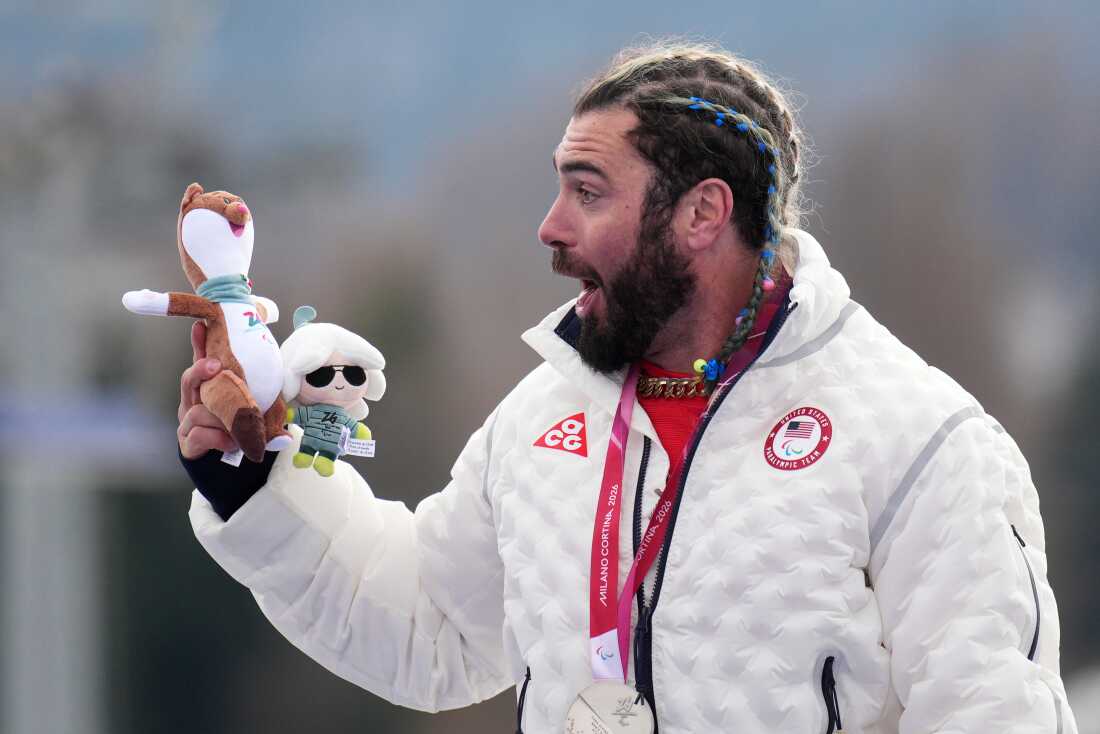
Patrick Halgren celebrates after winning a silver medal in the alpine skiing men’s super-G standing on Monday.
Emilio Morenatti/AP
hide caption
toggle caption
Emilio Morenatti/AP
The 33-year-old wasn’t necessarily a favorite for the podium, having placed 26th and 24th at his events in the Beijing Paralympics. But Halgren said he felt the presence of his late twin brother Sven — his source of encouragement to try para Alpine skiing — who died in a motorcycle accident in 2016. Halgren himself lost most of his left leg, and nearly his life, in a motorcycle accident three years earlier.
Halgren, who wowed the internet with his winning performance and rock-star persona, dedicated his win to Sven and called it the “best day of my life until tomorrow.”
“You celebrate the victories the same as the defeats,” he added. “I’ve been blessed to have to develop my character over the last 11 years, losing my leg, and could either roll over and die, or I could become the greatest Patrick Halgren on Earth, and that’s what you’re seeing.”
In snowboarding:

Kate Delson, center, and Brenna Huckaby, right, of Team U.S. pose for a photo on the podium during the medal ceremony for the para snowboard banked slalom.
Maja Hitij/Getty Images
hide caption
toggle caption
Maja Hitij/Getty Images
Three-time Paralympian Brenna Huckaby leaves Italy as the most decorated Paralympic snowboarder in history.
She won bronze in the women’s banked slalom event — which she dominated in 2022 — to bring her career total to five medals. That came days after she finished sixth in the snowboard cross event, which she still saw as a win.
“I’m here representing a very small portion of people who want to see themselves represented,” Huckaby said. “They want to know that if they lose their leg above the knee, life does not end. I accomplished that here simply by being. So I’m happy.”

First-time Paralympian Kate Delson medaled in both of those events, winning gold in the banked slalom and silver in snowboard cross.
“I was just stoked to be here, I think it’s such a fun course,” Delson said after. “I got to get a medal with my teammate, [Huckaby], one of my best friends in the world, that’s unreal.”
On the men’s side, Noah Elliott won gold in the banked slalom, a repeat of 2018, and silver in snowboard cross to double his career medal count.
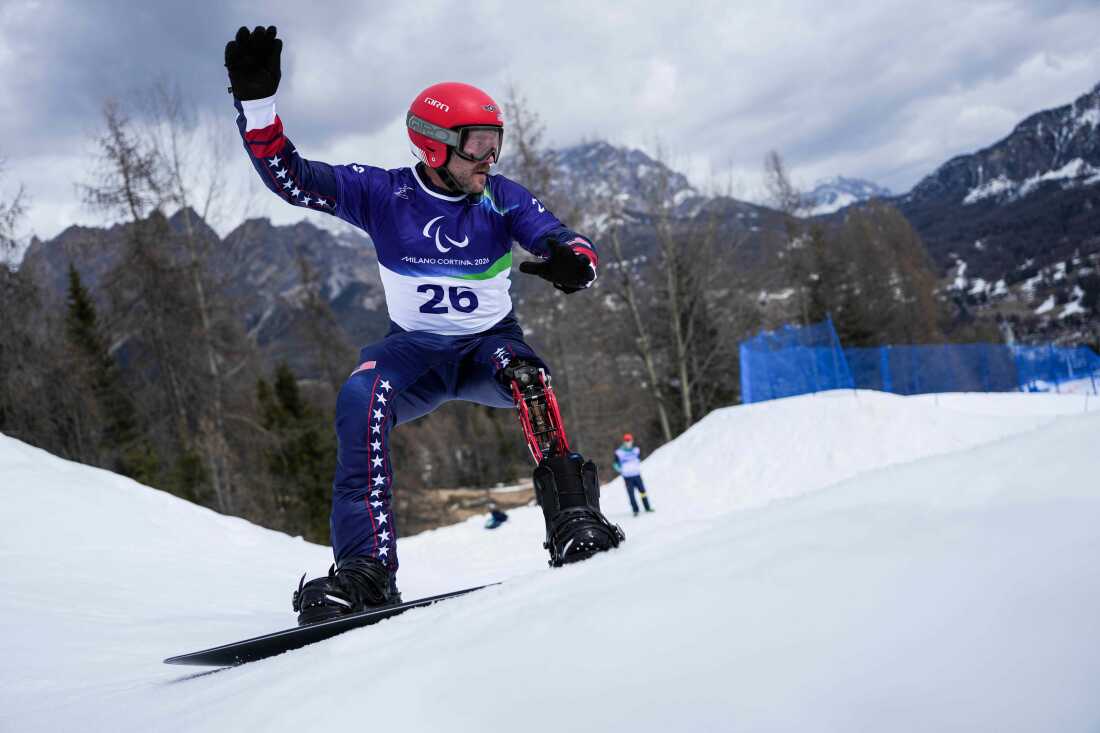
Mike Schultz brought home a bronze medal in his final Paralympics, for which he outfitted many athletes with their prosthetics.
Evgeniy Maloletka/AP
hide caption
toggle caption
Evgeniy Maloletka/AP
And Mike Schultz earned his fourth career medal — bronze in banked slalom — at the last race of his third and final Paralympics.
“To finish my last run and bring home a bronze medal, that’s storybook stuff there,” Schultz said in an emotional Instagram video after watching a compilation of congratulatory messages from his U.S. snowboarding teammates, whom he called his family.
All the while, the 44-year-old outfitted many para athletes — including some who beat him — with high-performance prosthetics, a business he has run for over a decade, which he plans to pursue in retirement.


Folarin Balogun (r) of the U.S. celebrates scoring his team’s second goal with Weston McKennie during their World Cup match against Paraguay on June 12 in Inglewood, Calif. The U.S. defeated Paraguay and, later, Australia. The U.S. wraps up group play against Turkey on Thursday evening. Win, lose or draw, the U.S. has already won its group and will advance to the knockout round.
Richard Heathcote/Getty Images
hide caption
toggle caption
Richard Heathcote/Getty Images
INGLEWOOD, Calif. — For the U.S. men’s national soccer team, a loss in Thursday night’s FIFA World Cup game against Turkey wouldn’t change anything.
A win, though, would be history.

The squad’s earlier wins over Paraguay and Australia, plus two losses by Turkey to the same teams, mean the Americans have already won their group and clinched a favorable path in the knockout round, no matter the outcome of Thursday’s game.
But the American men have never won more than two games in a single World Cup. A third win would be new territory for this team, which has not been shy about its aspirations in this tournament and its confidence about living up to them.
“The group stage is not done yet. We want to end it the right way. We want to end it the way we came into it and continue to build off of the momentum that we’ve been creating,” said defender Mark McKenzie, speaking to reporters Wednesday.

Because the outcome of the game does not affect knockout-round placement, the U.S. can rest key starters who will enter the match with a yellow card. For those players — defenders Antonee Robinson and Chris Richards, midfielder Tyler Adams and forward Folarin Balogun — picking up a second yellow card against Turkey would result in a suspension in the Round of 32. (Any single yellow cards will be cleared after the group stage concludes.)
The team could also choose to ease in forward Christian Pulisic, who is expected to be available for the game after sitting out the U.S.-Australia game with a minor calf injury.
Turkey had come into the World Cup with high expectations. With talented young stars like the 21-year-old attackers Arda Güler of Real Madrid and Kenan Yildiz of Juventus, the team was thought by many — from analysts to the players themselves — to be a dark horse capable of a deep run.
Instead, they were eliminated last week when their loss to Paraguay followed the U.S. win over Australia, prompting apologies from Turkey’s despondent players to their fans after the game.
On Wednesday, Yildiz echoed that apology and promised to “give our best” in Thursday’s game against the U.S. “We had high expectations. I know because all of our country was supporting us and thought we will come very far,” Yildiz said. “Hopefully for the next game we can make a good result and go out with pride.”
The U.S. and Turkey last faced each other in an international friendly in June 2025, which Turkey won 2-1. The U.S. roster for that game was missing several key players, including Pulisic, Robinson, Balogun and midfielder Weston McKennie.
“We had a really young team, but we went out there and put in a good performance. I don’t think the result necessarily reflected how we played,” Richards said. “Whoever’s on the field, I know we’re going to go out there and give 110 percent.”

A federal judge on Wednesday permanently barred President Donald Trump’s administration from implementing most of his first executive order on elections, part of which sought to require people to show documentary proof of citizenship when they register to vote.
The ruling by U.S. District Court Judge Denise Casper in Boston effectively converts a preliminary injunction she issued a year ago, in which she temporarily blocked many of Trump’s efforts to overhaul elections, into a permanent ban.
Casper rejected the Republican administration’s argument that the lawsuit to block the changes brought by Democratic state attorneys general was premature because the rules had yet to be put in place. Instead, she agreed that the Constitution gives states and Congress the authority to regulate elections, and that Trump’s requirements violated the separation of powers.
The Constitution “does not grant the President any specific powers over elections,” wrote Casper.
Among other proposed changes, Trump’s order would have required people to provide documentary proof of citizenship when registering to vote, prevented mail ballots from being counted if they arrive after Election Day, even if they were postmarked by then, and punished states that failed to comply by withholding certain federal money.
In a statement, New York Attorney General Letitia James said she was grateful the court had blocked Trump’s “unconstitutional attempt to seize control of our elections” and would continue to defend voting rights in this year’s midterm elections.
“Generations of Americans fought tirelessly for the right to vote, and we honor their legacy by protecting that right against anyone who tries to undermine it,” said James, a Democrat.
A voter casts a ballot during New York’s primary election on Tuesday, June 23, 2026, in New York. (AP Photo/Ryan Murphy)
California Attorney General Rob Bonta, whose state was the lead plaintiff in the case, said the ruling reaffirmed the constitutional principle that it s up to the states and Congress to set election rules.
“While we are proud of this result, we are clear-eyed that President Trump’s attacks on voting rights and our elections show no signs of slowing down,” Bonta, a Democrat, said in a statement. “So let me be clear: we will keep fighting back every step of the way.”
Requests for comment sent to the White House and he U.S. Department of Justice were not immediately returned.
The ruling was the latest in a series against the elections executive order Trump signed just months after taking office for his second term. The Republican president has since signed another executive order on elections that seeks to create a national voter list and limit mail balloting. That directive also faces multiple legal challenges.
Last fall, a federal judge in Washington, D.C., overseeing a separate challenge to the first election executive order by civil rights and Democratic Party-aligned groups blocked the government from taking steps to include the proof-of-citizenship requirement on the federal voter registration form. That judge later barred Trump’s defense secretary from requiring documentary proof of citizenship when military personnel register to vote or request ballots.
In an apparent nod to the difficulty of implementing a proof-of-citizen requirement by executive order, Trump is pushing legislation in the Republican-controlled Congress to create such a mandate. The SAVE America Act has passed the House but has stalled in the Senate, leading Trump to advocate for eliminating the filibuster that is blocking the legislation.
On Wednesday, he abruptly canceled the expected signing of a bipartisan housing bill, saying he would not sign legislation until Congress passes his proof of citizenship requirement for voting.
The president and many of his Republican allies have been promoting the narrative that voting by noncitizens is a major problem, when in fact it’s quite rare. The federal voter registration form already requires people to attest that they are U.S. citizens. Violating that is punishable as a felony that can lead to prison or deportation.
In another major voting case, the U.S. Supreme Court is due to issue an opinion soon on whether mail ballots must arrive by Election Day. That could immediately change the rules in 14 states that allow grace periods ranging from days to weeks if the ballots are postmarked by Election Day.
Casper, who was nominated by Democratic President Barack Obama, is the chief judge for the U.S. District Court for the District of Massachusetts.

new video loaded: Mamdani Allies Sweep New York Primaries
transcript
transcript
Mamdani Allies Sweep New York Primaries
Mayor Zohran Mamdani’s progressive coalition had a big night on Tuesday. Brad Lander, Darializa Avila Chevalier and Claire Valdez won their Democratic House primaries.
-
“I see a New York that we can all afford. I see a New York that truly invests in its babies, not bombs.” Reporter: “What’s the first thing you’re looking forward to doing in Congress?” “Well, tomorrow — thank you — I mean, tomorrow morning, you know, I’m going to be back at 26 Federal Plaza doing court watching, and we want to carry that into Congress as well.”
By Julie Yoon
June 24, 2026
-

 Los Angeles, Ca30 minutes ago
Boyle Heights warehouse cleanup begins as crews face 85 million pounds of spoiled food
-

 Detroit, MI50 minutes ago
Would Detroit Lions Salary Cap Be Wrecked If Terrion Arnold Gets Cut?
-

 San Francisco, CA59 minutes ago
Two more Presidio Heights homes reach $10M range as luxury supply dwindles
-

 Dallas, TX1 hour ago
One Dallas Cowboys Contract That Will Age Poorly in 2026
-

 Miami, FL1 hour ago
Live updates: Today’s South Florida News
-
 Boston, MA1 hour ago
A federal judge in Boston has blocked parts of Trump’s order to limit voting by mail
-
 Denver, CO1 hour ago
Denver Transplant Games sets Guinness World Record for most living donors, recipients in one place at one time
-

 Seattle, WA1 hour ago
17-year-old boy shot in High Point, multiple suspects seen running from crashed car

