News
'Senseless death': Three men charged with killing New Zealand tourist during Newport Beach robbery

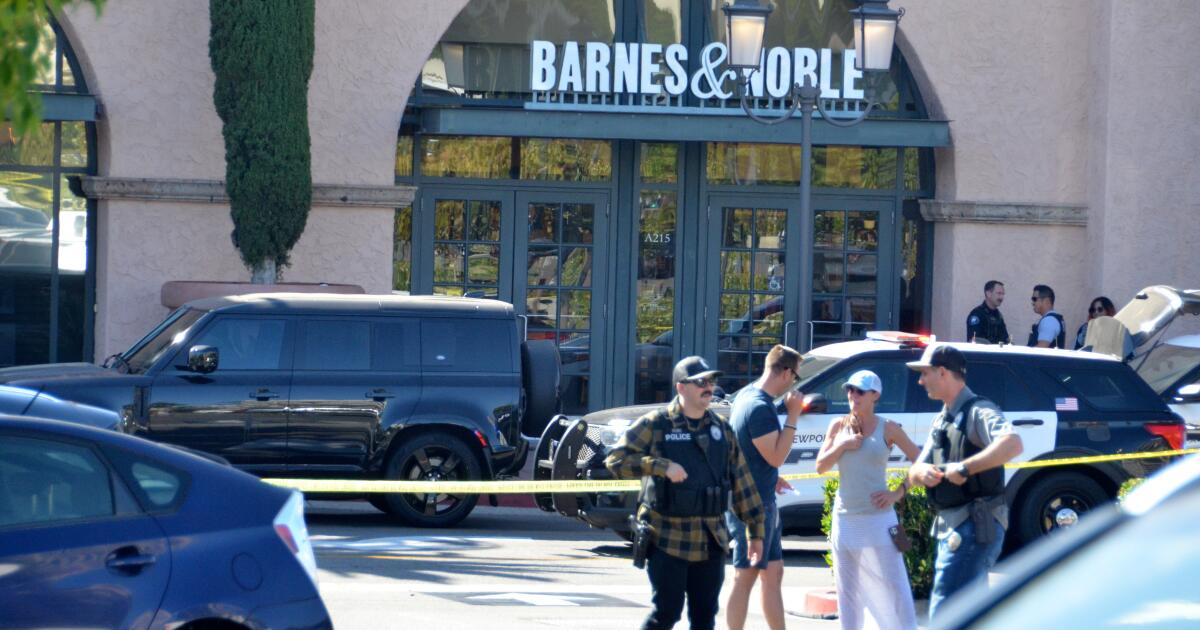
Orange County prosecutors charged a third-strike offender and two other men with murder on accusations of running a car over a 68-year-old New Zealand woman and dragging her nearly 65 feet during a robbery at Newport Beach’s Fashion Island.
Prosecutors charged third-striker Leroy Ernest Joseph McCrary, 26, of Los Angeles; Malachi Edward Darnell, 18, also of Los Angeles; and Jaden Cunningham, 18, of Lancaster with special-circumstances murder. They could be sentenced to death if they are convicted of killing Patricia McKay in the commission of a robbery, with a felony enhancement of causing the death of a person over the age of 65. The trio were captured after leading police on a high-speed chase into L.A. County.
The incidents Tuesday raised questions about why McCrary hadn’t served prison time for his previous felony convictions.
California has had a moratorium on carrying out the death penalty since 2019 and has not executed anyone since 2006.
McCrary also faces charges of felony attempted second-degree robbery and evading while driving recklessly. He was previously convicted of the felonies of residential burglary in 2018, criminal threats in 2020, and robbery in 2023, all in L.A. County. Records show he was also convicted of being a narcotics addict in possession of a firearm in 2023.
In addition to the murder charge, Darnell faces charges of second-degree attempted robbery, attempted murder, and personal use of a firearm, as well as a felony enhancement of personal discharge of a firearm.
Cunningham is also charged with attempted second-degree robbery in addition to murder.
Patricia McKay and husband Douglas McKay, a well-known Auckland businessman and leader, were waiting for a ride after shopping at Newport Beach’s Fashion Island on Tuesday when a white Toyota Camry pulled up outside the mall next to the couple, and two men in masks jumped out. One of the men put a gun to Douglas McKay’s head and demanded his watch as they forced him to the ground, according to prosecutors.
Cunningham is accused of tossing Patricia McKay to the ground as she held several shopping bags, and then allegedly dragged her into the street in front of the Camry while grabbing the bags.
Douglas McKay jumped in front of the vehicle in an effort to stop it from running over his wife, but McCrary allegedly drove it forward, pushing him out of the way and running over the woman, then dragging her body 65 feet under the car.
As Cunningham ran after the getaway car, another man seeking to intervene gave chase. Darnell, who by then was back inside the car, is accused of firing three shots at the Good Samaritan.
After the incident, police pursued the Camry as it sped north, reaching speeds of up to 110 mph. A television news helicopter captured video of the car speeding on the left shoulder of the 105 Freeway and at one point grazing the concrete median.
Cunningham was arrested after he bailed out of the vehicle in the city of Cypress. McCray and Darnell were arrested later in South Gate. All three defendants were being held without bail Friday.
“Our entire community extends its deepest sympathies to the loved ones of Patricia McKay and to the entire country of New Zealand as we mourn her senseless death in the commission of a crime that should have never happened,” Orange County Dist. Atty. Todd Spitzer said in a statement announcing the charges. “Lawlessness and violence will not be tolerated in our society.”
New Zealand Prime Minister Christopher Luxon described Patricia McKay’s death as “an absolute tragedy,” and extended condolences to family members, whom he knows personally. Douglas McKay is a prominent energy and business executive who served for several years as chair of the Bank of New Zealand and three years as the first chief executive of the Aukland Council created in 2010 for the region’s “supercity.”
In a statement, the McKay family said: “No words can express our sadness as we try to come to terms with the loss of our mother, wife, and friend Patricia. We ask for privacy at this time as we work through this as a family.”
In 2023, McCrary pleaded no contest to charges of robbery and being a narcotics addict in possession of a firearm. He was sentenced to two years of probation with three years in state prison suspended.
Asked to explain the lack of prison time for McCrary, L.A. County Dist. Atty. George Gascón said in a statement: “The case against [him] had significant problems with proof. As a result of these issues, the management team at the Airport Court authorized a plea offer that allowed Mr. [McCrary] to be placed on probation with a suspended state prison sentence.”
Still, Gascón’s office called the latest crimes that McCrary is accused of “reprehensible.”
In announcing this week’s charges, Spitzer, the Orange County prosecutor, put some of the blame on Gov. Gavin Newsom and other California Democrats.
“Our shopping centers and malls have become hunting grounds for criminals who are stalking innocent shoppers to rob them blind,” he said in a statement, “because our Governor and our Legislature refuse to hold anyone accountable for their actions.”




News
Man accused of plot to assassinate Trump testifies Iran pressured him, says Biden and Haley were other possible targets

The allegation sounded like the stuff of spy movies: A Pakistani businessman trying to hire hit men, even handing them $5,000 in cash, to kill a U.S. politician on behalf of Iran ‘s powerful paramilitary Revolutionary Guard.
It was true, and potential targets of the 2024 scheme included now-President Donald Trump, then-President Joe Biden and former presidential candidate and ex-U.N. Ambassador Nikki Haley, the man told jurors at his attempted terrorism trial in New York on Wednesday. But he insisted his actions were driven by fear for loved ones in Iran, and he figured he’d be apprehended before anything came of the scheme.
“My family was under threat, and I had to do this,” the defendant, Asif Merchant, testified through an Urdu interpreter. “I was not wanting to do this so willingly.”
Merchant said he had anticipated getting arrested before anyone was killed, intended to cooperate with the U.S. government and had hoped that would help him get a green card.
U.S. authorities were, indeed, on to him – the supposed hit men he paid were actually undercover FBI agents – and he was arrested on July 12, 2024, a day before an unrelated attempt on Trump’s life in Butler, Pennsylvania. During a search, investigators said they found a handwritten note that contained the codewords for the various aspects of the plot, CBS News previously reported.
Merchant did sit for voluntary FBI interviews, but he ultimately ended up with a trial, not a cooperation deal.
“You traveled to the United States for the purpose of hiring Mafia members to kill a politician, correct?” Assistant U.S. Attorney Nina Gupta asked during her turn questioning Merchant Wednesday in a Brooklyn federal court.
“That’s right,” Merchant replied, his demeanor as matter-of-fact as his testimony was unusual.
The trial is unfolding amid the less than week-old Iran war, which killed Iranian Supreme Leader Ayatollah Ali Khamenei in a strike that Trump summed up as “I got him before he got me.” Jurors are instructed to ignore news pertaining to the case.
The Iranian government has denied plotting to kill Trump or other U.S. officials.
Merchant, 47, had a roughly 20-year banking career in Pakistan before getting involved in an array of businesses: clothing, car sales, banana exports, insulation imports. He openly has two families, one in Pakistan and the other in Iran – where, he said, he was introduced around the end of 2022 to a Revolutionary Guard intelligence operative. They initially spoke about getting involved in a hawala, an informal money transfer system, Merchant said.
Merchant testified that his periodic visits to the U.S. for his garment business piqued the interest of his Revolutionary Guard contact, who trained him on countersurveillance techniques.
The U.S. deems the Revolutionary Guard a “foreign terrorist organization.” Formally called the Islamic Revolutionary Guard Corps, the force has been prominent in Iran under Khamenei.
Merchant said the handler told him to seek U.S. residents interested in working for Iran. Then came another assignment: Look for a criminal to arrange protests, steal things, do some money laundering, “and maybe have somebody murdered,” Merchant recalled.
“He did not tell me exactly who it is, but he told me – he named three people: Donald Trump, Joe Biden and Nikki Haley,” he added.
In 2024, multiple sources familiar with the investigation told CBS News Merchant planned to assassinate current and former government officials across the political spectrum.
Merchant allegedly sketched out the plot on a napkin inside his New York hotel room, prosecutors said, and told the individual “that there would be ‘security all around’ the person” they were planning to kill.
“No other option”
After U.S. immigration agents pulled Merchant aside at the Houston airport in April 2024, searched his possessions and asked about his travels to Iran, he concluded that he was under surveillance. But still he researched Trump rally locations, sketched out a plot for a shooting at a political rally, lined up the supposed hit men and scrambled together $5,000 from a cousin to pay them a “token of appreciation.”
He even reported back to his Revolutionary Guard contact, sending observations – fake, Merchant said – tucked into a book that he shipped to Iran through a series of intermediaries.
Merchant said he “had no other option” than to play along because the handler had indicated that he knew who Merchant’s Iranian relatives were and where they lived.
In a court filing this week, prosecutors noted that Merchant didn’t seek out law enforcement to help with his purported predicament before he was arrested. He testified that he couldn’t turn to authorities because his handler had people watching him.
Prosecutors also said that in his FBI interviews, Merchant “neglected to mention any facts that could have supported” an argument that he acted under duress.
Merchant told jurors Wednesday that he didn’t think agents would believe his story, because their questions suggested “they think that I’m some type of super-spy.”
“And are you a super-spy?” defense lawyer Avraham Moskowitz asked.
“No,” Merchant said. “Absolutely not.”

The bombing of an Iranian elementary school that killed some 165 people, many of them schoolgirls, included more targets near the school than has been initially reported, a review of commercial satellite imagery by NPR has found.
The images suggest that the school was hit on Saturday as part of a precision airstrike on a neighboring Iranian military complex — and that it may have been struck as a result of outdated targeting information.
The new images come from the company Planet and are of the city of Minab, located in southeastern Iran. They show that a health clinic and other buildings near the school were also struck. Three independent experts confirmed NPR’s analysis of the additional strike points.
The strike points “look like pretty clean detonation centroids,” said Corey Scher, a postdoctoral researcher at the Conflict Ecology laboratory at Oregon State University.
“These certainly appear like detonation sites,” agreed Scher’s colleague, Oregon State associate professor Jamon Van Den Hoek.
Jeffrey Lewis, a professor at Middlebury College who specializes in satellite imagery, said the imagery was consistent with a precision airstrike.
The images show “very precise targeting,” Lewis told NPR. “Almost all the buildings [in the compound] are hit.”
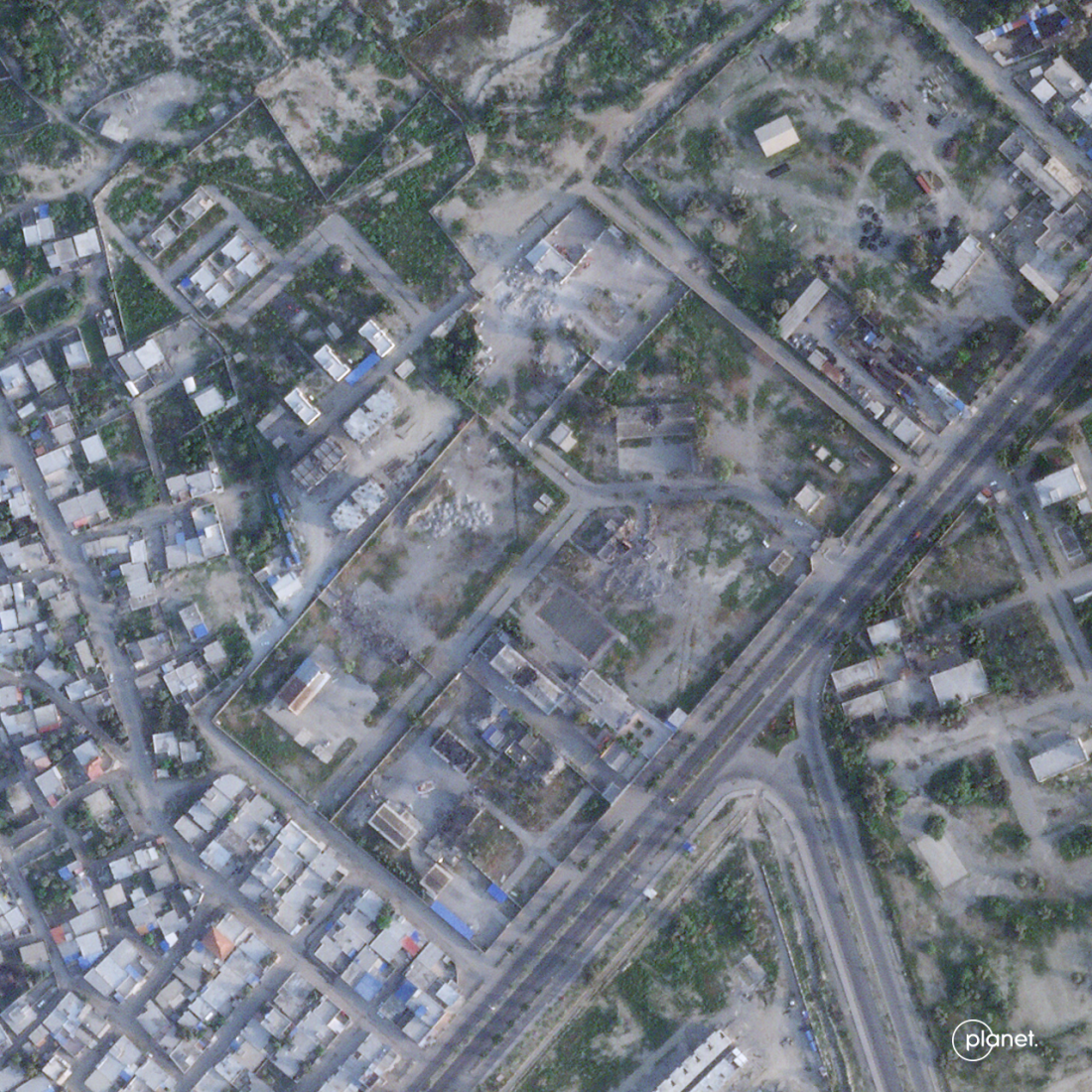
A satellite image of an Iranian Revolutionary Guard compound taken on March 4, several days after an airstrike destroyed a school on the edge of the compound. The image reveals that half a dozen other buildings in addition to the school were struck.
Planet Labs PBC
hide caption
toggle caption
Planet Labs PBC
Iranian state media said 165 people died in the bombing, which struck a girls’ school. The school was located within less than 100 yards of the perimeter of an Iranian Revolutionary Guard naval base, according to satellite images and publicly available information. The clinic was also located within the base perimeter, although both facilities had been walled off from the base.
Israel has denied involvement. “We are not aware at the moment of any IDF operation in that area,” Israel Defense Forces spokesperson Nadav Shoshani told NPR on Monday. “I don’t know who’s responsible for the bombing.”

At a press conference Wednesday morning, U.S. Defense Secretary Pete Hegseth said that the U.S. is looking into what happened at the school. “All I know, all I can say, is that we’re investigating that,” Hegseth said. “We, of course, never target civilian targets.”
Given Minab’s location in the southeastern part of Iran, Lewis believes it’s more likely the U.S. would have conducted the strike than Israel. As one gets farther south and east in Iran, “a strike is much more likely to be a U.S. strike than an Israeli strike because of the type of munitions and the geographic location,” he said.
Esmail Baghaei, the spokesman for Iran’s Foreign Ministry, called the strike “deliberate” and said that the U.S. and Israel bombed the school in part to tie up Iranian forces in the region with rescue efforts. “To call the attack on the girls school merely a ‘war crime’ does not capture the sheer evil and depravity of such a crime,” he said.
But Lewis said it’s more likely that the strike was the result of an error. Satellite images show that the school and clinic buildings were both once part of the base. The school was separated from the base by a wall between 2013 and 2016. The clinic was walled off between 2022 and 2024.
Lewis believes it’s possible American military planners had not updated their target sets.
“There are thousands of targets across Iran, and so there will be teams in the United States and Israel that are responsible for tracking those targets and updating them,” he said. “It’s possible that the target didn’t get updated.”
The Pentagon did not immediately respond to NPR’s request for additional information about the strike.
NPR’s Arezou Rezvani and NPR’s RAD team contributed to this report.

Mojtaba Khamenei, the second son of the assassinated Ali Khamenei, is being heavily tipped to succeed his father as supreme leader of Iran, which would pitch a hardliner into the task of steering the Islamic republic through the most turbulent period in its 48-year history and offer a powerful signal that, for now, it has no intention of changing course.
No official confirmation has been given and the announcement may be delayed until after the funeral of Ali Khamenei, which was on Wednesday postponed.
His son is believed to have been the choice of the Islamic Revolutionary Guard Corps (IRGC), and the Israeli defence minister, Gideon Saar, has warned he will be assassinated.
Ayatollah Seyed Khatani, a member of the Assembly of Experts, the body that chooses the new supreme leader, said the assembly was close to selecting a leader.
Rigid in his anti-western views, Mojtaba Khamenei is not the candidate Donald Trump would have wanted. Marco Rubio, the US secretary of state, said on Tuesday that Iran was run by “religious fanatic lunatics” – and Khamenei’s appointment is hardly likely to dispel that opinion.
The choice of supreme leader is made by the 88-strong Assembly of Experts, who in this case are picking from a field of six possible candidates. His election would be a powerful if unsurprising symbol that the government is not looking to find an accommodation with America.
Trump has said the worst-case scenario would be if Khamenei’s successor was “as bad as the previous person”.
There has been speculation for more than a decade that he would be his father’s successor, which grew when Ebrahim Raisi, the elected president and favourite of Khamenei, was killed in a helicopter crash.
Mojtaba Khamenei was born in 1969 and studied theology after graduating from high school. At the age of 17, he went to serve in the Iran-Iraq war, but it was not until the late 1990s that he came to be recognised as a public figure in his own right.
After the landslide defeat of Khamenei’s preferred candidate, Ali Akbar Nategh Nuri, in the 1997 presidential election, where he won only 25% of the final vote, various conservative Iranian groups realised the need to make changes to their structures and Mojtaba Khamenei was central to that project.
He was also seen as instrumental by reformists in suppressing the protests in 2009 that came after allegations the presidential election had been rigged, with his name chanted in the streets as one of those responsible. Mostafa Tajzadeh, a senior member of Iran’s reformist parties who was imprisoned after the vote, alleged that his and his wife, Fakhr al-Sadat Mohtashamipour’s, legal case was under the direct supervision of Mojtaba Khamenei.
In 2022 he was given the title of ayatollah – essential to his promotion. By then he was a regular figure by his father’s side at political meetings, as well as playing an influential role in the Islamic Republic’s Broadcasting Corporation, the government’s official media outlet often criticised for churning out dull political propaganda that many Iranians reject in favour of overseas satellite channels. He has also played a central role in the administration of his father’s substantial financial empire.
His closest political allies are Ahmad Vahidi, the newly appointed IRGC commander; Hossein Taeb, a former head of the IRGC’s intelligence organisation; and Mohammad Bagher Ghalibaf, the current speaker of the parliament.
His rumoured appointment and its hereditary nature has long been resisted by reformists. The former prime minister Mir Hossein Mousavi, referring to the long history of rumours about Mojtaba Khamenei succeeding his father as leader, wrote in 2022: “News of this conspiracy have been heard for 13 years. If they are not truly pursuing it, why don’t they deny such an intention once and for all?”
The Assembly of Experts, in response, denounced “meaninglessness of doubts” and said the assembly would select only “the most qualified and the most suitable”.
Israel on Tuesday struck the building in the Iranian city of Qom, one of Shia Islam’s main seats of power, where the assembly was scheduled, but the building was empty, according to IRGC-affiliated media.

Man accused of plot to assassinate Trump testifies Iran pressured him, says Biden and Haley were other possible targets

Supreme Court blocks California ban on notifying students’ parents about gender transitions

Comer to say Tim Walz ‘enabled fraud,’ failed whistleblowers in bombshell Minnesota hearing

Nancy Guthrie’s abductor may have returned to the crime scene, left critical clues at tribute: expert

Trump, BBC agree on mediator for $10 billion lawsuit over Jan 6 documentary editing controversy

Florida High School Football Rankings: Top 25 teams – Oct. 21

Cleary's 21 help Le Moyne down Central Connecticut State 69-64 in OT

How old is Bo Nix? What to know about Oregon quarterback ahead of 2024 NFL Draft

99th annual Pony Swim held in Virginia

Indiana Members Credit Union announced as new anchor tenant at Bottleworks District
Man accused of plot to assassinate Trump testifies Iran pressured him, says Biden and Haley were other possible targets

DHS defends McLaughlin against allegations husband’s company profited millions from ad contracts: ‘Baseless’

Fareed Zakaria’s takes on Trump and the collapse of nuclear stability

Sánchez defies Trump in political gamble as Madrid say no to war
Satellite images show Iran school strike hit more buildings than earlier reported
-

 World1 week ago
Exclusive: DeepSeek withholds latest AI model from US chipmakers including Nvidia, sources say
-

 Massachusetts1 week ago
Mother and daughter injured in Taunton house explosion
-

 Wisconsin3 days ago
Setting sail on iceboats across a frozen lake in Wisconsin
-

 Maryland4 days ago
AM showers Sunday in Maryland
-

 Florida4 days ago
Florida man rescued after being stuck in shoulder-deep mud for days
-

 Denver, CO1 week ago
10 acres charred, 5 injured in Thornton grass fire, evacuation orders lifted
-

 Massachusetts2 days ago
Massachusetts man awaits word from family in Iran after attacks
-

 Oregon6 days ago
2026 OSAA Oregon Wrestling State Championship Results And Brackets – FloWrestling