News
Northeast readies for a major winter storm, with blizzard warnings in effect

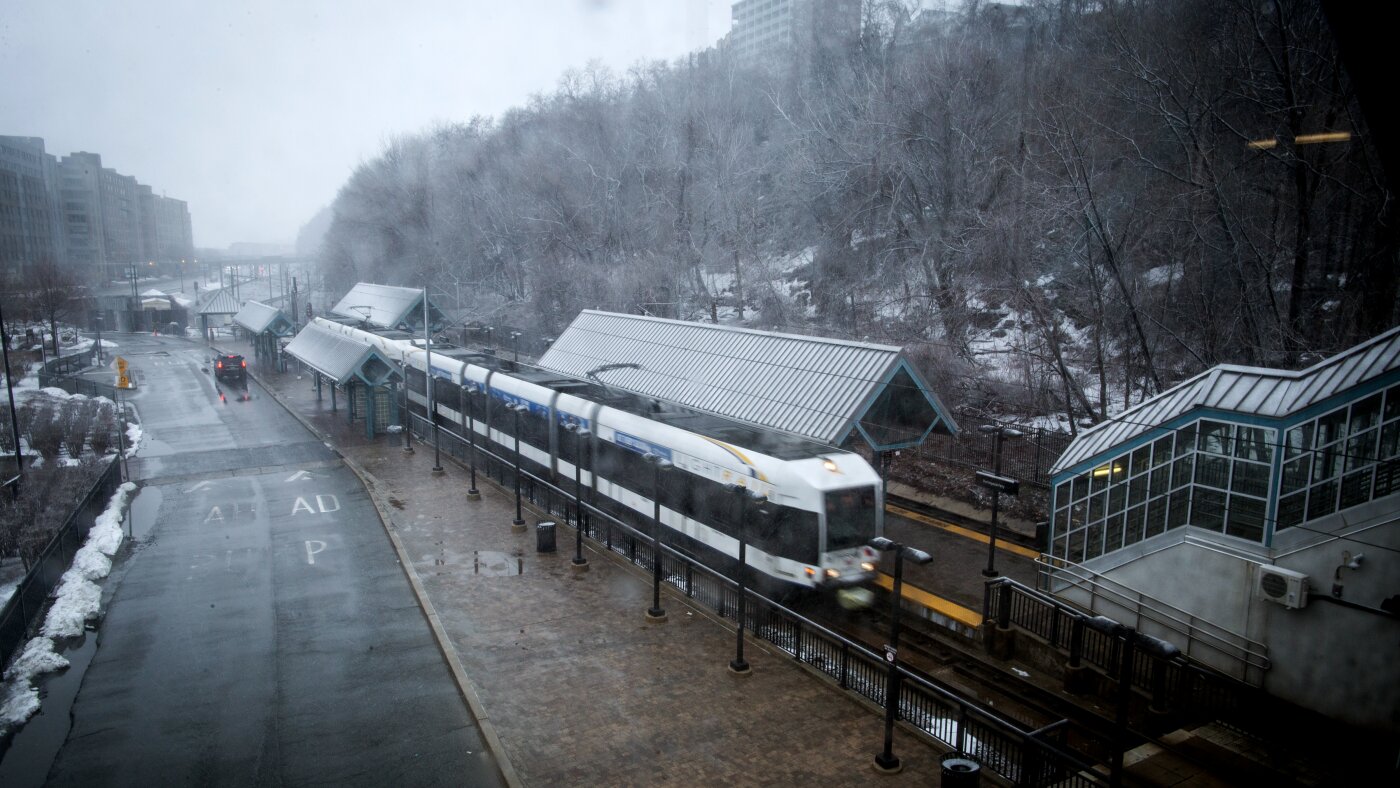
New Jersey Light Rail arrives at Port Imperial Station as snow falls on Sunday in Weehawken, N.J.
Kena Betancur/Getty Images
hide caption
toggle caption
Kena Betancur/Getty Images
Officials are warning those in the path of a dangerous winter storm to take precautions and heed warnings as blizzard conditions are set to impact the East Coast Sunday through Monday.
The National Weather Service (NWS) on Sunday said the storm will bring “heavy snow, high winds, blizzard conditions and coastal flooding across the Mid-Atlantic and Northeast.”
Cody Snell, a forecaster with the NWS Weather Prediction Center, said Sunday there could be at least 18 inches to 2 feet of snow along parts of the East Coast from New Jersey up through Massachusetts.
“That’s where we’re going to see the major impacts from snowfall with this system that includes heavy snowfall rates, which can reduce visibility and accumulate on roads very quickly tonight, into tomorrow morning,” Snell said during a briefing on Sunday. “We’re going to see the snowfall be very heavy and wet. … It’s going to weigh down trees, power lines.”

Winds with gusts from 40 to 70 mph from the New Jersey coast to New England are expected, which could lead to power outages, the NWS said on Sunday. Coastal flooding and erosion could also occur from Delaware to Cape Cod.
Blizzard warnings have been issued for parts of Maryland, Delaware, New Jersey, Pennsylvania, New York, Connecticut, Rhode Island, Massachusetts, New Hampshire and Maine.
NYC Mayor Zohran Mamdani said public schools will be closed Monday and cautioned people to enjoy the snow safely once the worst of the storm ends.
“We haven’t seen a storm like this in a decade. Some parts of the city could see up to 28in,” Mamdani said in a social media post. “Please, stay inside if you can and if you see someone on the street in need of assistance, call 311.”
A state of emergency has been declared in Delaware, New Jersey, New York, Connecticut and Massachusetts.
Travel could be “dangerous or impossible” in areas including southeast Pennsylvania, New Jersey, Long Island, Rhode Island, and southeast Maine, according to the NWS.
A travel ban has been issued for New York City, in which all “bridges, highways, and streets will be closed to traffic from 9pm Sunday thru noon Monday,” according to NYC Comptroller Mark Levine.
“No cars, trucks, scooters, or e-bikes. Limited exemptions for essential and emergency movement,” Levine posted on social media Sunday. “Please take this seriously. Stay home if at all possible.”
LaGuardia Airport and John F. Kennedy Airport on Sunday warned fliers that “significant travel impacts are expected” and to “check their flight status regularly with their airline before heading to the airport.”
Portions of Virginia, Washington D.C., and Maryland are also expected to receive snow through Monday morning.
Maryland Gov. Wes Moore declared a state of preparedness in Maryland on Saturday.

More than 5,100 flights within, into and out of the U.S. have been delayed as of 5:30 p.m. ET on Sunday, according to FlightAware. More than 3,300 flights within, into and out of the U.S. have been canceled.
Amtrak also said on Sunday it adjusted some of its routes through Monday because of the winter storm.
NWS meteorologist Owen Shieh advised people to be cautious when shoveling because the snow will be “deceptively heavy.”
“As you’re clearing the driveways, please take care, take lots of breaks and don’t overdo it when it comes to shoveling the snow,” Shieh said during a briefing Sunday.
Shieh also warned that if someone becomes stranded during the storm to not leave their car. “To wander off in the middle of the storm would actually be more dangerous, and so please keep that in mind if emergency travel is necessary,” Shieh said.
The Federal Emergency Management Agency (FEMA) on Saturday urged people impacted by the storm to “avoid unnecessary travel, charge devices, stock up on essentials & be ready for power outages.” The agency also said for people to follow directives from their local officials.


In an exclusive interview with CBS News on Thursday, Treasury Secretary Scott Bessent said he doesn’t believe the recent disclosure of President Trump’s billions in crypto earnings is problematic for the president.
“I don’t think there’s an appearance problem,” Bessent told CBS News anchor and MoneyWatch correspondent Kelly O’Grady regarding Mr. Trump’s earnings.
According to a financial disclosure released earlier this week, Mr. Trump has earned approximately $1.4 billion from his crypto ventures since beginning his second term. Those include his “meme coin” $TRUMP and earnings from World Liberty Financial, a cryptocurrency company backed by the president and his family.
Congressional Democrats have criticized Mr. Trump’s crypto windfall, arguing it presents a conflict of interest since his administration has sought to loosen regulations on cryptocurrency.
“This is an innovation presidency,” Bessent told CBS News. “So whether it’s digital access, whether it’s AI, whether it’s everything that is going on in the tech ecosystem that, you know, all Americans are benefiting from that.”
White House spokesperson Anna Kelly told CBS News on Tuesday that “there are no conflicts of interest” in the disclosure.
In his interview with CBS News, Bessent also touched on the latest developments with the tax-deferred Trump Accounts and his outlook for the U.S. economy as it grapples with the impacts of the Iran war.
Economic relief is coming for American families, Bessent believes
The Treasury secretary said his message to Americans who are experiencing strain at the grocery store and at the pump wrought by the Iran war is that “we’re going to get to the other side of this.”
Since the war began in late February, halts to shipping traffic in the critical Strait of Hormuz, which handles roughly 20% of the world’s global oil supply, have led to rising gas prices, which have in turn accelerated inflation and raised costs more broadly. In May, the annual inflation rate rose to 4.2%, according to the Labor Department, its highest level since April 2023.
The average price of a gallon of regular gasoline on Thursday was $3.83, according to AAA. At the height of the war, gas prices topped $4.50 a gallon, but have steadily declined in recent weeks as oil prices return to near prewar levels and the U.S. and Iran negotiate over a more permanent end to the war.
Bessent said he is hopeful that the average drops to $3 a gallon by Labor Day.
“Gasoline prices are a little stickier on the way down,” Bessent said. “We’re trying to give the gasoline retailers a little bit of a nudge. We’re telling them we’re watching them. We’ve had some good uptake from some of the bigger retailers from some of the bigger retailers in terms of what they want to do for consumers.”
Thursday’s jobs report from the Bureau of Labor Statistics showed that U.S. employers added 57,000 jobs in June, far below what economists had predicted, but the unemployment rate held steady, dipping slightly to 4.2% from 4.3% the month before. However, the report found that annual wage growth was 3.5%, below the rate of inflation.
Bessent described the discrepancy between wage gains and inflation as a “short-term spike,” and said he expects to see oil and energy prices continue to drop.
“I would expect, perhaps, as soon as this month, we’re going to see real wage gains,” Bessent said.
Asked whether the stock market’s strong performance in recent months, or the real-world pressure facing many Americans, is a more realistic view of the state of the U.S. economy, Bessent said he believes the market’s strong performance will be predictive of the direction the economy takes.
“The stock market lives in the future. So what the stock market is telling us is, presumably, what I am saying today, that we’ll get to the other side of this,” Bessent said. “Rates will come down and then we will be back up to real wage gain. So both can be true.”
Trump Accounts a tool to create “financial literacy,” Bessent says
The White House announced this week that beginning on July 4, Americans can begin contributing to Trump Accounts, a federal program launched earlier this year designed to help children under 18 invest money in the stock market and build savings before they reach adulthood, similar to how adults save for retirement.
“Thirty-eight percent of American households have no investment in our great equity markets, and we want everyone to share, you know, in the bounty that is the U.S.,” Bessent said. “In our innovation and our capital markets, and, you know, the economic engine, greatest in the history of the world. So, you know, over time, I would think that that 38% number would move toward zero. And then the other thing too is financial literacy.”
According to Bessent, more than 6 million Trump Accounts have been opened so far, and there are approximately 70 million children in the U.S. eligible for them.
On July 4, the federal government will begin contributing $1,000 to accounts for eligible children who are born between Jan. 1, 2025, and Dec. 31, 2028. The Trump Accounts were part of the White House’s “big, beautiful bill” legislation passed last year.
Bessent noted how wealthy philanthropists, organizations and states can also donate to the accounts, even by contributing public stock. Last year, Michael Dell, who founded Dell Technologies, and his wife Susan Dell announced they would donate $6.25 billion to the accounts, or $250 per person.
“I would expect that we are going to see, again from these philanthropic families and institutions and companies, I would expect that we would see the lower-income profile families, actually the accounts will be topped up more,” Bessent said.
Bessent said the accounts could also build throughout adulthood and be rolled into an individual retirement account.
“We want them to really understand the power of long-term compounding,” Bessent said of the families who take part in the program. “That you’ll own a share of a company, that many people have – bank deposits. They’re used to getting interest, they’re used to paying interest. So what we want them to understand is, what does a piece of the action feel like?”
News
Ukraine latest / Limits of military might / Can major powers regain dominance? : Sources & Methods

A view taken on June 24 shows a heavily damaged multi-story apartment building following a recent attack, which local Russian-installed officials called a Ukrainian drone strike, in the town of Gorlivka in the Donetsk region, Russian-controlled Ukraine, amid the ongoing Russian-Ukrainian conflict.
AFP via Getty Images
hide caption
toggle caption
AFP via Getty Images
Four years in and Ukraine is still giving Russia a run for its money. Four months in and Iran shows no sign of bowing to U.S. demands.
What do Russia’s fight with Ukraine and the U.S. war with Iran tell us about the limits of military might?
Host Mary Louise Kelly speaks with NPR’s Ukraine Correspondent Joanna Kakissis about the overnight attack in Kyiv, which comes on the heels of Ukraine’s drone assaults in Moscow. NPR National Security Correspondent Greg Myre joins them to talk about what the conflicts in Ukraine
and Iran say about military might and whether major powers can regain dominance.
Email the show at sourcesandmethods@npr.org
NPR+ supporters hear every episode without sponsor messages and unlock access to our complete archive. Sign up at plus.npr.org.
News
Newsom’s office responds to SCOTUS ruling on women’s sports as California faces ongoing trans athlete wave

Linda McMahon slams Democrats for dismissing women’s sports concerns
Education Secretary Linda McMahon discusses the Supreme Court’s ruling upholding transgender sports bans, emphasizing the need to protect women’s sports. McMahon highlights the impact on female athletes, addressing concerns about fairness, lost opportunities, and safety in locker rooms. She criticizes Democrats for their dismissal of these issues, reaffirming the Trump administration’s commitment to defending women’s rights under Title IX.
California Gov. Gavin Newsom’s office has responded after the U.S. Supreme Court made a historic ruling on trans athletes in women’s sports on Tuesday.
The court ruled 6-3 to uphold state laws that protect women’s sports from biological male trans athletes. California is one of 23 states in the country that don’t have laws to protect women’s sports, and since 2014, has had a law in place to protect the rights of males to compete against females.
A spokesperson for Newsom’s office said the Supreme Court ruling will not impact California’s current setup.
SUPREME COURT MAKES RULING ON TRANS ATHLETES IN WOMEN’S SPORTS
California Gov. Gavin Newsom speaks during a press conference in Hayward, California, on March 2, where he criticized President Donald Trump’s decision to strike Iran. (Tayfun Coskun/Anadolu via Getty Images)
“The Supreme Court’s decision does not affect California’s laws. The state remains committed to ensuring every Californian, including the LGBTQ community, is met with dignity and respect,” the spokesperson told Fox News Digital.
A source within Newsom’s office provided Fox News Digital a bulleted list titled “As a Governor, Governor Newsom has the strongest record in the country on protecting and expanding transgender rights.”
The list included several bragging points, including “making it easier to update gender markers on official documents,” and “appointed multiple trans judges.”
The list concludes by pointing out, “California is one of 22 states that have laws requiring transgender students to participate in sports consistent with their gender identity. California passed this law in 2013 (AB 1266) and it was signed into law by Governor Jerry Brown.”
Newsom’s state was ravaged by a trans athlete national media crisis in May, for the second year in a row and third time in total in one year, as prominent trans athlete AB Hernandez competed in girls’ sports.
Hernandez won two track and field state titles for the second straight year. Ahead of the first round of the state tournament in early May, “Save Girls Sports” protesters led by former NCAA women’s soccer player Sophia Lorey scheduled a press conference near the competition grounds.
AB HERNANDEZ ADVANCES IN CALIFORNIA STATE CHAMPIONSHIP AS SAVE GIRLS’ SPORTS ACTIVISTS RALLY NEARBY
A source within Newsom’s office previously addressed the press conference in the days leading up to the event in a statement provided to Fox News Digital, prompting controversy and criticism from locals.
“The Governor has said discussions on this issue should be guided by fairness, dignity, and respect. He rejects the right wing’s cynical attempt to weaponize this debate as an excuse to vilify individual kids. The Governor’s position is simple: stand with all kids and stand up to bullies,” the statement read.
The governor faced mass backlash from activists across the country for his office’s statement. The controversy only exploded the very next week when it was revealed the California Interscholastic Federation (CIF) re-implemented a pilot program that bumped every girl who finished behind the trans athlete up by one spot on the podium. The change resulted in now-infamous imagery of Hernandez sharing podium spots with the female second-place finishers.
President Donald Trump’s Department of Justice is engaged in Title IX lawsuits against education agencies in California for its policies that allow trans athletes in girls’ high school sports. The lawsuit was officially launched in July after Hernandez won two state finals in triple jump and high jump, and won second place in long jump, at last year’s championships.
Newsom previously declared that he believed males competing in girls’ sports is “deeply unfair” during an episode of his podcast with the late Charlie Kirk in March 2025.
Then in July 2025, Newsom spoke about the issue in an interview on the “Shawn Ryan Show” saying he has been “amazingly frustrated by it” and that he regularly encounters parents who are angry about the state’s policies at his children’s soccer games.
“Every parent coming up says, ‘It’s so unfair.’ Like ‘Whoa,’ like everywhere I went, progressively-minded people, not bigots, that are champions of trans policy like I am, but didn’t like the sports. They were like ‘come on man, you got to figure this out,’” Newsom said.
Newsom added that his allies in the LGBTQ caucus were “furious” with him after he made his initial comments in March while speaking to Kirk, and even recalled an alleged conversation with President Donald Trump about it.
CLICK HERE TO DOWNLOAD THE FOX NEWS APP
“Trump is having the time of his life, and I assure you he is because we’ve had conversations on this topic,” Newsom said.
“And now he’s suing and threatening us, and they’re just, and you know, I’m the poster child,” Newsom added. “But I do think we have to address that issue.”
-

 Atlanta, GA3 minutes ago
Mets celebrate America’s 250th with four-game series in Atlanta
-
 Minneapolis, MN10 minutes ago
‘Threads of Us’ explores how Minnesota immigrants hold onto home
-

 Indianapolis, IN13 minutes ago
Police advise against celebrating Fourth of July by shooting in the air
-

 Pittsburg, PA18 minutes ago
Fireworks Near Me: July 4th Events Around USC, Pittsburgh For 2026
-

 Augusta, GA25 minutes ago
As temps rise, Augusta officials open May Park cooling center
-

 Washington, D.C27 minutes ago
What’s that noise? What you need to know about D.C. flyovers Friday and Saturday – WTOP News
-

 Cleveland, OH33 minutes ago
Extreme heat warning ends Friday evening: What to expect
-

 Austin, TX40 minutes ago
Texas May Have the Best Defensive Back Class in America

