News
John Everett Benson, Who Chiseled John F. Kennedy’s Grave, Dies at 85


John Everett Benson, a master stone carver, designer and calligrapher whose chisel marked the deaths of presidents, playwrights, authors and artists, as well as generations of American families — and whose elegant inscriptions graced museums and universities, government buildings and houses of worship — died on Thursday in Newport, R.I. He was 85.
His son Christopher said he died in a hospital but did not specify the cause.
Mr. Benson practiced the ancient and exacting art of carving into rock; slate was his preferred medium. He did so, precisely and gorgeously, on cornerstones, gravestones and monuments, as his father had before him, working out of an atelier in Newport called the John Stevens Shop. Founded in 1705, it is one of the oldest continuously run businesses in the country.
The art Mr. Benson practiced is mostly devoted to mortality, the brief span of a life, though it is designed for eternity, or something close to it. It is often described as the slowest writing in the world. Mr. Benson could spend a day carving a cross; a gravestone might take three months.
For the inscriptions for the East Building of the National Gallery in Washington, designed by I.M. Pei in the 1970s, he averaged an hour and a half carving each letter, some of which are nearly a foot tall. He and his team at the time, two young carvers named John Hegnauer and Brooke Roberts, spent months completing the painstaking work.
He carved the words on the pedestal that supports Secretariat’s statue at Belmont Park; he also carved John D. Rockefeller Jr.’s credo into a slab of polished granite in Rockefeller Center. His elegant slate alphabet stone — alphabet stones are where lapidary artists show off their chops, their calligraphic feats and flourishes — lives in Harvard’s Houghton Library. He also worked on the National Cathedral in Washington, Yale University and the Boston Public Library, among other institutions.
Mr. Benson, who was known as Fud, was 25 when began his first major commission: to mark John F. Kennedy’s grave at Arlington National Cemetery and carve selections from his speeches onto a low wall made from seven granite blocks. (He changed into clean bell bottoms when Jackie Kennedy came to the shop in Newport to approve his design.)
Stone carvers on public sites invariably draw a crowd. And, inevitably, someone will ask, “What if you make a mistake?” As Mr. Benson, Mr. Hegnauer and Mr. Roberts worked at another site, the Kennedy Center for the Performing Arts, onlookers asked and asked, so much so that Mr. Benson requested that a flyer be made to put an end to the incessant questioning.
Q: What happens if they make a mistake?
A: Don’t worry, they won’t.
“Why go to all this kind of trouble to get a name on a building?” Mr. Benson said in “Final Marks: The Art of the Carved Letter” (1979), a documentary about his work made by Frank Muhly. “Why carve it into the stone? Why carve it in this particular fashion?” He added: “There’s a tremendous emotional appeal about a carved letter. It partakes of the substance of the building. And of the carved letters, this particular style” — Mr. Benson favored what is known as a V-cut — “shows very clearly that the letter is made of the same stuff as the building itself. There are lots easier ways to do it, let me tell you.”
John Everett Benson was born on Oct. 8, 1939, in Newport, R.I., one of three children, and grew up in an 18th-century clapboard house overlooking Narragansett Bay. His mother, Esther Fisher (Smith) Benson, known as Fisher, was a Philadelphia-born Quaker who used “plain speech” at home, deploying “thee,” “thy” and “thine” for “you,” “your” and “yours.”
His father, John Howard Benson, was an artist who had become enamored of the stone carver’s art. He bought the John Stevens Shop with a $1,200 loan in 1927, when he was 26, and began to revive its business.
The elder Mr. Benson was, like his son, a polymath skilled at calligraphy and carving, and he elevated the practice, reaching back to the Roman tradition of carving large, elegant capital letters designed first with a brush and ink on paper. In his time he was known as the country’s finest stone carver, and he worked on many commissions, including the Metropolitan Museum of Art and the Rhode Island School of Design, where he was a professor.
Fud was 15 when he began apprenticing in the shop, and his first commissions were gravestones for two clients’ pets. He was 16 when his father died of a heart attack in 1956. His mother ran the business while he studied sculpture at the Rhode Island School of Design, and he took over the shop after he graduated in 1961.
Mr. Benson was eloquent, erudite and prone to grand gestures. He was agile enough to perform a Fred Astaire chair trick — stepping from seat to chair back in a graceful arc — though he sometimes overestimated his abilities. During a youthful fascination with firearms, he shot himself in the leg. He was better on the fiddle, and played traditional Irish music and sea chanteys with a local band, the Reprobates, in Newport’s bars.
In addition to his son Christopher, a painter, Mr. Benson is survived by his wife, Karen Augeri Benson, a lawyer, whom he married in 1988; another son, Nick, a stone carver; and four grandchildren. His marriage to Ruth Furgiuele in 1959 ended in divorce in the early 1970s. Mr. Benson’s older brother, Thomas, a sculptor and art and antiques restorer who died in 1987, was a founder of the Newport Museum of Yachting. His younger brother, Richard, known as Chip, a noted photographer and printer, died in 2017.
Mr. Benson’s last monumental work was the Franklin D. Roosevelt Memorial in Washington, designed by Lawrence Halprin as a series of outdoor “rooms” made from red South Dakota granite onto which Mr. Benson carved the president’s notable quotations and speeches, including the “Four Freedoms” speech.
In 1993, Mr. Benson turned the business over to his son Nick and returned to sculpture. Like his father, Nick began his apprenticeship at age 15. His father’s praise was hard won, Nick recalled, and was delivered sort of sideways: “Well, Jesus,” he might say, “it doesn’t look like you need me.”
Nick Benson carved the World War II, Martin Luther King and Dwight D. Eisenhower memorials in Washington, and he won a MacArthur “genius” grant in 2010 for preserving the art of hand letter carving.
Mr. Benson’s headstones were his bread and butter. His orders, from a who’s who of Americans, were backlogged for months and even years. He made Tennessee Williams’s headstone out of pink Tennessee marble, as he did for George Balanchine. Lillian Hellman’s, a flat slate marker on Martha’s Vineyard, is engraved with the years of her birth and death and is embellished with a delicate feather quill. (Curiously, he ended up carving the gravestone of Ms. Hellman’s nemesis, Mary McCarthy, when she died in 1989, five years later.)
Jean Stafford declared in an article for The New York Times in 1971 that she had ordered hers ahead of time, “because I knew they would make me something beautiful.” (She died eight years later.) Rachel Lambert Mellon, known as Bunny, ordered hers in 1999, when she commissioned one for her husband, the philanthropist Paul Mellon, who died that year. She kept hers in her library in Virginia until her own death in 2014.
“They’re simple, well-established objects,” Mr. Benson told the writer Philip Kopper in 1977. “All you can do is try to make the lettering as beautiful as you can. And that’s a darlin’ way to spend a day or two.”




The bombing of an Iranian elementary school that killed some 165 people, many of them schoolgirls, included more targets near the school than has been initially reported, a review of commercial satellite imagery by NPR has found.
The images suggest that the school was hit on Saturday as part of a precision airstrike on a neighboring Iranian military complex — and that it may have been struck as a result of outdated targeting information.
The new images come from the company Planet and are of the city of Minab, located in southeastern Iran. They show that a health clinic and other buildings near the school were also struck. Three independent experts confirmed NPR’s analysis of the additional strike points.
The strike points “look like pretty clean detonation centroids,” said Corey Scher, a postdoctoral researcher at the Conflict Ecology laboratory at Oregon State University.
“These certainly appear like detonation sites,” agreed Scher’s colleague, Oregon State associate professor Jamon Van Den Hoek.
Jeffrey Lewis, a professor at Middlebury College who specializes in satellite imagery, said the imagery was consistent with a precision airstrike.
The images show “very precise targeting,” Lewis told NPR. “Almost all the buildings [in the compound] are hit.”
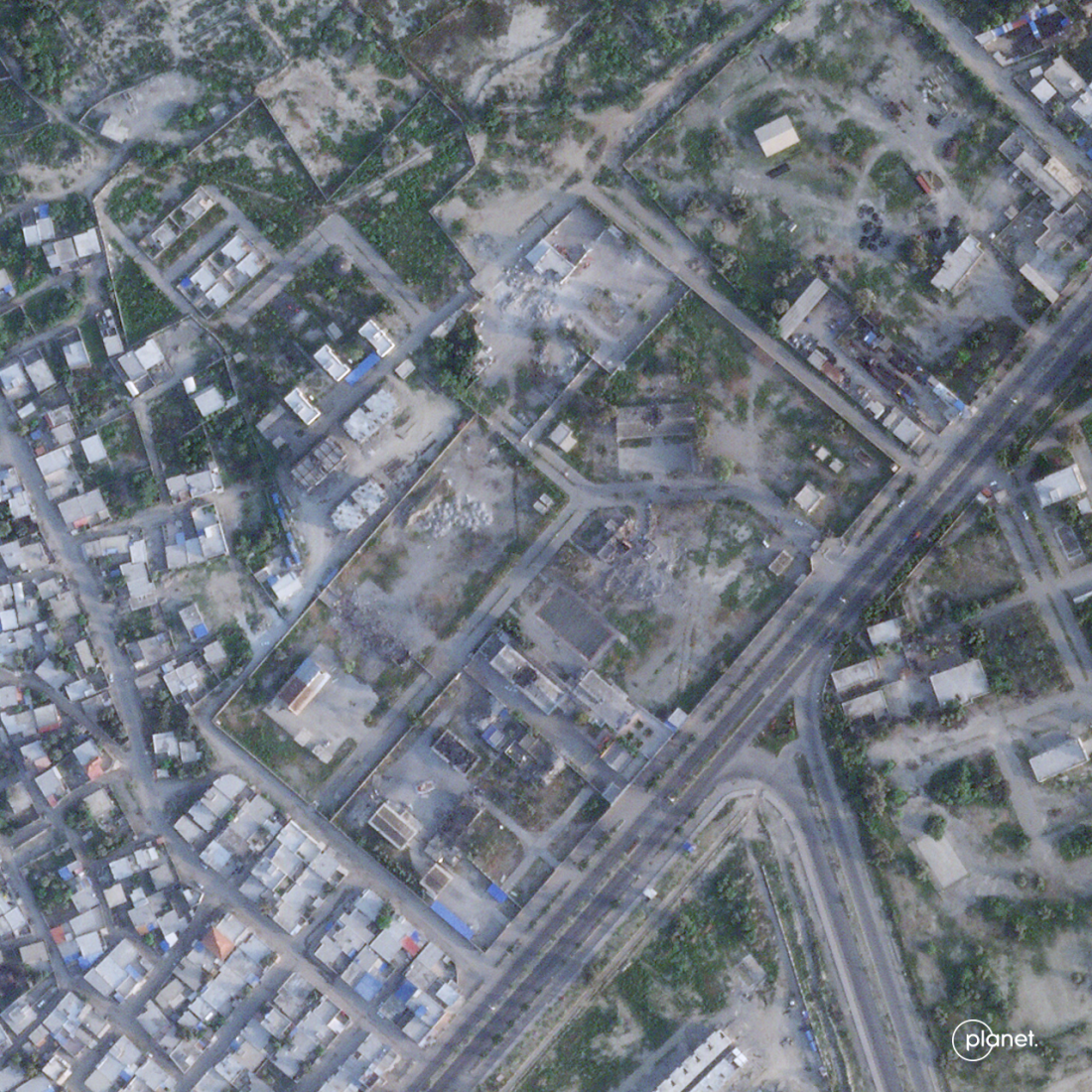
A satellite image of an Iranian Revolutionary Guard compound taken on March 4, several days after an airstrike destroyed a school on the edge of the compound. The image reveals that half a dozen other buildings in addition to the school were struck.
Planet Labs PBC
hide caption
toggle caption
Planet Labs PBC
Iranian state media said 165 people died in the bombing, which struck a girls’ school. The school was located within less than 100 yards of the perimeter of an Iranian Revolutionary Guard naval base, according to satellite images and publicly available information. The clinic was also located within the base perimeter, although both facilities had been walled off from the base.
Israel has denied involvement. “We are not aware at the moment of any IDF operation in that area,” Israel Defense Forces spokesperson Nadav Shoshani told NPR on Monday. “I don’t know who’s responsible for the bombing.”

At a press conference Wednesday morning, U.S. Defense Secretary Pete Hegseth said that the U.S. is looking into what happened at the school. “All I know, all I can say, is that we’re investigating that,” Hegseth said. “We, of course, never target civilian targets.”
Given Minab’s location in the southeastern part of Iran, Lewis believes it’s more likely the U.S. would have conducted the strike than Israel. As one gets farther south and east in Iran, “a strike is much more likely to be a U.S. strike than an Israeli strike because of the type of munitions and the geographic location,” he said.
Esmail Baghaei, the spokesman for Iran’s Foreign Ministry, called the strike “deliberate” and said that the U.S. and Israel bombed the school in part to tie up Iranian forces in the region with rescue efforts. “To call the attack on the girls school merely a ‘war crime’ does not capture the sheer evil and depravity of such a crime,” he said.
But Lewis said it’s more likely that the strike was the result of an error. Satellite images show that the school and clinic buildings were both once part of the base. The school was separated from the base by a wall between 2013 and 2016. The clinic was walled off between 2022 and 2024.
Lewis believes it’s possible American military planners had not updated their target sets.
“There are thousands of targets across Iran, and so there will be teams in the United States and Israel that are responsible for tracking those targets and updating them,” he said. “It’s possible that the target didn’t get updated.”
The Pentagon did not immediately respond to NPR’s request for additional information about the strike.
NPR’s Arezou Rezvani and NPR’s RAD team contributed to this report.

Mojtaba Khamenei, the second son of the assassinated Ali Khamenei, is being heavily tipped to succeed his father as supreme leader of Iran, which would pitch a hardliner into the task of steering the Islamic republic through the most turbulent period in its 48-year history and offer a powerful signal that, for now, it has no intention of changing course.
No official confirmation has been given and the announcement may be delayed until after the funeral of Ali Khamenei, which was on Wednesday postponed.
His son is believed to have been the choice of the Islamic Revolutionary Guard Corps (IRGC), and the Israeli defence minister, Gideon Saar, has warned he will be assassinated.
Ayatollah Seyed Khatani, a member of the Assembly of Experts, the body that chooses the new supreme leader, said the assembly was close to selecting a leader.
Rigid in his anti-western views, Mojtaba Khamenei is not the candidate Donald Trump would have wanted. Marco Rubio, the US secretary of state, said on Tuesday that Iran was run by “religious fanatic lunatics” – and Khamenei’s appointment is hardly likely to dispel that opinion.
The choice of supreme leader is made by the 88-strong Assembly of Experts, who in this case are picking from a field of six possible candidates. His election would be a powerful if unsurprising symbol that the government is not looking to find an accommodation with America.
Trump has said the worst-case scenario would be if Khamenei’s successor was “as bad as the previous person”.
There has been speculation for more than a decade that he would be his father’s successor, which grew when Ebrahim Raisi, the elected president and favourite of Khamenei, was killed in a helicopter crash.
Mojtaba Khamenei was born in 1969 and studied theology after graduating from high school. At the age of 17, he went to serve in the Iran-Iraq war, but it was not until the late 1990s that he came to be recognised as a public figure in his own right.
After the landslide defeat of Khamenei’s preferred candidate, Ali Akbar Nategh Nuri, in the 1997 presidential election, where he won only 25% of the final vote, various conservative Iranian groups realised the need to make changes to their structures and Mojtaba Khamenei was central to that project.
He was also seen as instrumental by reformists in suppressing the protests in 2009 that came after allegations the presidential election had been rigged, with his name chanted in the streets as one of those responsible. Mostafa Tajzadeh, a senior member of Iran’s reformist parties who was imprisoned after the vote, alleged that his and his wife, Fakhr al-Sadat Mohtashamipour’s, legal case was under the direct supervision of Mojtaba Khamenei.
In 2022 he was given the title of ayatollah – essential to his promotion. By then he was a regular figure by his father’s side at political meetings, as well as playing an influential role in the Islamic Republic’s Broadcasting Corporation, the government’s official media outlet often criticised for churning out dull political propaganda that many Iranians reject in favour of overseas satellite channels. He has also played a central role in the administration of his father’s substantial financial empire.
His closest political allies are Ahmad Vahidi, the newly appointed IRGC commander; Hossein Taeb, a former head of the IRGC’s intelligence organisation; and Mohammad Bagher Ghalibaf, the current speaker of the parliament.
His rumoured appointment and its hereditary nature has long been resisted by reformists. The former prime minister Mir Hossein Mousavi, referring to the long history of rumours about Mojtaba Khamenei succeeding his father as leader, wrote in 2022: “News of this conspiracy have been heard for 13 years. If they are not truly pursuing it, why don’t they deny such an intention once and for all?”
The Assembly of Experts, in response, denounced “meaninglessness of doubts” and said the assembly would select only “the most qualified and the most suitable”.
Israel on Tuesday struck the building in the Iranian city of Qom, one of Shia Islam’s main seats of power, where the assembly was scheduled, but the building was empty, according to IRGC-affiliated media.

new video loaded: Senators Question Kristi Noem on ICE Immigration Tactics
transcript
transcript
Senators Question Kristi Noem on ICE Immigration Tactics
Homeland Security Secretary Kristi Noem repeatedly refused to apologize for suggesting that Alex Pretti and Renee Good, two U.S. citizens shot and killed by agents, were domestic terrorists.
-
What we’ve seen is a disaster under your leadership, Ms. Noem. A disaster. What we’ve seen is innocent people getting detained that turn out are American citizens. I could talk about the culture that’s been created here. After the killings of Renee Good and Alex Pretti, when I spoke to Alex’s parents, they told me that you calling him a domestic terrorist — this was directly from them — the day after he was killed, a nurse in our V.A., Alex — one of the most hurtful things they could ever imagine was said by you about their son. Do you have anything you want to say to Alex Pretti’s parents? Ma’am, I did not call him a domestic terrorist. I said It appeared to be an incident of — I think the parents saw it for what it was. In a hearing — recent hearing before the HSGAC committee, C.B.P. and ICE officials testified under oath that their agencies did not inform you that Pretti was a domestic terrorist — during that hearing, stated during that hearing, I was getting reports from the ground, from agents at the scene, and I would say that it was a chaotic scene. How did you think that calling them domestic terrorists at that scene was somehow going to calm the situation? The fact that you can’t admit to a mistake, which looks like under investigation, it’s going to prove that Ms. Good and Mr. Pretti probably should not have been shot in the face and in the back. Law enforcement needs to learn from that. You don’t protect them by not looking after the facts.

By Christina Kelso and Jackeline Luna
March 3, 2026

Rhode Island teacher accused of sexting, kissing high school boy

Detroit Tigers 2026 roster prediction 2.0: Is Kevin McGonigle ready?

Latest California-based gig work app lets people book content creators, editors

Study says the real value of a $100K salary in Dallas is…less than that

Miami’s own Marcello Hernandez delivers special tribute to former teacher on SNL

Florida High School Football Rankings: Top 25 teams – Oct. 21

Cleary's 21 help Le Moyne down Central Connecticut State 69-64 in OT

How old is Bo Nix? What to know about Oregon quarterback ahead of 2024 NFL Draft

99th annual Pony Swim held in Virginia

Indiana Members Credit Union announced as new anchor tenant at Bottleworks District

DHS defends McLaughlin against allegations husband’s company profited millions from ad contracts: ‘Baseless’

Fareed Zakaria’s takes on Trump and the collapse of nuclear stability

Sánchez defies Trump in political gamble as Madrid say no to war
Satellite images show Iran school strike hit more buildings than earlier reported

US submarine sinks Iranian warship by torpedo in a first since World War II
-

 World1 week ago
Exclusive: DeepSeek withholds latest AI model from US chipmakers including Nvidia, sources say
-

 Massachusetts1 week ago
Mother and daughter injured in Taunton house explosion
-

 Wisconsin3 days ago
Setting sail on iceboats across a frozen lake in Wisconsin
-

 Maryland4 days ago
AM showers Sunday in Maryland
-

 Denver, CO1 week ago
10 acres charred, 5 injured in Thornton grass fire, evacuation orders lifted
-

 Florida4 days ago
Florida man rescued after being stuck in shoulder-deep mud for days
-

 Massachusetts2 days ago
Massachusetts man awaits word from family in Iran after attacks
-

 Oregon6 days ago
2026 OSAA Oregon Wrestling State Championship Results And Brackets – FloWrestling