Connect with us

News

Investors bet global central banks will be forced to delay rate cuts

Published

on

Investors bet global central banks will be forced to delay rate cuts

Investors are pushing back their expectations of interest rate cuts around the world, as the US Federal Reserve’s battle with price pressures complicates other central banks’ loosening plans.

As the US reported the latest in a string of poor inflation figures, markets reined in their forecasts for rate cuts by the European Central Bank and the Bank of England, as well as by the Fed itself.

“The Fed’s inflation problems have a global dimension and other central banks cannot ignore them,” said James Knightley, chief international economist at ING in New York. “In particular, if the Fed can’t cut rates soon it could stoke up dollar strength, which causes stress for the European economy and constrains other central banks’ ability to cut rates.”

He added: “Plus there is a worry that what is happening on inflation in the US could surface in Europe as well.” 

Senior officials at the ECB and BoE argue they are not confronting the same inflation problems as the US, implying they have more scope to cut rates earlier.

Advertisement

But shifts in the futures market indicate the global impact of the persistent US inflation problem.

Traders now expect the ECB to cut rates by an average of about 0.7 percentage points this year starting at its next policy meeting on June 6, while two weeks ago they expected cumulative cuts of 0.88 points.

At the beginning of the year, when US inflation appeared on a firmer downward path, they expected cuts of 1.63 points.

Markets now anticipate BoE cuts of 0.44 percentage points this year compared with 0.56 points two weeks ago and 1.72 points at the start of the year.

The backdrop for the shift has been the market’s reduced expectations for the Fed, which is set to keep rates at their 23-year-high at its meeting next week. While at the start of the year investors had expected as many as six quarter-point cuts, this year, they now expect one or two.

Advertisement
Line chart of Rate expectations in 2024 (%) showing Markets expect one or two rate cuts from the Fed and BoE this year, and three from the ECB

The US and its European counterparts have diverged in the past. But if other regions cut rates more aggressively than the Fed, they risk harming their own economies because of the impact on exchange rates, import costs and inflation.

“There’s a good macro case for divergence, but ultimately there’s a limit on how far it can go,” said Nathan Sheets, chief economist at US lender Citi. He added that it was “more challenging” for the ECB to “cut aggressively in an environment where the Fed is waiting”.

Fed chair Jay Powell conceded this month that US inflation was “taking longer than expected” to hit its target, signalling that borrowing costs would need to stay high for longer than previously thought.

In figures on Friday, the Fed’s preferred inflation metric came in higher than expected at 2.7 per cent for the year to March, and a minority of traders are now even betting on Fed rate rises in the next 12 months.

Marcelo Carvalho, global head of economics at BNP Paribas, said the ECB was neither “Fed-dependent” nor “Fed-insensitive”.

Despite the market’s expectations that high US borrowing costs will limit their freedom of manoeuvre, top European central bankers insist their less serious inflation problem requires a different response.

Advertisement
Line chart of Inflation rates (annual % change) showing Price pressures have fallen sharply across advanced economies

“It is a different kind of animal we are trying to tame,” ECB president Christine Lagarde said this month in Washington.

She said the “roots and drivers” of the two regions’ price surges were different — with Europe affected more by energy costs and the US by big fiscal deficits.

BoE governor Andrew Bailey has also argued that European inflation dynamics were “somewhat different” from the US.

Top officials from the ECB and BoE have signalled rates will still be cut this summer, despite the inflation data that has led investors to price in the first Fed rate reduction in November.

The shift is a marked contrast to earlier this year when the Fed was seen as leading the way down.

“The ECB and BoE are operating in a much weaker growth environment, so I suspect they will have no compunctions about cutting rates earlier,” said Mahmood Pradhan, head of global macroeconomics at Amundi Asset Management.

Advertisement

But ECB policymakers have given divergent indications on how big a rate gap with the Fed they can tolerate.

Banque de France governor François Villeroy de Galhau told Les Echos that he expects continued cutting “at a pragmatic pace” after June. However, Austria’s central bank head Robert Holzmann warned: “I would find it difficult if we move too far away from the Fed.”

The euro has fallen 3 per cent against the dollar since the start of the year to just above $1.07, but investors have increased bets it could drop to parity with the US currency.

Such a fall would add about 0.3 percentage points to eurozone inflation over the next year, according to recent ECB research. The bank’s vice-president, Luis de Guindos, said this week it would “need to take the impact of exchange rate movements into account”.

The far-reaching impact of US policy is already highly visible in Japan, where investors are increasing bets that the Bank of Japan will need to keep raising borrowing costs as a weaker yen fuels inflation. The yen has dropped to 34-year lows against the dollar, pushing up the price of imported goods.

Advertisement

But some EU policymakers argue that if a more hawkish Fed leads to tighter global financial conditions, it could bolster the case for easing in the eurozone and elsewhere.

“A tightening in the US has a negative impact on inflation and output in the eurozone,” Italy’s central bank boss Fabio Panetta said on Thursday, adding that this was “likely to reinforce the case for a rate cut rather than weakening it”.

Tighter US policy also affects global bond markets, with Germany’s 10-year Bunds often mirroring movements by the 10-year US Treasury.

BNP Paribas estimates that if European bond yields were driven half a percentage point higher by the fallout from US markets, it would require an extra 0.2 percentage points of rate cuts by the ECB to offset the impact of tighter financial conditions. Similarly, it would require 0.13 points of extra cuts by the BoE.

Tomasz Wieladek at T Rowe Price in London argued that the ECB and BoE “need to actively lean against this tightening in global financial conditions to bring their domestic financial conditions more in line with the fundamentals in their own economies”.

Advertisement

Additional reporting by George Steer in London

News

Trump claims US stockpiles mean wars can be fought ‘forever’; Kristi Noem testifies before Congress – US politics live

Published

on

Trump claims US stockpiles mean wars can be fought ‘forever’; Kristi Noem testifies before Congress – US politics live

Trump says US stockpiles mean “wars can be fought ‘forever’”

In a late night post on Truth Social, Donald Trump said that the US munitions stockpiles “at the medium and upper medium grade, never been higher or better”.

He added that the US has a “virtually unlimited supply of these weapons”, meaning that “wars can be fought ‘forever’”.

This comes after Trump said that the US-Israel war on Iran could go beyond the four-five weeks that the administration initially predicted. The president also did not rule out the possibility of US boots on the ground in Iran during an interview with the New York Post on Monday.

Advertisement

“I rebuilt the military in my first term, and continue to do so. The United States is stocked, and ready to WIN, BIG!!!,” he wrote.

Share

Key events

During his opening remarks, Senate judicicary committee chairman, Chuck Grassley, blamed Democrats for the ongoing shutdown Department of Homeland Security (DHS) but highlighted four agencies: the Secret Service, Federal Emergency Management Agency (FEMA), the Transportation Security Administration (TSA), and the Coast Guard.

Democrats are demanding tighter guardrails for federal immigration enforcement, but a sweeping tax bill signed into law last year conferred $75bn for Immigration and Customs Enforcement (ICE), which means the agency is still functional amid the wider department shuttering.

Share
Continue Reading

News

Supreme Court blocks redrawing of New York congressional map, dealing a win for GOP

Published

on

Supreme Court blocks redrawing of New York congressional map, dealing a win for GOP

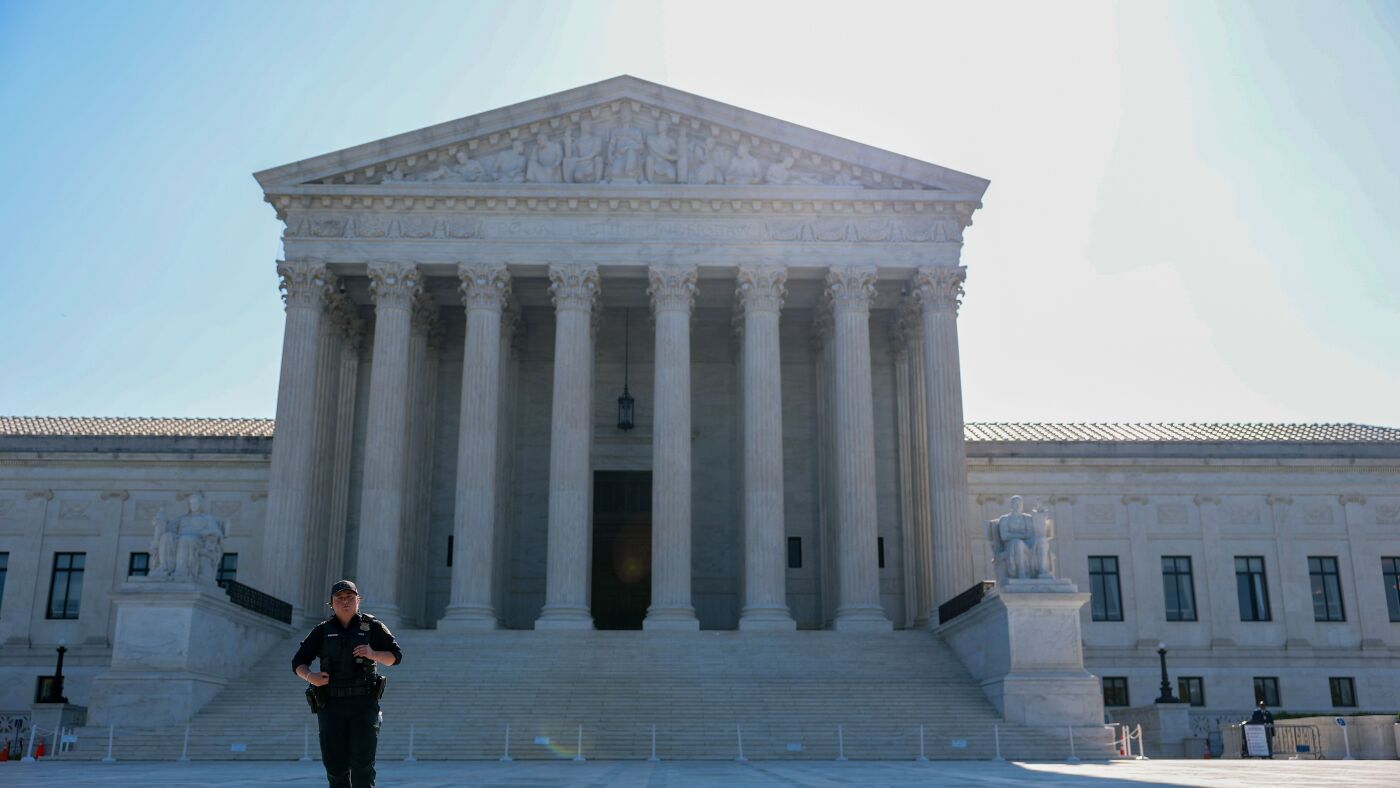
The Supreme Court

Win McNamee/Getty Images


hide caption

toggle caption

Advertisement

Win McNamee/Getty Images

The Supreme Court on Monday intervened in New York’s redistricting process, blocking a lower court decision that would likely have flipped a Republican congressional district into a Democratic district.    
  
At issue is the midterm redrawing of New York’s 11th congressional district, including Staten Island and a small part of Brooklyn. The district is currently held by a Republican, but on Jan. 21, a state Supreme Court judge ruled that the current district dilutes the power of Black and Latino voters in violation of the state constitution.  
  
GOP Rep. Nicole Malliotakis, who represents the district, and the Republican co-chair of the state Board of Elections promptly appealed to the U.S. Supreme Court, asking the justices to block the redrawing as an unconstitutional “racial gerrymander.” New York’s congressional election cycle was set to officially begin Feb. 24, the opening day for candidates to seek placement on the ballot.  
  
As in this year’s prior mid-decade redistricting fights — in Texas and California — the Trump administration backed the Republicans.   
 
Voters and the State of New York contended it’s too soon for the Supreme Court to wade into this dispute. New York’s highest state court has not issued a final judgment, so the voters asserted that if the Supreme Court grants relief now “future stay applicants will see little purpose in waiting for state court rulings before coming to this Court” and “be rewarded for such gamesmanship.” The state argues this is an issue for “New York courts, not federal courts” to resolve, and there is sufficient time for the dispute to be resolved on the merits. 
  
The court majority explained the decision to intervene in 101 words, which the three dissenting liberal justices  summarized as “Rules for thee, but not for me.” 
 
The unsigned majority order does not explain the Court’s rationale. It says only how long the stay will last, until the case moves through the New York State appeals courts. If, however, the losing party petitions and the court agrees to hear the challenge, the stay extends until the final opinion is announced. 
 
Dissenting from the decision were Justices Sonia Sotomayor, Elena Kagan, and Ketanji Brown Jackson. Writing for the three, Sotomayor  said that  if nonfinal decisions of a state trial court can be brought to highest court, “then every decision from any court is now fair game.” More immediately, she noted, “By granting these applications, the Court thrusts itself into the middle of every election-law dispute around the country, even as many States redraw their congressional maps ahead of the 2026 election.” 

Monday’s Supreme Court action deviates from the court’s hands-off pattern in these mid-term redistricting fights this year. In two previous cases — from Texas and California — the court refused to intervene, allowing newly drawn maps to stay in effect.  
  
Requests for Supreme Court intervention on redistricting issues has been a recurring theme this term, a trend that is likely to grow.  Earlier last month  the high court allowed California to use a voter-approved, Democratic-friendly map.  California’s redistricting came in response to a GOP-friendly redistricting plan in Texas that the Supreme Court also permitted to move forward. These redistricting efforts are expected to offset one another.     
   
But the high court itself has yet to rule on a challenge to Louisiana’s voting map, which was drawn by the state legislature after the decennial census in order to create a second majority-Black district.  Since the drawing of that second majority-black district, the state has backed away from that map, hoping to return to a plan that provides for only one majority-minority district.    
     
The Supreme Court’s consideration of the Louisiana case has stretched across two terms. The justices failed to resolve the case last term and chose to order a second round of arguments this term adding a new question: Does the state’s intentional creation of a second majority-minority district violate the constitution’s Fourteenth and Fifteenth Amendments’ guarantee of the right to vote and the authority of Congress to enforce that mandate?    
Following the addition of the new question, the state of Louisiana flipped positions to oppose the map it had just drawn and defended in court. Whether the Supreme Court follows suit remains to be seen. But the tone of the October argument suggested that the court’s conservative supermajority is likely to continue undercutting the 1965 Voting Rights Act.   

Advertisement
Continue Reading

News

Map: Earthquake Shakes Central California

Published

on

Map: Earthquake Shakes Central California

Note: Map shows the area with a shake intensity of 3 or greater, which U.S.G.S. defines as “weak,” though the earthquake may be felt outside the areas shown.  All times on the map are Pacific time. The New York Times

A minor earthquake with a preliminary magnitude of 3.5 struck in Central California on Monday, according to the United States Geological Survey.

The temblor happened at 7:17 a.m. Pacific time about 6 miles northwest of Pinnacles, Calif., data from the agency shows.

As seismologists review available data, they may revise the earthquake’s reported magnitude. Additional information collected about the earthquake may also prompt U.S.G.S. scientists to update the shake-severity map.

Source: United States Geological Survey | Notes: Shaking categories are based on the Modified Mercalli Intensity scale. When aftershock data is available, the corresponding maps and charts include earthquakes within 100 miles and seven days of the initial quake. All times above are Pacific time. Shake data is as of Monday, March 2 at 10:20 a.m. Eastern. Aftershocks data is as of Monday, March 2 at 11:18 a.m. Eastern.

Advertisement
Continue Reading

Trending