News
Democrat Spanberger wins Virginia governor race with message on DOGE, cost of living


Democratic candidate for governor Abigail Spanberger gives remarks during a rally on Saturday in Norfolk, Virginia.
Shaban Athuman/VPM News
hide caption
toggle caption
Shaban Athuman/VPM News
Democrat Abigail Spanberger will be Virginia’s next governor, according to a race call by the Associated Press.
Spanberger, who previously served three terms in the U.S. House, defeated her Republican opponent, Lt. Gov. Winsome Earle-Sears. She’ll be Virginia’s first woman governor.
The contest received national attention as one of the first major tests of voter sentiment in response to the Trump administration’s policies.
Virginia is home to around 320,000 federal workers and hundreds of thousands of federal contractors. On the campaign trail, Spanberger argued that federal layoffs, cutbacks by President Trump’s Department of Government Efficiency (DOGE), tariffs, and the federal shutdown were an attack on the Virginia economy — and pitched herself as a way for voters to push back.
“We need a governor who will recognize the hardship of this moment, advocate for Virginians, and make clear that not only are we watching people be challenged in their livelihoods and in their businesses and in communities, but Virginia’s economy is under attack,” Spanberger said at a stop on a campaign bus tour late last month.
That message resonated with Haley Morgan Wright, a voter whose husband is a federal employee currently working without pay during the federal shutdown. She wants Spanberger to use her platform as governor to uplift the stories of civil servants like him.
“He cares about his country, he wants to serve his country and has opted to do it in this way,” she said after casting a ballot in the Northern Virginia exurbs. “He’s not superfluous.”
Spanberger was backed by national Democrats
National Democrats had looked to Spanberger and Virginia Democrats for a boost heading into the 2026 midterms. Former President Barack Obama had campaigned for her and the party backed her in what was one of just two governor’s races this year.

Voters cast their ballots at Huguenot High School on Tuesday in Richmond, Virginia.
Ryan M. Kelly/VPM News
hide caption
toggle caption
Ryan M. Kelly/VPM News
“The DNC has been spending a lot of money and a lot of time in Virginia,” said DNC Vice Chair Rep. Malcolm Kenyatta at a meeting for party volunteers in Northern Virginia. “Because we know that what you all do and the momentum that is going to come out of your victories is going lead to us flipping the House of Representatives in 2026.”
In 2021, Republican Glenn Youngkin defeated Democrat Terry McAuliffe with 50.6% of the vote to 48.7%. Virginia governors are limited to one four-year term.
Spanberger, who served in the CIA before running for Congress in 2018, has cultivated a reputation as a pragmatic centrist. The theme of her run for governor was “affordability” — speaking to Virginians’ concerns about rising costs of housing, utility bills, pharmaceutical drugs, and the economic uncertainty she blamed on Trump’s tariffs and federal layoffs.
Earle-Sears, meanwhile, portrayed herself as an example of the American dream — a Jamaican immigrant who became a U.S. Marine and small business owner.
She accused Spanberger of backing policies on transgender rights that she said are a threat to girls’ safety in school bathrooms and locker rooms.
“Love is not having my daughter having to be forced to undress in a locker room with a man. That’s not love,” Earle-Sears said at a rally in late October. “Love is making sure that our girl children have opportunities in sports and are not forced to play against biological males.”
Earle-Sears’ stance on transgender students in girls’ bathrooms sounded good to Elizabeth Drake, a voter who said she works with youth at a church in Loudoun County.
“I feel like we’re actually going back and setting ourselves back a lot by endangering women,” she said. “I’m not saying that that doesn’t mean we can have alternative spaces for people, but the women’s locker rooms, women’s bathrooms, women’s safe homes are not it.”
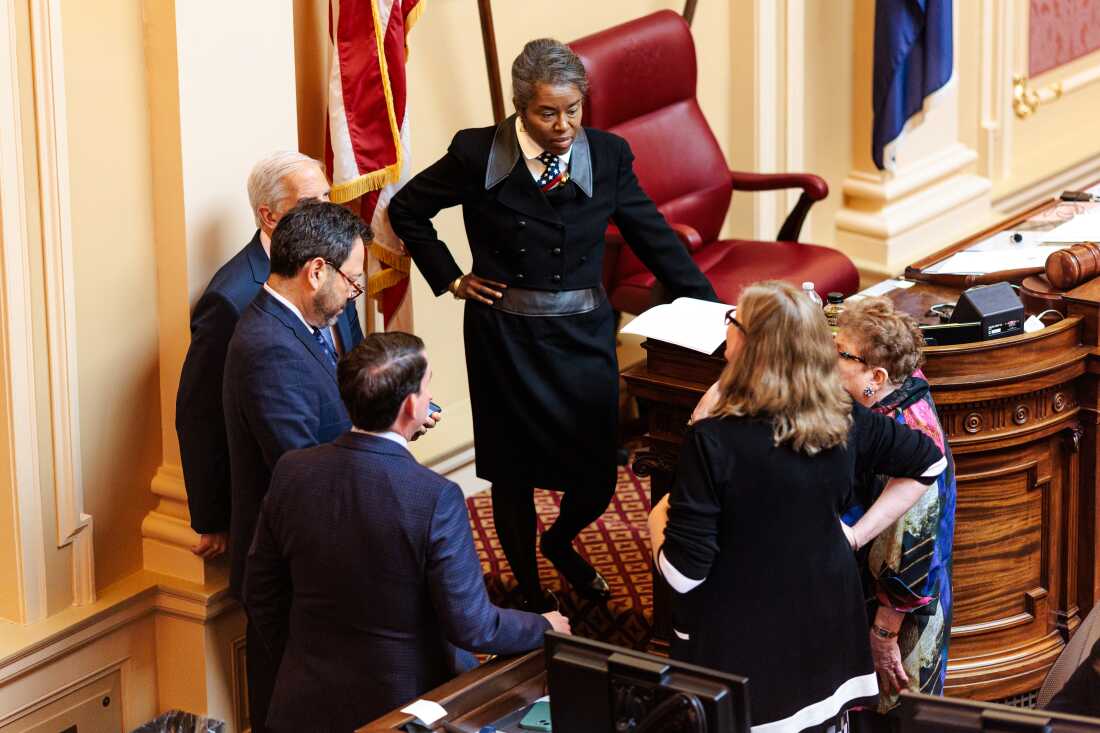
Winsome Earle-Sears, currently Virginia’s lieutenant governor, in the Virginia General Assembly last month.
Shaban Athuman/VPM News
hide caption
toggle caption
Shaban Athuman/VPM News
The race was jolted by late-breaking events
She also attacked Spanberger for supporting Biden administration policies. She vowed to continue business-friendly polices of outgoing Republican Gov. Glenn Youngkin. While she backed Trump’s policies, Trump did not endorse her.
Several developments impacted the final weeks of the race. The federal shutdown shadowed the final month of early voting, with both campaigns blaming the other party for the stalemate.
Virginia lawmakers began considering a plan to redistrict the state’s congressional districts to favor Democratic candidates in the 2026 midterm elections, as President Trump pushes Republicans in other states to move to favor their candidates. That could be an issue facing the next Virginia governor.

Former President Barack Obama campaigned for Spanberger over the weekend.
Steve Helber/AP
hide caption
toggle caption
Steve Helber/AP
And Republicans seized on revelations of text messages by Democratic candidate for attorney general, Jay Jones, in which he described the hypothetical shooting of a Republican lawmaker. Spanberger denounced the messages though Earle-Sears faulted her for not calling on Jones to drop out of the race.
Jones was in a tight race Tuesday against Republican incumbent Jason Miyares for the attorney general’s office.
Margaret Barthel covers Virginia politics for WAMU.



Note: Map shows the area with a shake intensity of 4 or greater, which U.S.G.S. defines as “light,” though the earthquake may be felt outside the areas shown. The New York Times
A light, 4.9-magnitude earthquake struck in Louisiana on Thursday, according to the United States Geological Survey.
The temblor happened at 5:30 a.m. Central time about 6 miles west of Edgefield, La., data from the agency shows.
U.S.G.S. data earlier reported that the magnitude was 4.4.
As seismologists review available data, they may revise the earthquake’s reported magnitude. Additional information collected about the earthquake may also prompt U.S.G.S. scientists to update the shake-severity map.
Source: United States Geological Survey | Notes: Shaking categories are based on the Modified Mercalli Intensity scale. When aftershock data is available, the corresponding maps and charts include earthquakes within 100 miles and seven days of the initial quake. All times above are Central time. Shake data is as of Thursday, March 5 at 8:40 a.m. Eastern. Aftershocks data is as of Thursday, March 5 at 10:46 a.m. Eastern.

To read this article for free
Register now
Once registered, you can:
• Read free articles
• Get our Editor’s Digest and other newsletters
• Follow topics and set up personalised events
• Access Alphaville: our popular markets and finance blog
News
Man accused of plot to assassinate Trump testifies Iran pressured him, says Biden and Haley were other possible targets

The allegation sounded like the stuff of spy movies: A Pakistani businessman trying to hire hit men, even handing them $5,000 in cash, to kill a U.S. politician on behalf of Iran ‘s powerful paramilitary Revolutionary Guard.
It was true, and potential targets of the 2024 scheme included now-President Donald Trump, then-President Joe Biden and former presidential candidate and ex-U.N. Ambassador Nikki Haley, the man told jurors at his attempted terrorism trial in New York on Wednesday. But he insisted his actions were driven by fear for loved ones in Iran, and he figured he’d be apprehended before anything came of the scheme.
“My family was under threat, and I had to do this,” the defendant, Asif Merchant, testified through an Urdu interpreter. “I was not wanting to do this so willingly.”
Merchant said he had anticipated getting arrested before anyone was killed, intended to cooperate with the U.S. government and had hoped that would help him get a green card.
U.S. authorities were, indeed, on to him – the supposed hit men he paid were actually undercover FBI agents – and he was arrested on July 12, 2024, a day before an unrelated attempt on Trump’s life in Butler, Pennsylvania. During a search, investigators said they found a handwritten note that contained the codewords for the various aspects of the plot, CBS News previously reported.
Merchant did sit for voluntary FBI interviews, but he ultimately ended up with a trial, not a cooperation deal.
“You traveled to the United States for the purpose of hiring Mafia members to kill a politician, correct?” Assistant U.S. Attorney Nina Gupta asked during her turn questioning Merchant Wednesday in a Brooklyn federal court.
“That’s right,” Merchant replied, his demeanor as matter-of-fact as his testimony was unusual.
The trial is unfolding amid the less than week-old Iran war, which killed Iranian Supreme Leader Ayatollah Ali Khamenei in a strike that Trump summed up as “I got him before he got me.” Jurors are instructed to ignore news pertaining to the case.
The Iranian government has denied plotting to kill Trump or other U.S. officials.
Merchant, 47, had a roughly 20-year banking career in Pakistan before getting involved in an array of businesses: clothing, car sales, banana exports, insulation imports. He openly has two families, one in Pakistan and the other in Iran – where, he said, he was introduced around the end of 2022 to a Revolutionary Guard intelligence operative. They initially spoke about getting involved in a hawala, an informal money transfer system, Merchant said.
Merchant testified that his periodic visits to the U.S. for his garment business piqued the interest of his Revolutionary Guard contact, who trained him on countersurveillance techniques.
The U.S. deems the Revolutionary Guard a “foreign terrorist organization.” Formally called the Islamic Revolutionary Guard Corps, the force has been prominent in Iran under Khamenei.
Merchant said the handler told him to seek U.S. residents interested in working for Iran. Then came another assignment: Look for a criminal to arrange protests, steal things, do some money laundering, “and maybe have somebody murdered,” Merchant recalled.
“He did not tell me exactly who it is, but he told me – he named three people: Donald Trump, Joe Biden and Nikki Haley,” he added.
In 2024, multiple sources familiar with the investigation told CBS News Merchant planned to assassinate current and former government officials across the political spectrum.
Merchant allegedly sketched out the plot on a napkin inside his New York hotel room, prosecutors said, and told the individual “that there would be ‘security all around’ the person” they were planning to kill.
“No other option”
After U.S. immigration agents pulled Merchant aside at the Houston airport in April 2024, searched his possessions and asked about his travels to Iran, he concluded that he was under surveillance. But still he researched Trump rally locations, sketched out a plot for a shooting at a political rally, lined up the supposed hit men and scrambled together $5,000 from a cousin to pay them a “token of appreciation.”
He even reported back to his Revolutionary Guard contact, sending observations – fake, Merchant said – tucked into a book that he shipped to Iran through a series of intermediaries.
Merchant said he “had no other option” than to play along because the handler had indicated that he knew who Merchant’s Iranian relatives were and where they lived.
In a court filing this week, prosecutors noted that Merchant didn’t seek out law enforcement to help with his purported predicament before he was arrested. He testified that he couldn’t turn to authorities because his handler had people watching him.
Prosecutors also said that in his FBI interviews, Merchant “neglected to mention any facts that could have supported” an argument that he acted under duress.
Merchant told jurors Wednesday that he didn’t think agents would believe his story, because their questions suggested “they think that I’m some type of super-spy.”
“And are you a super-spy?” defense lawyer Avraham Moskowitz asked.
“No,” Merchant said. “Absolutely not.”

Minnesota Wild Acquires Defenseman Jeff Petry from the Florida Panthers | Minnesota Wild

Leaders throughout Mississippi remember JSU’s Elayne Hayes-Anthony

Missouri Supreme Court reviews airport property tax deduction

Montana GOP won’t endorse in federal races this cycle • Daily Montanan

Nebraska’s Running Backs Have an Strong Role Model in Emmett Johnson

Florida High School Football Rankings: Top 25 teams – Oct. 21

Cleary's 21 help Le Moyne down Central Connecticut State 69-64 in OT

How old is Bo Nix? What to know about Oregon quarterback ahead of 2024 NFL Draft

99th annual Pony Swim held in Virginia

Indiana Members Credit Union announced as new anchor tenant at Bottleworks District

Map: 4.9-Magnitude Earthquake Shakes Louisiana

Paxton vows he’s ‘staying in this race’ even if Trump backs Cornyn in Texas GOP clash

Which Kurdish groups is the US rallying to fight Iran?

Man accused of plot to assassinate Trump testifies Iran pressured him, says Biden and Haley were other possible targets

DHS defends McLaughlin against allegations husband’s company profited millions from ad contracts: ‘Baseless’
-

 World1 week ago
Exclusive: DeepSeek withholds latest AI model from US chipmakers including Nvidia, sources say
-

 Massachusetts1 week ago
Mother and daughter injured in Taunton house explosion
-

 Wisconsin4 days ago
Setting sail on iceboats across a frozen lake in Wisconsin
-

 Maryland5 days ago
AM showers Sunday in Maryland
-

 Florida4 days ago
Florida man rescued after being stuck in shoulder-deep mud for days
-

 Denver, CO1 week ago
10 acres charred, 5 injured in Thornton grass fire, evacuation orders lifted
-

 Massachusetts3 days ago
Massachusetts man awaits word from family in Iran after attacks
-

 Oregon6 days ago
2026 OSAA Oregon Wrestling State Championship Results And Brackets – FloWrestling