News
Congress avoids a shutdown but leaves 'a big mess' for Trump and Republicans in 2025


WASHINGTON — Congress struck an 11th-hour deal to avert a government shutdown during the holidays, but in the process, it lengthened an already extensive to-do list for the first year of President-elect Donald Trump’s return to office.
The funding bill keeps the government open until March 14. Even though Republicans will control the White House, the House and the Senate, they’ll again need Democratic votes to stop a shutdown in less than three months.
In addition, Trump’s demand that Congress extend or abolish the debt ceiling to take it off his plate next year failed dramatically. On Wednesday, he threatened electoral primary challenges against “any Republican” who voted to fund the government without dealing with the debt limit. On Friday, 170 House Republicans defied him and did just that.
The turmoil of the week previews the legislative chaos that awaits Washington in the second Trump administration when the incoming president faces a wide range of major deadlines and ambitions.
Sen. Ron Johnson, R-Wis., said Republicans made a mistake by punting funding to March 14, and instead should have approved a stopgap bill through the end of next September to clear their plate for Trump’s agenda.
“I think it’s kind of stupid,” he said of the new deadline. “Don’t ask me to explain or defend this dysfunction.”
Rep. Andy Barr, R-Ky., said late Friday that the “lesson” of the last few days is: “Unity is our strength. Disunity is the enemy of the conservative cause.”
He advised Trump and his team to avoid such a situation in the future by presenting legislative demands “early” so the GOP can “air out whatever differences there are” well before a deadline.
“The House needs to over-communicate within our various factions,” Barr said. “The House needs to over-communicate with [incoming Senate] Majority Leader [John] Thune, and House and the Senate both need to over-communicate with the administration.”
In the last four days, the communication was particularly poor. A day after Speaker Mike Johnson released an initial bipartisan deal, Trump and his billionaire confidant Elon Musk blew it up. The speaker went through three additional iterations of his plan to prevent a shutdown, ultimately succeeding after nixing Trump’s most consequential — and last-minute — demand.
“I’m concerned,” said Sen. Gary Peters, D-Mich., who faces re-election in 2026. “Obviously, we’ve seen this kind of chaos for the last two years. So I would fully expect we’ll see that continue in the next two years and probably get even worse.”
On Thursday night, Rep. Derrick Van Orden, R-Wis., downplayed what he called a “disjointed process,” saying it’s a natural way for House Republicans and Trump’s team to understand “how to communicate with each other.”
“It’s going to be awesome. You know why it’s going to be awesome? Because now we know how to work together,” Van Orden said just before Speaker Johnson’s Plan B went down in flames in the House.
Van Orden’s fellow Wisconsinite, Sen. Johnson, was less bullish about smoothly plowing through the early part of the 2025 agenda.
“We got a big mess on our hands, no doubt about it,” Johnson said. “That’s why I’m trying to underpromise and hopefully over-deliver.”
In addition to another government funding deadline and a debt limit that must be addressed by mid-2025 to avert a calamitous default, Trump and Republicans need to confirm his personnel through the Senate, and they want to pass major party-line bills to beef up immigration enforcement and extend his expiring 2017 tax law.
“It’s not going to be boring,” Sen. Ted Cruz, R-Texas, deadpanned when asked about the tasks facing Congress next year.
There’s also the question of Musk’s role after his part in scuttling the original bipartisan funding deal raised hackles across Capitol Hill.
“A lot of people on both sides of the aisle are deeply disturbed by a billionaire threatening people if they don’t vote the right way,” Rep. Debbie Dingell, D-Mich., said.
The tumult of the last week “foretells something very ominous about next year,” Rep. Gerry Connolly, D-Va., said after the House vote, noting that the Republican majority in the lower chamber will be even smaller next year.
“I think we’re in for a lot of turbulence on the Republican side of the House because of the instability and chaos and disruption that Trump embraces,” Connolly said.
He also wondered whether Republicans will be able to elect a speaker on Jan. 3 with a wafer-thin majority; it took 15 rounds of voting to elect a speaker at the beginning of the last Congress and some hard-right Republicans are wobbly on Speaker Johnson after his handling of the shutdown threat this week.
“So I leave very unsettled tonight in terms of what we just experienced,” Connolly said before the House adjourned for the holidays. “I think it’s very ominous, and it is portentous.”


A Waymo robotaxi drives in San Francisco’s North Beach neighborhood this week.
Heather Diehl/Getty Images
hide caption
toggle caption
Heather Diehl/Getty Images
Police in San Mateo, Calif., posted Monday on social media that they had apprehended a pair of teenagers from a Waymo driverless robotaxi after the company alerted authorities to suspected criminal activity. It’s the latest incident involving video surveillance of passengers and others by autonomous vehicles — raising questions about the limits of privacy in such vehicles.
The Facebook post by the San Mateo County Police said: “Parents do you know where your teens are? @waymo does!”
The 15-year-olds were allegedly drinking alcohol and shooting toy guns from the car, according to the police. They said Waymo’s systems detected behavior that then triggered a safety response, after which the company disabled the vehicle and contacted police.
Waymo’s cars, equipped with an array of cameras, microphones and other sensors to monitor passengers and other nearby vehicles, are becoming more common in cities across the United States. Experts say the detention of the two teens in San Mateo highlights a potential — but not inevitable — trade-off between privacy and convenience. It also questions the extent to which companies similar to Waymo are required to hand over private data, including audio and video of passengers, in situations where a crime is suspected.
NPR reached out to Waymo, which is owned by Alphabet, the parent company of Google, for comment on the details of the San Mateo incident and how the company responded, but did not hear back. But on its website, the company says that as many as 29 cameras in its autonomous cars provide an all-around view and “are designed with high dynamic range and thermal stability, to see in both daylight and low-light conditions, and tackle more complex environments.”
“There already exist laws that govern duty to report or even duty to protect” for carriers such as Waymo, according to Alessandro Acquisti, a professor of information technology at the MIT Sloan School of Management. “The privacy problems arise when and if driverless carrier companies used such laws or ethical obligations as a pretext for blanket, indiscriminate accumulation of identifiable data for unspecified future purposes.”
That includes not just monitoring people inside the cars, but outside too. Take, for example, a hit-and-run investigation last year in Los Angeles. Media reported that the police inquiry was aided by video captured by a Waymo taxi that had a clear view of the crime. Critics suggested at the time that authorities were using the company’s vehicles as a mobile surveillance platform. And during 2025 protests in Los Angeles against Immigration and Customs Enforcement crackdowns, demonstrators vandalized Waymos, apparently angry that video recorded by the vehicles could be used by police, although there is no evidence that happened.
In a transparency report, Google says it received nearly 290,000 requests from governments worldwide in the first six months of 2025 for disclosure of user information across all its platforms, including Waymo. The company says that in more than 80% of the requests in those six months, some information was disclosed. “Google carefully reviews each request to make sure it satisfies applicable laws. If a request asks for too much information, we try to narrow it, and in some cases we object to producing any information at all,” the company says.
In an email to NPR, San Mateo Police Department spokesperson Jeanine Luna said that detaining the teens in the Waymo on Monday was “wholly appropriate” under the circumstances. “We received the call of a ‘firearm’ being shot from a moving vehicle,” she said. “Furthermore, the occupants were described as being possibly ‘intoxicated.’” she said.
“Being that the vehicle was disabled (the occupants had every right to exit the vehicle before police arrival, but they did not), a high-risk traffic stop was conducted to ensure the safety of all involved,” Luna added. “They were not arrested and were released to their parents, however, potential charges are still pending dependent on what the video from inside the vehicle shows.”
Autonomous taxis represent an ethical gray area
Robotaxis began to roll out across the U.S. in December 2018, when Waymo launched in Phoenix. These services have been used for less than a decade — so the norms surrounding them aren’t settled, experts agree.
The Facebook post may make Waymo passengers wonder what triggers a police intervention, says Irina Raicu, director of the Internet Ethics program at Santa Clara University. She has used Waymo’s driverless taxis and says ethically, the privacy issues surrounding them sit in a gray area. “There’s something about being in a car without another person that makes you think it’s private.”
“With all these recording devices, we don’t see them, [and] they’re not these obvious things being stuck in our faces,” Raicu adds.
That brings up a key issue: informed consent, Acquisti says.
“It is not clear the extent to which passengers … are reminded that when they step into the car, that they are being monitored, and most likely they are not told in its entirety how the data will be used,” he says.
Bruce Schneier, a cybersecurity and privacy expert and professor at the Munk School at the University of Toronto, believes that Waymo does have a compelling interest in protecting its vehicles. He compares monitoring a robotaxi via cameras to a human taxi driver keeping an eye on passengers in the rearview mirror.
“Maybe the driverless car comes back … and it has all of its cushions slashed, and it’s like, ‘Who the hell did that? Let’s go and look at the tape,’” Schneier suggests. “You can’t have sex in the back of a taxi, right? Someone would say, ‘Stop it.’”
He concludes that some supervision makes sense. In an Uber rideshare, he notes, “most of the time there’s a camera recording the back seat.” (Uber says on its website that it allows drivers to install such cameras for the purpose of “fulfilling transportation services.”)

Waymo robotaxis, while a fairly common sight in the San Francisco Bay Area, are still a novelty in much of the country. And many people are hesitant to ride in one, according to a Pew Research Center poll published this month. The survey found that only 5% of Americans had ever ridden in a driverless car. Meanwhile, 71% of those polled said they would feel uncomfortable in one, with only 7% saying they would be “extremely or very comfortable” riding in one.
For that reason, experts who spoke with NPR said they were optimistic that it’s not too late to shift gears on privacy norms and policies surrounding these vehicles.
Acquisti doesn’t see why privacy measures can’t be built into driverless vehicles.
“I would immediately challenge the notion that people have to be monitored,” he says, noting that privacy-preserving technologies exist and can be installed.
“Driverless cars are coming, but they don’t have to come in this particular incarnation,” Raicu says. “They’re still being designed and redesigned. It’s early days.”

Donald Trump has terminated the remaining members of the independent, federal commission that assists election administration officials nationwide just a few months before the midterm elections, multiple outlets reported Thursday.
The remaining three commissioners of the four-member bipartisan commission were forced out on Thursday in different ways. The one Republican appointee resigned and the other two, Democratic appointees were notified of their terminations via email from the White House presidential personnel office.
“On behalf of President Donald J Trump, I am writing to inform you that your position as Commissioner of the Election Assistance Commission is terminated, effective immediately. Thank you for your service,” the email, seen by Reuters, said.
The White House did not immediately respond to a request for comment.
The Election Assistance Commission serves as a “national clearinghouse of information on election administration”, accredits testing laboratories and certifies voting systems, and maintains the national mail-voter registration form developed by the National Voter Registration Act of 1993, according to the commission’s website. The terminations follow Trump and top administration officials’ advocacy to change vote-by-mail requirements and investigations into the 2020 election outcome, which Trump lost to Democrat Joe Biden.
“It is irresponsible and dangerous that this Administration remains dead set on causing chaos for our election officials across this country,” Arizona secretary of state Adrian Fontes said in a Thursday statement. “This move undermines the integrity of nonpartisan election administration.”
The 2002 law that established the commission, the Help America Vote Act, states the president can appoint replacements to the commission.
It is unclear how Trump will move ahead with the commission.
Reuters contributed reporting
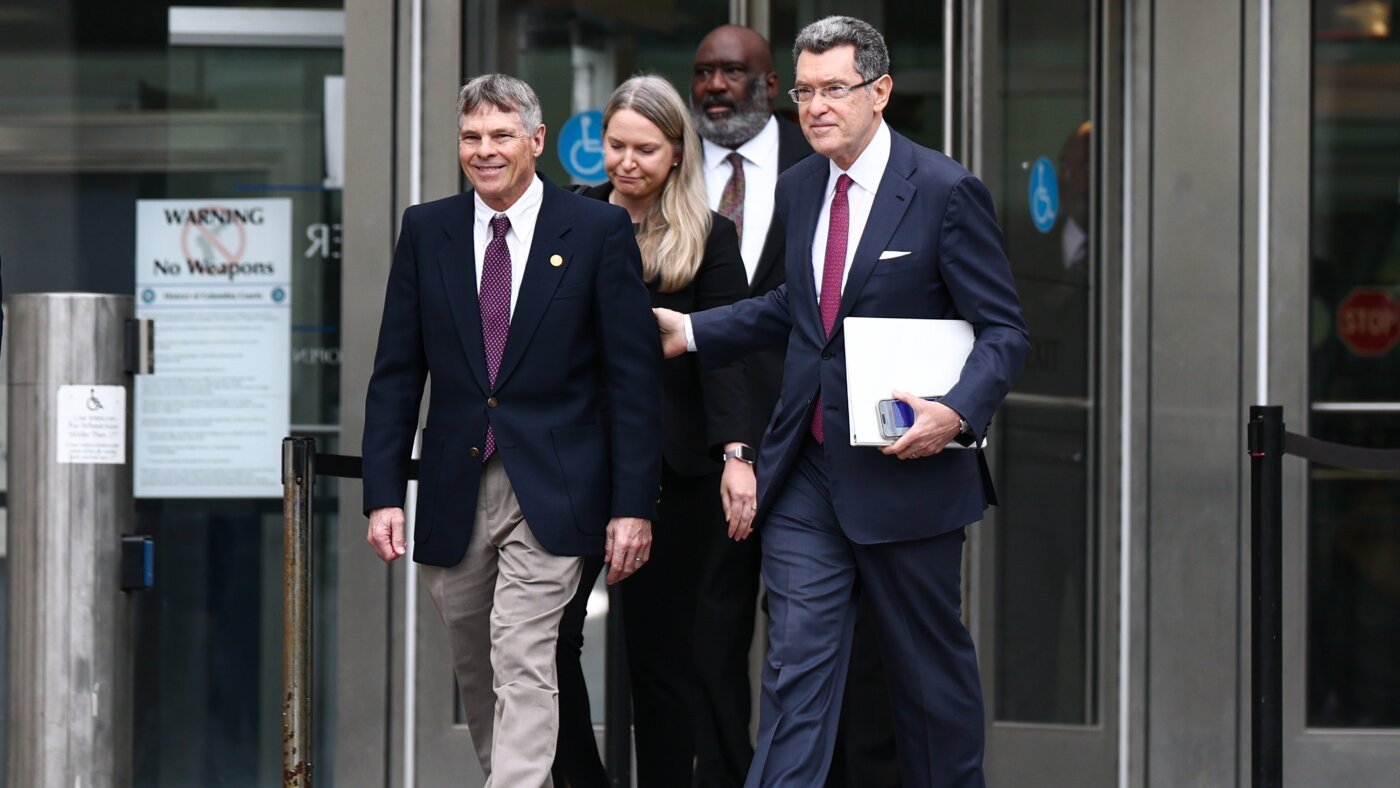
Former U.S. Olympian David Hearn (left) walks with his attorney Norman Eisen to speak to reporters and protesters gathered after his arraignment at the Superior Court of the District of Columbia in Washington, D.C. on Thursday.
Finn Gomez/Getty Images
hide caption
toggle caption
Finn Gomez/Getty Images
Former U.S. Olympic canoeist David Hearn pleaded not guilty to damaging the Lincoln Memorial Reflecting Pool in D.C. Superior Court Thursday morning.
Federal prosecutors charged Hearn with a single count of destruction of property causing more than $1,000 in damage to the pool.

Hearn has previously claimed, which his attorneys repeated during a short press conference outside the court, that he simply touched the water in the pool out of curiosity.
The Trump administration had just completed a $14 million renovation of the pool.
But shortly after the work finished, peeling paint and algae gathered in the water. The remodel has been largely criticized as a massive failure and waste of taxpayer dollars.

Superior Court Judge Carmen McLean released Hearn on his own recognizance. His next hearing is scheduled for Aug. 5.
Norm Eisen, one of Hearn’s attorneys, spoke to reporters outside of court following the hearing. He said the administration is using Hearn as a “scapegoat … for their own failures.”
“It is not a crime to touch the reflecting pool, to touch water in the United States of America,” he said.
Prosecutors say there is a host of evidence against Hearn.
This is a developing story.
-

 Los Angeles, Ca40 minutes ago
Knee irritation forces Shohei Ohtani out of Friday start, All‑Star game
-

 Detroit, MI1 hour ago
Detroit Evening Report: Waymo cars blocking first responders – WDET 101.9 FM
-

 San Francisco, CA1 hour ago
San Francisco Mayor Daniel Lurie Blocks Vacant Grocery Store Tax Proposal | KQED
-

 Miami, FL1 hour ago
Oregon Battling Miami, Mario Cristobal for Four-Star EDGE Recruit
-

 Dallas, TX1 hour ago
FC Dallas Forward Logan Farrington Inks Contract Extension
-

 Boston, MA1 hour ago
Red Sox face lengthy travel issues ahead of series vs. Mets
-

 Denver, CO2 hours ago
What’s going on with the Nuggets? Unpacking an NBA offseason on hold
-

 Seattle, WA2 hours ago
Seattle Kraken Sign Goaltender Victor Östman and Defenseman Ville Ottavainen to One-Year Deals | Seattle Kraken

