Connect with us

News

China’s factory activity falls for third straight month

Published

on

China’s factory activity falls for third straight month

Stay informed with free updates

China’s manufacturing activity fell for a third consecutive month in July, according to an official survey, increasing pressure on policymakers to speed up stimulus measures to boost the world’s second-biggest economy.

The country’s official manufacturing purchasing managers’ index came in at 49.4, in line with a Bloomberg poll of analysts’ forecasts and down from 49.5 in June. A reading above 50 marks an expansion compared with the previous month.

China’s politburo this week called for faster implementation of a stimulus programme, and the central bank has cut interest rates as the government tries to meet its economic growth target of 5 per cent for this year.

Advertisement

China’s economy is suffering from weak domestic consumption as a prolonged property slowdown and tighter government control over business undermine confidence.

At its recent five-yearly strategic policy meeting, Beijing emphasised high-end manufacturing and an upgraded industrial sector over property and household consumption.

The non-manufacturing PMI came in at 50.2 in July, still in growth territory and in line with analysts’ forecasts of 50.2 but down from a reading of 50.5 in June.

China’s National Bureau of Statistics said on Wednesday that among the sub-indices, production was 50.1, down 0.5 from the previous month but still indicating a slight expansion.

The new order index, however, was 49.3, down 0.2 from the previous month and indicating that the demand in the manufacturing market had declined.

Advertisement

Employment in manufacturing and non-manufacturing was below the 50-mark, indicating weakness in the labour market.

Despite the struggling housing market, construction activity was in positive territory. Services were flat at 50, down from 50.2 the previous month, with some areas such as entertainment and sport booming while others such as retail and capital markets were in contraction territory.

“Lower commodity prices and steel production point to weakened growth momentum of manufacturing activity in July,” Goldman Sachs wrote in a report released ahead of the figures.

It attributed the lower services PMI to “the persistent weakness in property and financial services sectors”.

Morgan Stanley analysts said ahead of the figures that deleveraging among local government financing vehicles and in the housing sector were posing “gravitational drags on the economy”. Emerging industries — electric vehicles and green energy — were also suffering overcapacity.

Advertisement

They said policymakers were attempting to counter fiscal tightening by widening the use of the proceeds of long-term government bond issuance to support consumption and capital expenditure. But “policy pass-through may take time”, they wrote.

China’s government has issued Rmb1tn ($138bn) of ultra long-term special government bonds to fund infrastructure and other projects and provide a stimulus to the economy.

It has also announced schemes to revitalise the property market, including a Rmb300bn programme to buy unsold housing unveiled in May.

But the real estate measures have been seen as too little to have a large impact, and economists have said that more structural measures are needed to restore investor confidence and stimulate consumption.

Advertisement

News

New Jersey’s special Democratic primary too early to call

Published

on

New Jersey’s special Democratic primary too early to call

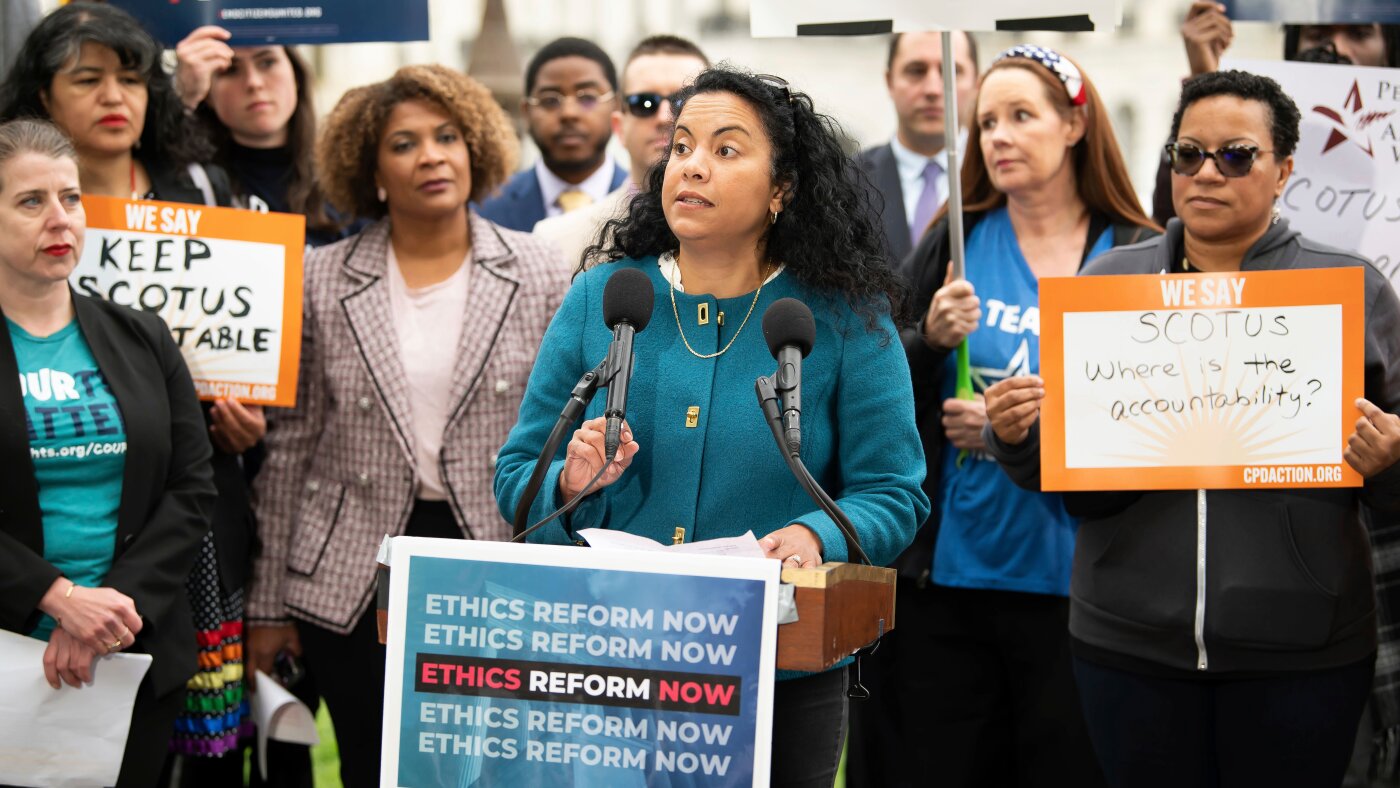
FILE – Analilia Mejia, center, speaks during a rally calling for SCOTUS ethics reform, May 2, 2023, in Washington.

Joy Asico/AP


hide caption

toggle caption

Advertisement

Joy Asico/AP

TRENTON, N.J. — The race in New Jersey between a onetime political director for Sen. Bernie Sanders and a former congressman was too early to call Thursday, in a special House Democratic primary for a seat that was vacated after Mikie Sherill was elected governor.

Former U.S. Rep. Tom Malinowski started election night with a significant lead over Analilia Mejia, based largely on early results from mail-in ballots. The margin narrowed as results from votes cast that day were tallied.

Advertisement

With more than 61,000 votes counted, Mejia led Malinowski by 486, or less than 1 percentage point.

All three counties in the district report some mail-in ballots yet to be processed. Also, mail-in ballots postmarked by election day can arrive as late as Wednesday and still be counted.

Malinowski did better than Mejia among the mail-in ballots already counted in all three counties, leaving the outcome of the race uncertain.

The Democratic winner will face Randolph Mayor Joe Hathaway, who was unopposed in the Republican primary, on April 16.

Malinowski served two terms in the House before losing a bid for reelection in a different district in 2022. He had the endorsement of New Jersey Democratic Sen. Andy Kim, who has built support among progressive groups.

Advertisement
FILE - Democratic Congressman Tom Malinowski speaks during his election night party in Garwood, N.J., Nov. 8, 2022.

FILE – Democratic Congressman Tom Malinowski speaks during his election night party in Garwood, N.J., Nov. 8, 2022.

Andres Kudacki/AP


hide caption

toggle caption

Andres Kudacki/AP

Advertisement

Mejia, a former head of the Working Families Alliance in the state and political director for Sanders during his 2020 presidential run, had the Vermont independent senator’s endorsement as well as that of U.S. Rep. Alexandria Ocasio Cortez of New York. She also worked in President Joe Biden’s Labor Department as deputy director of the women’s bureau.

Both Malinowski and Mejia were well ahead of the next-closest candidates: Brendan Gill, an elected commissioner in Essex County who has close ties to former Gov. Phil Murphy; and Tahesha Way, who served as lieutenant governor and secretary of state for two terms under Murphy until last month.

The other candidates were John Bartlett, Zach Beecher, J-L Cauvin, Marc Chaaban, Cammie Croft, Dean Dafis, Jeff Grayzel, Justin Strickland and Anna Lee Williams.

The district covers parts of Essex, Morris and Passaic counties in northern New Jersey, including some of New York City’s wealthier suburbs.

Advertisement

The special primary and April general election will determine who serves the remainder of Sherrill’s term, which ends next January. There will be a regular primary in June and general election in November for the next two-year term.

Sherrill, also a Democrat, represented the district for four terms after her election in 2018. She won despite the region’s historical loyalty to the GOP, a dynamic that began to shift during President Donald Trump’s first term.

Continue Reading

News

Video: Investigators Say Doorbell Camera Was Disconnected Before Nancy Guthrie’s Kidnapping

Published

on

Video: Investigators Say Doorbell Camera Was Disconnected Before Nancy Guthrie’s Kidnapping

new video loaded: Investigators Say Doorbell Camera Was Disconnected Before Nancy Guthrie’s Kidnapping

More details and a timeline were released on the kidnapping of Nancy Guthrie, the mother of the NBC anchor Savannah Guthrie.

By McKinnon de Kuyper

February 5, 2026

Continue Reading

News

Republicans pan Democrats’ demands for ICE reform in DHS funding, with little time to reach deal

Published

on

Republicans pan Democrats’ demands for ICE reform in DHS funding, with little time to reach deal

Washington — Senate Republicans criticized Democrats’ list of demands to rein in Immigration and Customs Enforcement on Thursday, further reducing the odds of reaching a deal to keep the Department of Homeland Security funded beyond next week’s deadline.

“As of right now, we aren’t anywhere close to having any sort of an agreement that would enable us to fund the Department of Homeland Security,” Senate Majority Leader John Thune said on the Senate floor Thursday.

Senate Minority Leader Chuck Schumer and House Minority Leader Hakeem Jeffries released a list of policies to impose “guardrails” on DHS on Wednesday night, including by restricting immigration agents from wearing masks and requiring them to display an ID and use body cameras. The Democrats also demanded agents be banned from entering private property without judicial warrants, along with requiring agents to verify that someone is not a U.S. citizen before holding them in immigration detention, among other things.

“The American people rightfully expect their elected representatives to take action to rein in ICE and ensure no more lives are lost. It is critical that we come together to impose common sense reforms and accountability measures that the American people are demanding,” Schumer and Jeffries wrote. 

The Democrats also said there are steps the administration can take immediately to “show good faith,” including removing DHS Secretary Kristi Noem from her position and fully ramping down the immigration operation in Minneapolis. 

Advertisement

Thune, a South Dakota Republican, called Democrats’ demands “unrealistic and unserious,” while saying they aren’t “even willing to engage in a negotiation and discussion to try and reach a result.”

“This is not a blank-check situation where Republicans just agree to a list of Democrat demands,” Thune said. 

Senate Majority Leader John Thune of South Dakota at the Capitol in Washington, D.C., on Feb. 5, 2026.

Anna Moneymaker / Getty Images

Advertisement


Off the Senate floor, Thune told reporters that there are a number of things on Democrats’ list of demands that appear to be designed as “messaging” priorities, but he acknowledged that “there’s some room there.”

“There’s some things that could get done,” Thune said. “But, you know, you have to have people at the table to do that.”

Sen. Katie Britt of Alabama, who’s leading the negotiations for Senate Republicans, quickly responded to Democrats’ demands on X Wednesday night. She called the proposal a “ridiculous Christmas list of demands for the press.”

“This is NOT negotiating in good faith, and it’s NOT what the American people want,” Britt said. “They continue to play politics to their radical base at the expense of the safety of Americans. DHS, FEMA, Secret Service, and the Coast Guard run out of money in 9 days. Democrats don’t seem to care one bit.”

Earlier in the day Wednesday, Schumer and Jeffries held a news conference where they outlined some of the demands. They encouraged Republicans to “get serious” about negotiations on reforming the nation’s immigration enforcement operation. 

Advertisement

“This is turning America inside out in a way we haven’t seen in a very long time,” Schumer said. 

The back and forth comes after the House voted to fund the bulk of the government earlier this week, following a four-day partial shutdown. The package extended funding for the Department of Homeland Security, which oversees ICE and Customs and Border Protection, through Feb. 13. The move was meant to give lawmakers time to negotiate long-term funding and reforms to ICE and CBP. 

Thune pointed to the tight timeline Thursday. He noted that Democrats insisted that DHS only be funded for two weeks. 

“We have one week and one day left to pass the Department of Homeland Security appropriations bill,” Thune said. “The onus is on Democrats to negotiate in good faith and reach an agreement quickly.”

Thune argued that Democrats have “reopened” negotiations, which means “taking up ideas and priorities from both sides.” He pointed to the need for a “serious discussion” about the “climate of harassment — and worse — that law enforcement has been facing, simply trying to do their jobs.” 

Advertisement

He said the issue of cooperation between federal and local law enforcement must also be discussed, saying “too many jurisdictions prohibit local law enforcement from cooperating with Immigration and Customs Enforcement,” in an apparent nod to so-called sanctuary city policies that Republicans have widely opposed. 

“I hope my Democrat colleagues are ready to have some conversations with the White House about these and other issues,” Thune said. 

The majority leader argued that “the White House has demonstrated that it’s taking things seriously,” pointing to a recent move to require all agents in Minneapolis to wear body cameras and the administration’s move to withdraw some personnel from the city.

“I want to see my Democrat colleagues take things seriously as well,” he added.

Advertisement
Continue Reading

Trending