News
Black bear populations are bouncing back. Here’s how these Texas towns are coping


Ken Clouse and his wife Pam look at a still image taken from a game camera on their porch. The couple says in the last two years, they’ve regularly seen black bears in their neighborhood south of Alpine, Texas.
Carlos Morales/NPR
hide caption
toggle caption
Carlos Morales/NPR
ALPINE, Texas — In one of the most remote corners of Texas, Matt Hewitt is unlocking the door to a giant steel trap he’s hoping will catch a black bear.
“It’s completely empty,” Hewitt says, as he reaches for a bucket with bait – days-old glazed donuts and frozen cantaloupe.
Hewitt, a researcher at the Borderlands Research Institute, affiliated with Sul Ross State University, leads a group that captures and collars black bears to try and get an idea of just how many are roaming the mountains and desert stretches of Far West Texas. And although it’s too soon to say exactly how many bears there are, Hewitt believes “there’s more than people realize.”
Historically, black bears were once the biggest predator to travel the region in large numbers, but overhunting and habitat loss led to their decline over several decades.
But in recent years, the number of black bears in West Texas have been on the rise: sightings in the state have jumped from nearly 80 in 2020 to at least 130 so far this year, according to state data. And in other states, researchers believe black bear populations are growing too.

Inside an eight-foot steel trap, researcher Matt Hewitt has sprinkled stale doughnuts and chunks of cantaloupe. Hewitt hopes the bait’s enough to lure and trap a black bear.
Carlos Morales/NPR
hide caption
toggle caption
Carlos Morales/NPR
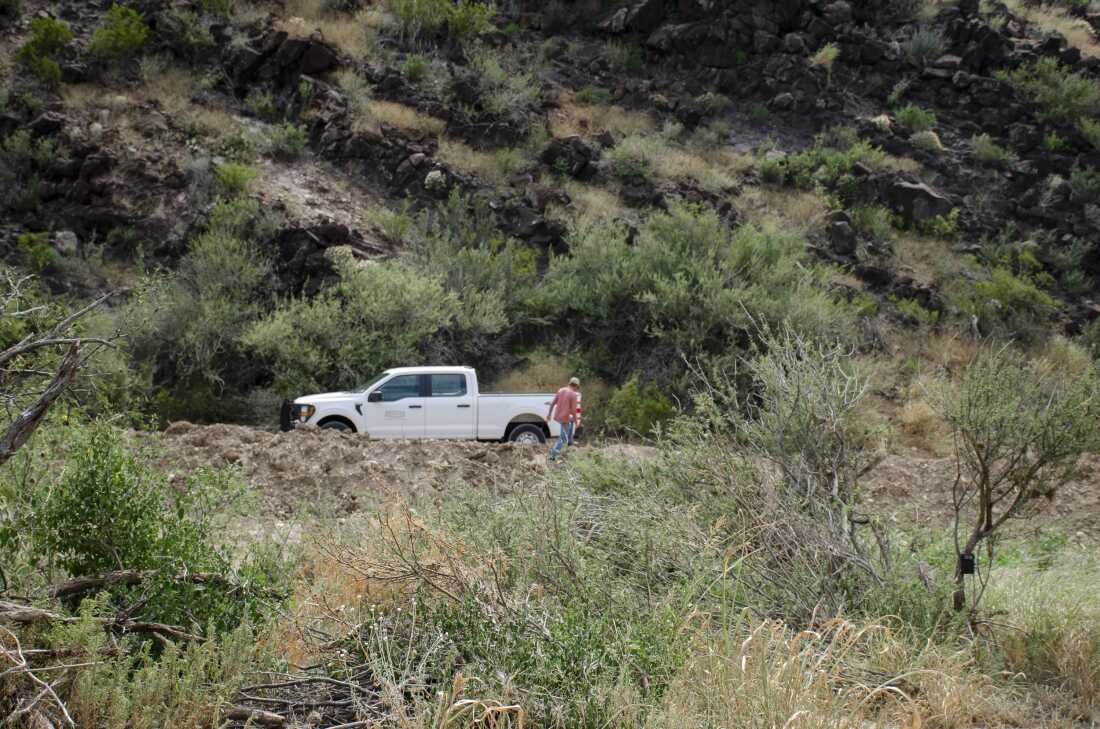
Matt Hewitt, a researcher with Borderlands Research Institute, heads for his truck after securing a snare, which he hopes will snag tufts of bear hair.
Carlos Morales/NPR
hide caption
toggle caption
Carlos Morales/NPR
But in West Texas, for all the celebration of the bears’ return to the wilderness, there are challenges and concerns as bears have ventured into neighborhoods, gotten into yards and posed a threat to livestock and pets.
“I don’t mind the bears coming back, we don’t want them wiped out, that’s for sure,” said Pam Clouse, who lives in Alpine, an area that’s seen a number of bear encounters in recent years. “You know, they were almost extinct.”
Clouse and her husband, Ken, both grew up in West Texas, and consider themselves wildlife enthusiasts. During drought years, the couple would sprinkle buckets full of corn on their yard and keep troughs of water on their property for wandering wildlife like deer and javelina.
Recently, they removed the food and water at the suggestion of state officials, and have even electrified their fence, too — all in effort of keeping the bears away.
But the bears are still coming, they say. “These bears are pretty large,” said Pam Clouse, as she pulled up an image of a bear from a trail camera at their house. “They’re probably about 4, 500 pounds if I had to guess.”

A still image taken from a trail camera Pam and Ken Clouse have on their porch in Alpine, Texas.
hide caption
toggle caption
The Clouses feel like more can be done to ease residents’ concerns over bears wandering onto their property. “I’m not promoting a hunting season for the black bears,” said Ken Clouse. “But there’s got to be some type of control.”
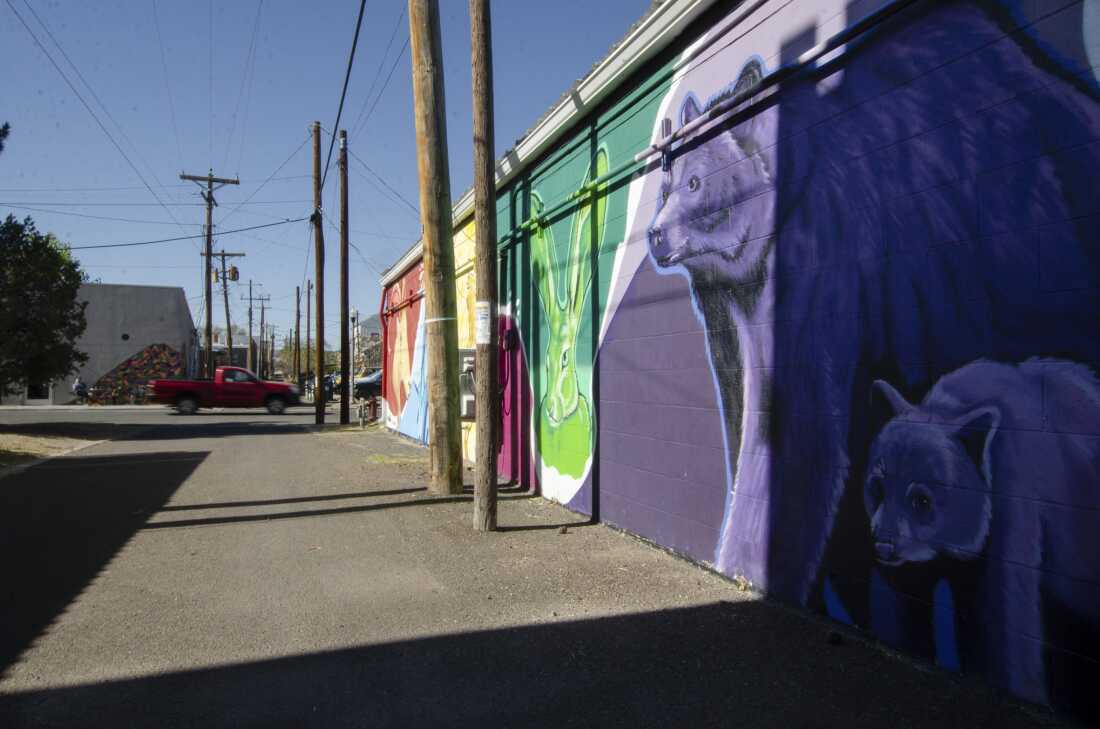
A mural in downtown Alpine, Texas highlights the wildlife that call the Trans-Pecos region of West Texas home – including the black bear.
Carlos Morales/NPR
hide caption
toggle caption
Carlos Morales/NPR
Learning to live with bears
In states like Montana and Colorado, residents have adapted to living with bears by installing bear-resistant dumpsters and trash bins and, in some cases, installing alarm systems or sprinklers — things to try and startle bears.
But of all the measures, wildlife biologists stress removing food and anything that might attract a hungry bear.
During the late summer and fall months, as black bears prepare to den, they’re looking to eat as much as possible, and they’ll go through great lengths to consume the 20,000 daily calories they’re after.
“They have a great sense of smell, much better than our own,” said Raymond Skiles, former wildlife biologist at Big Bend National Park in West Texas. “So, number one, they can smell food when you and I would never have a clue.”
Skiles was at Big Bend National Park when black bears made their return there in the late 1980s. He said it took time and work at the park, but they were able to adapt to the return of bears there. The park brought in dumpsters that were hard for bears to get into, educated visitors about the animal, and put into place rules that ensured food wasn’t being left out.
Today, Skiles said, those measures have gone a long way in reducing the possibility of bear-human conflict in the Chisos Mountains, one of the most popular corners of the park. Now, Skiles wonders if the same can happen in cities and towns across West Texas.

Krysta Demere sits in the offices for Texas Parks and Wildlife Department in Alpine. Part of her job as a wildlife biologist is getting people ready to live with black bears and educate them in hopes of reducing bear-human conflict.
Carlos Morales/NPR
hide caption
toggle caption
Carlos Morales/NPR
From the national park, an expansive stretch of desert land roughly the size of Rhode Island, the bears are now pushing north. Wildlife conservationists here say it’s likely because the land has reached what they call “carrying capacity.”
“And when you’re over carrying capacity, there’s not [enough] resources on the natural landscape for those animals,” explained Krysta Demere, a wildlife biologist with the Texas Parks and Wildlife Department. “So, then they begin to move out and search for new food sources.”
Part of Demere’s job is to help people across West Texas get ready to live with bears, something they haven’t experienced in well over 80 years.
“And that’s a long time,” said Demere. “That means there’s not a generation alive today that’s had to live with [the] black bear before.”
But the next generation in Alpine and the ones after that will likely grow up knowing this place, once again, as bear country.



“OK, don’t step into the actual fissure. We don’t actually know how deep it goes.” In 2024, Eilen Stewart bought a house on a landslide. “Honestly, we’re priced out of a lot of the L.A. area. So when we saw this house in this amazing neighborhood — it’s safe. It’s beautiful. It’s got amazing school districts. I mean, it just seemed like this house is half the price that it should be. Of course, that’s when we figured out that there’s a reason that the house is this price.” Land here was moving as much as a foot per week around that time. But this house seemed OK, so Eilen and her husband went for it, paying $1.3 million, a deal for coastal Palos Verdes, Calif. “We knew there was a landslide, but we made a calculated risk. And we’ll see if it pays off or not.” Parts of Palos Verdes have been inching towards the sea for decades, but heavy rainfall in recent years accelerated the landslide, cracking foundations and destroying homes. “This is probably one of the largest active landslides with homes on it in the entire United States, if not the world. It’s almost like a giant raft that’s moving on this real slippery layer at depth.” “The movement has always been here. It’s just been at an acceptable level. But once anything has started moving, it’s very, very difficult to stop.” “For longtime residents like Tim Kelly, who bought his home here in 1994, leaving would mean a massive financial hit. Landslides generally aren’t covered by insurance. “So prior to the landslide, my house was — based on Zillow and Redfin and all those — was at approximately $2.1 million. It’s been reassessed on the L.A. County tax rolls at $129,000. All right, guys. 7:01, we’re late. We’re late.” With little choice but to stay put and a deep love for their neighborhood, Tim and a crew of dedicated neighbors are trying to slow down the landslide by drying it out. Every morning, they fire up generators for wells that pump water out of the ground. “Putting in de-watering wells is one of the primary approaches to slow the slide down. And we’ve seen a dramatic reduction in movement as a result of taking those measures. In some areas, we’ve reduced the movement by almost 90 percent at its peak.” Last winter was also less rainy than the two before, another factor. Gas and electricity were cut off to many in 2024, and residents have had to go off grid. Some families have left altogether for safety reasons. Nearly two years later, 172 homes are still disconnected from grid power, including Eilen’s. Her land has also moved a lot since she moved in. “When we first moved in, you could see maybe this much of the ocean. It was kind of a little tiny sliver. But all of those homes that are in front of us sunk down a good 10 feet. And part of the silver lining is that we have a much better view now.” Eilen estimates she spent about $200,000 on landslide-related fixes, including picking up the house, placing it on steel beams and moving it away from the slide. But all of this might just be delaying the inevitable. “You’re fighting nature, and what we see is that nature is changing with climate change and maybe more rainfall occurring in the future. We do have means and methods to tackle that. It’s just very expensive.” As of June this year, Palos Verdes will have spent about $65 million on landslide mitigation since 2022. Its entire annual city budget is about $40 million. “We’re aggressively trying to get money from the state and federal government to be able to solve the problem and implement the solutions that we have. But we need more to keep going.” At least 11 homes have sold in the landslide zone since 2024. Last summer, the city banned future new construction here. But anybody is still free to move in. “It’s buyer beware, right, because you’re coming into an area that the land is going to be moving forever. But if they want to then it’s their choice.” “If the house slid down the hill tomorrow, what would you do?” “I would put up a tent in that backyard and still live here.”

People inspect the site of a destroyed branch of Al-Qard Al-Hassan, a non-bank financial institution run by Hezbollah, which was hit by an Israeli airstrike in central Beirut on Thursday.
Hussein Malla/AP
hide caption
toggle caption
Hussein Malla/AP
The U.S. military said on Friday that all six crew members were killed when a KC-135 refueling aircraft went down in Iraq, raising the death toll after two weeks of war with Iran.
The U.S. Central Command (CENTCOM), which oversees the Middle East, reported an unspecified incident involving two aircraft Thursday. It said the U.S. KC-135 refueling aircraft was lost in western Iraq, while the other landed safely. It is investigating the circumstances but confirmed the “loss of the aircraft was not due to hostile fire or friendly fire.”
The news came as President Trump and his defense secretary touted success in the U.S.-Israeli war with Iran but complained about negative media coverage of Operation Epic Fury.
Defense Secretary Pete Hegseth said Friday that joint U.S.-Israeli military strikes have hit more than 15,000 targets and injured the new Iranian supreme leader.
President Trump, in a post on Truth Social, said the U.S. is “totally destroying” Iran’s regime, militarily and economically.
Late Thursday, Israeli Prime Minister Benjamin Netanyahu said Israel had weakened Iran’s rulers, but it may not be enough to topple them — the Iranian people would have to do that.
Iranian and Lebanese health officials and Israeli authorities reported more than 1,300 people killed in Iran, 773 people in Lebanon and 12 civilians in Israel, as well as two Israeli soldiers killed in Lebanon. Wednesday’s aircraft crash over Iraq brings the U.S. military death toll to 13, seven of whom were killed in combat. Eight U.S. service members are severely injured, according to the Pentagon.
The humanitarian toll also deepened as the total number of people displaced by the fighting in Iran and Lebanon reached into the millions.
Here are further updates about the conflict.
Officials brace for an end without a deal — and the risk of a “war routine”
A senior official in the region, speaking on condition of anonymity because they were not authorized to discuss internal deliberations, told NPR they expected the war to last at least another week, and that Israeli leaders increasingly believe the U.S. and Israel will end the war unilaterally, without a negotiated agreement. In such a scenario, the official said, Iran and allied groups, including the Lebanese militant group Hezbollah and Houthi rebels in Yemen, could establish a new normal of intermittent fire at Israel, prompting repeated Israeli retaliation.
The official said that kind of tit-for-tat exchange would leave Israelis living with an intolerable “war routine” even if the intensity of the conflict fades.
The official also said Israel is not ruling out an expanded ground operation in southern Lebanon, but described Israel as holding back so far from striking broad civilian infrastructure, largely because the U.S. sees Lebanon as a partner.
— Daniel Estrin, Carrie Kahn
Israel expands strikes in Iran and hits Hezbollah targets in Lebanon
Israel’s air force said Friday it struck more than 200 targets over the past day in western and central Iran, including ballistic missile launchers, air defense systems and weapons manufacturing sites.
The military said the strikes included simultaneous strikes in Tehran, Shiraz and Ahvaz. They targeted regime infrastructure, including an underground site used to produce and store ballistic missiles, as well as a central air-defense base.
In Lebanon, Israel said it hit Hezbollah command centers in the country’s south and in central Beirut.
A senior official in the region, speaking on condition of anonymity because they were not authorized to speak publicly, said the strike on Beirut’s bustling Bachura neighborhood, located near the prime minister’s office, was symbolic, and meant to send a message that Israel will not tolerate Hezbollah’s fire much longer.
Lebanon’s president, Joseph Aoun, has called for direct talks with Israel to end the bombing. Israel has not responded publicly on the matter.
The Israeli military also said it struck the Al-Zrariya Bridge over the Litani River, describing it as a key crossing used by Hezbollah fighters and an area from which launchers had been positioned.
— Hadeel Al-Shalchi and Rebecca Rosman
Iran and Hezbollah attacks hit Israel overnight; dozens treated for minor injuries
An Iranian ballistic missile in the northern Israeli town of Zarzir left dozens lightly wounded, according to Israel’s emergency services organization, Magen David Adom.
One person was reported to be in moderate condition and was being treated after being hit with shrapnel. Another 57 people were being treated for minor injuries, mostly from glass shards.
Hezbollah also continued firing into northern Israel overnight, and Israel’s military said its air defense and strike operations were responding across both fronts.
— Rebecca Rosman
U.S. temporarily eases Russian oil sanctions for cargoes already at sea
The Trump administration issued a temporary authorization allowing countries to purchase Russian oil already stranded at sea. It argued the move is a narrowly tailored step to stabilize energy markets.
In a post on X, Treasury Secretary Scott Bessent said the measure applies only to oil “already in transit” and will not provide significant financial benefit to Russia.
In a statement published last week, a number of top Senate Democrats warned such a move would weaken sanctions and benefit Russia as energy prices rise.
— Rebecca Rosman
French soldier killed in attack in Iraq
French President Emmanuel Macron said Friday a French soldier was killed in an attack in the Irbil region of Iraq that left several other French soldiers wounded.
Macron called the attack “unacceptable” and said the war in Iran cannot justify strikes on forces deployed in Iraq as part of the fight against ISIS.
Since the start of the war with Iran, the French president has underlined his concerns about international law not being respected, but also deployed several naval vessels to the Eastern Mediterranean, near Cyprus, to protect French military bases and citizens in the region. French officials have insisted it is a defensive, rather than an offensive mission.
— Eleanor Beardsley
Daniel Estrin and Carrie Kahn contributed to this report from Tel Aviv, Hadeel Al-Shalchi contributed from Beirut, Jane Arraf from Irbil, Rebecca Rosman and Eleanor Beardsley from Paris.

new video loaded: F.B.I. Investigating Synagogue Attack as ‘Targeted Act of Violence’
transcript
transcript
F.B.I. Investigating Synagogue Attack as ‘Targeted Act of Violence’
A driver rammed a vehicle into a synagogue outside Detroit on Thursday. Authorities are investigating the attacker’s motive.
-
“He breached the building, drove down the hall, and he was engaged by security. We can’t say what killed him at this point, but security did engage the suspect with gunfire. No kids or no staff was injured whatsoever, OK. So we have no victims other than one of the lead security people, was hit by the car and was taken to the hospital for treatment. That individual should be OK.” “I can confirm that we are leading the investigation right now as a targeted act of violence against the Jewish community.”

By Jackeline Luna
March 12, 2026

Vance touts Trump economy gains during North Carolina tour, cites rising home purchases

Sleep remedy dubbed ‘nature’s Valium’ sparks debate among experts

USA beats Canada in World Baseball Classic to maintain American sports dominance over northern neighbor

Remote robot surgery removes cancer 1,500 miles away

El Pollo Loco is on fire as it spreads to other states and sales sizzle

Florida High School Football Rankings: Top 25 teams – Oct. 21

Cleary's 21 help Le Moyne down Central Connecticut State 69-64 in OT

How old is Bo Nix? What to know about Oregon quarterback ahead of 2024 NFL Draft

99th annual Pony Swim held in Virginia

Indiana Members Credit Union announced as new anchor tenant at Bottleworks District
Vance touts Trump economy gains during North Carolina tour, cites rising home purchases

NATO leaders call on Trump to reverse Russian oil sanctions suspension

Video: Welcome to the Neighborhood. It’s Sinking.

Hegseth cranks up pressure on US war colleges

Thousands march worldwide in solidarity with Palestine, Iran on al-Quds Day
-

 Detroit, MI1 week ago
U.S. Postal Service could run out of money within a year
-

 Miami, FL1 week ago
City of Miami celebrates reopening of Flagler Street as part of beautification project
-

 Pennsylvania1 week ago
Pa. man found guilty of raping teen girl who he took to Mexico
-

 Sports1 week ago
Keith Olbermann under fire for calling Lou Holtz a ‘scumbag’ after legendary coach’s death
-

 Oklahoma5 days ago
OSSAA unveils Class 6A-2A basketball state tournament brackets, schedule
-

 Michigan4 days ago
Operation BBQ Relief helping with Southwest Michigan tornado recovery
-

 Southeast4 days ago
‘90 Day Fiancé’ alum’s boyfriend on trial for attempted murder over wild ‘Boca Bash’ accusations
-
 Health6 days ago
Ancient herb known as ‘nature’s Valium’ touted for improving sleep and anxiety