News
Australia announces strict new gun laws. Here’s how it can act so swiftly


Mourners gather at the Bondi Pavilion as people pay tribute to the victims of a mass shooting at Bondi Beach.
Izhar Khan/Getty Images
hide caption
toggle caption
Izhar Khan/Getty Images
At least 15 people were killed at a beach in Sydney, Australia, on Sunday when a father and son opened fire on a crowd celebrating the beginning of Hanukkah. At least 42 people were hospitalized.
Prime Minister Anthony Albanese described the shooting as a “terrorist incident” targeting Jewish Australians.
Mass shootings are rare in Australia, which has historically strict gun laws. But Sunday’s deadly massacre has prompted Albanese and other Australian officials to revisit those laws and call for further restrictions to prevent more mass shootings in the future.
Here’s what Australian officials are proposing, and why the country’s politics and culture might allow for it.
Australia already has strict gun laws
The origin of Australia’s notoriously strict gun laws dates back to 1996, when a gunman killed 35 people in an attack in Tasmania.
The April 28 mass shooting came to be known as the Port Arthur massacre, and almost immediately the bloodshed prompted Australia’s political leaders to unite behind an effort to tighten the country’s gun laws. That effort was led by conservative prime minister John Howard.
The result was the National Firearms Agreement, which restricted the sale of semi-automatic rifles and pump-action shotguns and established a national buyback program that resulted in the surrender of more than 650,000 guns, according to the National Museum of Australia. Importantly, it also unified Australia’s previously disjointed firearms laws — which had differed among the states and territories before 1996 — into a national scheme, according to the museum.
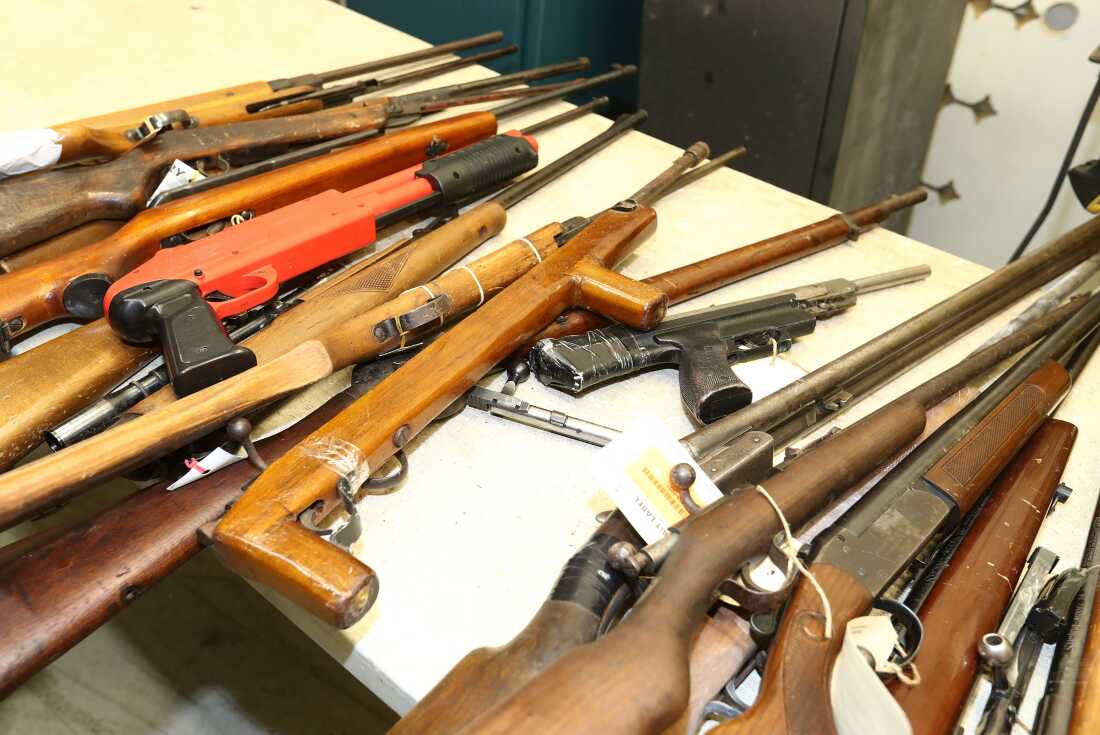
Guns handed into Victoria Police in Australia in 2017 as part of a round of weapons amnesty.
Robert Cianflone/Getty Images
hide caption
toggle caption
Robert Cianflone/Getty Images
The agreement has been cited internationally, including by the likes of former President Barack Obama, as a model for greater gun control and is credited with dramatically reducing firearms deaths in Australia. The country had zero mass shootings in the more than two decades that followed the agreement, one paper found.
Albanese said in a press conference Monday that the “Howard government’s gun laws have made an enormous difference in Australia and are a proud moment of reform, quite rightly, achieved across the parliament with bipartisan support.”
But Australian firearm ownership has been on the rise again in recent years. The public policy research group The Australia Institute wrote in a January report that there were more than 4 million guns in the country, which is 25% higher than the number of firearms there in 1996. Certain provisions of the National Firearms Agreement have been inconsistently implemented and in some cases “watered down,” the group said.
Graham Park, president of Shooters Union Australia, told supporters in a member update over the summer that Australian firearms owners are “actually winning,” The Guardian reported.
What the proposed gun measures will do
The prime minister and regional Australian leaders agreed in a meeting on Monday to work toward even stronger gun measures in response to Sunday’s shooting. Here’s what they include:
- Renegotiate the National Firearms Agreement, which was enacted in 1996 and established Australia’s restrictive gun laws.
- Speed up the establishment of the National Firearms Register, an idea devised by the National Cabinet in 2023 to create a countrywide database of firearms owners and licenses.
- Use more “criminal intelligence” in the firearms licensing process.
- Limit the number of guns one person can own.
- Limit the types of guns and modifications that are legal.
- Only Australian citizens can hold a firearms license.
- Introduce further customs restrictions on guns and related equipment. The Australian government could limit imports of items involving 3D printing or accessories that hold large amounts of ammunition.
Albanese and the regional leaders also reaffirmed their commitment to Australia’s national firearms amnesty program, which lets people turn in unregistered firearms without legal penalties.
While not specifically referenced by the National Cabinet, some of the proposals address details related to Sunday’s shooting.
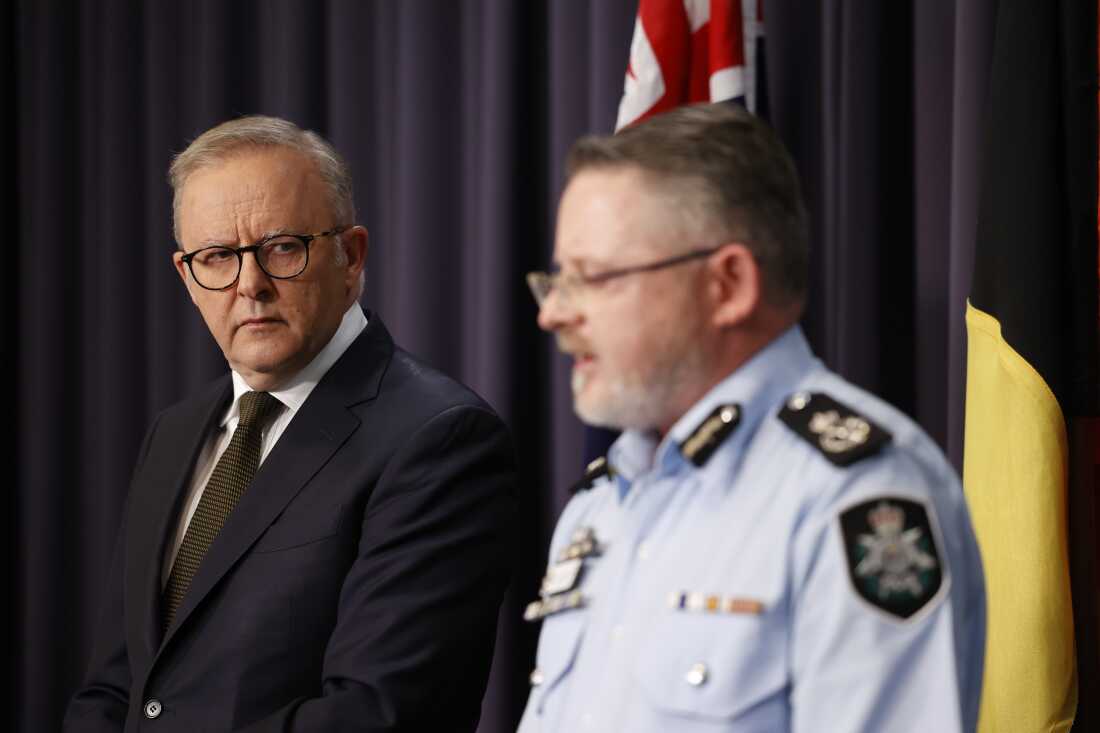
Australia’s prime minister, Anthony Albanese, (left) at Parliament House with AFP Acting Deputy Commissioner for National Security Nigel Ryan speak after the Bondi Beach shooting.
Hilary Wardhaugh/Getty Images
hide caption
toggle caption
Hilary Wardhaugh/Getty Images
Albanese said Monday the son came to the attention of the Australian Security Intelligence Organisation in 2019. ABC Australia reported that he was examined for his close ties to an Islamic State terrorism cell based in Sydney.
Minister for Home Affairs Tony Burke said the son is an Australian-born citizen. Burke added that the father arrived in Australia on a student visa in 1998, which was transferred to a partner visa in 2001. He was most recently on a “resident return” visa.
How Australia’s political system enables swift legal changes
Part of the reason Australia’s government can act so quickly on political matters of national importance is because of something called the National Cabinet.
The National Cabinet is composed of the prime minister and the premiers and chief ministers of Australia’s six states and two territories.
It was first established in early 2020 as a way for Australia to coordinate its national response to the COVID-19 pandemic. Since then, the group has convened to discuss a number of national issues, from a rise in antisemitic hate crimes to proposed age restrictions on social media use.
The National Cabinet doesn’t make laws, but its members attempt to agree on a set of strategies or priorities and work with their respective parliaments to put them into practice.
Australians wanted stronger gun laws even before Sunday
Gun control efforts in Australia inevitably draw comparisons to the U.S., where the Second Amendment dominates any discussion about firearms restrictions.
John Howard, the prime minister during the Port Arthur massacre, said in a 2016 interview with ABC Australia that observing American culture led him to conclude that “the ready availability of guns inevitably led to massacres.” He added: “It just seemed that at some point Australia ought to try and do something so as not to go down the American path.”

In fact, the National Firearms Agreement avows that gun ownership and use is “a privilege that is conditional on the overriding need to ensure public safety.”
Robust gun laws remain popular among Australians today. A January poll by The Australia Institute found that 64% of Australians think the country’s gun laws should be strengthened, while just 6% believe they should be rolled back. That is in a country where compulsory voting means that politics “generally gravitates to the centre inhibiting the trend towards polarisation and grievance politics so powerfully evident in other parts of the globe,” Monash University politics professor Paul Strangio wrote last year.
Now, there are renewed calls to further harden Australia’s gun laws in the wake of Sunday’s deadly shooting.

“After Port Arthur, Australia made a collective commitment to put community safety first, and that commitment remains as important today as ever,” Walter Mikac said in a statement on Monday.
Mikac is founding patron of the Alannah & Madeline Foundation, which is named for his two daughters who were killed in the 1996 shooting. His wife, Nanette, was also killed.
“This is a horrific reminder of the need to stay vigilant against violence, and of the importance of ensuring our gun laws continue to protect the safety of all Australians,” Mikac added.







Gunfire rang out at a bar in Austin, Texas, early Sunday and at least three people were killed, the city’s police chief said.
Austin Police Chief Lisa Davis told reporters the shooter was killed by officers at the scene.
Fourteen others were hospitalized and three were in critical condition, Austin-Travis County EMS Chief Robert Luckritz said.
“We received a call at 1:39 a.m. and within 57 seconds, the first paramedics and officers were on scene actively treating the patients,” Luckritz said.
There was no initial word on the shooter’s identity or motive.
Davis noted how fortunate it was that there was a heavy police presence in Austin’s entertainment district at the time, enabling officers to respond quickly as bars were closing.
“Officers immediately transitioned … and were faced with the individual with a gun,” Davis said. “Three of our officers returned fire, killing the suspect.”
She called the shooting a “tragic, tragic” incident.

Austin Mayor Kirk Watson said his heart goes out to the victims, and he praised the swift response of first responders.
“They definitely saved lives,” he said.
Davis said federal law enforcement is aiding the investigation.


The blizzard blew so fierce that the skier at the head of the line kept disappearing into a whiteout. The winds were gusting over 50 miles per hour. Almost four feet of fresh powder had piled up and more was falling every minute.
At the back of the line was Anton Auzans, trudging behind 12 other backcountry skiers climbing through a clearing high in California’s Sierra Nevada. He had his hood pulled low against the pelting wind.
Then came a single word yelled by a ski guide somewhere ahead: “Avalanche!”
Mr. Auzans looked up in time to see a wall of white dotted with strange blurs of color. In the moment before it reached him, he realized that the colors were the tumbling skis and clothing of the other skiers.
He dove behind a dead tree for protection, but the snow was surging down the mountain like a raging river. It poured around the trunk, dragged him away and swallowed him in darkness.
Hundreds of thousands of pounds of snow rushed into the clearing, slowing as it spilled over flatter ground, and settled into a dense pile and a terrible silence. The slide had buried everyone in the group. Almost.
Two men from the group had fallen behind.
Back in the woods, Jim Hamilton was struggling with a sticky ski binding that had refused to lock onto his boot and caused him to fall behind. He was cursing his bad luck.
He was hustling to catch the group, following their ski track through the woods. With him was a ski guide. Mr. Hamilton expected to catch sight of the others at the next clearing. Instead, their track abruptly ended at a rough berm of snow debris, as if a giant plow had driven through.
Mr. Hamilton had been too far behind to hear the warning or the rush of snow. For a second he was mystified. Where was everybody?
Then he heard Mr. Auzans yell. “Major avalanche! Major avalanche! We have people buried!” Mr. Auzans’s head had just poked out of the snow.
Anton Auzans and Jim Hamilton are two survivors of the deadliest avalanche in modern California history. This account is based on a number of interviews with the two men conducted over several hours, in which they offered the first eyewitness telling of what happened.
The Feb. 17 avalanche killed nine skiers who were among 15 people on a guided trip high in the mountains near Lake Tahoe, including six women who were all close friends.
The two men, both lifelong skiers who had never met before the trip, said that as the storm beat down, conditions steadily grew worse, but their guides largely stuck to an itinerary laid out long before the storm, and led the group beneath steep terrain where a massive slide buried nearly everyone. The few skiers who were free dug desperately to save the others, but were overwhelmed by the number of people trapped, and by the unrelenting blizzard that threatened to cause another deadly slide.
In the days since, many in the public, including some veteran backcountry skiers, have raised questions about why four experienced guides left a protected backcountry hut during a historic storm and led their group across avalanche terrain, while not spreading skiers out so that one avalanche would not take out the whole group.
Those questions remain largely unanswered. The Nevada County Sheriff’s Office and California’s workplace safety agency, Cal-OSHA, are investigating whether there were safety violations or criminal negligence by the company that led the trip, Blackbird Mountain Guides. No findings have been announced.
There were four other survivors: One ski guide, two women in the group and a third man who had signed up for the trip. The surviving women declined to comment through a spokeswoman, as did the other ski client. The guide, a man, could not be reached for comment.
In a statement after the accident, Blackbird Mountain Guides, asked people not to speculate, adding, “It’s too soon to draw conclusions, but investigations are underway.”
A Welcome Forecast of Heavy Snow
The trip started on a blue-sky day.
Mr. Auzans and Mr. Hamilton arrived at Donner Pass, where Interstate 80 cuts through a gap in the mountains, on the morning of Sunday, Feb. 15. The weather was mild and snowy peaks were shining under a clear sky.
Sunday: Groups skied to huts
The plan was to ski three miles over a high mountain ridge east of the highest summit in the area, Castle Peak, to a hidden subalpine basin called Frog Lake. There, at 7,600 feet, sat a cozy collection of backcountry huts that would provide the skiers with hot meals, warm beds and a launching point for human-powered climbs up remote mountains to ski untracked slopes.
A monster winter storm was set to move in that night and drop up to eight feet of snow over four days. The local avalanche forecasting office warned of possible “widespread avalanche activity” and slides large enough to bury people in the days ahead. But the skiers viewed the weather not as a concern, but as a stroke of good luck.
For six weeks the region had gone without a significant storm, leaving the snow thin and crusty and not much fun to ski. The storm promised to bring what the skiers had hoped for, what they had each paid almost $1,500 for: bottomless fresh powder.
At the pass, the two clients were greeted by their guides from Blackbird Mountain Guides, — Andrew Alissandratos, 34, and the guide who survived — and by the third man.
A second group had also hired Blackbird to head to the huts that day: Eight friends, all women in their 40s or early 50s, who had been taking backcountry trips together for years. Many of them also liked to surf. Most had high-powered jobs and impressive résumés. Both groups were led by Blackbird, and had signed up for the same hut trip, but each group had their own pair of guides.
The four guides from Blackbird all had extensive experience and formal training. They checked that everyone had the required safety gear — an avalanche beacon for locating people who are buried; a long, folding probe to pinpoint them under the snow; and a shovel for digging them out. Mr. Auzans and Mr. Hamilton had both taken basic avalanche safety classes, but neither had experienced an avalanche before.
When the topic of the impending storm came up, Mr. Hamilton said the guides told him not to worry, they knew how to pick safe terrain. They would have to stay on treed slopes and avoid the steep inclines that many skiers love, but he said one guide told him there would be so much powder that no one would care.
The groups put climbing skins on the bottom of their skis to grip the snow and climbed up to a ridge on the side of Castle Peak, about 1,700 feet above the freeway.
Mr. Hamilton snapped pictures of views that spilled out seemingly forever. He was 65, a software engineer and grandfather, and had moved to California from Massachusetts a year before. He had only been backcountry skiing four times and would never have attempted a trip like this without expert guides. But he wanted to experience the renowned deep Lake Tahoe backcountry powder, so he had looked online and found the Frog Lake trip on Blackbird’s website. There was one slot left.
“Wow,” he had said to himself, “it’s meant to be.”
On the ridge, the skiers took off their climbing skins for a long ski down an open bowl to a steep snow gully called Frog Lake Notch that cut beneath a granite summit called Perry’s Peak.
On a big powder day, Frog Lake Notch would be a natural avalanche path, but that Sunday, the old snow was firm and safe. By early afternoon, they had reached the huts at Frog Lake.
It was just the kind of experience Mr. Auzans was hoping for.
A 37-year-old electrician in the Bay Area with a young son, he had grown up snowboarding at nearby resorts and in recent years had grown increasingly interested in the backcountry.
He loved the serenity and beauty of the mountains. In summer he backpacked and camped. In winter, backcountry skiing offered the same solitude and grandeur, with the added bonus of primo powder.
At the same time, he knew there was added danger. On the handful of backcountry day trips he had taken, he always went with guides because he did not completely trust himself.
A Rising Danger
Frog Lake’s main hut had a fully stocked kitchen and big leather chairs set in front of a crackling fire. After a dinner of ravioli, the men settled in by the hearth.
Mr. Auzans cracked open the book he had brought on the history of the Donner Party. He was, by his own admission, obsessed with stories of disaster and survival, and wanted to learn about the group of pioneers, who in 1846, tried to cross the Sierra Nevada and got trapped by heavy snowfall. Nearly half of them died and some, stranded for months by deep snow, resorted to cannibalism. Donner Pass still bears their name.
The book sparked a discussion around the fire about the disaster, then other historic disasters.
As they talked, one of the men observed that most disasters aren’t caused by just one thing, but by a series of small events that led to a catastrophe.
On Sunday night it started to snow hard. By the next morning, the huts were covered by nearly a foot of fresh powder and it was still dumping.
The three male clients and the group of women gathered in the main hut for breakfast. While they ate, the four guides met in a separate room to make a plan for the day.
Early Monday, the Sierra Avalanche Center, which forecasts backcountry snow conditions in the region, posted an update: “Avalanche danger is rising. Backcountry travelers could easily trigger large avalanches today.” The center added: “Consider avoiding avalanche terrain in areas where clues to unstable snow are present.”
The forecast now said that the hazard, on a scale of 1 to 5, had increased to Level 3, with “considerable” danger, up from Level 2, with “moderate” danger, on Sunday. But the center continued to warn that, by Monday night, the hazard could increase to Level 4, with “high” danger.
Whether the guides checked those forecasts or conferred with Blackbird headquarters is unclear, the two men said in interviews, because the guide meeting happened behind closed doors. Mr. Hamilton said that the huts did have an internet connection. Blackbird Mountain Guides said in a statement, “Guides in the field are in communication with senior guides at our base, to discuss conditions and routing based upon conditions.”
Most avalanches occur on slopes between 30 and 45 degrees. The guides told the group that they would climb about 800 feet through the trees on the east side of another nearby summit, called Frog Lake Peak, and ski a 25-degree slope that would be safe.
The guides did not ask for feedback or if anyone had misgivings, Mr. Hamilton and Mr. Auzans said, and no one spoke up.
Avalanche prediction has improved dramatically since the 1980s, but knowing when snow is likely to slide has not led to a drop in fatalities. Many backcountry users continue to go into dangerous terrain, even when advised of the risk.
That has caused avalanche safety experts in recent decades to recognize that accidents have as much to do with failures in human decisions as they do with failures in snow layers. In response they have shifted education toward helping people spot human factors that push them to take dangerous risks.
Backcountry users are taught to recognize a group of human decision-making traps that can make getting caught in an avalanche more likely, said Sara Boilen, a psychologist in Montana, an avid backcountry skier and a snow safety researcher who regularly gives an avalanche safety talk.
People skiing familiar terrain — such as experienced guides on home turf — are more likely to assume a familiar route is safe. Skiers who see an opportunity as scarce or fleeting — such as a long-awaited trip or fresh powder — are more likely to downplay the danger. Individuals wanting to fit in with the group may be reluctant to speak out. Novices are prone to defer to someone they see as an expert, and not question their decisions.
In groups of six to 10, statistics show, the risk grows substantially, as numbers give the illusion of safety and unspoken competition pushes the tolerance for risk.
Over time, Dr. Boilen said, taking risks can become normalized.
“It’s very hard to avoid. I’ve seen it in my friends, I’ve seen it in myself,” she said. “You can creep past a red line you would never intentionally step across.”
The ski from the Frog Lake huts on Monday turned out to be fantastic. The guides chose enjoyable runs. The snow was deep and soft. There were no signs of avalanches. Both groups returned to the huts wet, tired and happy, Mr. Hamilton said.
“It was everything you thought it would be. Just epic. And I never once felt like we were in danger,” he said. “I remember watching the women fly by me and they are having a blast.”
Fleeing Into a Storm
By Monday night the snow was hitting harder than ever.
At midnight, the wind started blowing steadily from the southwest, gusting over 40 m.p.h. It howled through the trees and shook the huts.
Monday: Strong winds caused snow to drift
The wind drove snow across the bare peaks above Frog Lake, depositing tons of loose powder on northern slopes in deep, unstable piles. On Perry’s Peak, just above the huts, a pile started to accumulate on a bare slope with an angle of about 35 degrees. It was prime avalanche terrain. It was also right above the path the skiers would take to try to get back to their cars on Donner Pass.
When the skiers woke on Tuesday, the chance of avalanches had increased from possible to likely, according to the Sierra Avalanche Center forecast.
The guides once again held a morning planning meeting in a separate room while their clients had breakfast. When they came out, they told the skiers the groups had to cancel a planned ski lap and leave before conditions got worse.
“‘We have to get out of here now,’” Mr. Auzans recalled them firmly telling the groups.
Returning the way they came in, through Frog Lake Notch, was a no go. The steep slopes were now too dangerous. That left several alternatives, some seemingly riskier than others.
The website for the Frog Lake Huts offered an alternative path down a tree-covered slope to the southeast. There was also a one-lane road to the huts, closed in winter, that went east through safe terrain. Both routes were longer, and would have left the skiers far from their cars.
Tuesday: Skiers returned to trail
A third possibility was to stay in the huts, which had food and water and plenty of room. But the guides never mentioned the option, the men said. Instead, a fourth alternative was chosen by the guides. The groups would head for the cars, retracing much of their path in, but would avoid Frog Lake Notch by going around the back of Perry’s Peak.
Why the guides chose that course of action was not clear to the two men. There was no discussion with clients, Mr. Hamilton and Mr. Auzans said, and no clients openly raised concerns.
“I didn’t say anything,” Mr. Auzans recalled. “I’m not an expert and so I decided to trust the plan.”
An Attempt to Get Out
Winds were gusting at over 50 m.p.h. when they left. At times the skiers could not see more than a few feet.
The women’s and men’s groups combined into one party with four guides, and started zigzagging up a gentle slope to the ridge of Perry’s Peak, 500 feet above the huts.
The snow was hip deep without skis on. The guides took turns in the lead, packing a trail for the others to follow, but it was slow going. An hour later, they had covered less than a mile.
As they trudged uphill, skiers naturally bunched up behind the leader. At points on the climb the guides stopped the group and sent skiers one at a time across steeper slopes.
At around 10 a.m. they reached the ridge, stopped in the howling wind to pull off their climbing skins, and skied down the north side.
Mr. Hamilton watched the women, all veteran powder skiers, slip along effortlessly. He was not as graceful. He fell and struggled to get up. By the time they regrouped at the bottom, it was about 10:45 a.m.
The group now faced a mile-long climb up a gentle valley beneath Perry’s Peak. Beyond it was a long downhill glide to the cars. No part of the path crossed steep slopes. The group appeared to be home free.
The women put on their climbing skins ahead of the men and left with the lead guide to break trail. Mr. Auzans and the third client soon followed.
Mr. Hamilton tried to hurry, but could not get his boot into his binding. The guide at the rear of the group waited with him. Finally, they heard it click into place and moved up the trail.
Tuesday: Minutes before avalanche
A Scream, and Then Silence
At about that moment, the wind-piled mass of snow on the north side of Perry’s Peak failed. Untold tons rushed down like a tsunami, picking up speed as it tumbled the equivalent of 40 stories.
What triggered the avalanche may never be determined. The careful investigation that might provide answers, experts say, would be difficult because the storm and efforts by rescuers to stop further avalanches likely covered signs in the snow that could have provided clues. But the impact was immediately clear.
Directly in the path of the avalanche, the other 13 skiers were climbing a gentle slope through a clearing. Nearly all of them were bunched up behind the lead guides who were breaking trail. Mr. Auzans was last in line.
The skiers were not spread out to cross avalanche terrain. The clearing did not pose an obvious danger. The slope was only about 20 degrees — not steep enough for snow to slide. It remains unknown if, in the blowing snow, the guides realized that a steep slope towered just above them to the left.
“Avalanche!” was all Mr. Auzans heard.
By the time he looked up, the rest of the group had already been swallowed. The snow pushed him over and dragged him down. As he was being buried, the survival stories he loved to read flashed in his mind and he put his hands over his face to try to make an air pocket.
Everything went black. He was packed too tightly to move. He knew from his training that he had to get out soon or he would likely die.
If people buried in an avalanche are rescued within 20 minutes, accident data shows, 90 percent live. But in the next 15 minutes, carbon dioxide from their own breathing builds up in the snow, the heat of their breath can form an ice shield that blocks all air, and the survival rate drops to 30 percent. It then drops steadily as time goes on.
Trapped in the snow, Mr. Auzan thought about his 3-year-old son and never seeing him again. He said a rage built up inside him and gave him the strength to push his hands free. Suddenly, he was looking at daylight.
He struggled to make the hole bigger, broke through and sat up. He was expecting to see a commotion of rescue activity. There was only silence.
“This is bad,” he thought.
Moments later, Mr. Hamilton and the guide that was at the rear came through the trees.
“We have people buried!” Mr. Auzans shouted. He pointed to the last spot he had seen anyone.
The guide pulled his avalanche beacon from his jacket, unfolded his probe and hurried toward the signal.
Mr. Auzans was stuck — his boots were still attached to his skis, which were buried in the snow. He dug to work himself free.
Mr. Hamilton spotted a ski pole sticking up from the debris. It started to wave. He skied over and saw an arm of the third male client. He had made an airway with one arm, and was able to talk through the hole.
Don’t worry about me, I’m OK, Mr. Hamilton remembers him saying. Go look for other people.
Minutes were ticking by. Mr. Auzans dug himself out, grabbed his shovel and went to help the guide whose probe had found a skier about four feet under the snow.
The digging was hard. The slide had compacted the snow into something less like powder and more like cement. It took a number of minutes to get down to the skier.
They uncovered the face of a woman. As they brushed away the snow they kept asking if she was OK. She only moaned, but that meant she was breathing. The guide and Mr. Auzans immediately moved to try to find more skiers, leaving all but the area around the woman’s face still buried.
A few feet away the probe found a second skier. They dug steadily, hacking at the hard snow. As they dug, Mr. Hamilton went back to the other male client and began to dig him out, hoping he could help with the rescue.
About four feet down, the guide and Mr. Auzans found a second woman. Brushing the snow from her face, they saw her eyes blink. She moaned. Breathing. They told her they needed to go look for more survivors.
Somewhere in the blur of digging, Mr. Auzans called 911. It was 11:30 a.m. He reported a slide with multiple people buried. Rescuers immediately went into action.
At least 30 minutes had passed since the slide, Mr. Auzans estimated. Time was running out.
While shoveling to the second woman, they had encountered someone’s leg and another person’s backpack. The group seemed to all be buried close together.
Within minutes they had uncovered the head of a third skier. It was one of the male guides. But when they tried to revive him, they got no response.
Without stopping, they dug down to a fourth skier. A woman. She, too, appeared lifeless.
‘We Had to Save the People We Knew Were Alive’
Now the men above the snow faced a bleak decision.
It was about noon. About an hour had passed since the slide. There were seven people still unaccounted for, but the chances of finding them alive seemed slim.
The storm was still hitting with savage force. Another avalanche could hit at any moment. The two women who were alive were still mostly buried. They seemed to drift in and out of consciousness as snow blew in on their faces.
The men knew if they did not rescue the women and move to safety that they all might die. They made the decision to stop the search.
“We were all in danger. We did as much as we could. We pushed until we started finding people that were deceased. Making the decision to stop the search was one of the hardest things I’ve ever had to do,” Mr. Auzans said afterward. “What are our priorities? We had to save the people we knew were alive.”
The group turned their efforts to freeing the women. When they pulled the first one up to the surface, she slumped over and mumbled that she just needed to sleep. Mr. Auzans got her standing, but found that she could barely walk.
The guide pulled the second woman out, and she started to cough up blood.
They knew they had to move out of the avalanche path. They led the women into the woods, leaving the clearing and the people buried there.
The decision has weighed on both men in the days since.
“I honestly tried my best. I tried my best,” Mr. Auzans said in an interview from his home on Monday, less than a week after the avalanche. “I was buried. I helped to save three people.”
He said he wished they could have saved them all, adding, “My heart goes out to all the families of the deceased.”
Tuesday: Waiting for rescue
At about 12:30 p.m., Mr. Auzans texted 911 that they were moving to safety. The guide dug a snow pit, then laid a tarp over the top to make a crude shelter and put the women inside in sleeping bags. They began a long wait.
Rescuers knew where the group was, but with the storm, a helicopter was not an option. Snowmobiles and snowcats could not reach them. The group thought there was a good chance they would have to spend the night.
They put their water in their jackets to keep it from freezing. They built a larger snow pit where everyone could stay warm.
For hours they waited in the storm. Some kept their emotions at bay by keeping busy, others broke down, overwhelmed by the enormous loss and the thought of the devastation ahead for the many loved ones of the dead.
At about 5:30 p.m., just as it was getting dark, about a dozen rescuers arrived on skis.
With avalanche conditions still high and daylight fading, the rescuers decided the priority was to get the survivors out.
The only way was on skis. The women had regained enough strength to move on their own. The rescuers found skis for them in the pile of debris.
In the dark, using headlamps, the rescuers led the five survivors back over to the ridge on Perry’s Peak, and down to the huts, where snowcats and an army of other rescuers were waiting.
Left behind on the dark mountain were the six friends who traveled together: Carrie Atkin, Liz Clabaugh, Danielle Keatley, Kate Morse, Caroline Sekar and Kate Vitt. And the three veteran guides: Andrew Alissandratos, Nicole Choo and Michael Henry.
It would be days before the storm relented and rescuers could return to retrieve them.
Methodology
The positions of the skiers and the extent of the avalanche path are approximate based on survivor accounts, an avalanche report from the Sierra Avalanche Center and avalanche experts. New York Times journalists built the 3-D model of the area using a 2021-2022 laser scan from the United States Geological Survey.

Mass shooting at Austin, Texas bar leaves at least 3 dead, 14 wounded, authorities say

Newsom’s ‘disgraceful’ call for Dems to be ‘culturally normal’ is ‘dangerous,’ far-left podcaster says

Judge orders Ilhan Omar attack suspect to remain in custody pending trial

RICK PERRY: Where’s the beef? Trump knows and he’s trying to make it affordable

Virginia Democrats talk affordability — and vote to nearly triple their own pay

Florida High School Football Rankings: Top 25 teams – Oct. 21

Cleary's 21 help Le Moyne down Central Connecticut State 69-64 in OT

How old is Bo Nix? What to know about Oregon quarterback ahead of 2024 NFL Draft

99th annual Pony Swim held in Virginia

Indiana Members Credit Union announced as new anchor tenant at Bottleworks District
Mass shooting at Austin, Texas bar leaves at least 3 dead, 14 wounded, authorities say

Mamdani’s response to Trump’s Iran strike sparks conservative backlash: ‘Rooting for the ayatollah’

Activists hail ‘historic’ EU’s decision on accessible abortion
A long-buried recording and the Supreme Court of old (CT+) : Consider This from NPR

2 Survivors Describe the Terror and Tragedy of the Tahoe Avalanche
-

 World3 days ago
Exclusive: DeepSeek withholds latest AI model from US chipmakers including Nvidia, sources say
-

 Massachusetts4 days ago
Mother and daughter injured in Taunton house explosion
-

 Montana1 week ago
2026 MHSA Montana Wrestling State Championship Brackets And Results – FloWrestling
-

 Denver, CO4 days ago
10 acres charred, 5 injured in Thornton grass fire, evacuation orders lifted
-

 Louisiana6 days ago
Wildfire near Gum Swamp Road in Livingston Parish now under control; more than 200 acres burned
-

 Technology1 week ago
YouTube TV billing scam emails are hitting inboxes
-

 Technology1 week ago
Stellantis is in a crisis of its own making
-

 Politics1 week ago
OpenAI didn’t contact police despite employees flagging mass shooter’s concerning chatbot interactions: REPORT