News
Airport security lines are long. Here’s what to know if you’re flying

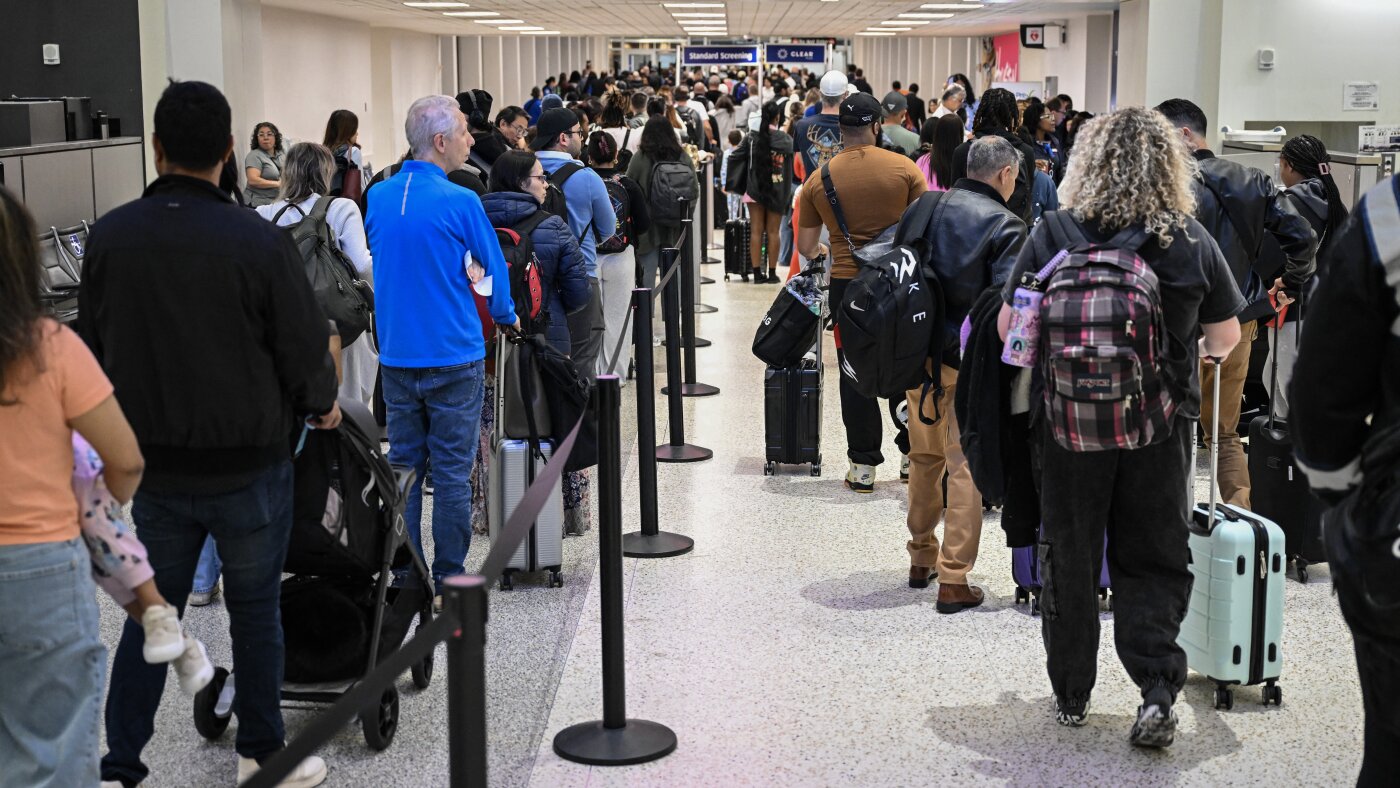
Travelers wait in line at a TSA security checkpoint at George Bush Intercontinental Airport in Houston, Texas, on March 20, 2026.
Ronaldo Schemidt/AFP via Getty Images
hide caption
toggle caption
Ronaldo Schemidt/AFP via Getty Images
It’s spring break season in the U.S. — and travelers are facing long airport lines as security screeners work without pay while the Department of Homeland security is shut down.
Congressional Democrats have declined to fund the agency in an attempt to force reforms of federal immigration enforcement practices.
Wait times at major hubs in Houston and Atlanta reached two hours on Friday, while New Orleans’s Louis Armstrong International Airport advised passengers to arrive at least three hours before their scheduled departures. In Philadelphia, airport officials closed three security checkpoints entirely this week because of short staffing.
On Saturday, President Trump threatened to send Immigration and Customs Enforcement agents to staff airport security lanes if Democrats don’t “immediately” agree to fund DHS. A bipartisan group of senators has been negotiating with the White House over immigration enforcement and ending the shutdown.
“I will move our brilliant and patriotic ICE Agents to the Airports where they will do Security like no one has ever seen before, including the immediate arrest of all Illegal Immigrants who have come into our Country,” Trump posted on Truth Social. In a follow-up post he said he told ICE to “GET READY” to deploy to airports on Monday.
Why are wait times so long?
Officials say wait times are unpredictable and can fluctuate sharply as airports struggle with Transportation Security Administration staffing shortages.

TSA staffers are considered essential workers, so about 50,000 have been working without pay due to the shutdown that started Feb. 14. Last week, they missed their first full paychecks. The Department of Homeland Security says more than 300 TSA officers have quit. More than half of TSA staff in Houston called out sick and nearly a third called out in Atlanta and New Orleans last week, DHS said.
The staffing shortage comes as travel has also been disrupted by severe weather, and as schools across the country close for spring break.
Some 2.8 million people were projected to travel on U.S. airlines each day in March and April, adding up to a record 171 million passengers, according to the industry group Airlines for America.
What do officials say?
Transportation officials are warning the situation could get worse if the shutdown isn’t resolved. A second missed paycheck would put even more strain on TSA workers, Transportation Secretary Sean Duffy told CNN on Friday.

“If a deal isn’t cut, you’re going to see what’s happening today look like child’s play,” Duffy said. “Is it still safe as you go through the airport? Yes, but it takes a lot longer because we have less agents working.” He added that some smaller airports may be forced to temporarily close if more staff calls out.
In the U.K., Foreign Office officials are also warning travelers of “travel disruption” caused by “longer than usual queues at some U.S. airports,” and recommended passengers check with their travel provider, airport, or airline for guidance.
On Saturday, billionaire Elon Musk weighed in with an offer to personally pay TSA staff.
“I would like to offer to pay the salaries of TSA personnel during this funding impasse that is negatively affecting the lives of so many Americans at airports throughout the country,” Musk posted on X early Saturday morning.
U.S. law generally bars government employees from receiving outside compensation for their work.
Even with disruptions, travel demand is still high
On top of long security wait times and weather impacts, travel is being affected by the war in Iran, which is driving up global oil prices.

On Friday, United Airlines said it would cut some flights over the next six months after jet fuel prices doubled in recent weeks. Capacity cuts are likely to send airfares even higher, even as ticket prices are already rising, said Clint Henderson, a spokesperson for the travel website The Points Guy.
Still, he said, none of that seems to be deterring Americans from flying.
“The appetite for travel is insatiable,” he said. “People seem willing to endure a lot of stuff to travel. And I don’t see any signs of that decreasing.”
How can travelers prepare?
Travel experts say it’s not just long wait times that travelers should prepare for — it’s the uncertainty.
“Every day this goes on, it’s getting worse and worse and worse,” Henderson said.
Here are some tips on how to prepare for upcoming air travel:
1. Know before you go
Many airport websites list estimated security wait times. That should be the first place you check to get a sense of how long lines might be, Henderson says. (TSA also estimates wait times on its website and app, but that’s not being regularly updated because of the shutdown, he added.)
“Knowledge is power,” Henderson said. “You should know what’s going on at your local airport.”
He noted there are 20 U.S. airports where security screening is done by private contractors, not the TSA — and they are not experiencing staffing shortages or long waits. Some are smaller regional airports, but the list also includes some larger hubs, including San Francisco International Airport and Kansas City International Airport.
“There’s big, big, big metropolitan areas where it’s not an issue at all,” Henderson said.
2. Budget extra time
If you’re someone who shows up at the airport when your flight starts boarding, think twice, says travel writer Chris Dong.
“I’m the type of traveler who usually arrives pretty last minute,” Dong said, “but I think that that advice would not be sound for the current situation.”
Even if wait times are listed as short, things can change on a dime. Dong recently flew out of John F. Kennedy Airport in New York and found the TSA PreCheck line unexpectedly closed.
“So then everyone that was funneled through the regular line, it was an extra like 20, 30 minutes,” he said. “I was sweating it out because I usually arrive super last-minute. And those levels of uncertainty are just higher now with the shutdown.”
3. Consider biometric screening
Henderson typically recommends signing up for TSA PreCheck or the Global Entry program to move through airport security more quickly — and to opt in to biometric screening. That has to be done in advance, and travelers also have to choose biometric screening in their airline apps.
“Make sure if that’s an option that you’re opted in for that, because that will save you so much agita,” he said.
For those who haven’t signed up in advance, there is a last-minute alternative: the private CLEAR program, which allows people to enroll at the airport. Henderson notes it’s pricey — annual membership costs $209 — but that some credit card companies will refund that fee.
“For me to skip a three-hour line is probably worth the membership fee, especially if you know your credit card will pay you back for it,” he said.
That said, expedited screening lanes are not always faster than regular screening, both Henderson and Dong warned. Always check what all the lanes look like when you arrive at the airport.
4. Make a plan B
If you miss a connection or your flight is canceled, be proactive about rebooking. “Have all the tools available to you in the toolbox in case things go wrong,” Henderson advises.
That includes installing your airline’s app on your smartphone and writing down their customer service number, so you aren’t scrambling to find it.
“And then, you know, obviously have a plan B,” Henderson said. “Know what other airlines fly the route that you want to take in case, you know, you missed your Delta flight and American is offering a flight you can take later that day.”
He says while airlines don’t generally like to rebook passengers on competitors’ flights, it’s worth asking. He also recommends having the information at hand to give to customer service agents, including flight number, airline and departure time.
And if an airline cancels your flight in the U.S., you’re entitled to a refund, according to the Department of Transportation.



An Air Canada jet collided with a fire truck at LaGuardia Airport in Queens on Sunday night, killing two people and injuring dozens. The fire truck was responding to an unrelated incident when the crash happened.
Audio from air traffic control, flight data and imagery of the aftermath provide clues as to how the collision unfolded.
Before the crash
After multiple attempts at takeoff and reporting an issue with an odor, a United Airlines plane on the east side of the airport requested assistance. A Port Authority Aircraft Rescue and Firefighting truck responded and began traveling across the airport toward the United plane.
At the same time, around 11:36 p.m. an Air Canada Express Flight 8646 approached Runway 4 at about 150 miles per hour, according to flight data.
Fire truck cleared to cross runway
About 30 seconds before the collision, which was around 11:37 p.m., the fire truck requested permission from air traffic control to cross Runway 4 at crossing “D.” An air traffic controller promptly granted access, responding “Truck 1 and company, cross 4 at delta.”
Ten seconds after granting permission and about 10 seconds before the collision, the same controller is heard saying, “Stop, stop, stop, stop, Truck 1, stop, stop, stop.”
Flight data shows that the Air Canada plane touched down on the runway about 15 seconds before the collision with the fire truck.
About 10 seconds before the crash, the controller said, “Stop, Truck 1, stop!”
In the six seconds between when the controller told Truck 1 to stop the first time and the second time, the United flight covered approximately 1,000 feet, traveling about 200 feet per second, or 130 miles per hour, according to analysis of the flight data.
Moment of crash
Surveillance footage reviewed by The New York Times shows the Air Canada flight traveling down the runway and approaching the intersection where the fire truck had requested permission to cross. As the fire truck made a left turn onto Runway 4, the plane collided into the back half of the truck around 11:37 p.m.
Before the crash, one passenger, Rebecca Liquori, 35, said that there was turbulence as the flight prepared to land and that a flight attendant gave a warning about what to do in case of a possible emergency landing.
Using the length of the plane as a reference scale, The Times estimated the speed of the plane in the video footage to be about 110 miles per hour right before impact.
After the crash, the plane traveled about an additional 600 feet down the runway before coming to a stop off to the side of the runway. The fire truck was knocked onto its side and also slid down the runway before coming to a halt on a grassy median.
The diagram below shows what a Bombardier CRJ-900 jet looks like compared with a typical airport fire truck.
Aftermath
Images and video of the aftermath show that a large portion of the front of the airplane, including most of its cockpit, was torn off or crushed by the impact. Both the pilots died in the collision. A flight attendant, Solange Tremblay, was ejected from the plane while still strapped into her seat, sustaining a fractured leg.

A statue of the explorer Christopher Columbus stands on White House grounds at the Eisenhower Executive Office Building (EEOB) in Washington, D.C., on March 23, 2026.
Jim Watson/AFP/Getty Images
hide caption
toggle caption
Jim Watson/AFP/Getty Images
The Trump administration placed a statue of Christopher Columbus on White House grounds over the weekend, doubling down on its efforts to commemorate the 15th-century explorer.
“As we celebrate our Nation’s 250th anniversary of independence, the White House is proud to honor Christopher Columbus’s legendary life and legacy with a well-deserved statue on the White House grounds,” Davis Ingle, a White House spokesperson, said in a statement. “In this White House, Christopher Columbus is a hero, and President Trump will ensure he’s honored as such for generations to come.”
The statue is a replica of the one that used to sit in Baltimore’s Little Italy, according to John Pica, a Maryland lobbyist and president of the Italian American Organizations United. In 2020, after the killing of George Floyd by a white police officer and a reckoning on racial justice issues in the U.S., protesters pulled the statue down and hurled it into the city’s Inner Harbor.
The marble statue depicted Columbus facing east towards the sun, and was dedicated by former Baltimore Mayor William Donald Schaefer and President Ronald Reagan in October 1984.
Soon after, Pica, who also has served as a Maryland state senator, said his group hired divers to fish pieces of the statue out of the harbor. They raised money through grants and private contributions to hire a Maryland sculptor to rebuild it, Pica said.
The replica had been finished for a few years and sat in storage until Pica got a call last week that the White House wanted the statue. The statue was installed around 2 a.m. Sunday morning, he said, and it is on loan to the White House until the end of Trump’s term.
“It’s a place where it can peacefully shine and be protected,” he added.
“It’s a source of pride for Italian Americans,” Pica said. “Christopher Columbus, notwithstanding the controversy around him, is a symbol of pride and adventure for Italian Americans.”
Pica said he understands the hesitancy around Columbus’ legacy. In a way, he said, Italian Americans are “stuck” with Columbus.
“We don’t raise a glass of wine to Christopher Columbus on Columbus Day,” Pica said. “We celebrate our heritage. We don’t have Columbus celebrations. We have Italian American celebrations and Italian heritage celebrations. It’s just Columbus happens to be the symbol.”
The statue is not the administration’s first attempt to shine a favorable light on the controversial figure.
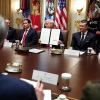
Last year, the Trump administration issued a proclamation commemorating Columbus Day, and took a jab at people who have criticized the explorer.
“Outrageously, in recent years, Christopher Columbus has been a prime target of a vicious and merciless campaign to erase our history, slander our heroes, and attack our heritage,” the proclamation read. “Before our very eyes, left-wing radicals toppled his statues, vandalized his monuments, tarnished his character, and sought to exile him from our public spaces.”
Indigenous Peoples’ Day, which is not an official federal holiday but is celebrated by cities and states across the country, previously had been recognized by the Biden administration.
Members of the public offer mixed reactions to the statue
On Monday morning, groups of schoolchildren, tourists and locals passed by the White House and offered differing opinions of the statue.
The statue wasn’t visible to the public because of construction and fences walling off the area. But when Ivone Sagastume, a first-generation Guatemalan American, heard about the new statue, she was brought to tears. To her, she said, the statue is another way the Trump administration is dividing the country.
“We as a nation have fought for unity and for respect of other cultures,” Sagastume, 35, said. “That symbol is just going to destroy that even more, it’s just destroying what this country was built on.”
Gerald Horne, a professor of history and African American studies at the University of Houston, said that reaction to the statue makes sense.
“Statues are political statements and those who have objected to the statue of Christopher Columbus are objecting to his role in helping to ignite genocide against the Indigenous population, of being an enslaver himself,” Horne said.
Middle school history teacher Scott Silk, 57, looked out at the White House with a group of students from San Diego behind him.
“For so many people in the United States, Christopher Columbus is a symbol of racism and the oppression of native peoples,” he said.
He said if he and his students could see the statue, he would ask them to reflect on what it means.

But others, like Martha Castillo, a tourist from San Diego, Calif., said it’s important to remember American history.
“I think it’s a good idea to have it here,” Castillo, 55, said. “This is a historic place and I think it should be here in the White House.”
Peter Diaz, 47, traveled from Miami, Fla. to explore the city’s capital. Diaz said the country has “bigger problems” than a statue.
“How many statues do we have in every city? In every state?” he said. “Are those really the issues that we care about? Don’t you think we have to think about our kids?”

Travelers are facing long waits at airport security checkpoints as the partial government shutdown continues to strain staffing for Transportation Security Administration workers. About 50,000 T.S.A. personnel have been working without pay for over a month, and hundreds have quit or called out of work.
On Monday, President Trump deployed Immigration and Customs Enforcement agents to some U.S. airports, saying that they would help ease long security lines. By Monday afternoon, the lines at the Atlanta, LaGuardia and Newark airports had become so long that those airports removed wait time estimates from their websites. Atlanta’s airport advised passengers to allow for at least four hours for security screenings.
Here are the latest available wait times at select major airports across the country.
Show wait times for:
See wait times at airports across the country

Apple launches iOS 26.4 with AI playlists, purchase sharing, and more

Who actually runs Iran right now? The key power players as Trump claims talks to ‘top’ official

King Charles to address Congress in historic first state visit to Washington

March Madness sparks surprising surge in sexual procedure for men

Trump admin says SJSU now faces ‘impending enforcement’ for transgender volleyball scandal conflict

Florida High School Football Rankings: Top 25 teams – Oct. 21

How old is Bo Nix? What to know about Oregon quarterback ahead of 2024 NFL Draft

Cleary's 21 help Le Moyne down Central Connecticut State 69-64 in OT

99th annual Pony Swim held in Virginia

Indiana Members Credit Union announced as new anchor tenant at Bottleworks District
King Charles to address Congress in historic first state visit to Washington

Iran names successor to security chief killed in US-Israeli attack

See How the LaGuardia Plane Crash Unfolded

Mullin confirmed as DHS chief as lawmakers near solution on shutdown standoff

Von der Leyen clinches Australia trade deal
-

 Detroit, MI6 days ago
Drummer Brian Pastoria, longtime Detroit music advocate, dies at 68
-

 Oklahoma1 week ago
Family rallies around Oklahoma father after head-on crash
-

 Georgia1 week ago
How ICE plans for a detention warehouse pushed a Georgia town to fight back | CNN Politics
-

 Movie Reviews5 days ago
‘Youth’ Twitter review: Ken Karunaas impresses audiences; Suraj Venjaramoodu adds charm; music wins praise | – The Times of India
-

 Alaska1 week ago
Police looking for man considered ‘armed and dangerous’
-

 Education1 week ago
Video: Turning Point USA Clubs Expand to High Schools Across America
-
 Science1 week ago
Long COVID leaves thousands of L.A. county residents sick, broke and ignored
-

 Sports3 days ago
IOC addresses execution of 19-year-old Iranian wrestler Saleh Mohammadi