News
A weakened Helene brings 'catastrophic' flooding as it crosses southern Appalachians


Floodwaters surround a home in the aftermath of Hurricane Helene on Friday in Crystal River, Fla.
Phelan M. Ebenhack/AP
hide caption
toggle caption
Phelan M. Ebenhack/AP
Helene weakened to a post-tropical cyclone on Friday evening but continued to unleash “catastrophic” flooding in the southeastern U.S. and southern Appalachians, forecasters said.
Life-threatening flooding and landslides in parts of southern Appalachia were expected to continue into the evening, the National Hurricane Center said.
Gusty winds were still lashing parts of Georgia, the Carolinas, Tennessee and Kentucky.
Carving a northwest path, Helene was expected to slow and then stall over the Tennessee Valley late Friday, according to forecasters.
“The expected slow motion could result in significant flooding over the Ohio and Tennessee Valleys, and over the southern Appalachians through the weekend,” the center said in a late morning update.
In an evening update from the National Hurricane Center, maximum sustained winds were moving at 25 mph. The storm made landfall Thursday night in Florida’s Big Bend region — the nexus of the Panhandle and peninsula in the state’s northwest — as a Category 4 hurricane with maximum sustained winds of 140 mph.
Preliminary post-landfall modeling showed the storm surge reached 15 feet above ground level in the Big Bend area near Keaton Beach, Steinhatchee and Horseshoe Beach, the National Weather Service said.

Flooding concerns have shifted to western North Carolina, which was expected to receive up to 11 inches of rain.
Death toll across five states reaches 44 people
At least 44 people in five states have died as a result of the storm, the Associated Press reported. As emergency rescue crews comb through the wreckage, officials in several states said they expected the number of storm-related deaths to climb.
While the worst of the storm is over for many in the Southeast, officials are warning residents to stay vigilant in its aftermath amid hazardous conditions, such as flooded and debris-strewn roads.
The storm surge reached more than 5 feet along the Gulf Coast of Florida Thursday night. Andrew Swan, 31, rode out the storm in Madeira Beach, Fla., watching over a friend’s house. He told WUSF the water rushed into the house up to his chest, and he spent the night sleeping on a kitchen counter with his legs over the stove.
West of Tampa, officials in Pinellas County described the scenes of wreckage there as a “war zone.”
Five Floridians were confirmed dead in the county, at least two from drownings, the sheriff’s office said.
The high winds and tornadoes were also blamed for several deaths. Gov. Ron DeSantis said one person died on a highway in Tampa from a falling sign. Another person died after a tree fell on their home in Dixie County.

A downed tree is seen along Margret Mitchell Drive in the Buckhead area of Atlanta on Friday.
Jason Allen/AP/FR172026 AP
hide caption
toggle caption
Jason Allen/AP/FR172026 AP
The majority of deaths were in Georgia and the Carolinas, several of them the result of falling trees.
In South Carolina, 19 people died, including two firefighters who died when a tree struck their truck, local officials told the AP.
In Georgia, the death toll was 15, according to a spokesperson for Gov. Brian Kemp. At least two children were among the dead, reported local CBS station 13WMAZ. Two Georgians died in Wheeler County after their trailer was picked up by a tornado, an emergency management official said.
In North Carolina, Helene produced unusually heavy winds — up to 140 mph — on land, the strongest observed in coastal North Carolina since the start of modern meteorological recordkeeping in the 19th century.
Gov. Roy Cooper confirmed
left four people in critical condition
Virginia had one storm-related death after a tree fell and a building collapsed in Craig County, Gov. Glenn Youngkin said.
Record-breaking rainfall in southern Appalachians
Heavy rains from Helene set a record in Atlanta, which received its highest 48-hour rainfall on record over the past two days. The Georgia Climate Office tweeted on Friday that the area has already seen 11.12 inches of rain, beating a previous record of 9.59 set in 1886. Record keeping started in 1878.
In North Carolina, the rainfall totals Friday afternoon were staggering: 29.58 inches for Busick, N.C.; 24.20 for nearby Mount Mitchell State Park; about 13 inches in Boone, some 55 miles away.
The storm dumped more than 8 inches of rain in Wilmington and wrought serious damage to coastal homes and small buildings, as well as agricultural fields.
Along with floods, the persistent rains have created landslide conditions in western North Carolina, as member station WFAE reported. The National Weather Prediction Center has forecast 6 to 12 inches for the region, well above the landslide condition threshold for the area.
In Tennessee, over 50 patients and staff were stuck on the roof of Unicoi County Hospital in Erwin, as floodwaters rose on Friday morning. By the afternoon, they were finally rescued.
Heavy rains inundate western North Carolina
Rising lakes and rivers as well as flooding from rapid rainfall led officials to close all roads in western North Carolina Friday.
The North Carolina Department of Transportation warned drivers to stay off the roads except for emergencies or efforts to evacuate to higher ground.
Meanwhile, the National Weather Service released an urgent warning through Friday afternoon urging anyone below the Lake Lure Dam near Ashville to evacuate immediately to higher ground, after concerns that the nearly century-old dam could fail.
Brigadier General Daniel Hibner with the Army Corps of Engineers said dam failures are to be expected in flash flooding events like this one. “It’s not uncommon to see a dam failure in an event like this,” he said at a press briefing. “I would be surprised if there weren’t multiple (dam failures) throughout this area.”
Yet the dam remained intact as of Friday evening. In a 6 p.m. ET update on social media, Rutherford County officials said the lake’s water levels were beginning to recede.
Lake Lure is famous for serving as a backdrop to several scenes in the 1987 film Dirty Dancing.
Helene knocked out power to millions
More than 4 million homes and businesses were without power on Friday afternoon in Florida, Georgia, North Carolina and South Carolina, according to poweroutage.us. By nightfall, that number had dipped to about 3.7 million.
Meanwhile, the NHC warned about the potential for long-lasting power outages in southeastern states.
For those relying on generators for power supply, the consumer safety officials advised people to keep them at least 20 feet away from the home to avoid deadly carbon monoxide poisoning. Improper portable generator use led to more deaths associated with 2020’s Hurricane Laura than the storm itself.



The bombing of an Iranian elementary school that killed some 165 people, many of them schoolgirls, included more targets near the school than has been initially reported, a review of commercial satellite imagery by NPR has found.
The images suggest that the school was hit on Saturday as part of a precision airstrike on a neighboring Iranian military complex — and that it may have been struck as a result of outdated targeting information.
The new images come from the company Planet and are of the city of Minab, located in southeastern Iran. They show that a health clinic and other buildings near the school were also struck. Three independent experts confirmed NPR’s analysis of the additional strike points.
The strike points “look like pretty clean detonation centroids,” said Corey Scher, a postdoctoral researcher at the Conflict Ecology laboratory at Oregon State University.
“These certainly appear like detonation sites,” agreed Scher’s colleague, Oregon State associate professor Jamon Van Den Hoek.
Jeffrey Lewis, a professor at Middlebury College who specializes in satellite imagery, said the imagery was consistent with a precision airstrike.
The images show “very precise targeting,” Lewis told NPR. “Almost all the buildings [in the compound] are hit.”
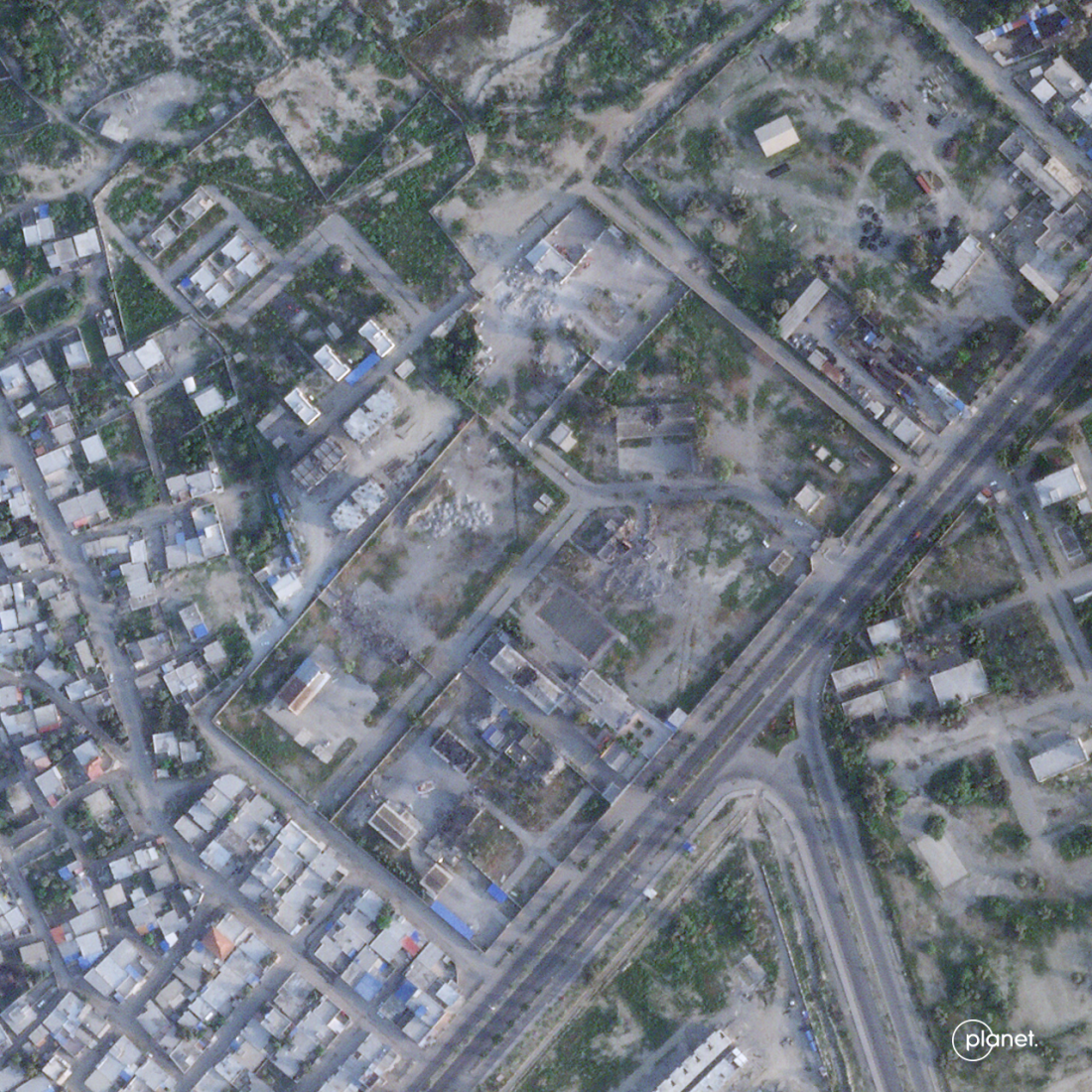
A satellite image of an Iranian Revolutionary Guard compound taken on March 4, several days after an airstrike destroyed a school on the edge of the compound. The image reveals that half a dozen other buildings in addition to the school were struck.
Planet Labs PBC
hide caption
toggle caption
Planet Labs PBC
Iranian state media said 165 people died in the bombing, which struck a girls’ school. The school was located within less than 100 yards of the perimeter of an Iranian Revolutionary Guard naval base, according to satellite images and publicly available information. The clinic was also located within the base perimeter, although both facilities had been walled off from the base.
Israel has denied involvement. “We are not aware at the moment of any IDF operation in that area,” Israel Defense Forces spokesperson Nadav Shoshani told NPR on Monday. “I don’t know who’s responsible for the bombing.”

At a press conference Wednesday morning, U.S. Defense Secretary Pete Hegseth said that the U.S. is looking into what happened at the school. “All I know, all I can say, is that we’re investigating that,” Hegseth said. “We, of course, never target civilian targets.”
Given Minab’s location in the southeastern part of Iran, Lewis believes it’s more likely the U.S. would have conducted the strike than Israel. As one gets farther south and east in Iran, “a strike is much more likely to be a U.S. strike than an Israeli strike because of the type of munitions and the geographic location,” he said.
Esmail Baghaei, the spokesman for Iran’s Foreign Ministry, called the strike “deliberate” and said that the U.S. and Israel bombed the school in part to tie up Iranian forces in the region with rescue efforts. “To call the attack on the girls school merely a ‘war crime’ does not capture the sheer evil and depravity of such a crime,” he said.
But Lewis said it’s more likely that the strike was the result of an error. Satellite images show that the school and clinic buildings were both once part of the base. The school was separated from the base by a wall between 2013 and 2016. The clinic was walled off between 2022 and 2024.
Lewis believes it’s possible American military planners had not updated their target sets.
“There are thousands of targets across Iran, and so there will be teams in the United States and Israel that are responsible for tracking those targets and updating them,” he said. “It’s possible that the target didn’t get updated.”
The Pentagon did not immediately respond to NPR’s request for additional information about the strike.
NPR’s Arezou Rezvani and NPR’s RAD team contributed to this report.

Mojtaba Khamenei, the second son of the assassinated Ali Khamenei, is being heavily tipped to succeed his father as supreme leader of Iran, which would pitch a hardliner into the task of steering the Islamic republic through the most turbulent period in its 48-year history and offer a powerful signal that, for now, it has no intention of changing course.
No official confirmation has been given and the announcement may be delayed until after the funeral of Ali Khamenei, which was on Wednesday postponed.
His son is believed to have been the choice of the Islamic Revolutionary Guard Corps (IRGC), and the Israeli defence minister, Gideon Saar, has warned he will be assassinated.
Ayatollah Seyed Khatani, a member of the Assembly of Experts, the body that chooses the new supreme leader, said the assembly was close to selecting a leader.
Rigid in his anti-western views, Mojtaba Khamenei is not the candidate Donald Trump would have wanted. Marco Rubio, the US secretary of state, said on Tuesday that Iran was run by “religious fanatic lunatics” – and Khamenei’s appointment is hardly likely to dispel that opinion.
The choice of supreme leader is made by the 88-strong Assembly of Experts, who in this case are picking from a field of six possible candidates. His election would be a powerful if unsurprising symbol that the government is not looking to find an accommodation with America.
Trump has said the worst-case scenario would be if Khamenei’s successor was “as bad as the previous person”.
There has been speculation for more than a decade that he would be his father’s successor, which grew when Ebrahim Raisi, the elected president and favourite of Khamenei, was killed in a helicopter crash.
Mojtaba Khamenei was born in 1969 and studied theology after graduating from high school. At the age of 17, he went to serve in the Iran-Iraq war, but it was not until the late 1990s that he came to be recognised as a public figure in his own right.
After the landslide defeat of Khamenei’s preferred candidate, Ali Akbar Nategh Nuri, in the 1997 presidential election, where he won only 25% of the final vote, various conservative Iranian groups realised the need to make changes to their structures and Mojtaba Khamenei was central to that project.
He was also seen as instrumental by reformists in suppressing the protests in 2009 that came after allegations the presidential election had been rigged, with his name chanted in the streets as one of those responsible. Mostafa Tajzadeh, a senior member of Iran’s reformist parties who was imprisoned after the vote, alleged that his and his wife, Fakhr al-Sadat Mohtashamipour’s, legal case was under the direct supervision of Mojtaba Khamenei.
In 2022 he was given the title of ayatollah – essential to his promotion. By then he was a regular figure by his father’s side at political meetings, as well as playing an influential role in the Islamic Republic’s Broadcasting Corporation, the government’s official media outlet often criticised for churning out dull political propaganda that many Iranians reject in favour of overseas satellite channels. He has also played a central role in the administration of his father’s substantial financial empire.
His closest political allies are Ahmad Vahidi, the newly appointed IRGC commander; Hossein Taeb, a former head of the IRGC’s intelligence organisation; and Mohammad Bagher Ghalibaf, the current speaker of the parliament.
His rumoured appointment and its hereditary nature has long been resisted by reformists. The former prime minister Mir Hossein Mousavi, referring to the long history of rumours about Mojtaba Khamenei succeeding his father as leader, wrote in 2022: “News of this conspiracy have been heard for 13 years. If they are not truly pursuing it, why don’t they deny such an intention once and for all?”
The Assembly of Experts, in response, denounced “meaninglessness of doubts” and said the assembly would select only “the most qualified and the most suitable”.
Israel on Tuesday struck the building in the Iranian city of Qom, one of Shia Islam’s main seats of power, where the assembly was scheduled, but the building was empty, according to IRGC-affiliated media.

new video loaded: Senators Question Kristi Noem on ICE Immigration Tactics
transcript
transcript
Senators Question Kristi Noem on ICE Immigration Tactics
Homeland Security Secretary Kristi Noem repeatedly refused to apologize for suggesting that Alex Pretti and Renee Good, two U.S. citizens shot and killed by agents, were domestic terrorists.
-
What we’ve seen is a disaster under your leadership, Ms. Noem. A disaster. What we’ve seen is innocent people getting detained that turn out are American citizens. I could talk about the culture that’s been created here. After the killings of Renee Good and Alex Pretti, when I spoke to Alex’s parents, they told me that you calling him a domestic terrorist — this was directly from them — the day after he was killed, a nurse in our V.A., Alex — one of the most hurtful things they could ever imagine was said by you about their son. Do you have anything you want to say to Alex Pretti’s parents? Ma’am, I did not call him a domestic terrorist. I said It appeared to be an incident of — I think the parents saw it for what it was. In a hearing — recent hearing before the HSGAC committee, C.B.P. and ICE officials testified under oath that their agencies did not inform you that Pretti was a domestic terrorist — during that hearing, stated during that hearing, I was getting reports from the ground, from agents at the scene, and I would say that it was a chaotic scene. How did you think that calling them domestic terrorists at that scene was somehow going to calm the situation? The fact that you can’t admit to a mistake, which looks like under investigation, it’s going to prove that Ms. Good and Mr. Pretti probably should not have been shot in the face and in the back. Law enforcement needs to learn from that. You don’t protect them by not looking after the facts.

By Christina Kelso and Jackeline Luna
March 3, 2026

Detroit Tigers 2026 roster prediction 2.0: Is Kevin McGonigle ready?

Latest California-based gig work app lets people book content creators, editors

Study says the real value of a $100K salary in Dallas is…less than that

Miami’s own Marcello Hernandez delivers special tribute to former teacher on SNL

When did Southie get richy-rich? – The Boston Globe

Florida High School Football Rankings: Top 25 teams – Oct. 21

Cleary's 21 help Le Moyne down Central Connecticut State 69-64 in OT

How old is Bo Nix? What to know about Oregon quarterback ahead of 2024 NFL Draft

99th annual Pony Swim held in Virginia

Indiana Members Credit Union announced as new anchor tenant at Bottleworks District

DHS defends McLaughlin against allegations husband’s company profited millions from ad contracts: ‘Baseless’

Sánchez defies Trump in political gamble as Madrid say no to war
Satellite images show Iran school strike hit more buildings than earlier reported

US submarine sinks Iranian warship by torpedo in a first since World War II

Which oil and gas facilities in the Gulf have been attacked?
-

 World1 week ago
Exclusive: DeepSeek withholds latest AI model from US chipmakers including Nvidia, sources say
-

 Massachusetts1 week ago
Mother and daughter injured in Taunton house explosion
-

 Wisconsin3 days ago
Setting sail on iceboats across a frozen lake in Wisconsin
-

 Maryland4 days ago
AM showers Sunday in Maryland
-

 Denver, CO1 week ago
10 acres charred, 5 injured in Thornton grass fire, evacuation orders lifted
-

 Florida4 days ago
Florida man rescued after being stuck in shoulder-deep mud for days
-

 Massachusetts2 days ago
Massachusetts man awaits word from family in Iran after attacks
-

 Oregon6 days ago
2026 OSAA Oregon Wrestling State Championship Results And Brackets – FloWrestling