News
A Supreme Court ruling on voting rights could boost Republicans’ redistricting efforts

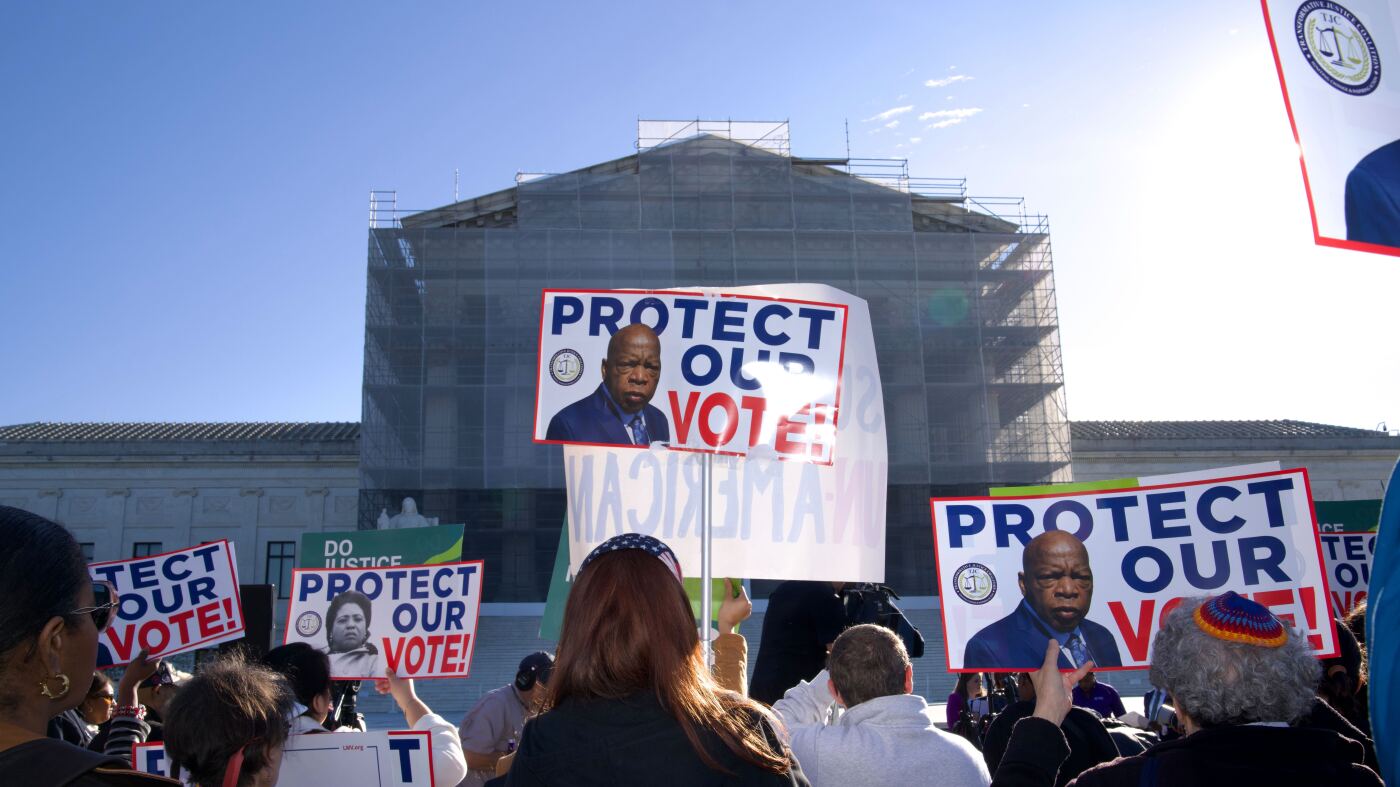
Demonstrators holding signs in support of minority voting rights gather outside the U.S. Supreme Court in Washington, D.C., on Wednesday.
Claire Harbage/NPR
hide caption
toggle caption
Claire Harbage/NPR
A major redistricting case returning to the U.S. Supreme Court on Wednesday could not only determine the fate of the federal Voting Rights Act, but also unlock a path for Republicans to pick up a slew of additional congressional seats.
If the high court overturns the act’s Section 2 — a provision that bans racial discrimination in voting — GOP-controlled states could redraw at least 19 more voting districts for the House of Representatives in favor of Republicans, according to a recent report by the voting rights advocacy groups Black Voters Matter Fund and Fair Fight Action.

And depending on when the court rules in the case, known as Louisiana v. Callais, some number of the seats could be redistricted prior to next year’s midterm election.
The analysis comes as President Trump continues to lead a GOP push for new maps in Texas, Missouri, North Carolina and other states that could help Republicans preserve their slim House majority after the 2026 election.
The GOP effort could be bolstered by a Supreme Court ruling that eliminates longstanding Section 2 protections against the dilution of the collective power of racial minority voters.
Many of the landmark law’s supporters fear such an outcome after the conservative-majority court didn’t rule last term on the Louisiana case, and instead scheduled a rare second round of oral arguments, which is expected to focus on the constitutionality of Section 2’s redistricting requirements.


A ruling gutting Section 2 could have a cascading effect on congressional maps in mostly Southern states where Republicans either control both legislative chambers and the governor’s office or have a veto-proof majority in the legislature — and where voting is racially polarized, with Black voters tending to vote Democratic and white voters tending to vote Republican.
If mapmakers in those states are no longer required under Section 2 to draw districts where racial minority voters have a realistic opportunity of electing their preferred candidate, Louisiana, Florida, Georgia, Missouri, North Carolina and Texas could end up with fewer Democratic representatives in Congress. Alabama, Mississippi, South Carolina and Tennessee could lose all of theirs, the report finds.
As much as 30% of the Congressional Black Caucus and 11% of the Congressional Hispanic Caucus could also be lost.
It all leads to a possibility of Republicans cementing one-party control of the House for at least a generation, says Cliff Albright, co-founder and executive director of Black Voters Matter Fund.

Demonstrators hold signs and wear shirts for Black Voters Matter Fund outside the Supreme Court on Wednesday.
Claire Harbage/NPR
hide caption
toggle caption
Claire Harbage/NPR
“Part of the point that we’re trying to make with this report is that what happens in the South doesn’t just stay in the South,” Albright adds. “This racial gerrymandering has the ability to not just disempower, disenfranchise Black voters and to eliminate Black elected officials and Latino elected officials. What happens in these states impacts the entire country.”
How the Supreme Court overturning Section 2 could lead to a redistricting “free-for-all”
In the Louisiana case, a lower court ordered the state’s Republican-controlled legislature to draw a new congressional map after a group of Black voters sued under Section 2.
Section 2 “ensures all communities of color can still participate equally in the voting process and elect candidates who reflect their interests,” says Alanah Odoms, executive director of the American Civil Liberties Union of Louisiana, whose attorneys are helping to represent those Black voters. “And if communities of color are not able to do that, we stand to lose what I think most of us believe is so fundamental to our democracy, which is equal participation, equal opportunity.”

The court-ordered map, which was in effect for the 2024 election, led to Democrats picking up a second seat in Louisiana.
A group of self-described “non-African American” voters, led by Phillip Callais, has argued, however, that the race-based redistricting the court ordered to get in line with Section 2 is unconstitutional. Just as the Supreme Court ruled against race-based affirmative action at colleges and universities in 2023, they argue, the court should put an end to race-based political mapmaking under Section 2.
In seeking a rehearing in the Louisiana case, the Supreme Court asked all sides in the case to consider whether the state’s “intentional creation of a second majority-minority congressional district violates the Fourteenth or Fifteenth Amendments to the U.S. Constitution.”
In one of their latest briefs to the high court, Republican state officials in Louisiana now argue against using race “in any form” when redistricting.
And in a major shift from past administrations, the Justice Department under Trump agrees that Section 2’s protections against racial discrimination are no longer constitutional.
Two years ago, the Supreme Court rejected a similar argument by Alabama Republicans.
“The court could reaffirm the Voting Rights Act as it did in 2023 in Allen v. Milligan,” says Atiba Ellis, a professor and an associate dean at Case Western Reserve University’s law school. “But many observers — and I am one of them — have been concerned about the court becoming more and more cynical about race-conscious remedies to address longstanding civil rights wrongs. And this decision has the potential to be the tipping point where the court declares unconstitutional or heavily restricts the ability for Congress to create remedies that promote multiracial democracy.”
That kind of decision coming amid the ongoing mid-decade congressional redistricting war between Republicans and Democrats, Ellis adds, could set the stage for a true “free-for-all” — pointing also to the court’s 2019 ruling that partisan gerrymandering is not reviewable by federal courts.

“It is one thing for politicians on both sides of the aisle to use the power that they have to engage in unprecedented power grabs. But the most important check on those grabs has been the prevention of racial discrimination,” Ellis says about Section 2. “Absent the federal law that would prevent that discrimination, I think the consequences could be tremendous and could be felt for decades.”
The window of time to pass new congressional maps before the midterms is closing as state deadlines draw nearer. Louisiana’s top election official, Secretary of State Nancy Landry, has asked the Supreme Court to rule in this case by early January 2026 to avoid disrupting the state’s current schedule.
But the timing remains unclear for the Supreme Court, which usually releases decisions for major cases toward the end of its term in June.
The court has confirmed that it plans to discuss early next month if it will take up a North Dakota case about whether private individuals and groups — whose lawsuits have been the main way of enforcing Section 2 — can continue to sue. Republican state officials in Mississippi have also raised that issue in another redistricting case on direct appeal to the high court.
Edited by Benjamin Swasey


An aerial view shows damage from a tornado, on Saturday in Lena, Ill.
Scott Olson/Getty Images
hide caption
toggle caption
Scott Olson/Getty Images
Communities across the Upper Midwest are cleaning up after tornadoes and severe weather impacted the region over the weekend, damaging and destroying dozens of homes and knocking out power for tens of thousands.
“Numerous” severe storms were tracked across parts of Iowa, Illinois and Missouri on Friday, according to the National Weather Service. At least 66 tornado reports were submitted in multiple states including Oklahoma, Illinois, Missouri, Wisconsin and Iowa, the NWS Quad Cities IA/IL office said Sunday.
No deaths have been reported from the severe weather and tornado outbreak.

In Marion Township in Minnesota, about 30 homes were damaged and a dozen have significant damage because of a tornado, according to the Olmsted County Sheriff’s Office. The tornado also damaged at least 20 homes in Stewartville and there is a temporary shelter in Rochester for people displaced by the storms, according to MPR News.
“Tornado disaster recovery continues to occur at full speed,” the Olmsted County Sheriff’s Office said on Saturday.
In Illinois, McClean County officials declared a disaster emergency because of severe storms in Bloomington. “At this time, no injuries have been reported, and emergency response agencies remain actively engaged to ensure public safety and continuity of essential services,” officials said in a statement.
But further north in the village of Lena, an EF-2 tornado caused the “most significant damage” where “many homes and outbuildings were damaged, trees uprooted, and power lines downed,” the NWS said. Numerous roads have also been blocked by debris, the Stephenson County Sheriff’s Office also said.

People continue to clean up following a tornado, on Saturday in Lena, Ill.
Scott Olson/Getty Images
hide caption
toggle caption
Scott Olson/Getty Images
There have been no fatalities and no reports of serious injuries associated with the storm, Chief Deputy Andy Schroeder from the Stephenson County Sheriff’s Office told NPR on Sunday.
More than 43,000 customers lost power in Illinois but power was restored to almost all of them by Saturday night, according to electric utility ComEd.
Several tornadoes also occurred across Wisconsin, according to the NWS office in La Crosse. Twenty-six tornado warnings were issued by the office on Friday, the most in one day since the weather service office was built in 1995.
In one Marathon County town, 75 homes were destroyed by a tornado, according to Ringle Fire Chief Chris Kielman.
“It took out a whole residential area,” Kielman said, according to Wisconsin Public Radio.
The American Red Cross of Wisconsin said volunteers are helping those impacted by the storm with meals, shelter and support.
Parts of the state are still dealing with multiple rounds of severe weather and tornadoes from earlier in the week that brought flooding to some communities.

Leslie Adams holds a photo of his mother, Shirley, who died after developing infected bedsores at a rehabilitation center, according to a lawsuit he filed. A court awarded the family $17 million, but they are still trying to collect it.
Taylor Glascock for KFF Health News
hide caption
toggle caption
Taylor Glascock for KFF Health News
By the time she was hospitalized in 2020, Pearlene Darby, a retired teacher, had suffered open sores on both legs, both hips, and both heels, as well as a five-inch-long gash on her tailbone. She died two weeks later at age 81 from infections and bedsores, according to her death certificate. Her daughter sued the nursing home, alleging it had left Darby sitting in her own feces and urine time and again.
The lawsuit, settled on confidential terms last year, blamed not only the managers of City Creek Post-Acute and Assisted Living but also the building’s owner, a real estate investment trust, or REIT. In the year Darby died, City Creek paid CareTrust REIT more than $1 million in rent, while the Sacramento, California, nursing home ran a deficit, court records show.
Federal tax rules ban REITs from running health care facilities, but CareTrust was not an absentee landlord either, according to internal records filed in the case. It chose the nursing home’s management company and required through the lease that the home keep at least 80% of beds occupied. CareTrust granularly tracked how well the home kept to its financial plan, down to the money spent monthly on nurses and food, the records said. And the documents showed that the real estate company kept tabs on government safety inspection findings and Medicare quality ratings.
Both CareTrust and the nursing home operator denied liability for Darby’s death. CareTrust officials said in court papers that it is not involved in day-to-day nursing home decisions or patient care, and that it monitors facilities to ensure nothing jeopardizes rent payments.
In a written statement, CareTrust Corporate Counsel Joseph Layne told KFF Health News: “We are the property owners, not the operators.”

Pearlene Darby, pictured here with her grandson Caleb Darby, was a resident of a Sacramento, California, nursing home. She died two weeks after being hospitalized for bedsores and an infection. The home denied liability and the case was settled out of court.
Shirlene Darby
hide caption
toggle caption
Shirlene Darby
Landlords with influence
Over the past decade, real estate investment trusts have bought thousands of buildings that house nursing homes, hospitals, assisted living facilities, and medical offices. A KFF Health News examination of court filings and corporate records shows that these landlords have more influence than the health care facilities publicly acknowledge.
The documents reveal REITs often select the management who oversee the operations and leave them in place even when they are aware of threadbare staffing, floundering governance, repeated safety violations, or other problems that hamper quality of care. A California jury in March awarded $92 million in punitive damages against a former REIT over the death of a 100-year-old resident with dementia who froze to death outside her assisted living facility.
“The REITs are in charge,” said Laraclay Parker, one of the lawyers who represent Darby’s daughter.
Absence of oversight
Despite their ubiquity, REITs remain invisible to state and federal health regulators. Hospitals and nursing homes are not required to disclose rent payments or landlord identities in the annual reports they submit to Medicare.
Under President Donald Trump, the Centers for Medicare & Medicaid Services indefinitely suspended a Biden-era requirement that nursing homes disclose REIT involvement. Catherine Howden, a CMS spokesperson, said in a statement that the agency does not regulate facilities based on their tax status or corporate form and instead focuses on the quality of the care they provide.

REITs now own a fifth of the nation’s senior housing, which includes assisted living, memory care, and independent living, according to an industry analysis. REITs also hold investments in 1 in 6 nursing homes. Publicly traded REITs that focus on health care are now worth nearly a quarter of a trillion dollars, according to Nareit, an industry association.
While one research study found REIT investments were associated with higher spending on nursing wages, another concluded that after being bought by REITs, nursing homes frequently replaced registered nurses with less skilled nurses and aides. A third analysis concluded that health inspection results were worse after REIT investment.
Researchers also found that investor-owned hospital chains that sold buildings to REITs were more likely to close or go bankrupt, as happened in 2024 with Steward Health Care. Often, private equity investors kept the sale proceeds as profits while the hospitals were burdened with new rent costs. “There were no improvements in clinical outcomes,” said Thomas Tsai, an associate professor at the Harvard T.H. Chan School of Public Health.
REITs are required to distribute most of their income and don’t have to pay the 21% federal corporate income tax on it. There is a catch: A REIT that “directly or indirectly operates or manages” a health care facility loses the tax break for five years. Typically, a REIT leases the property to another company that runs the nursing home or assisted living facility and maintains its tax break. Nareit said health care REITs distributed more than $7 billion in dividends in 2024.
Michael Stroyeck, head of health care analysis at Green Street, a real estate research company, said “there’s definitely a symbiotic relationship” between REITs and facility managers because they have the same goals. He said he has seen REITs replace operators that are having difficulties or go bankrupt.
John Kane, a senior vice president at the American Health Care Association and the National Center for Assisted Living, an industry group that represents nursing homes, said in a statement: “Given government funding often falls short, REITs have been valuable partners in helping to invest in long term care without influencing daily operations.”
Low staffing at a chain
Strawberry Fields REIT, which like CareTrust trades on the New York Stock Exchange, owns or controls the buildings of 131 nursing home facilities. The nursing home operations inside 66 of those facilities are owned by Moishe Gubin, Strawberry Fields’ chief executive, and Michael Blisko, one of its directors, according to Strawberry Fields’ annual report for last year.
Gubin and Blisko also jointly own Infinity Healthcare Management, which manages their nursing homes; Blisko is Infinity’s CEO. On average, Infinity-affiliated nursing homes provided an hour and a quarter less nursing care per resident per day than the national average of four hours, a KFF Health News analysis of federal records found.
Infinity and several of its nursing homes have recently settled 30 death and injury lawsuits in Cook County, Illinois, totaling more than $4 million, said Margaret Battersby Black, a Chicago lawyer. A jury last year awarded $12 million in a lawsuit brought against Infinity and one of its Chicago nursing homes over the 2023 death of Shirley Adams. A retired candy factory worker, Adams died after developing infected bedsores at Lakeview Rehabilitation and Nursing Center, according to the lawsuit.
“She had wounds that no one could explain,” one of her adult children, Leslie Adams, testified at trial. Medicare gives Lakeview its lowest quality rating, one star out of five.

Leslie Adams lost his mother, Shirley, who died after developing infected bedsores at Lakeview Rehabilitation and Nursing Center, according to a lawsuit he filed. “She had wounds that no one could explain,” he testified. (Taylor Glascock for KFF Health News)
Taylor Glascock for KFF Health News
hide caption
toggle caption
Taylor Glascock for KFF Health News
Paul Connery, a lawyer for Adams’ family, said they are still trying to collect on the judgment against the nursing home and management company, which now totals $17 million with interest and attorney fees.
“If I get caught speeding and I went to court, they issue me a ticket and I’ve got a fine to pay,” Adams said in an interview. “How are they able to still continue to move on with business like nothing has happened?”
In a phone interview and an email, Gubin said Strawberry Fields, Infinity, and the nursing homes are all legally distinct and that he has not played an active role in Infinity in more than a decade. He said nursing homes get sued all the time but that the verdict against Lakeview is so large that it will force the home to declare bankruptcy or shut down.

The owners and operators of Lakeview Rehabilitation and Nursing Center in Chicago also are directors of the real estate investment trust that owns the building, a securities filing shows.
Taylor Glascock for KFF Health News
hide caption
toggle caption
Taylor Glascock for KFF Health News
“The whole thing is unfortunate,” Gubin said by phone. “For 15 years they were a perfectly good guardian” and “a well-run building,” he said. “You wouldn’t think it was fair to be judged on your worst day.”
Blisko and an Infinity lawyer did not respond to requests for comment.
Strawberry Fields, which owns 10 assisted living facilities and two long-term care hospitals in addition to the nursing homes, earned net income last year of $33 million from $155 million in rent, a 21% profit margin, securities filings show. Gubin said those weren’t excessive returns.
A $110 million verdict
Traditionally, REIT leases make the operating companies responsible for paying property taxes, insurance premiums, and maintenance costs. In 2008, Congress gave health care REITs a new option to make money: On top of collecting rents, they could set up subsidiaries and take profits directly from health care businesses. They still must have independent management overseeing care decisions. Many REITs have embraced the role even though the subsidiaries must pay corporate taxes and risk losing money if the businesses do poorly.

Colony Capital was a REIT that through layers of shell corporations owned both the building and the operation of Greenhaven Estates, a Sacramento assisted living and memory care facility. In 2018 Greenhaven paid Colony $1.4 million in rent, nearly a third of its $4.5 million in revenue that year, according to financial records filed in court.
Greenhaven also was on the verge of losing its license, according to a revocation notice filed in November 2018 by the California Department of Social Services. Greenhaven had racked up years of health violations, including from letting untrained workers administer medications, lacking enough employees to care for people with dementia, and neglecting a resident who smeared feces over his body, bed, floor, and bathroom, the notice said.
In February 2019, a few weeks after celebrating her 100th birthday, Mildred Hernandez, a resident with Alzheimer’s, wandered out of Greenhaven in the middle of the night. Her assisted living wing had no exit door alarms even though it housed several residents with dementia, court records showed. Berta Lepe, one of Greenhaven’s caregivers, found Hernandez under a bush, wearing only a shirt and underwear. The temperature was in the 30s.

Mildred Hernandez was 100 when she died of hypothermia after wandering out of her assisted living facility in the middle of the night. A jury awarded $92 million in punitive damages against the owner of the home.
Ric Tapia
hide caption
toggle caption
Ric Tapia
“She was talking, but I couldn’t understand what she was saying,” Lepe testified at trial over a lawsuit from Hernandez’s family. Hernandez died of hypothermia a few hours later, according to her death certificate.
Frontier Management, the company that Colony had hired to manage Greenhaven, denied liability and settled the lawsuit on undisclosed terms.
Since the lawsuit, Colony has changed its name to DigitalBridge, which no longer owns Greenhaven and gave up its REIT status. At trial earlier this year, DigitalBridge said resident care was the responsibility of Frontier and that Colony “encouraged” Frontier to address problems. Richard Welch, a former Colony executive, testified that replacing management is disruptive. “I viewed it as a last resort,” he said.
In March, a jury awarded Hernandez’s family a total of $110 million: $10 million in compensatory damages, $92 million in punitive damages against DigitalBridge, and $8 million in punitive damages against Formation Capital, an asset management company.
“REIT money is very detached from knowing about or caring about patient or resident outcomes, because it’s not in their business model,” Ed Dudensing, a lawyer for the family, said in an interview. “Their allegiance is to their investors.”
DigitalBridge has asked the judge to delay finalizing the judgment while its legal challenges to the lawsuit and the verdict are evaluated. A DigitalBridge attorney and a corporate spokesperson did not respond to requests for comment, a Formation attorney declined comment, and a Frontier attorney and a spokesman did not respond to a request for comment.
‘Wet from head to toe’
When CareTrust bought City Creek Post-Acute and Assisted Living in 2019, the Sacramento nursing home where Pearlene Darby lived had a one-star Medicare rating and was losing money. CareTrust leased the building to a management company called Kalesta Healthcare Group based on the business plan Kalesta submitted.
While CareTrust was not the operator, it held periodic phone calls with Kalesta, which provided “a full update of what’s happening at the facility,” including changes in leadership, financial progress, and health inspection survey results, according to deposition testimony by Ryan Williams, a Kalesta co-founder.
According to a state inspection report, in 2020, the year Darby died, City Creek left a resident in soiled linens “wet from head to toe lying in bed” for more than eight hours. During a different visit, a health inspector cited the home after watching a nurse put a dirty diaper back onto a resident after caring for a wound. “It was just a small stool and it is far from where the wound is,” the nurse told the inspector, according to the report.
James Callister, CareTrust’s chief investment officer, said in his deposition that CareTrust officials “review results of regulatory surveys provided to us by the tenant. We review the five-star rating.” He said, “We evaluate results of care, but we do not evaluate types of care given or how or when, no.”
Darby had been living in City Creek since 2011 after a stroke left her in a wheelchair. She needed help getting in and out of bed. From September through November 2020, Darby lost 30 pounds, her family’s lawsuit alleged. During those months, employees dropped her three times as one worker rather than the required two operated the mechanical lift, the lawsuit said.
The suit alleged City Creek failed to reposition her every two hours in bed or her wheelchair, which is the clinical standard for people at risk of bedsores, and to promptly order devices to protect her skin.
In November, the nursing home sent Darby to the hospital. A blood test found bacteria had entered her bloodstream from her feces’ touching open skin wounds, according to the lawsuit. The hospital diagnosed her with sepsis. A surgeon said she needed an operation to redirect fecal waste from her intestines but concluded she wasn’t medically stable enough for surgery, the suit said.
Darby began receiving comfort care measures and was sent back to City Creek. She died two weeks later. In court filings, CareTrust and Kalesta denied the allegations.
In a phone interview, Williams, the Kalesta co-founder, said Darby’s death occurred during the most challenging point of the covid pandemic, when California rules required any nurses testing positive for the virus to be sent home and nurses were quitting out of fear for their health. “It was the most herculean of professional efforts to secure enough staff,” he said.
While expressing sympathy for Darby and her family, he said it was “unconscionable” that personal injury lawyers sued nursing homes over care failures during “the worst of times.”
In court, CareTrust petitioned Judge Richard Miadich to dismiss it from the lawsuit before trial. “This case does not concern a property condition,” CareTrust’s lawyers wrote. “CareTrust is simply a landlord.” But the judge ruled last year a jury should decide whether CareTrust “exercised actual control over City Creek.”
The case was settled out of court a few months later. All parties declined to reveal the settlement terms.
A 67% Profit
As recently as November 2023 — four years after its acquisition — City Creek earned one star from Medicare. It was cited for failing to have the minimum nursing home staffing required by California law during five of 24 randomly selected days in 2022, according to an inspection report. Williams said in the interview that Kalesta had increased spending on nursing over the course of its ownership, including boosting wages, but that it takes a year or two to turn around a troubled nursing home. He said the home’s star rating in 2023 was dragged down by its poor inspection history from before Kalesta took over.
City Creek’s rating has climbed in the past two years, and it now has the top overall rating of five, according to Medicare. Medicare rates City Creek’s current staffing levels as average. That’s better than most nursing homes in more than 200 buildings CareTrust bought before 2025, according to a KFF Health News analysis of federal data. On average, CareTrust nursing homes provided a half hour less nursing care per resident per day than the national average of four hours.
In its statement to KFF Health News, CareTrust’s counsel Layne said the REIT worked to “identify quality operators as tenants,” and that the homes the REIT rents out have more nurses and aides than the minimum required for nursing homes by their state governments. “The operators are licensed by state regulators and retain sole responsibility for operations,” the statement said.
CareTrust, which now owns more than 500 senior housing and nursing home buildings, reported net income last year of $320 million from $476 million in rents and other revenue — a 67% profit margin. As one point of comparison, HCA Healthcare, one of the nation’s largest for-profit hospital and health care chains, reported a 10% profit margin for last year.
Lesley Ann Clement, one of Darby’s lawyers, said cases like hers show the nursing home industry is wrong to complain it lacks financial resources for more staffing.
“There’s plenty of money,” Clement said. “They’re just not spending it on patient care.”
KFF Health News is a national newsroom that produces in-depth journalism about health issues and is one of the core operating programs at KFF — the independent source for health policy research, polling, and journalism.

The US is planning to board and seize Iran-linked oil tankers and commercial ships in the coming days, according to a Saturday report by The Wall Street Journal.
The report noted that these actions would take place in international waters, potentially outside of the Middle East.
The US “will actively pursue any Iranian-flagged vessel or any vessel attempting to provide material support to Iran,” US Chairman of the Joint Chiefs of Staff Gen. Dan Caine said. “This includes dark fleet vessels carrying Iranian oil.”
“As most of you know, dark fleet vessels are those illicit or illegal ships evading international regulations, sanctions, or insurance requirements,” Caine continued.
Caine was further quoted as saying that the new campaign, which would be operated in part by the US Indo-Pacific Command, would be part of a broader US President Donald Trump-led campaign against Iran, known as “Economic Fury.”
White House spokeswoman Anna Kelly told the WSJ that Trump was “optimistic” that the new measures would lead to a peace deal.
The potential US military action comes as Iran tightens its grip on the Strait of Hormuz, including attacking several ships earlier on Saturday, the WSJ reported.
The report cited CENTCOM as saying that the US has already turned back 23 ships trying to leave Iranian ports since the start of its blockade on the Strait.
The expansion of naval action beyond the Middle East will provide the US with further leverage against Iran by allowing it to take control of a greater number of ships loaded with oil or weapons bound for Iran, the report noted.
“It’s a maximalist approach,” said associate professor of law at Emory University Law School Mark Nevitt. “If you want to put the screws down on Iran, you want to use every single legal authority you have to do that.”
Iran claimed earlier on Saturday that it had regained military control over the Strait, intending to hold it until the US guarantees full freedom of movement for ships traveling to and from Iran.
“As long as the United States does not ensure full freedom of navigation for vessels traveling to and from Iran, the situation in the Strait of Hormuz will remain tightly controlled,” the Iranian military stated.
In addition, Iranian Supreme Leader Mojtaba Khamenei declared on Saturday in an apparent message on his Telegram channel that the Iranian navy is prepared to inflict “new bitter defeats” on its enemies.
-

 Technology2 minutes ago
iPhone and Samsung flashlight tricks you should know
-
 Business8 minutes ago
David Ellison hits CinemaCon, vowing to make more movies with Paramount-Warner Bros.
-
 Entertainment14 minutes ago
Larry David discusses ‘Curb Your Enthusiasm,’ ‘Seinfeld’ legacies and new HBO series
-
 Lifestyle19 minutes ago
Nine non-negotiable items for a well-designed life
-
 Politics26 minutes ago
Supreme Court weighs phone searches to find criminals amid complaints of ‘digital dragnets’
-
 Sports38 minutes ago
Ryan Ward has a solid debut, but bullpen blows it again as Dodgers lose to Rockies
-

 World50 minutes ago
Schools, shops shut in northern Israel to protest the Lebanon ceasefire
-
News1 hour ago
Communities launch cleanup after severe weather and tornadoes churn across Midwest