Wisconsin
Common Cause Wisconsin: Tuesday, November 5th is election day! What you need to know to have your vote count and to make your voice heard!


The most anticipated and consequential national election in our lifetime is now finally upon us and the eyes of the nation are on Wisconsin – one of the most closely contested battleground states in the nation. Here is some important guidance to assist you so that your vote and voice are included in these critical state and national decisions.
If you haven’t yet cast your vote via absentee ballot, then you must prepare now for how you will vote in-person at your polling place tomorrow.
✅Mail-in Absentee Ballot Return
IF you still have an absentee ballot that was mailed to you and you have not returned it yet, be sure to personally hand return your completed ballot TODAY. Absolutely Do NOT mail it! All ballots need to be received no later than 8:00 PM tomorrow (Tuesday) on Election Day. Your clerk and myvote.wi.gov will have information about where you can take your ballot.
Don’t forget: The ballot envelope needs a witness signature and the complete address of the witness, filled out by the witness.
REMINDER: Voters with a disability who need assistance may have someone return their absentee ballot.
You can track your ballot through the official ballot tracker on MyVote. Don’t see that your ballot was received? Contact your clerk for further information.
✅In-Person Voting at your Polling Location on Election Day
If you are planning to vote in person at the polls, read the information below so you are prepared when you show up to vote at your polling location. Polls are open from 7:00 AM to 8:00 PM on Tuesday, November 5th.
Polling Location
Polling places can change from election to election. To find out where to go to cast your ballot, visit the Find My Polling Place page on the MyVote Wisconsin website and type in your address.
Registration
You can register to vote on Election Day at your polling location. Being registered to vote means being registered at your current address. You need to have lived at your current address for at least 28 days prior to Election Day in order to register to vote in that election district or ward. You’ll need to bring a proof of residence document to complete your registration (this document can be shown electronically – like on your phone or tablet).
Photo ID
You are required to show a specified form of photo ID before you vote. If you have a Wisconsin driver’s license or a Wisconsin Department of Transportation-issued ID card, then you’re all set. Selected other forms of ID work too, and it’s very important to check the official list of acceptable IDs at Bring It to The Ballot to make sure you have what you need.
What if you don’t have an acceptable ID to vote tomorrow? You can ask for AND vote with a provisional ballot. But, for your ballot to be counted, you MUST either come back to your polling place with an acceptable form of ID before it closes at 8:00 PM on Election Day OR bring your ID to your municipal clerk’s office by 4:00 PM the Friday after the election (Friday, November 8th). If you don’t have an acceptable ID for voting and need help getting one, call or text the VoteRiders helpline 866-ID-2-VOTE for assistance.
Need a ride to the polls
Our friends with the WI Disability Vote Coalition have compiled information about how you can secure a ride to go vote on Election Day (November 5). Most services are free, and include accessible transportation options as well. Some require you to schedule the ride in advance. You can find this useful resource on the Disability Vote Coalition’s website.
✅Your Ballot
You will find federal and state election contests on your ballot. This will include the United States President, U.S. Senator, U.S. House of Representatives, Wisconsin State Legislative offices, and others. (Find out what is on your ballot at MyVote). These offices and the people who serve in these roles have a direct impact on your life.
Get to know who wants to represent you and which candidate best represents your values before you vote. Find candidate and ballot information from the League of Women Voters of Wisconsin at Vote411.
There is a Statewide Constitutional Amendment Referenda on your ballot: There is one statewide referendum question on the ballot on November 5th. Common Cause urges voters to resoundingly reject the amendment with a ‘NO’ vote. This release from Common Cause Wisconsin explains why this constitutional amendment should be defeated.
✅College Students voting in Wisconsin
Are you a college student voting in Wisconsin? Or do you know a student who wants to vote in Wisconsin? Here is important information from the Common Cause Wisconsin website to share: Three Things College Students Need to Do To Vote in Wisconsin
✅Have questions or need some assistance? Help is just a call, text, or email away.
If you experience problems at the polls or have questions, there is help readily available to you. Call or text Election Protection at 866-OUR-VOTE (866-687-8683) for assistance and support from nonpartisan election protection volunteers with any questions you have or to report any problems.
Voters with disabilities have the right to have ready access to any polling place. This includes the right to use an accessible voting machine, getting assistance marking and returning an absentee ballot, and voting curbside at a polling location. Call the Disability Rights Wisconsin Voter Hotline for assistance: 1-844-347-8683. Or email: info@disabilityvote.org. Additional online resources are also at the Wisconsin Disability Vote Coalition website.
Call or text the WI Voter Helpline at 608-285-2141 and you will be connected to a nonpartisan person who can help answer all your questions. You can also request services such as getting assistance at the DMV to get an ID to vote or having someone witness your absentee ballot.
Please vote tomorrow (or that you have voted earlier) so that your voice will be heard, and your vote will be counted! Encourage anyone and everyone you know who is eligible to vote in Wisconsin to do so. That includes citizens who reside in Wisconsin (for at least 28 days). Urge them to register to vote at their polling place tomorrow (and to bring documented proof of residency and one of the required forms of photo ID).
Remember, to count every vote takes time. Be patient about results. And know all returns are unofficial until the canvass and certification of the votes.
Every single vote does and will matter and could determine the direction our state, and the nation will go in the months, years and decades ahead. Our lives and our future are at stake, and your vote will determine the outcome.



Wisconsin’s Most Wanted: John Luckett
U.S. Marshals are searching for a man charged with smuggling drugs into jail that killed his cellmate. John Luckett bonded out and is now on the run.
MILWAUKEE – U.S. Marshals are searching for a man charged with smuggling drugs into jail that killed his cellmate. John Luckett bonded out and is now on the run.
John Luckett on the run
What we know:
“It clearly shows no remorse for the victim,” the U.S. Marshal on the case said.
In May 2025, Luckett was booked into the Milwaukee County Jail on gun charges. Hours later, a corrections officer checked his cell.
FREE DOWNLOAD: Get breaking news alerts in the FOX LOCAL Mobile app for iOS or Android
“His cellmate started to experience a medical emergency and eventually passed away from what was eventually learned to be a narcotics overdose,” the marshal explained.
A criminal complaint explains, officers searched Luckett’s body and found drugs hidden in his underwear.
“That’s when they found the five bags of narcotics, and those narcotics tested positive for cocaine and fentanyl,” the marshal said.
Luckett eventually bonded out, and was showing up to court. That changed when he was charged with first-degree reckless homicide. A warrant was issued for Luckett’s arrest. U.S. Marshals say he is still in the Milwaukee area.
“He’s already killed one person with these drugs and if he’s still out there dealing now, he’s endangering the public,” the marshal said.
SIGN UP TODAY: Get daily headlines, breaking news emails from FOX6 News
Luckett is described as being 5’8″ tall and weighing 160 pounds. The 37-year-old has a history of gun and drug charges.
Call with tips
What you can do:
If you know where Luckett is located, you are urged to call the U.S. Marshal Tip Line at 414-297-3707. You will remain anonymous.
The Source: Information in this post was provided by the U.S. Marshals Fugitive Task Force.
Wisconsin
Wisconsin’s Storybook City Under An Hour From Madison Has Fun Shops, Festivals, And A Historic Downtown – Islands

Between its more than 15,000 lakes and slew of charming small towns and cities, Wisconsin can make for a relaxing, crowd-free destination. One downside to having so many cozy spots to choose from, though, is that the decision-making process can get complicated. But if you already know you want someplace with a historic downtown, fun shops, festivals, and a storybook-like quality, Columbus might just be the city for you. Craw Fish River runs through part of the town, and the whole area is surrounded by farmland. These views, plus brick storefronts, a close-knit community, and a history that dates back to the 19th century, give Columbus a fairytale feel.
Don’t let the city’s small size fool you — it offers an impressive selection of attractions to keep visitors entertained, from fun, unique shops to seasonal festivals that bring the whole community together. Its downtown is a great area for architecture lovers to explore. It has even been included in the National Register of Historic Places since the 1990s. The neighborhood’s buildings are big attractions, especially when it comes to structures like City Hall and the Farmers and Merchants Union Bank.
What makes Columbus such a well-rounded destination is its collection of outdoor attractions and proximity to bigger hotspots. The city is remarkably well-connected, and coming here should be a breeze. It sits right alongside U.S. Highway 151, which makes it possible to reach Madison in 40 minutes. Because of its surrounding road network and lack of public transportation options, many visitors choose to drive here. Still, fliers can land at Dane County Regional Airport and rent a car from there.
Columbus is a storybook city with a historic downtown and festivals
The area surrounding Madison is full of fairytale-like charm. Shorewood Hills, for example, is a serene suburb with walkable streets and scenic paths, but Columbus still manages to stand out thanks to its historic downtown with interesting architecture and fun community events. Part of its warm feel also comes from its beautiful setting. Picture surrounding greenery and riverfront gems like Rotary Park, which even boasts ice skating opportunities.
Columbus’ history dates back to the 1830s, after which the area grew into an essential agricultural and trade hub, and these well-preserved buildings help take visitors back in time. Architecture enthusiasts will also enjoy exploring the four blocks that comprise Columbus’ historic downtown area. The turn-of-the-century structures you’ll find here are built with an impressive level of attention to detail and craftsmanship. The City Hall is a Richardsonian Romanesque-style building, while the Farmers and Merchants Union Bank, designed by Louis Sullivan, is known for its “jewel box” design, with lavish terra-cotta decorations. The city streets are so storybook-like that they were even used as a filming location for the 2009 movie “Public Enemies.”
Another fantastic way to revel in the local charm is to attend a local festival. The annual CPKC Holiday Train (which raises donations for food banks across North America) passes through Columbus, and the community celebrates by hosting art and music-related events. In the spring, the city hosts Redbud Days, which feature garage sales, vendor fairs, giveaways, and more.
Exploring Columbus’ shops and outdoor attractions
One perk of coming to Columbus that travelers might not expect due to its size is its impressive shopping scene. At the center is the Columbus Antique Mall, Wisconsin’s largest, measuring over 78,000 square feet and spread across three floors. Here, you’ll find hundreds of vendor booths selling a wide selection of items, from collectibles and toys to home decor and clothing. Open every day, the store has introduced a variety of payment options, but it still might be worth paying in cash since credit transactions incur a fee. Pro tip: Check out the sales policies for up to an extra 20% off certain items during special days.
Next, you can stop by Olive and Herb, which sells Italian extra virgin olive oil, balsamic vinegars, hot sauces, spices, and more. One Google reviewer says, “High-quality oils, and the amazing thing is that you can actually taste them.” For gifts, home decor, and seasonal items, head to The Painted Crate. It’s locally owned, and Facebook reviewers compliment the unique items and reasonable prices.
And while some might already know Madison as the “biking capital of the Midwest,” with miles of thrilling, scenic trails, Columbus’ outdoor attractions are a bit more underrated. Fireman’s Park, for example, is the city’s largest, featuring picnic shelters, a disc golf course, and an aquatic center. It’s also the site of the week-long Fourth of July celebrations, which include a carnival, vendors, a parade, and special entertainment. Kestrel Ridge Golf Course is another nice spot for active travelers. It’s scenic, has a good layout, and offers an excellent refund policy in case of bad weather. Those who want to keep exploring nature-focused attractions can drive 40 minutes to Lake Kegonsa State Park, a Wisconsin gem with lots of fishing, boating, and camping opportunities.
Wisconsin
The retired college professor fighting a $313 trespassing ticket in Wisconsin thinks he’s part of a national struggle | Fortune

“Lake Michigan has sort of got a personality,” Paul Florsheim said wryly, as if describing an old friend rather than the center of a legal battle that has consumed the last year of his life. “It changes its moods all the time. I go all throughout the year, even in the bitterest part of winter, because it’s just beautiful down there. You have these ice flows, and they’re sort of like volcanoes, and the waves come crashing through these structures. It’s like another world.”
Florsheim has been walking that world, a stretch of the Lake Michigan shoreline in Shorewood, Wis., a small village north of Milwaukee, for more than 50 years, since his childhood. He walked it with his parents. He walked it when he returned to his hometown in 2008 after 30 years away. He walked it with his dog in the early mornings, before anyone else was out, in every season.
Courtesy Florsheim’s stepdaughter Jessica Lakind and her mother Marcy Lichterman
And when the recently retired UW-Milwaukee professor walked the route last year, the Village of Shorewood issued him a $313 trespassing ticket for doing so. Now, he’s one face of a growing trend: America’s public waterfronts are increasingly … less so.
Florsheim’s legal fight is winding its way through the Milwaukee County Circuit Court, on his way, he hopes, to the Wisconsin Supreme Court. Florsheim thinks the stakes are considerably larger than one man’s morning walk. He sees the same dynamic at work in the Texas Supreme Court’s June 19 ruling that handed Elon Musk’s SpaceX effective control over Boca Chica Beach—known locally as “poor man’s beach”—and in the wave of data center projects now competing for access to Great Lakes freshwater.
“If we don’t stand up for what is ours, sort of collectively ours, we’re going to regret it down the road,” he told Fortune.” People don’t want to give up what belongs to them, just as members of the citizenry. And I do think that’s what’s resonating right now.”
Exclusivity in the public realm
Florsheim’s case began when his neighbor—a dentist who built a boathouse on the beach and monitored foot traffic from it—began calling cops on walkers. When Shorewood issued him the ticket, Florsheim’s first instinct was to fight it. When the village lawyer called before the Dec. 2024 trial and encouraged him to settle, warning of mounting court fees, Florsheim declined. When the trial began, it drew a packed courtroom, and the NPR member station story previewing it became the most-read piece in the station’s history, per Florsheim.
He’s well aware about what makes his case unusual. “A water policy professor at UW told me, ‘I’ve been waiting for a case like this my whole life.’ And I said, ‘What do you mean? This must happen all the time.’ She said, ‘No, it doesn’t. People probably get tickets with some regularity for walking on the private part of the beach, but nobody fights them.’” The retired professor, the grandson of the founder of Florsheim Shoes, paused: he had the resources to lead the charge. “The average person would not be doing what I’m doing. I’m retired, so I have the time. Would I be doing this if I was hiring a lawyer? The honest answer is probably no.”
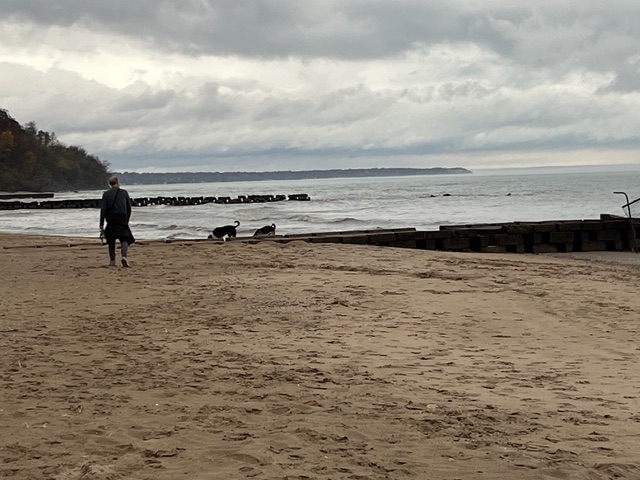
Courtesy Florsheim’s stepdaughter Jessica Lakind and her mother Marcy Lichterman
Wisconsin, like most states, recognizes the “Ordinary High Water Mark”—the line where exposed shoreline ends and open water begins—as the boundary of public ownership. But where many states allow the public to cross private beachfront in transit to reach those publicly held waters (also known as “riparian” access) Wisconsin grants landowners exclusive control over that strip of shoreline. You can boat, fish, or swim freely if you’re in the water, but you just can’t set foot on the sand to get there.
The charge rests on Doemel v. Jantz, a 1923 Wisconsin Supreme Court ruling that Florsheim has spent months researching. He said he contacted the archivist at the University of Wisconsin-Oshkosh, which sits on Lake Winnebago where the original dispute originated, finding that it involved a dairy farmer’s right to walk his cattle through the privately owned property to get to the publicly owned water. If his cattle remained in the public water, he was golden; if they crossed that barrier onto sand, not so.
The municipal judge who ruled against him in January wrote a 16-page opinion—extraordinary for a small municipal court—holding that she was bound by Doemel, but that it “probably should be revisited and perhaps overturned.” On June 22, Florsheim’s attorneys filed their response brief with the circuit court, arguing the land he walked is owned by the state of Wisconsin, not his neighbor. “It is decidedly not his land; it is the public’s land,” the brief states. The access to that land, Florsheim argues, doesn’t require a public vote to be protected. “The access to the beach is part of the public trust doctrine, which is baked into the state’s constitution,” he said. “So even though there hasn’t been a vote, there really doesn’t need to be, because it is established.” A hearing is set for August 13.
He is also clear about where his fight sits in the broader picture. His “bitter feud,” he says, is not with the dentist. “My bitter feud is much more with the village, because they should be protecting the rights of the general citizenry rather than the property owners on the beach.”
The ‘poor man’s beach’ in Texas ceded to SpaceX
A similar phenomenon playing out some 1,400 miles south. On June 19, the Texas Supreme Court unanimously ruled that SaveRGV, the Sierra Club, and the Carrizo/Comecrudo Nation of Texas had no legal standing to challenge SpaceX’s closure of Boca Chica Beach during rocket launches. The state’s attorney general had intervened to defend SpaceX throughout, never reaching the constitutional question of whether a 2009 amendment, backed by 77% of Texas voters protecting public beach access, outweighed a 2013 law written specifically for SpaceX. The court dismissed on standing. “The affected public has no remedy to enforce their constitutional right to access their own beach,” Marisa Perales, the attorney for the groups, told Fortune. That same week, Musk became the world’s first trillionaire following SpaceX’s record-breaking $75 billion IPO.
Boca Chica Beach is a free, undeveloped eight-mile stretch of Gulf shoreline near Brownsville—the southernmost city in Texas—where Highway 4 dead-ends at the water and SpaceX’s Starbase launch towers loom to the north. The stretch of Gulf shoreline, known locally as “poor man’s beach,” is the last wild, free, publicly accessible beach on the southernmost tip of Texas.
The Boca Chica takeover had been proceeding on the ground regardless of the litigation. SpaceX employees voted to incorporate the area as the city of Starbase in 2025; just as the county handed the new municipality authority to close the beach during launches. In Feb., Starbase officials voted to annex 7,133 additional acres near the beach, much of it within the Boca Chica Wildlife Refuge. The court ruling removed the last legal obstacle. “Starbase is clearly Elon Musk’s company town,” South Texas Environmental Justice Network co-founder Bekah Hinojosa told The Texas Tribune. Neither the Village of Shorewood, the Texas General Land Office, a lawyer representing the environmental groups, nor SpaceX responded to Fortune’s requests for comment.
Data centers in the Midwest and afar
Closer to Florsheim in the Midwest, over 220 data centers are planned across the Great Lakes region, drawn by the basin’s freshwater—21% of the world’s surface supply—for server cooling. Microsoft is investing $20 billion in data centers at Mount Pleasant, Wisconsin, a community that straddles the Great Lakes basin line and can divert lake water. Midwest Environmental Advocates—the same nonprofit representing Florsheim—sued after Racine, Wis. withheld public records on a data center’s water consumption for seven months. Fewer than one-third of data centers currently track water usage, and in Great Lakes states the reporting obligation falls on public water systems, not the corporate users drawing from them.
“A lot of these data centers want to be near the Great Lakes,” Florsheim said. “The question of what is in the public domain, and should we allow that to become privatized — that’s what’s ringing. It’s not just the beach. It’s the water. It’s who owns the resources that belong to all of us. And I think people are standing up.”
The problem goes beyond the Great Lakes region as well, and well beyond the country’s shorelines. In July 2025, President Donald Trump signed an executive order directing federal agencies to use “federally owned land and resources for the expeditious and orderly development of data centers,” fast-tracking construction on Department of Energy sites and opening military bases to proposals.
The order’s reach has extended to places once considered untouchable: in Northern Virginia, data center construction has pushed directly against Manassas National Battlefield Park, a Civil War site that saw 541,000 visitors in 2024, bounded on three sides by federal land, as part of a broader buildout that has made Virginia home to 663 operating data centers with another 595 planned, facilities that collectively handle roughly 70% of the world’s internet traffic. The pattern is consistent: public land, identified as available, converted to private use.
Florsheim still walks the beach and plans to keep walking it as he awaits the August 13 hearing.
“It’s become much bigger than my little spat on the beach,” he said. “I do feel confident that we will eventually prevail.”
-

 Oklahoma4 minutes ago
Oklahoma Ford Sports Blitz: June 28, 2026
-

 Oregon7 minutes ago
Missing, endangered 2-year-old last seen in Portland area
-

 Pennsylvania12 minutes ago
MSU basketball extends offer to Pennsylvania 4-star center prospect
-
Rhode Island19 minutes ago
RI Lottery Numbers Midday, Numbers Evening winning numbers for June 28, 2026
-

 South-Carolina22 minutes ago
South Carolina Lottery Pick 3, Pick 4 results for June 28, 2026
-
South Dakota27 minutes ago
SD Lottery Millionaire for Life winning numbers for June 28, 2026
-
Tennessee34 minutes ago
TN Lottery Cash 3 Evening, Cash 4 Evening winning numbers for June 28, 2026
-

 Texas37 minutes ago
After historic floods, Texas Hill Country Little League is back

