Wisconsin
Wisconsin’s Storybook City Under An Hour From Madison Has Fun Shops, Festivals, And A Historic Downtown – Islands


Between its more than 15,000 lakes and slew of charming small towns and cities, Wisconsin can make for a relaxing, crowd-free destination. One downside to having so many cozy spots to choose from, though, is that the decision-making process can get complicated. But if you already know you want someplace with a historic downtown, fun shops, festivals, and a storybook-like quality, Columbus might just be the city for you. Craw Fish River runs through part of the town, and the whole area is surrounded by farmland. These views, plus brick storefronts, a close-knit community, and a history that dates back to the 19th century, give Columbus a fairytale feel.
Don’t let the city’s small size fool you — it offers an impressive selection of attractions to keep visitors entertained, from fun, unique shops to seasonal festivals that bring the whole community together. Its downtown is a great area for architecture lovers to explore. It has even been included in the National Register of Historic Places since the 1990s. The neighborhood’s buildings are big attractions, especially when it comes to structures like City Hall and the Farmers and Merchants Union Bank.
What makes Columbus such a well-rounded destination is its collection of outdoor attractions and proximity to bigger hotspots. The city is remarkably well-connected, and coming here should be a breeze. It sits right alongside U.S. Highway 151, which makes it possible to reach Madison in 40 minutes. Because of its surrounding road network and lack of public transportation options, many visitors choose to drive here. Still, fliers can land at Dane County Regional Airport and rent a car from there.
Columbus is a storybook city with a historic downtown and festivals
The area surrounding Madison is full of fairytale-like charm. Shorewood Hills, for example, is a serene suburb with walkable streets and scenic paths, but Columbus still manages to stand out thanks to its historic downtown with interesting architecture and fun community events. Part of its warm feel also comes from its beautiful setting. Picture surrounding greenery and riverfront gems like Rotary Park, which even boasts ice skating opportunities.
Columbus’ history dates back to the 1830s, after which the area grew into an essential agricultural and trade hub, and these well-preserved buildings help take visitors back in time. Architecture enthusiasts will also enjoy exploring the four blocks that comprise Columbus’ historic downtown area. The turn-of-the-century structures you’ll find here are built with an impressive level of attention to detail and craftsmanship. The City Hall is a Richardsonian Romanesque-style building, while the Farmers and Merchants Union Bank, designed by Louis Sullivan, is known for its “jewel box” design, with lavish terra-cotta decorations. The city streets are so storybook-like that they were even used as a filming location for the 2009 movie “Public Enemies.”
Another fantastic way to revel in the local charm is to attend a local festival. The annual CPKC Holiday Train (which raises donations for food banks across North America) passes through Columbus, and the community celebrates by hosting art and music-related events. In the spring, the city hosts Redbud Days, which feature garage sales, vendor fairs, giveaways, and more.
Exploring Columbus’ shops and outdoor attractions

One perk of coming to Columbus that travelers might not expect due to its size is its impressive shopping scene. At the center is the Columbus Antique Mall, Wisconsin’s largest, measuring over 78,000 square feet and spread across three floors. Here, you’ll find hundreds of vendor booths selling a wide selection of items, from collectibles and toys to home decor and clothing. Open every day, the store has introduced a variety of payment options, but it still might be worth paying in cash since credit transactions incur a fee. Pro tip: Check out the sales policies for up to an extra 20% off certain items during special days.
Next, you can stop by Olive and Herb, which sells Italian extra virgin olive oil, balsamic vinegars, hot sauces, spices, and more. One Google reviewer says, “High-quality oils, and the amazing thing is that you can actually taste them.” For gifts, home decor, and seasonal items, head to The Painted Crate. It’s locally owned, and Facebook reviewers compliment the unique items and reasonable prices.
And while some might already know Madison as the “biking capital of the Midwest,” with miles of thrilling, scenic trails, Columbus’ outdoor attractions are a bit more underrated. Fireman’s Park, for example, is the city’s largest, featuring picnic shelters, a disc golf course, and an aquatic center. It’s also the site of the week-long Fourth of July celebrations, which include a carnival, vendors, a parade, and special entertainment. Kestrel Ridge Golf Course is another nice spot for active travelers. It’s scenic, has a good layout, and offers an excellent refund policy in case of bad weather. Those who want to keep exploring nature-focused attractions can drive 40 minutes to Lake Kegonsa State Park, a Wisconsin gem with lots of fishing, boating, and camping opportunities.

Wisconsin
The retired college professor fighting a $313 trespassing ticket in Wisconsin thinks he’s part of a national struggle | Fortune

“Lake Michigan has sort of got a personality,” Paul Florsheim said wryly, as if describing an old friend rather than the center of a legal battle that has consumed the last year of his life. “It changes its moods all the time. I go all throughout the year, even in the bitterest part of winter, because it’s just beautiful down there. You have these ice flows, and they’re sort of like volcanoes, and the waves come crashing through these structures. It’s like another world.”
Florsheim has been walking that world, a stretch of the Lake Michigan shoreline in Shorewood, Wis., a small village north of Milwaukee, for more than 50 years, since his childhood. He walked it with his parents. He walked it when he returned to his hometown in 2008 after 30 years away. He walked it with his dog in the early mornings, before anyone else was out, in every season.
Courtesy Florsheim’s stepdaughter Jessica Lakind and her mother Marcy Lichterman
And when the recently retired UW-Milwaukee professor walked the route last year, the Village of Shorewood issued him a $313 trespassing ticket for doing so. Now, he’s one face of a growing trend: America’s public waterfronts are increasingly … less so.
Florsheim’s legal fight is winding its way through the Milwaukee County Circuit Court, on his way, he hopes, to the Wisconsin Supreme Court. Florsheim thinks the stakes are considerably larger than one man’s morning walk. He sees the same dynamic at work in the Texas Supreme Court’s June 19 ruling that handed Elon Musk’s SpaceX effective control over Boca Chica Beach—known locally as “poor man’s beach”—and in the wave of data center projects now competing for access to Great Lakes freshwater.
“If we don’t stand up for what is ours, sort of collectively ours, we’re going to regret it down the road,” he told Fortune.” People don’t want to give up what belongs to them, just as members of the citizenry. And I do think that’s what’s resonating right now.”
Exclusivity in the public realm
Florsheim’s case began when his neighbor—a dentist who built a boathouse on the beach and monitored foot traffic from it—began calling cops on walkers. When Shorewood issued him the ticket, Florsheim’s first instinct was to fight it. When the village lawyer called before the Dec. 2024 trial and encouraged him to settle, warning of mounting court fees, Florsheim declined. When the trial began, it drew a packed courtroom, and the NPR member station story previewing it became the most-read piece in the station’s history, per Florsheim.
He’s well aware about what makes his case unusual. “A water policy professor at UW told me, ‘I’ve been waiting for a case like this my whole life.’ And I said, ‘What do you mean? This must happen all the time.’ She said, ‘No, it doesn’t. People probably get tickets with some regularity for walking on the private part of the beach, but nobody fights them.’” The retired professor, the grandson of the founder of Florsheim Shoes, paused: he had the resources to lead the charge. “The average person would not be doing what I’m doing. I’m retired, so I have the time. Would I be doing this if I was hiring a lawyer? The honest answer is probably no.”
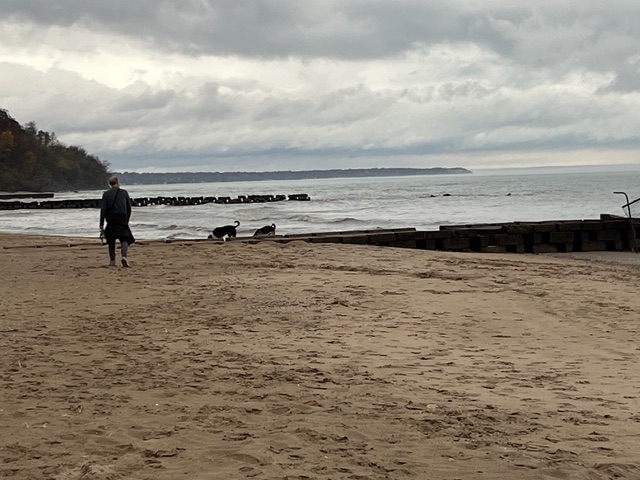
Courtesy Florsheim’s stepdaughter Jessica Lakind and her mother Marcy Lichterman
Wisconsin, like most states, recognizes the “Ordinary High Water Mark”—the line where exposed shoreline ends and open water begins—as the boundary of public ownership. But where many states allow the public to cross private beachfront in transit to reach those publicly held waters (also known as “riparian” access) Wisconsin grants landowners exclusive control over that strip of shoreline. You can boat, fish, or swim freely if you’re in the water, but you just can’t set foot on the sand to get there.
The charge rests on Doemel v. Jantz, a 1923 Wisconsin Supreme Court ruling that Florsheim has spent months researching. He said he contacted the archivist at the University of Wisconsin-Oshkosh, which sits on Lake Winnebago where the original dispute originated, finding that it involved a dairy farmer’s right to walk his cattle through the privately owned property to get to the publicly owned water. If his cattle remained in the public water, he was golden; if they crossed that barrier onto sand, not so.
The municipal judge who ruled against him in January wrote a 16-page opinion—extraordinary for a small municipal court—holding that she was bound by Doemel, but that it “probably should be revisited and perhaps overturned.” On June 22, Florsheim’s attorneys filed their response brief with the circuit court, arguing the land he walked is owned by the state of Wisconsin, not his neighbor. “It is decidedly not his land; it is the public’s land,” the brief states. The access to that land, Florsheim argues, doesn’t require a public vote to be protected. “The access to the beach is part of the public trust doctrine, which is baked into the state’s constitution,” he said. “So even though there hasn’t been a vote, there really doesn’t need to be, because it is established.” A hearing is set for August 13.
He is also clear about where his fight sits in the broader picture. His “bitter feud,” he says, is not with the dentist. “My bitter feud is much more with the village, because they should be protecting the rights of the general citizenry rather than the property owners on the beach.”
The ‘poor man’s beach’ in Texas ceded to SpaceX
A similar phenomenon playing out some 1,400 miles south. On June 19, the Texas Supreme Court unanimously ruled that SaveRGV, the Sierra Club, and the Carrizo/Comecrudo Nation of Texas had no legal standing to challenge SpaceX’s closure of Boca Chica Beach during rocket launches. The state’s attorney general had intervened to defend SpaceX throughout, never reaching the constitutional question of whether a 2009 amendment, backed by 77% of Texas voters protecting public beach access, outweighed a 2013 law written specifically for SpaceX. The court dismissed on standing. “The affected public has no remedy to enforce their constitutional right to access their own beach,” Marisa Perales, the attorney for the groups, told Fortune. That same week, Musk became the world’s first trillionaire following SpaceX’s record-breaking $75 billion IPO.
Boca Chica Beach is a free, undeveloped eight-mile stretch of Gulf shoreline near Brownsville—the southernmost city in Texas—where Highway 4 dead-ends at the water and SpaceX’s Starbase launch towers loom to the north. The stretch of Gulf shoreline, known locally as “poor man’s beach,” is the last wild, free, publicly accessible beach on the southernmost tip of Texas.
The Boca Chica takeover had been proceeding on the ground regardless of the litigation. SpaceX employees voted to incorporate the area as the city of Starbase in 2025; just as the county handed the new municipality authority to close the beach during launches. In Feb., Starbase officials voted to annex 7,133 additional acres near the beach, much of it within the Boca Chica Wildlife Refuge. The court ruling removed the last legal obstacle. “Starbase is clearly Elon Musk’s company town,” South Texas Environmental Justice Network co-founder Bekah Hinojosa told The Texas Tribune. Neither the Village of Shorewood, the Texas General Land Office, a lawyer representing the environmental groups, nor SpaceX responded to Fortune’s requests for comment.
Data centers in the Midwest and afar
Closer to Florsheim in the Midwest, over 220 data centers are planned across the Great Lakes region, drawn by the basin’s freshwater—21% of the world’s surface supply—for server cooling. Microsoft is investing $20 billion in data centers at Mount Pleasant, Wisconsin, a community that straddles the Great Lakes basin line and can divert lake water. Midwest Environmental Advocates—the same nonprofit representing Florsheim—sued after Racine, Wis. withheld public records on a data center’s water consumption for seven months. Fewer than one-third of data centers currently track water usage, and in Great Lakes states the reporting obligation falls on public water systems, not the corporate users drawing from them.
“A lot of these data centers want to be near the Great Lakes,” Florsheim said. “The question of what is in the public domain, and should we allow that to become privatized — that’s what’s ringing. It’s not just the beach. It’s the water. It’s who owns the resources that belong to all of us. And I think people are standing up.”
The problem goes beyond the Great Lakes region as well, and well beyond the country’s shorelines. In July 2025, President Donald Trump signed an executive order directing federal agencies to use “federally owned land and resources for the expeditious and orderly development of data centers,” fast-tracking construction on Department of Energy sites and opening military bases to proposals.
The order’s reach has extended to places once considered untouchable: in Northern Virginia, data center construction has pushed directly against Manassas National Battlefield Park, a Civil War site that saw 541,000 visitors in 2024, bounded on three sides by federal land, as part of a broader buildout that has made Virginia home to 663 operating data centers with another 595 planned, facilities that collectively handle roughly 70% of the world’s internet traffic. The pattern is consistent: public land, identified as available, converted to private use.
Florsheim still walks the beach and plans to keep walking it as he awaits the August 13 hearing.
“It’s become much bigger than my little spat on the beach,” he said. “I do feel confident that we will eventually prevail.”

Looking to explore Wisconsin this summer? The state is full of lakefront beaches, forests, rivers, bluffs, waterfalls and more.
These pockets of nature span several state counties and can make for great road trips. Here are eight hidden gems across Wisconsin for nature-lovers to enjoy while the weather is warm:
This state park is home to Wisconsin’s largest waterfall, Big Manitou Falls. It is accompanied by Little Manitou, a smaller cascade. Around every bend in the trail, there’s opportunity to get right next to a waterfall or rumbling rapid.
The park is on the Black River within Pattison State Park in Douglas County.
For a full Wisconsin waterfall experience, visit waterfalls at Copper Falls, 90 miles east, and Pattison State Park, 15 miles southwest.
On the northern tip of Wisconsin’s Bayfield peninsula 22 islands sit in Lake Superior. Most of the islands are part of Ashland County.
It’s known for its mainland sea caves, which you can visit with a kayak. Also accessible (exclusively) by kayak or boat, there are campsites on 18 of the 21 islands. Visitors can go on cruises for tours of lighthouses, sea caves and more.
Stretching across Vernon and Crawford counties, this region’s forested hills and winding rivers make it unique from other Wisconsin landscapes. Its 125-mile stretch starts near Wilton, winds through La Farge and Ontario and ends at Wauzeka.
It’s beautiful year-round, but canoeing or kayaking the Kickapoo River during the summer can make for great memories. Wildcat Mountain State Park and Kickapoo Valley Reserve trails are also great places to explore.
There are private cabins with large porches to enjoy the view of hills, but the area isn’t as touristy as some other Wisconsin summer spots.
This scenic byway spans 3,000 miles along the Mississippi river across several states. The Wisconsin stretch goes through small towns like Stockholm, Pepin and Alma, which have wineries and natural attractions to visit along a road trip. For a nature break, there’s hiking at Perrot State Park in Trempealeau County and Maiden Rock State Natural Area in Pepin County. To grab a bite or drink, get pizza on a farm at the Stone Barn and go wine tasting at Villa Bellezza and Danzinger.
Bluff-top camping along the Mississippi River
There are campsites in Wyalusing State Park near Bagley and Nelson Dewey State Park near Cassville that sit on bluffs above the Mississippi River. The campgrounds tend to fill quickly, so stay vigilant about any snatch-able sites, or keep it on your radar for a few months down the line.
Wyalusing sites are car-camping sites and have limited privacy, but they have great views, looking directly out on the Wisconsin and Mississippi rivers.
The four walk-in sites at Nelson Dewey State Park have a great view of the Mississippi with better privacy between sites. Below the bluff, trains whizz past.
Lakeside camping in the Northwoods
The Chequamegon-Nicolet National Forest and the Northern Highland-American Legion State Forest protect over 1.75 million forest acres and thousands of lakes. There are dozens of small campgrounds – many on lakes – at both parks. You could even backcountry camp off the North Country Trail on national forest land and off the Ice Age Trail.
Chequamegon-Nicolet National Forest encompasses 1.5 million acres and crosses 11 counties, including Ashland, Bayfield, Sawyer and Price counties. It’s just south of Lake Superior’s shores. Northern Highland-American Legion State Forest reaches Iron, Oneida and Vilas counties.
Some extra gems here are Laura Lake, Bagley Rapids and Crystal Lake.
On the way to Door County, the Ridges is a nature preserve in Baileys Harbor. It was Wisconsin’s first land trust, and today has lots of boardwalks, typical of this area of Lake Michigan.
The Kettle Moraine State Forest
Lakes, pines, prairies and glacial landforms can all be found in the Kettle Moraine. Dozens of forested campsites stretch through the woods, with plenty of privacy and space.
Its most famous trail is the Ice Age, which travels through 30 counties. More than 600 miles of it can be hiked, according to the Wisconsin Department of Natural Resources, but 30 miles are in the northern unit of the Kettle Moraine grounds. It’s meant to be hiked by foot but has branches for mountain biking and horseback riding.
The forest is divided into six units, which hit Fond Du Lac, Jefferson, Sheboygan, Walworth, Washington and Waukesha counties.
Contact Elena Metinidis at emetinidis@usatodayco.com.

Baboucarr Ann’s commitment to the Wisconsin Badgers has given the No. 2-ranked class in the entire nation, according to 247Sports.
Greg Gard got off to a hot start when he landed Jalen Brown, but now, Ann’s commitment has taken this team to the next level.
Both Ann and Brown are four-star recruits, and each are among the top players, if not the very best in their own state.
Ann, a Minnesota native, is officially listed as the No. 1 player in his state. As for Brown, he’s listed as the No. 5 player in Wisconsin.
To no surprise, both Ann and Brown are top-100-ranked players. Jack Thelen, another Minnesota native, is Gard’s third commitment, the No. 168 overall ranked player.
Together, Ann, Brown, and Thelen cover seemingly every area on the court. Brown is listed as a complete guard, while Ann is a small forward, and Thelen stands 7-foot-1 and could be this team’s next premier center.
For what it’s worth, Thelen is the No. 3-ranked player in Minnesota and is the No. 16 center in the class of 2027.
Contact/Follow @TheBadgersWire on X (formerly Twitter) and like our page on Facebook to follow ongoing coverage of Wisconsin Badgers news, notes, and opinion. You can also follow Jordon Lawrenz on X @jordonlaw_pxp.
-

 North Carolina4 minutes ago
Duke’s Grayson Allen returns to North Carolina after trade from Suns
-

 North Dakota11 minutes ago
EPA invests $1.6 million to improve drinking water in South Dakota, five other states
-

 Ohio14 minutes ago
4 incoming Ohio State hockey players were selected in the 2026 NHL Draft
-

 Oklahoma19 minutes ago
Where to find July 4th fireworks, festivals, and family fun in Oklahoma
-

 Oregon26 minutes ago
5-star OL Ismael Camara nears decision, Oregon staying in touch
-

 Pennsylvania29 minutes ago
10 Best Small Towns In Pennsylvania For A Crowd-Free Summer
-

 Rhode Island34 minutes ago
Video: Massive great white shark feeds on dead whale off the coast of Rhode Island
-

 South-Carolina41 minutes ago
South Carolina pitcher Will Craddock announces transfer to SEC program

