Midwest
WATCH: Hero Indiana officer saves missing autistic boy, 3, from drowning in pool

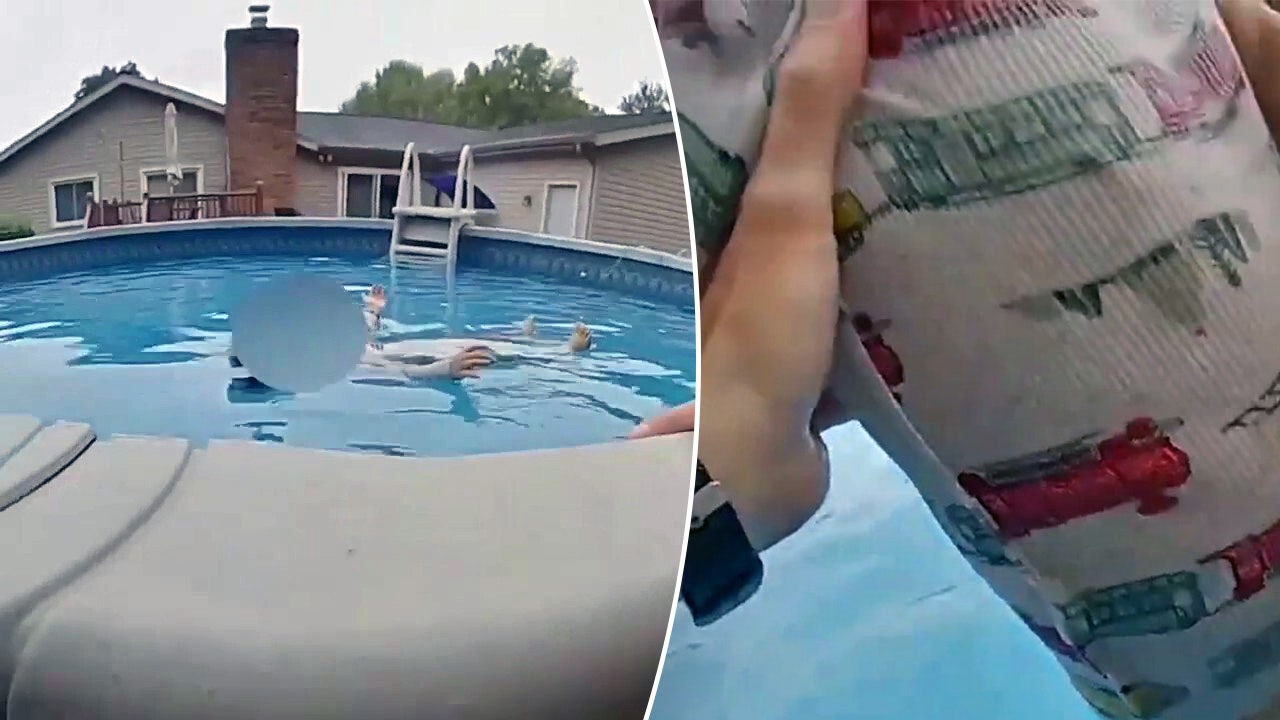
A police officer in Indiana is being hailed as a hero after rescuing a 3-year-old boy with autism from drowning in a neighbor’s pool.
Fort Wayne Police Officer Evan Myers was among those who responded to a family’s home on Sunday, Sept. 22, for reports of a missing 3-year-old child.
The parents of the boy, who is named Aziel, told WPTA that they were preparing brunch for family and friends when one of their friends forgot to lock the top latch of their door.
“My friend goes, ‘Where’s your son?’ So, I was like, he should’ve been on the couch watching his tablet,” the boy’s dad, Alex Calvillo, told the local outlet.
TEENS ARRESTED FOR STOMPING ON MAN’S HEAD IN BRUTAL BALTIMORE ATTACK
The parents of a 3-year-old boy with autism say they are grateful for the police officer that saved their son from drowning in a neighbor’s pool. (Fort Wayne Police Department /TMX )
The parents immediately called 911 and officers with the Fort Wayne Police Department promptly arrived at the home and began searching the area.
Body camera footage shows Myers running towards the neighbor’s above-ground pool.
Cries can be heard in the background, and as Myers gets closer, the child’s hands and feet are seen just above the water.
“I found him,” Myers is heard saying into his radio. “He’s in the pool.”
The 3-year-old was found in the swimming pool, police said. (Fort Wayne Police Department /TMX )
Myers quickly gets the toddler out of the pool to safety.
KENTUCKY SHERIFF SEEN IN FOOTAGE SHOOTING T JUDGE IN SHOCKING PRELIMINARY HEARING
“He’s breathing and is conscious,” Myers is heard saying. “Are you OK, buddy?”
Fort Wayne Police Officer Evan Myers was among those who responded to a family’s home last Sunday for reports of a missing 3-year-old child. (Fort Wayne Police Department /TMX )
Aziel’s parents told the local outlet they are extremely grateful to Myers.
“I want to personally thank him deeply for just being able to find my son,” Aziel’s mom, Savannah Ybarra, told the outlet.
“I definitely want to give him a huge thanks. I can’t describe how grateful I am,” Calvillo said. “Definitely means a lot to us and our family.”
Following the incident, Aziel’s parents said that they are installing a fence of their own.
Read the full article from Here


WICHITA, Kan. (KSNW) — The Kansas State Fair says Saturday, Sept. 19, will be a hard-hitting night of rock ‘n’ roll, with a three-band lineup for this year’s Rock Fest at the Fair.
From Ashes to New will share the Kansas Star Casino Grandstand with Saliva and Saving Abel. The concert kicks off at 6:30 p.m.
From Ashes to New
Blending hard rock, hip-hop, electronic and alternative rock, Ashes to New has built a loyal fan base with songs like “Barely Breathing,” “Die For You” and “Drag Me,” with the latter reaching No. 1 on Billboard’s Mainstream Rock Charts in May. “Die For You” was used to launch an anti-bullying campaign in 2018.
Saliva
Saliva saw its first taste of mainstream success with 2001’s “Every Six Seconds,” which featured its breakout hit “Click Click Boom” and “Your Disease,” which was nominated for a Grammy Award. The band has continued forward since the 2021 death of founding guitarist Wayne Swinny, with Bobby Amaru as frontman.
Saving Abel
Southern rockers Saving Abel launched in a Memphis suburb in 2004. The band’s multiplatinum hit “Addicted,” from its 2008 self-titled album, reached No. 2 on the Billboard Mainstream Rock chart and No. 20 on the Billboard Hot 100.
Reserved tickets go on sale starting Thursday starting at $45 for the grandstand and up to $415 for a VIP reserved table for six that includes two drink tickets, complimentary appetizers before the show and early entrance.
You can find full details at kansasstatefair.gov or call 620-669-3618.
For more Kansas news, click here. Keep up with the latest breaking news by downloading our mobile app and signing up for our news email alerts. Sign up for our Storm Track 3 Weather app by clicking here. To watch our shows live on our website, click here.
Michigan
Whitmer says she will pull Michigan National Guard from D.C. if troops used in Trump’s Safe and Beautiful Mission

Michigan Gov. Gretchen Whitmer says that the Michigan National Guard soldiers heading to Washington, D.C., will only support the America 250 Mission and threatens to pull them if they participate in patrols under President Trump’s Safe and Beautiful Mission.
In a letter to Maj. Gen. Paul Rogers on Monday, Whitmer urges Rogers to “take all necessary measures” to ensure that soldiers only provide public safety and security during events celebrating the 250th anniversary of the United States.
“If the National Guard is unable or unwilling to ensure the Michigan National Guard is only supporting the America 250 Mission, appropriately defined – and is unable or unwilling to communicate consistent with that fact – then I will end Michigan’s support for the America 250 mission,” Whitmer wrote to Rogers.
The Safe and Beautiful Mission was created under the Trump administration to deploy the National Guard to D.C. in August 2025 as part of a push to crack down on crime in the nation’s capital, despite data showing that crime had declined in recent years.
At the time, local police data showed that violent crime in the area had been declining after a spike in 2023. However, Mr. Trump criticized that data, calling them “phony numbers.”
The deployments drew criticism from officials who opposed the federal government sending the National Guard to multiple cities. In one case, Illinois and Chicago sued the Trump administration to block the deployment of troops. That suit has since been dismissed, with a judge declaring the administration’s orders to no longer be operational.
“Several governors have deployed their National Guard soldiers to support this [Safe and Beautiful] mission. As you know, I have not deployed – and will not deploy – the Michigan National Guard to support the D.C. Safe and Beautiful Mission,” Whitmer said.
CBS News Detroit reached out to the Joint Task Force for comment on Monday and has not heard back.


What to know about PCBs and their impact on the Great Lakes, Wisconsin
PCBs are a class of more than 200 chemicals that are known to cause cancer.
An invasive shrimp is swimming in Lake Superior. This is the last Great Lake to be invaded — all five Great Lakes now are infested by the crustaceans..
Researchers for the first time have confirmed a breeding population of an invasive Black Sea-native shrimp in Lake Superior.
The number and extent of the shrimp’s spread in Lake Superior is not clear. However, there is a breeding population in the Duluth.
The findings by researchers at the University of Minnesota-Duluth, Lake Superior Research Institute at the University of Wisconsin Superior, and the Hobart and William Smith Colleges in New York, published in the Journal of Great Lakes Research in April, found that the shrimp are now reproducing and surviving year-round in the Duluth-Superior Harbor, the farthest west the European species has been confirmed.
“Samples we collected in 2025 from two locations in the Duluth-Superior Harbor, a major inland shipping port in the Great Lakes, contained juveniles, adult males, and (pregnant or with young) adult females, indicating a self-sustaining population. Additionally, we document earlier evidence from 2018 samples we collected in the harbor that contained two juvenile specimens,” the article in the Journal said.
In an interview on the CBC’s “Superior Morning” show with Mary-Jane Cormier on June 10, lead researcher Donn Branstrator, of the University of Minnesota, said studies in the Duluth-Superior Harbor this spring after ice was off the lake found adult males and females.
“It’s pretty clear evidence of overwintering,” Branstrator told Cormier. “It would be very unlikely for the population to extinguish (at this point).”
Branstrator told Cormier ongoing bi-weekly research in the harbor, and along the Lake Superior shoreline will exam those questions.
According to the research, the non-native shrimp, about a quarter to half inch long, were first detected in the lower Great Lakes in 2006 in lakes Michigan and Ontario. By 2008, they were found in lakes Huron and Erie as well.
“It has also spread to Oneida and Seneca Lakes in New York … as well as the St. Lawrence River and various canals in northern New York State,” the research said.
Branstrator said the Black and Caspian sea region natives, also have spread throughout Europe into areas they were not native. He said they likely hitchhiked with ballast or bilge water, but the exact mechanism will never be known.
What we know about bloody red shrimp.
What is a bloody red shrimp?
Bloody red shrimp are small crustaceans native to the Black Sea and Caspian Sea region of Europe. They are adapted for fresh and brackish water.
This freshwater shrimp can be ivory-yellow in color or translucent, but exhibits pigmented red pigment cells in the carapax and tail, according to the USGS.
The quarter to half inch long shrimp feed on both phytoplankton and zooplankton at various stages of life.
While relatively small, they are among the larger creatures in the Great Lakes feeding on those food sources.
“They are very large bodied, at the upper end of what we consider zooplankton,” Branstrator said.
Branstrator said the shrimp live in near-shore environments and like to hide in crevices during the day, making use of dock pilings, breakwaters and other human-made structures.
They come out at night and “swarm” together in groups of up to 135 per square foot, the University of Wisconsin Sea Grant said.
Bloody red shrimp have a lifespan of about nine months, grow to adults in just 45 days, and an produce up to four generations per year. Females have been documented to carry up to 66 eggs in a clutch. Broods carried by females in the Muskegon population ranged from two to seven.
Where have the shrimp been found?
The shrimp have spread throughout Europe and now have been found in all five Great Lakes, as well as some locations away from the lakes.
The recent study found a breeding population in the Duluth, Minnesota, harbor, the first in Lake Superior.
According to the research, the non-native shrimp, about a quarter to half inch long, were first detected in the lower Great Lakes in 2006 in lakes Michigan (near Muskegon) and Ontario. By 2008, they were found in lakes Huron and Erie as well.
A single specimen was found in Duluth in 2017, and two were found in 2018. It wasn’t until 2025 that the researchers found a sustaining population when they captured 81 individuals.
How did the shrimp arrive in the Great Lakes?
The shrimp likely hitched a ride in the ballast water of ocean-going vessels, although Branstrator noted during an interview on CBC’s “Superior Morning” that we will never know for certain.
He added that the shrimp have multiple opportunities to hitch rides with vessels during the shipping season.
What impact will the shrimp have on Lake Superior and the Great Lakes?
Branstrator said that question hasn’t been answered. They feed on the same sources as other water-dwelling creatures, but they are large enough that small fish may find them to be a new food source.
Are any shrimp native to the Great Lakes?
The opossom shrimp is a Great Lakes native and looks similar to the bloody red shrimp.
-

 Kansas3 minutes ago
Kansas State Fair announces Rock Fest with three-band lineup
-

 Kentucky3 minutes ago
Looking for the best hot dog in Louisville? Try these 15 spots
-

 Louisiana15 minutes ago
Police chief admits guilt in Louisiana visa scam; all 5 defendants have now pled guilty
-

 Maine18 minutes ago
How SCOTUS striking limits on party spending could impact Maine’s Senate race
-

 Maryland23 minutes ago
Wes Moore’s military record: what’s known, what isn’t
-

 Michigan30 minutes ago
Whitmer says she will pull Michigan National Guard from D.C. if troops used in Trump’s Safe and Beautiful Mission
-

 Massachusetts33 minutes ago
Massachusetts dad on ‘adventure of a lifetime’ left fighting for his life in Fiji after noticing bug bite
-

 Minnesota38 minutes ago
Invasive ‘bloody red shrimp’ reach Lake Superior

