Midwest
The real reason Chicago Mayor Brandon Johnson is working so hard to resist Trump

NEWYou can now listen to Fox News articles!
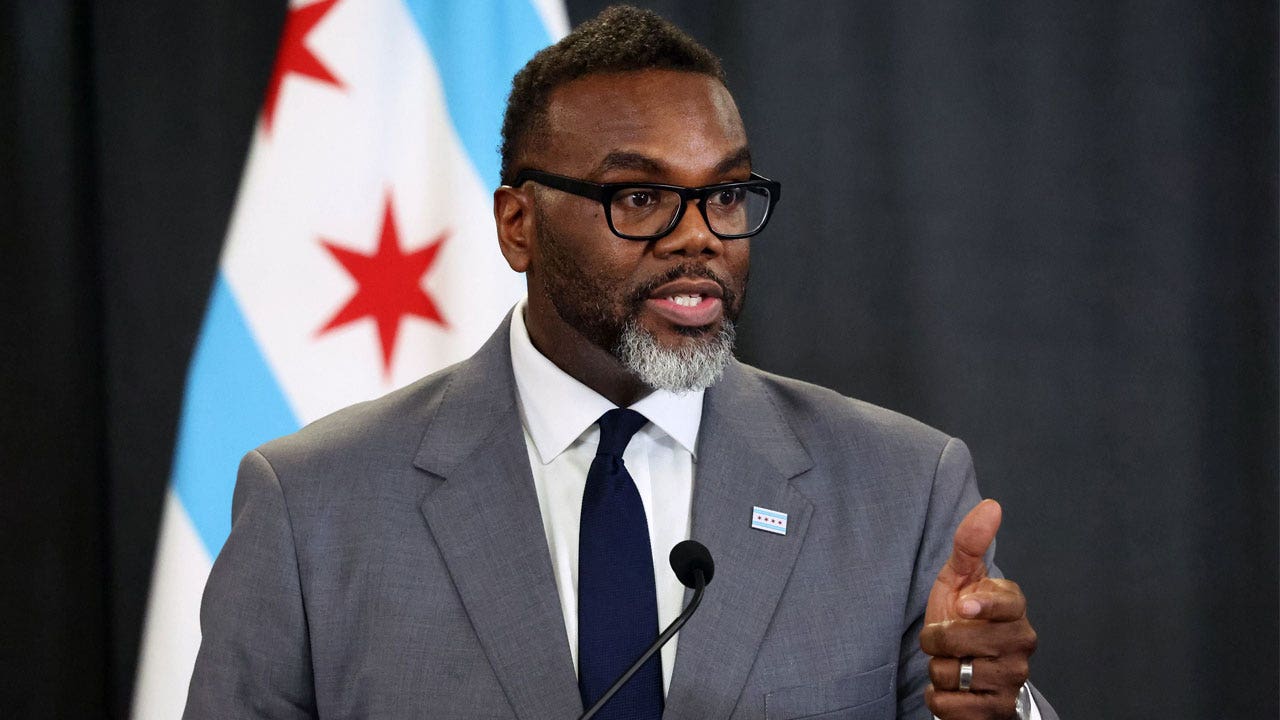
The reelection of Donald Trump as president of the United States promises great changes in the coming new year. However, there are politicians who have chosen to resist Trump and his administration. They often claim to do so because they believe they are more moral, virtuous, and human than the incoming president. Chicago mayor Brandon Johnson is one of them.
On the morning after the election, after he had campaigned for Vice President Kamala Harris in North Carolina, Johnson released an official statement from his mayoral office saying that “our president-elect has made direct threats against the most vulnerable and marginalized in our society.”
He added: “Chicagoans can be assured that they have a mayor who will not bend, who will not break when it comes to protecting our city, our values, and our neighbors. When it comes to fighting back against any hate, we will not flinch.”
There you have it: Brandon Johnson, the mighty moral man who would save us all.
CHICAGO MAYOR BOOTS PUBLIC FROM ROWDY CITY MEETING AS RESIDENTS OBJECT TO MIGRANT ‘INVASION’
Only if an ounce of that were true.
The reality is that Johnson has been a force against too many of us Chicagoans. It is because of men like him that I went to the American public for help in raising the funds to build my Economic and Leadership Opportunity Center on the South Side of Chicago. I have not received so much as a good word from him.
This is not surprising, since this man has not done much for public school education. The elementary school down the block from me has barely any kids reading or doing math on grade level. Why doesn’t Johnson, a former teacher, care about these kids? Where is the morality in sentencing kids to schools-in-name only?
It turns out that he was too busy launching a campaign to shut down some of Chicago’s best performing high schools: the CPS Selective Enrollment Schools. Many Black kids, including those from my neighborhood, fled to those schools to escape the failing ones. Now, Johnson wanted to shut down these schools because it wouldn’t be fair to the Black kids stuck in poor performing schools. You can’t make this up.
It was only after public outcry and pushback from a few government officials that Johnson backed off this issue — for now.
CHICAGO COMMUNITY ACTIVIST SOUNDS OFF ON MIGRANT CRISIS: ‘I WELCOME’ TRUMP BORDER CZAR
I couldn’t help the irony when Johnson posited him as a defender of the migrants that have moved into the city en masse. He said, “We’re going to defend the people of this city because…President Trump, his threat is not just toward new arrivals, and undocumented families” Mayor Johnson said. “His threats are also against Black families.”
How is he defending Black families when he threatens to shut down schools? And how is he defending Black families when he allows migrants into his city without any vetting and then allocates millions upon millions of dollars to them?
In a recent city meeting, a woman wearing a “Chicago flips red” shirt told Johnson that he was going to be “held accountable” for appointing a deputy mayor for “immigrant, migrant, and refugee rights” and spending freely on these people when the city is so far in debt that it’s not funny.
CLICK HERE FOR MORE FOX NEWS OPINION
Another speaker said in the same meeting, “We gonna talk about this budget, about the strange things that’s happening, because again, your name was on this executive order of May 2023, this executive order for immigration, migrants and refugee rights. You caused all this money to go to illegal immigrants.”
Yet another one said, “No one appointed a monarch to rule over the people of Chicago.”
Mayor Johnson’s response? “Sergeant at arms, please remove these individuals from the chambers.”
Johnson has appointed so many people to his administration that the public no longer has an accurate idea of who is responsible for what. All we know is that far too many of them are making six figures and apparently enough of them are people of color, allowing Johnson to brag that he has the most diverse administration of all time.
He may have that, but is he a moral man who truly cares about his people? Or is he an ideologue who uses resistance to Trump as a shield against his failures as a mayor? I strongly believe it is the latter. Johnson is not a friend to the city of Chicago. He is not a friend to the people. He’s a friend to the old rot of Chicago, institutional corruption.
That is why we must take his resistance against Trump for what it is: self-serving moralistic grandstanding. He is the government for the few who governs against our interests for a better Chicago.
That is why for this coming New Year I have made it my resolution to continue the fight for a better Chicago from my tiny corner in the city. Trump may be the president, but he is nothing without us, The People. That is why we must resist the Brandon Johnsons of our cities.
CLICK HERE TO READ MORE FROM PASTOR COREY BROOKS
Read the full article from Here


OSWEGO, Ill. (WLS) — A Chicago-area man claimed a $1.3 million jackpot prize during an ordinary stop at a local gas station.
ABC7 Chicago is now streaming 24/7. Click here to watch
The newly-minted millionaire said he bought the ticket while stopping to buy a drink.
“‘Why not?’” the winner said. “I played a Quick Pick, and it turned out to be a lucky day.”
His ticket matched all five numbers in the Thursday, June 11 evening Lucky Day Lotto drawing. The winning numbers were 1-13-19-27-35.
The ticket was purchased at Oswego BP, located at 2791 US Highway 34.
Overjoyed, he wasted no time sharing the big news with his wife.
“She was thrilled,” he said. “It’s funny-I actually won a $45,000 prize playing this same game 15 years ago when it was called Little Lotto.”
The winner plans to use the prize money to buy a new house and secure his and his wife’s retirement.
For selling the, the Oswego BP will receive a bonus of $13,000.
Copyright © 2026 WLS-TV. All Rights Reserved.
Indiana
‘Foul play’ suspected in death investigation on Indiana-Ohio state line, Wayne County officials say

WAYNE COUNTY, Ind. (WISH) — Police are investigating the death of a person who died in the emergency department of Reid Health in Richmond.
Wayne County Coroner Brent Meadows was notified of the death Wednesday evening, according to a media release. Evidence has reportedly indicated that foul play is involved.
Officials believe the incident may have occurred in the area of the Petro Travel Center in New Paris, Ohio, just across the Indiana-Ohio state line.
The coroner’s office said the deceased person has been transported to the Miami Valley Regional Crime Laboratory in Dayton, Ohio, for a forensic autopsy and identification.
The office is still working the locate and identify the victim’s family.
This remains an active investigation.
News 8’s Michaela Springer contributed to this report.


Thrive Iowa launches in Warren County and across the state
The new program aims to reduce barriers to families seeking help from local organizations.
Thrive Iowa, a new initiative from the Iowa Department of Health and Human Services, has officially launched in a number of counties across the state with the goal of helping struggling Iowa families connect with local resources and build a network of support in their community.
On June 23, Warren County celebrated its own program site launch as one of eight initial sites. Other counties that are celebrating their own site launches are Cass, Lee, Black Hawk, Webster, Buena Vista, Fayette and Clayton. A site is officially launched once it has enrolled a minimum of 20 participants, Iowa HHS Director of Communications Danielle Sample said in a statement.
The eight sites serve 11 counties in total, with services also available in Henry, Madison, and Van Buren counties, according to the Thrive Iowa website.
What is Thrive Iowa?
The initiative is focused on serving families, such as parents, caretakers, and pregnant individuals, according to the program’s website. To be eligible to receive help from the program, families must be living in Iowa, be a U.S. citizen or legal resident, and have an income at or below 200% of the federal poverty level.
The 2026 federal guidelines consider a family of four to be at the 200% threshold if they make $66,000 or less annually.
The program also outlines 13 core areas of well-being where it offers support. These include housing, recovery, employment, transportation, education, mental health, physical health, safety, dental, financial stability, food, child care and legal assistance.
The overall goal of the program is to reduce barriers to accessing support for families by doing the work of finding the right organization to meet their needs for them. Instead of having to reach out to multiple sources, a family can visit the program’s HopeHub, a case management system, to create a free account and receive a referral. Once referred, the individual is connected with a Thrive Navigator who will create a personalized plan and build local connections to assist the family.
Thrive Iowa is modeled after Restore Hope, an Arkansas-based nonprofit that began in 2015 to reduce the number of individuals in incarceration and the foster care system through community-based approaches. In addition to Iowa, this model is also used in Tennessee and Canada, according to the organization’s website.
The Iowa program plans to expand to other counties in the near future, Sample said. In July, Iowa HHS will begin onboarding more participating organizations and counties, expanding the program to serve 22 counties.
Warren County launch pledges to take families from crisis to careers
At the Warren County launch, the county’s initiative coordinator, Sarah Downard, was joined by Iowa State Rep. Brooke Boden, Ben Segebart, senior pastor at Indianola Freedom Fellowship Church, Sue Wilson, executive director of WeLIFT Job Search Center in Indianola, and Paul Chapman, executive director of Restore Hope.
Downard said the Warren County site is currently serving over 20 families.
To a room of around 75 community members and local organizations at The Hive event venue in Indianola, the five speakers emphasized the importance of the mission behind Thrive Iowa, which is collective impact and helping build strong communities through supporting the families that live there.
The group also invited the whole room to sign the site’s declaration of participation in the program, which stated the goals of the program and a pledge to work together to help take families from crisis to career.
“When families are struggling, we feel the impact everywhere,” Boden said. “We see this in our schools, our health care systems, our workplace, and our communities.”
Isabelle Foland is a communities reporter for the Register. Reach her at ifoland@registermedia.com.
-

 Arkansas1 minute ago
Get to know: Arkansas DB commitment John Catlin | Whole Hog Sports
-

 California8 minutes ago
Bug infestation found at California Department of Education headquarters, employees sent home
-

 Colorado11 minutes ago
Colorado Springs officials provide details of recent closure, repair work on Uintah Street
-

 Connecticut16 minutes ago
Connecticut man charged with murdering Duxbury woman is an
-

 Delaware23 minutes ago
Officer shoots, kills 19-year-old in Wilmington, Delaware, during foot chase, police say
-

 Florida26 minutes ago
Gators among top-20 rated teams in EA Sports College Football 27
-

 Idaho36 minutes ago
Dorothy Moon reelected to third term as Idaho GOP chair
-

 Georgia38 minutes ago
The Farmer’s Dog Partners with the University of Georgia College of Veterinary Medicine to Advance Veterinary Nutrition Training

