Midwest
Social media support for accused killers Luigi Mangione, Elias Rodriguez an 'exceptionally bad sign': expert

NEWYou can now listen to Fox News articles!
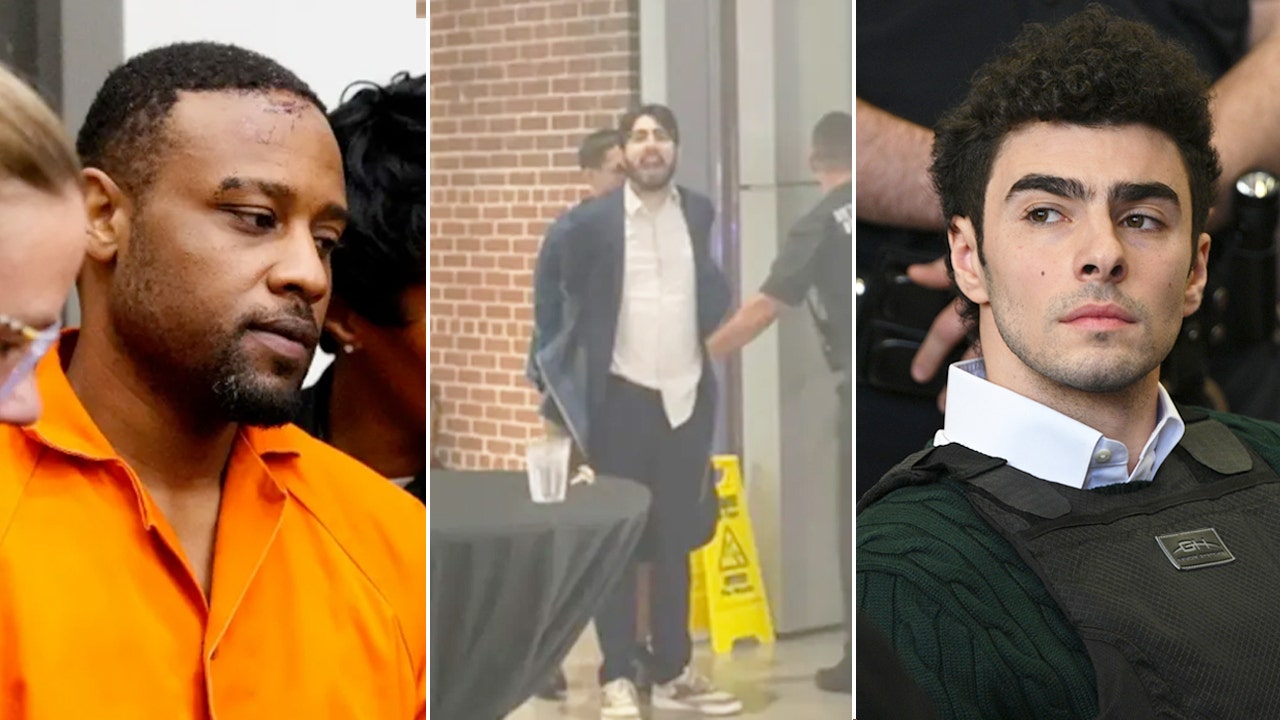
Social media users have been drawing comparisons between online support for accused killers Elias Rodriguez, Rodney Hinton Jr. and Luigi Mangione.
“That people who commit murder are receiving any meaningful amount of public support, seemingly because the victims are seen by the murder’s supporters as belonging to the political opposition, is an exceptionally bad sign for our society,” Nicholas Creel, Georgia College and State University ethics professor, told Fox News Digital. “Democracy requires people to be committed to certain values, such as the peaceable resolution of our differences. Without that, we’re at risk for a far wider breakdown in the rule of law, the kind where mass atrocities can easily arise.”
Rodriguez, 31, of Chicago, is accused of killing Yaron Lischinsky and Sarah Milgrim, a young engaged couple who worked at the Israeli Embassy in Washington, D.C., on Wednesday evening outside the Capital Jewish Museum.
Mangione, 26, is charged with first-degree murder in furtherance of an act of terrorism, stalking and a slew of other state and federal charges in both New York and Pennsylvania for allegedly gunning down UnitedHealthcare CEO Brian Thompson, a 50-year-old married father of two, on a sidewalk in Manhattan on Dec. 4, 2024.
FATHER OF SUSPECT ACCUSED OF KILLING ISRAELI EMBASSY STAFFERS IN DC WAS GUEST AT TRUMP’S JOINT ADDRESS
Social media users have expressed online support for murder suspects, from left, Rodney Hinton Jr., Elias Rodriguez and Luigi Mangione. (Curtis Means/Pool/AP Liz Dufour/The Enquirer/USA Today Network/Imagn)
Hinton, 38, is charged with aggravated murder after he allegedly “intentionally” struck retired Hamilton County Deputy Larry Henderson, who was directing traffic near the University of Cincinnati during a graduation ceremony, with a vehicle around 1 p.m. on May 2. He allegedly killed the officer a day after Cincinnati police fatally shot his son during a foot pursuit, according to police.
Experts who spoke with Fox News Digital also noted social media support for 20-year-old Thomas Crooks, who shot at then-presidential candidate Donald Trump during his 2024 campaign rally in Butler, Pennsylvania, before being fatally shot by responding officers.
SUSPECT ACCUSED OF KILLING ISRAELI EMBASSY STAFFERS IN DC COULD FACE MORE CHARGES
“Now that we’re seeing these other murders get the same kind of attention [as Brian Thompson’s], it does seem to be a pattern that is fairly new in terms of the reaction to this,” Creel told Fox News Digital regarding support for Mangione and Rodriguez specifically. “So when you get this larger and larger portion of the population that’s willing to … sanction that sort of behavior, you become very much ripe for a sort of authoritarian takeover, the kind that can start to lead to mass atrocities.”
He added that the most recent killings of Yaron Lischinsky and Sarah Milgrim represent a “very destructive sort of behavior to society.”
ISRAELI AMBASSADOR CONNECTS EMBASSY STAFFERS’ SLAYING TO ‘VERY IMPORTANT’ BIGGER PICTURE
Luigi Mangione was charged with first-degree murder in connection with the Dec. 4, 2024, killing of UnitedHealthcare CEO Brian Thompson in New York City. (David Dee Delagado for Fox News Digital | Businesswire)
“When we look at how does a country become a democracy and remain one – because that’s never a guarantee – what we tend to see is there’s certain values society has to hold, and one of those is the idea of not resorting to violence,” Creel said.
He and his colleague, Ania Rynarzewska, an assistant professor of marketing, have conducted research showing that people feel more empowered when their radical beliefs and ideas get support online.
POLICE RAID DC SHOOTING SUSPECT ELIAS RODRIGUEZ’S CHICAGO APARTMENT
A man with an Israeli flag with a cross in the center kneels next to emergency personnel working at the site where two Israeli Embassy staff members were shot dead near the Capital Jewish Museum in Washington, D.C., on May 21, 2025. (Reuters/Jonathan Ernst/TPX Images of the Day)
“Our research has found so far that before [Thompson’s murder], people felt powerless. So they felt like their voice didn’t matter,” Rynarzewska said. “And after the incident and after people started voicing their opinion on social media … they felt more empowered to speak. They felt like their voices were in the majority, so they no longer have to suppress it.”
In all three cases, authorities allege that the suspects had political or personal motives behind their respective alleged actions, and all three men are receiving support, both monetary and nonfinancial, from radical social media users.
Luigi Mangione is escorted by police in New York City on Dec. 19, 2024. (Rashid Umar Abbasi for Fox News Digital)
A preliminary investigation in the Rodriguez case shows the suspect was allegedly observed pacing back and forth outside the museum before he approached a group of four people leaving the building, including the two victims, and began shooting, D.C. authorities said.
He then entered the museum, where he was detained by event security. While in custody, he yelled, “Free, free Palestine!”
Yaron Lischinsky and Sarah Lynn Milgrim (Embassy of Israel to the USA via X/Handout via Reuters)
Mangione similarly shouted a message after his arrest in Altoona, Pennsylvania.
“It’s completely out of touch and an insult to the intelligence of the American people and its lived experience,” Mangione shouted outside a courthouse in Hollidaysburg days after his arrest.
WHO IS THE SUSPECT IN THE KILLING OF 2 ISRAELI EMBASSY STAFFERS?
Paul Mauro, former NYPD inspector and Fox News contributor, told Fox News Digital that Mangione, Rodriguez, Hinton and Crooks represent “a very specialized class of violent losers.”
Rodney Hinton Jr. has been charged with aggravated murder in the death of retired Hamilton County Deputy Larry Henderson. (Phil Didion/The Enquirer/Imagn)
“At some point, everybody’s been down in their luck,” Mauro said. “But … when you are in and around 30 years old, and you are still clinging to these adolescent beliefs about the world and how you are on the side of the righteous because you are a member of a particular internet forum, and you’re willing to … extinguish the lives of others … you’re going to take away loved ones from families. Well, I’m sorry, but you guys are in a class by yourselves.”
He added that law enforcement professionals have seen such activity by young radicals “developing” since about 2020.
Mauro also said officials should be following the money that U.S. colleges and universities are receiving from nongovernment organizations and whether any of that funding comes from U.S. adversaries, such as Iran.
Thomas Matthew Crooks was killed during the July 13, 2024, assassination attempt on then-former President Donald Trump. (Bethel Park School District)
The former NYPD inspector noted that Rodriguez, Mangione, Crooks and, to an extent, Hinton are all relatively young men who had “their whole lives ahead of them” before allegedly hunting down people they believed to be their political or personal “opponents.”
“They weaponize these college kids who are susceptible and naive and who have never really been scuffed up by the real world,” Mauro said. “And in many cases, they don’t want to be. They don’t really want to go out and get jobs and do all the stuff that we did. … And they stay in this hyperprogressive bubble thinking that they’re on the side of the righteous. And then what happens is they manage to survive.”
Creel and Rynarzewska similarly noted that young people who are lonely or isolated tend to find a sense of community in people who share radical views online.
“From a bigger societal perspective, that’s where we really see the destructive influence on … youth,” Creel said. “When you’re young, you’re developing your sense of the world. You’re coming to figure out, when you come of age, what’s acceptable, what’s not. That’s when norms are being developed, your values take hold. And so, because of that, when you see these far more fringe-type positions of people supporting violence – murder, even – that becomes one of those things that then you think is normalized.”
Mangione and Hinton have pleaded not guilty to their respective crimes. Fox News Digital has reached out to their attorneys for comment.
Read the full article from Here



Powerball, Mega Millions jackpots: What to know in case you win
Here’s what to know in case you win the Powerball or Mega Millions jackpot.
Just the FAQs, USA TODAY
The Illinois Lottery offers multiple draw games for those aiming to win big.
Here’s a look at June 8, 2026, results for each game:
Winning Powerball numbers from June 8 drawing
03-24-34-43-49, Powerball: 20, Power Play: 3
Check Powerball payouts and previous drawings here.
Winning Pick-3 numbers from June 8 drawing
Midday: 1-8-7, Fireball: 6
Evening: 4-3-9, Fireball: 5
Check Pick-3 payouts and previous drawings here.
Winning Pick-4 numbers from June 8 drawing
Midday: 7-2-6-3, Fireball: 1
Evening: 2-6-3-1, Fireball: 7
Check Pick-4 payouts and previous drawings here.
Winning LuckyDay Lotto numbers from June 8 drawing
Midday: 04-12-13-27-32
Evening: 01-11-18-27-30
Check LuckyDay Lotto payouts and previous drawings here.
Winning Lotto numbers from June 8 drawing
14-16-20-23-46-49, Extra Shot: 06
Check Lotto payouts and previous drawings here.
Feeling lucky? Explore the latest lottery news & results
Are you a winner? Here’s how to claim your prize
- Prizes up to $600: Claim at an Illinois Lottery retailer, a Claim Center, by mail, or via an e-Claim. By mail, send the required documentation to: Illinois Lottery Claims Department, P.O. Box 19080, Springfield, IL.
- Prizes from $601 to $10,000: Claim at a Claim Center, by mail, or via an e-Claim.
- Prizes over $10,000: Claim at a Claim Center or by mail.
- Appointments Required: Schedule an appointment for in-person claims.
- Documentation: Bring a photo ID and Social Security number proof.
When are the Illinois Lottery drawings held?
- Powerball: 9:59 p.m. CT on Monday, Wednesday, and Saturday.
- Mega Millions: 10:00 p.m. CT on Tuesday and Friday.
- Lucky Day Lotto (Day): 12:40 p.m. CT daily.
- Lucky Day Lotto (Evening): 9:22 p.m. CT daily.
- Lotto: 9:22 p.m. CT on Monday, Thursday, and Saturday.
- Pick 3 (Day): 12:40 p.m. CT daily.
- Pick 3 (Evening): 9:22 p.m. CT daily.
- Pick 4 (Day): 12:40 p.m. CT daily.
- Pick 4 (Evening): 9:22 p.m. CT daily.
This results page was generated automatically using information from TinBu and a template written and reviewed by an Illinois editor. You can send feedback using this form.

DEARBORN COUNTY, Ind. (WKRC) – Two medical helicopters responded following a crash on Monday.
It happened at around 11:30 p.m. on Indiana SR-350, just west of Aurora.
Authorities said two medical helicopters responded to the scene after a two-vehicle crash. The current conditions of those involved remain unclear.
BE THE FIRST TO COMMENT
The roadway was closed for a period of time but has since reopened.

CEDAR RAPIDS, Iowa (KCRG) — Forbes handed out grades to private colleges across the country, but some are saying the report card got it wrong.
“The C grade, quite frankly, is not reflective of our current strength,” said Todd Olson, Mount Mercy University president. “I approach the Forbes rating with interest, with respect, but not with a sense that it is the final correct answer on every school. I think that it’s one way of looking.”
Olson leads an institution in transition. Mount Mercy is merging with St. Ambrose University, a move Olson said has been in the works for three years.
Before the merger, Mount Mercy had a $43 million endowment, had operated at a deficit for two of the last 10 years and had cut staff and programming.
Merger aims to strengthen financial position
“We were setting up a responsible, but frankly, fairly challenging road ahead that was constrained in a variety of ways,” Olson said. “We had made moves to make sure we were on a track that was sustainable, but frankly, this track we’re on now with St. Ambrose enables us to be much more innovative and forward-looking.”
Olson said the financial aspect of the merger with St. Ambrose is complete and is expected to become final with U.S. Department of Education approval this fall.
With a combined endowment exceeding $300 million, Olson said the merger makes Mount Mercy stronger than Forbes’ C grade indicates.
“This is a very viable and, in fact, very promising option for many private universities to consider, and the fact is the economics of operating a private university are much easier as you build scale,” Olson said.
Olson said two factors facing all private institutions are lower birth rates and more people questioning the value of a college degree.
Top-rated school emphasizes affordability
Reflecting on its A+ grade, University of Dubuque President Travis Frampton credited alumni generosity, leadership’s vision and the university’s $430 million endowment.
Frampton also looked ahead to the future, saying private institutions need to continually prove their value to the community.
“For so long across the country, the public has been concerned about that with the high cost of higher education. I think presidents and administrations need to be mindful and listen to that public cry, and find ways of making costs more affordable,” Frampton said.
Frampton said the University of Dubuque could have put its proposed College of Osteopathic Medicine at its main campus, but instead, put the school on Main Street.
“By locating the medical school in downtown Dubuque, to me, that demonstrated how it would benefit the business community, generate growth, work on brain drain in Iowa,” Frampton said. “That helps diversify and get out of just sort of this tuition dependency and more in building a community through university.”
Frampton said Forbes awarding the University of Dubuque top marks for its financial situation affirmed his belief that diversifying an institution’s assets makes it stronger, citing the proposed medical school and expansions to its aviation program, moves that took the university years to develop.
“Your financial picture is not done in one snapshot,” Frampton said. “Previous administration, the board leadership, alumni giving to the university have all contributed significantly to our current position.”
Both presidents said a university is worth more than a single grade. It’s about trust built over years, proving why its tuition is worth it.
Coe College received a D grade from Forbes. The magazine did not give F grades and said 27% of private colleges in the U.S. also received a D.
You can find your private institution’s grade on the business magazine’s website.
Coe College told TV9 in a statement:
“We are aware of the Forbes article and recognize the challenges and headwinds that colleges and universities are facing nationwide and Coe is not immune to those challenges. The scope of the methodology behind the Forbes grading scale is narrow. Having the willingness and capability to realign approach is essential for colleges and universities as the rate of change across industries accelerates. At Coe, we have successfully embraced that evolution by putting workforce-aligned strategic initiatives into action.
As just one example, Coe is experiencing great momentum and student interest through the addition of an aviation studies and flight operations program which provides the training necessary to become a commercial pilot or pursue a professional aviation career. This program, among others, has brought interest in the college from new students and constituents.
We’re seeing similar momentum with the addition of an engineering physics program as well as other areas of study. We are at the beginning phase of offering our first online degree program with more to come in the future. Our athletic programs have expanded to include women’s wrestling which will compete for the first time during the 2026-2027 academic year.
In addition, the college has benefited from a number of large gifts from a nationwide donor base to support current operations and growth of our new programs.
The college is continually evaluating and evolving as we see the opportunity to do so to match our educational experience to industry demands. With these additions and assessments, the college is positioned for stability in the present and growth in the future.”
Watch TV9’s interview with University of Dubuque President Travis Frampton:
Watch TV9’s interview with Mount Mercy University President Todd Olson:
Copyright 2026 KCRG. All rights reserved.
-

 Colorado1 minute ago
Visitations allowed again at Colorado state prisons after suspension following inmate deaths
-

 Connecticut8 minutes ago
Opinion: Measles is lethal. CT hasn’t forgotten
-

 Delaware11 minutes ago
Delaware Lottery Powerball, Play 3 Day winning numbers for June 8, 2026
-

 Florida16 minutes ago
Central Florida feels record-breaking quake
-
Georgia23 minutes ago
Georgia Lottery Powerball, Cash 3 results for June 8, 2026
-

 Hawaii26 minutes ago
Hawaii County Surf Forecast for June 09, 2026 | Big Island Now
-

 Idaho31 minutes ago
OPINION: History behind ’76 Idaho dam disaster can still giv…
-

 Illinois38 minutes ago
Illinois Lottery Powerball, Pick 3 results for June 8, 2026

