Midwest
On this day in history, May 29, 1851, Sojourner Truth delivers famed 'Ain’t I a Woman' speech

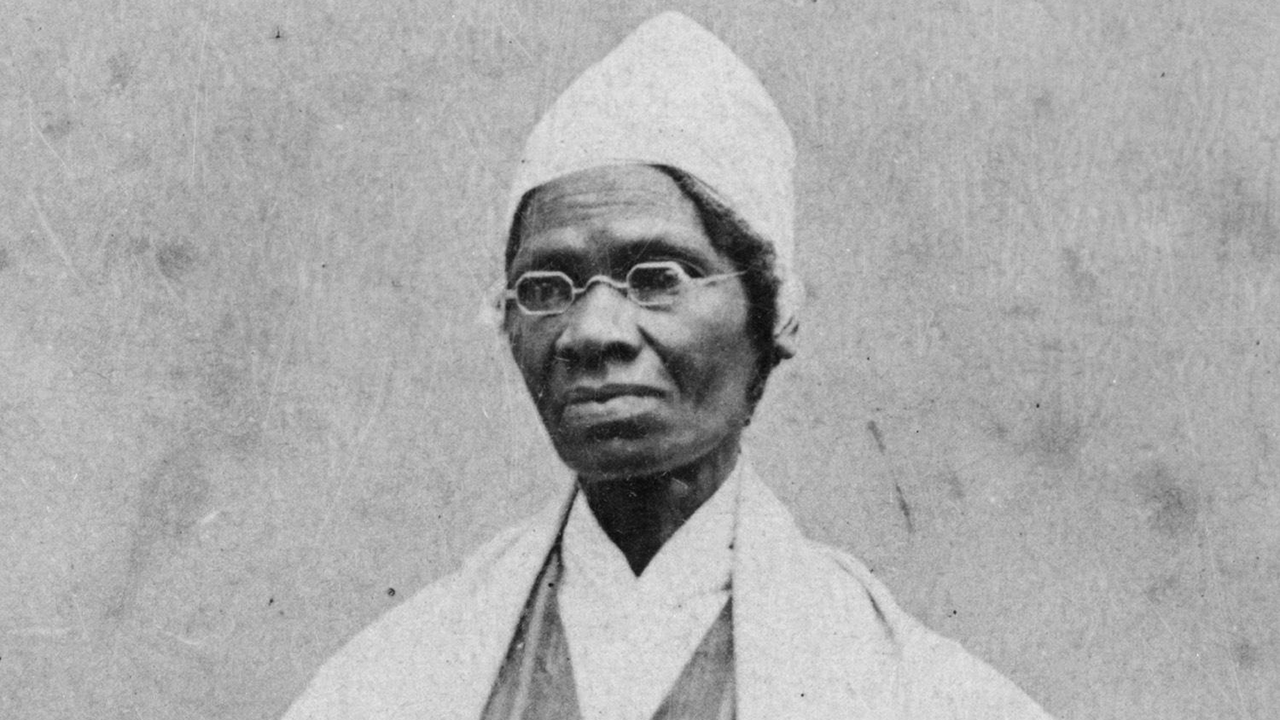
Sojourner Truth, the African American abolitionist, women’s rights advocate and social activist revered to this day for her presentation on racial inequalities, delivered her famous “Ain’t I a Woman?” speech on this day in history, May 29, 1851, at the Ohio Women’s Rights Convention in Akron, Ohio.
The powerful performance is still used today as a call for equal treatment of women, according to many sources.
Truth’s words are recognized as one of the most abolitionist and pro-women’s rights speeches in American history, the U.S. Capitol Visitor Center notes.
ON THIS DAY IN HISTORY, MAY 28, 1888, JIM THORPE, ‘GREATEST ATHLETE IN THE WORLD,’ IS BORN
“She suggested that the women’s rights movement had marginalized African American women and stated, ‘You need not be afraid to give us our rights for fear we will take too much, for we can’t take more than our pint’ll hold,’” the site indicates.
Truth was born into slavery in 1797 as Isabella Baumfree — and subsequently changed her name to Sojourner Truth.
Sojourner Truth headshot from 1864. Truth’s speech “Ain’t I a Woman?” is recognized as one of the most abolitionist and pro-women’s rights speeches in American history, the U.S. Capitol Visitor Center notes. (Associated Press)
She would come to be considered one of the most powerful advocates for human rights in the 19th century, says the National Park Service of the U.S. Department of the Interior.
She spent her early childhood on a New York estate owned by Col. Johannes Hardenbergh.
Like other slaves, she experienced the challenges of being sold and mistreated, says the same site.
“I did not run away, I walked away by daylight.”
In 1827, after her master did not honor his promise to free her or to uphold the New York Anti-Slavery Law of 1827, she fled.
She reportedly told her master, per the same site, “I did not run away, I walked away by daylight.”
ON THIS DAY IN HISTORY, SEPT. 22, 1862, ABRAHAM LINCOLN PROCLAIMS SLAVES WILL SOON BE ‘FOREVER FREE’
After choosing to convert her religion, in 1843 she changed her name to Sojourner Truth, the site noted.
Truth continued her commitment to the expanding antislavery movement, and by the 1850s she was involved in the women’s rights movement.
Truth continued her commitment to the emerging and expanding antislavery movement, and by the 1850s she was involved in the women’s rights movement.
At the 1851 Women’s Rights Convention held in Akron, Ohio, Truth delivered her noteworthy and famous abolitionist and women’s rights speech.
She continued to advocate for African Americans and women’s rights during and after the Civil War, says the National Park Service.
This excerpt from Truth’s famous speech has been distributed on many sites.
“That man over there says that women need to be helped into carriages, and lifted over ditches, and to have the best place everywhere,” she supposedly said.
“Nobody ever helps me into carriages, or over mud puddles, or gives me any best place! And ain’t I a woman? Look at me! Look at my arm! I have ploughed and planted, and gathered into barns, and no man could head me! And ain’t I a woman? I could work as much and eat as much as a man — when I could get it — and bear the lash as well! And ain’t I a woman?”
She went on, “I have borne 13 children, and seen most all sold off to slavery, and when I cried out with my mother’s grief, none but Jesus heard me! And ain’t I a woman?”
There are two conflicting versions of Truth’s famous speech — neither of which was transcribed at the time Truth actually gave it, says History.com.
An account reported in the Anti-Slavery Bugle, the first to be published, reportedly did not actually include the namesake phrase, “Ain’t I a Woman?” the same site recounts.
There are two conflicting versions of Truth’s famous speech.
On May 2, 1863, Frances Gage, a White abolitionist, published an account of Truth’s words in the National Anti-Slavery Standard.
In this account, Gage wrote that Truth used the rhetorical question, “Ar’n’t I a Woman?” to point out the discrimination that Truth experienced as a Black woman, says History.com.
ON THIS DAY IN HISTORY, JULY 28, THE 14TH AMENDMENT WAS CERTIFIED, ASSURING EQUALITY FOR ALL AMERICANS
Various details in Gage’s account, however, including that Truth said she had 13 children (she had five) — and that she spoke in dialect — have since cast doubt on its accuracy, the same site chronicled.
“There is little doubt that Truth’s speech — and many others she gave throughout her adult life — moved audiences.”
Some years later, the slogan was further distorted to “Ain’t I a Woman?” — which the same site says reflected the false belief that as a formerly enslaved woman, Truth would have had a Southern accent.
“Truth was, in fact, a New Yorker,” notes History.com. “Regardless, there is little doubt that Truth’s speech — and many others she gave throughout her adult life — moved audiences,” the same site says.
In the 1850s, Sojourner Truth settled in Battle Creek, Michigan, says Brittanica.com
Truth’s words continue to impact American society as a beacon of hope and equality, even though there are discussions about the actual messaging of her 1851 speech.
When the Civil War began, Truth was dedicated to recruiting soldiers for the Union Army, says the New York Historical Society Museum and Library.
“Although she was a pacifist, she believed that the war was a fair punishment from God for the crime of slavery.”
“Although she was a pacifist, she believed that the war was a fair punishment from God for the crime of slavery. She also knew the Union needed fighters to win,” reports the same source.
MEET THE AMERICAN WHO WROTE ‘THE BATTLE HYMN OF THE REPUBLIC’
In 1864, Truth went to Washington, D.C., where SHE worked for the National Freedman’s Relief Association, striving to improve the lives and prospects of free Black people, the same site indicated.
That fall, she was invited to meet President Abraham Lincoln, the site also says.
President Abraham Lincoln with General George B. McClellan at his headquarters at Antietam, October 3, 1862. In the fall of 1864, Sojourner Truth was invited to meet with President Lincoln. (Getty Images)
After the war, Truth lobbied the U.S. government to grant land to newly free Black men and women, says the New York Historical Society Museum and Library.
“She understood that Black people could never be truly free until they achieved economic prosperity, and she knew that owning land was an important first step. She also continued to travel throughout the United States, giving speeches about women’s rights, prison reform, and desegregation,” the same site recounted.
“She fought for her son’s freedom after he had been illegally sold.”
Truth was the first African American woman to win a lawsuit in the United States, says the Library of Congress. “This was when she fought for her son’s freedom after he had been illegally sold,” the source said.
Truth passed away at age 84 in Michigan — with thousands of mourners in attendance.
ON THIS DAY IN HISTORY, FEB 3, 1870, 15TH AMENDMENT IS RATIFIED, GRANTING BLACK MALES THE RIGHT TO VOTE
In Dec. 1883, just after her death, The New York Globe published an obituary, which read, in part: “Sojourner Truth stands preeminently as the only colored woman who gained a national reputation on the lecture platform in the days before the [Civil] War,” according to the Library of Congress.
Unveiled in the U.S. Capitol’s Emancipation Hall on April 28, 2009, a bronze bust of Sojourner Truth was the first sculpture honoring an African American woman in the U.S. Capitol, says the U.S. Capitol Visitor Center.
It was donated by the National Congress of Black Women and Congress authorized its placement in the Capitol (Public Law 109-427). President George W. Bush signed the bill into law on Dec. 6, 2006, says the same site.
“California-based sculptor Artis Lane, who designed the Rosa Parks Congressional Medal of Honor, was commissioned to create the bust. Lane depicted Truth with a smile to show Truth’s confidence and determination.”
For more Lifestyle articles, visit www.foxnews.com/lifestyle.
Read the full article from Here

North Dakota
Pembina bridge closure, causing headaches for community members, close to short-term solution

PEMBINA, N.D. — The closure of the Stutsman Street bridge has put some residents in Pembina out of reach of certain recreation spots. Timelines for bridge construction remain unclear as proposals for temporary fixes have been denied by the North Dakota Department of Transportation, but a Wednesday, July 1, meeting has brought some clarity to the issue.
The bridge has been out since early June. Mainly, the Pembina Golf Course has seen its business suffer due to children and local members being unable to access the course. John Feldman, treasurer of the Pembina Golf Course, calls the bridge a “lifeline to part of the city,” and its complete closure has been causing problems.
“All of our young kids that we’re trying to groom into golfers are not golfing anymore. Our locals that used to drive their golf carts across the bridge can’t do that anymore. So, business is down immensely,” Feldman said.
Feldman is part of a committee formed to work to get the bridge opened temporarily to pedestrians and carts. The committee has expressed its concerns with the city and city leaders are hoping to meet with NDDOT to address those concerns.
The Pembina City Council has been discussing the bridge and has made efforts to get in contact with NDDOT. Council President Connor Snitker told the Herald the NDDOT reached out to the city and a special council session took place Wednesday night with NDDOT present.
In an effort to find a temporary solution, city engineers had previously inspected the bridge to confirm the original findings and put forth a proposal to open the north half of the bridge to a weight-bearing capacity of one ton or less. That proposal, along with an alternative, was originally denied by NDDOT, but at Wednesday’s meeting, NDDOT said it would review federal regulations to find a temporary solution for pedestrians.
“We’re still running down every alternative path we can right now, trying to figure out if there’s a way to reclassify the bridge or do something that would allow us to have flexibility to at least have it operating at our temporary capacity,” Snitker said.
The DOT says the critical issues with the bridge make a temporary solution for pedestrians a challenge, but language in those regulations will be reviewed. A solution could be found as soon as this weekend.
“Late Tuesday night we received word from the Federal Highway Administration that there was an option we could pass along to the city and I think that went over well,” engineer Derek Pfeifer said. “We’ve been working really hard to find a short-term solution for them to at least allow pedestrians to cross the bridge.”
A load analysis was expected to be done Thursday to assess whether pedestrians would be able to cross. NDDOT remains adamant that only pedestrians would be allowed access with a temporary solution, and golf carts would still be unable to access the bridge.
“As long as the bridge meets a certain standard, it could open to pedestrians,” Snitker said. “It’s a step in the right direction.”
Main issues with the bridge are spalling — or flaking of surface materials — found under the load bearings, stress cracks and splitting in some of the pedestals above the columns. At the east end of the bridge, there has been five inches of movement toward the south. As the bridge moved, it sheared the anchor rods.
Before the bridge’s closure, children would regularly play the course. Easy bridge access allowed for some to even come to the course twice in a day. Now, a six-mile detour has seen that business go away.
The detour makes its way through gravel roads, which is prohibitive to golf carts and those who were walking to the course.
“We need the bridge open, not just for the golf course, but for the kids to come and play in the playground over there to play baseball,” Feldman said. “It’s really a livelihood over there for the kids and for adults.”
Looking ahead to a permanent resolution to the bridge, Pfeifer and NDDOT are looking to the city and county to come to a decision in order for them to determine the next steps.
“Do they want to fix it? Do they want to replace it?” he said. “A structural engineer will need to do an analysis of those findings that were there and what kind of effort it’s going to take to fix it. So at this point, it’s up to the city and county to determine how they want to move forward.”
Digital Content Producer and Sports Reporter at the Grand Forks Herald since December of 2020. Maxwell can be contacted at mmarko@gfherald.com.

COLUMBUS, Ohio (WSYX) — Friday, July 3
Downtown Columbus: Billed as the Midwest’s largest fireworks show, Red, White & BOOM! takes place along the Scioto Mile. The fireworks show starts at 10:00 p.m. More information can be found on the event’s website.
Bexley: Festivities at Capital University begin at 6:00 p.m., with a fireworks display starting at 10:00 p.m.
Buckeye Lake: The Buckeye Lake Area Star Spangled Tradition (BLASST) fireworks display will take place at approximately 10:00 p.m. The primary viewing area is at Fairfield Beach, Lake Shore Drive NE, Thornville.
Canal Winchester: First Friday at Loose Rail Brewing will feature a fireworks show at approximately 9:00 p.m. The brewery will also show Red, White & BOOM! on big screens.
Gahanna: Activities start at 5:00 p.m. at the Gahanna Municipal Golf Course and the fireworks show is at 10:00 p.m.
Newark: Central Ohio Technical College and Ohio State Newark campus will host festivities with live music and food trucks at the Martha Grace Reese Amphitheatre, culminating with a fireworks display at dusk (approximately 10:00 p.m.).
Pickerington: The city’s fireworks show starts at 10:00 p.m.
Reynoldsburg: Festivities begin at 6:00 p.m. at Civic Park, with fireworks starting at 9:45 p.m.
Saturday, July 4
Chillicothe: Fireworks are scheduled to begin at approximately 9:45 PM from the Yoctangee Park Annex.
Circleville: AMVETS Post 2256 will host food trucks, live music, and a fireworks display after dark.
Clintonville: Whetstone Park of Roses hosts a live music event followed by fireworks at 9:45 p.m.
Delaware: Fireworks will launch from the city’s Cherry Street property at 10:00 p.m.
Dublin: Independence Day Celebration activities wrap up with fireworks at 9:50 p.m. at Dublin Coffman High School.
Grove City: Fireworks will launch from Murfin Fields at 9:45 p.m.
Hilliard: Freedom Fest takes place at Roger Reynolds Municipal Park with fireworks starting around 9:45 p.m.
Lancaster: A full day of celebrations culminates with fireworks at dusk at the Fairfield County Fairgrounds.
Marysville: Fireworks at approximately 9:00 p.m. at the Union County Fairgrounds.
New Albany: The July 4th Festival ends with fireworks at 10:00 p.m. at New Albany High School.
Upper Arlington: The annual Party in the Park begins at 5:00 p.m. at Northam Park, followed by fireworks at 10:00 p.m.
Westerville: Evening festivities and food trucks can be found at the Westerville Sports Complex until the fireworks show begins at 10:00 p.m.
Worthington: The city’s celebration concludes with fireworks launched from Thomas Worthington High School at 10:00 p.m.


How Fourth of July became a celebration of history and hope
From revolution to massive fireworks, July Fourth evolved into a celebration of history, heritage and America’s values.
President Donald Trump will kick off Independence Day weekend with a speech at Mount Rushmore beneath busts of four of his predecessors.
As part of a day of festivities tied to the nation’s 250th anniversary, the president will address visitors to the South Dakota landmark in a keynote address on Friday, July 3. at approximately 8:30 p.m. MT/10:30 p.m. ET according to the schedule released by the White House.
After the president’s remarks, the night will end with a massive fireworks display. It will be Mount Rushmore’s first time hosting a July 3 fireworks display since 2020, which Trump also attended during his first term in office.
Earlier in the day, there will be a slew of activities and programming on site for visitors before the evening festivities. The National Park Service and the state are coordinating the celebration, and a ticket lottery to attend has already closed.
Here’s what to know about the timing of the Mount Rushmore celebrations and how to tune in.
What will be at the Mount Rushmore July 3 event?
The event on July Fourth eve will feature myriad exhibits, reenactors and interactive experiences throughout the day, according to Freedom 250, the group working with Trump’s administration to coordinate the weekend’s events.
At night, it will transition into a tribute to the Armed Forces, including military bands, aviation flyovers and precision drill demonstrations, the group said.
After, South Dakota Gov. Larry Rhoden and Interior Secretary Doug Burgum will take the stage to introduce Trump.
Following the president’s remarks, the event will conclude with the fireworks show.
What time is Trump speaking at Mount Rushmore? See schedule
Trump is expected to deliver his Mount Rushmore address at 8:30 p.m. MT (10:30 p.m. ET), according to the White House, though organizers have not yet released a detailed event schedule.
However, the day’s programming is set to run from 4-10 p.m. local time, according to the National Park Service.
The fireworks, which will close out the event, are expected to begin around 9:30 p.m. local time, according to the Sioux Falls Argus Leader, part of the USA TODAY Network.
Where to watch Trump’s speech at Mount Rushmore
The Mount Rushmore event will be streamed live on Travel South Dakota’s website.
Melina Khan is a national trending reporter for USA TODAY. Keep up with her on X @melinakh and Instagram @bymelinakhan.
-
North Carolina3 minutes ago
More than 60 North Carolina cases tied to parasite behind ‘explosive diarrhea’
-

 North Dakota6 minutes ago
Pembina bridge closure, causing headaches for community members, close to short-term solution
-

 Ohio11 minutes ago
Where and when to see fireworks in Central Ohio
-

 Oklahoma18 minutes ago
The Under-the-Radar Oklahoma State Football Transfer Generating Preseason Buzz
-

 Oregon21 minutes ago
Oregon lawmakers pushed to secure sensitive data from ICE. How does the law work?
-

 Pennsylvania26 minutes ago
A rare albino bird was found in Pennsylvania. It was a
-

 Rhode Island33 minutes ago
Water worries mount, outdoor water use banned in some parts of RI
-

 South-Carolina36 minutes ago
Tennessee Football 2026 SEC Opponent Summer QnA Preview: South Carolina | Rocky Top Insider


