Ohio
A year later, here’s how much Beard bridge fire has cost taxpayers so far


Timelapse video shows fire under Daniel Carter Beard Bridge
A surveillance camera near a pickle ball court captured the moments in the massive fire under the Daniel Carter Beard Bridge.
Ohio spent close to $8.7 million to reopen the Daniel Carter Beard bridge over the Ohio River following the catastrophic year-ago fire that closed the bridge for 100 days.
The city of Cincinnati will be spending about $2 million more to replace the playground under the bridge, destroyed by the fire.
That $10.7 million price tag – which does not include the cost of city, county or state employees, some of whom continue to manage fire-related work – is less than an earlier estimate of $13 million.
But whatever the amount, taxpayers are the ones footing the bills.
“It’s unfortunately just part of doing business,” said Matt Bruning, spokesman for the Ohio Department of Transportation. “We have to absorb that.”
Fire brings 4 arrests, 100 days of disruption
Cincinnati fire officials were called to the base the Beard bridge at 3:20 a.m. on Nov. 1, 2024.
That’s where fire erupted around 3 a.m. at the 1000 Hands Playground in Sawyer Point Park along the river.
The Ohio Department of Transportation immediately closed the bridge, reopening the northbound side that night and later saying the southbound lanes would remain closed until mid-March. Even though Kentucky owns the bridge, Ohio took the lead because the fire damaged Interstate 471 on the Ohio side of the river rather than the bridge itself.
By Dec. 11, Cincinnati officials had arrested four suspects in connection with the fire, with county officials taking the four to court.
On Feb. 9, 100 days after the fire, the state reopened the bridge in full, ahead of the March target.
That chronology is now part of the history of the Beard bridge, named for the founder of the Boy Scouts of America, opened in 1976, and nicknamed the Big Mac for a shape and color that resemble McDonald’s iconic “M.” It cost $14 million then – what would be close to $75 million in 2025 dollars.
ODOT spent $8.7 million, before staff expenses
Ohio’s transportation department brought on Great Lakes Construction Co. of Hinckley, Ohio, to manage the repair work.
Working with more than two dozen subcontractors, Great Lakes demolished and replaced two sections of I-471’s bridge deck, along with warped steel beams. Contractors also repaired about 70 feet of damaged wall on the northbound side of the interstate.
The state paid Great Lakes close to $6.8 million, part of which went to subcontractors. It paid another $1.2 million for a painting contractor, $433,000 in engineering and other consulting fees, and $286,000 for inspections.
The state’s $8.7 million bill does not include what it paid ODOT employees diverted to the Beard project.
Its communication staff, as one example, produced close to four dozen press releases over 100 days with bridge-related updates.
Lead suspect now serving time in Ohio prison
Some costs of the bridge disaster are harder to quantify.
That includes work by the Cincinnati Fire Department to investigate the case, Cincinnati Police Department to arrest the suspects, and Hamilton County courts and prosecutor’s office to try them. It also includes costs absorbed by the Ohio Department of Rehabilitation and Corrections to jail one of the convicted suspects.
The suspects who created those costs include:
- James Hamilton and Kaitlen Hall, who both pleaded guilty to obstruction of justice in the case. Each was sentenced to probation and community service.
- Zachary Stumpf, who pleaded guilty to obstructuring justice and was sentenced to three years of probation.
- Terry Stiles, who admitted to one count of arson and one count of aggravated arson. He earned a sentence of nine to 13 ½ years in prison. Now 40, Stiles began serving time at Noble Correction Institution in the eastern Ohio town of Caldwell on June 11.
Prosecutors said Stiles and Stumpf set the fire, with Hall providing transportation. The three had been driving around the area that night, looking for scooters to steal, prosecutors said earlier. Hamilton was not present for the fire, but attempted to help the other suspects evade arrest, attorneys said.
Replacement of 1000 Hands Playground will include public, private funds
Fire-related costs also include $1.9 million to $2.1 million to replace the 21-year-old 1000 Hands Playground destroyed in the fire. Between $600,000 and $700,000 of that will go to playground equipment.
Cincinnati Parks Foundation will raise an unknown portion of those dollars, with the city covering the balance.
The Cincinnati Parks board OK’d a $50,000 down payment for the project in May, with parks officials bringing on Midstates Recreation of Pataskala, Ohio, to design it.
Parks officials will release a preliminary design for public feedback soon, spokesman Rocky Merz said. A final design should be complete early next year, he said.
The new playground will cover 11,000 to 14,000 square feet, to be installed east of the 1000 Hands site and south of the volleyball, tennis and pickleball courts at Sawyer Point.
.



Columbus Aviators head coach and former Ohio State wide receiver Ted Ginn Jr. has been charged with driving while intoxicated in Tarrant County, Texas, according to multiple reports.
Ginn was stopped at 12:58 a.m. April 11 for traffic violations and an officer conducted a DWI investigation, Euless police spokesperson Brenda Alvarado told The Dallas Morning News. He was subsequently arrested, she said.
Ginn Jr. posted a $1,000 bond and was released, according to ABC6.
The Aviators face the Dallas Renegades at noon ET April 12.
“We are aware of an incident involving Head Coach Ted Ginn Jr. over the weekend and are in the process of gathering more information,” UFL president and CEO Russ Brandon said in an statement emailed to The Dispatch.
Brandon stated that Aviators offensive coordinator Todd Haley would assume head coach duties for the April 12 game.
Ginn Jr. was named the coach of the Aviators in December 2025. He had no prior head coaching experience. Before his 14-year-long career in the NFL, Ginn Jr. played receiver for Ohio State from 2004-06. He was the No. 9 pick in the 2007 NFL Draft.
The Dispatch has reached out to the Tarrant County Sheriff’s Department for more information related to Ginn Jr.’s arrest. The Dispatch also reached out to the UFL about Ginn Jr.’s charge.
This story was updated with more details on the arrest.

DELAWARE, Ohio (WCMH) — Both sides of Interstate 71 are closed due to a serious injury crash at US-36/SR-37.
I-71 is closed in both directions at US-36/SR-37 due to a fiery collision Saturday evening at 6:27 p.m. According to Ohio State Highway Patrol, 12 vehicles, including one semi truck, were involved in the collision.
Three people were taken to hospitals from the scene. Their condition was not immediately known.
Carissa Shaw, a driver who witnessed the crash, said that the scene was unbelievable.
“I saw the semi on the other side going northbound. Running into vehicles and coming towards the median right to my left. And immediately flames were shooting into the air. It was one of those moments where it’s like slow motion and you’re thinking, am I seeing what I’m seeing? It was so wild,” Shaw said. “People ran over to a red vehicle that was right to my left, and tried to help, but, the whole driver’s side was mangled.”
The Ohio Department of Transportation is urging drivers to take alternate routes.

COLUMBUS, Ohio — In August 2019, police in Bexley, Ohio, responded to a report of a “domestic dispute” at the home of Dr. Amy Acton.
Acton — then the director of the state’s Department of Health, now a Democratic candidate for governor — pulled a mirror off the wall, “shattering the glass” when she “became upset” because she felt her husband “was antagonizing her,” according to a police report. She told officers she had been drinking, had taken an unknown amount of prescription drugs and was about to drive away in her car before her husband, who also told police he had been drinking, talked her out of it, the report stated.
A medic dispatched to check on Acton recommended that she go to the hospital, but Acton “refused,” according to the police report. Police determined that there was no evidence of physical violence between Acton and her husband, only a “verbal argument over her extended work hours.”
Months later, Acton would become one of Ohio’s most visible leaders as the state battled Covid, advising and appearing almost daily alongside Gov. Mike DeWine as they issued stay-at-home orders and shared the latest case numbers. Acton’s time in the spotlight brought her doting admirers, as well as vicious critics. And as the lone Democrat serving in a Republican governor’s Cabinet, she quickly became a prospect for elected office herself after resigning her post in June 2020.
Acton, 60, is likely to face Republican Vivek Ramaswamy, a biotech entrepreneur who has been endorsed by DeWine and President Donald Trump, in the general election.
Her campaign on Friday disputed and sought to clarify several elements of the police report. Acton and her husband had returned home from dinner, where she had one drink, according to the campaign’s written response for this article. During a “verbal disagreement regarding her long work hours,” Acton “bumped into a wall hanging which fell,” the campaign said. She then went to bed and was asleep when police arrived, according to the campaign.
Officers were dispatched to the home at 9:45 p.m., according to the police report, which does not indicate how they were alerted to the incident.
Acton’s campaign said that she was not “intoxicated” at any point during the evening and that the prescription medications referenced in the police report were ones that she had taken regularly for years.
The campaign also disputed that there was any reason for Acton to go to a hospital, asserting that any “harm, injury, or impairment” would have been noted in the police report.
Police officials in Bexley, a Columbus suburb, did not respond to a request for comment for this article.
“Amy Acton worked around the clock on behalf of Ohioans while serving as Health Director,” Acton spokesperson Addie Bullock said in an emailed statement that also criticized Ramaswamy and his policy proposals “as Ohioans continue to reject him and his cost-raising scams.”
The 2019 incident at Acton’s home has, until now, not been reported publicly. It also was not something widely known, if it was known at all, inside the DeWine administration. The governor, according to his spokesperson, was not happy to learn of the matter for the first time from NBC News.
“Prior to your inquiry, Governor DeWine was unaware of both the 2019 incident and associated police report involving Dr. Acton,” the spokesperson, Dan Tierney, wrote in an emailed response to questions. “The Governor holds his staff to the highest standards of conduct. Given that the allegations in the report are deeply troubling, Governor DeWine would have expected Dr. Acton to have at that time promptly disclosed this to him, and he is very disappointed that it did not occur.”
DeWine has in the past been largely praiseful of Acton. His backing of Ramaswamy, 40, came relatively late and reluctantly, after the governor unsuccessfully tried to draft Lt. Gov. Jim Tressel, a former Ohio State football coach, into the primary.
Ohio has trended more decisively Republican, having elected only one Democratic governor in the last 36 years. Reliable, independent polling has been scarce, but several surveys have shown a close race, raising Democrats’ hopes for an upset.
Acton’s performance as health director has stood out as a major storyline in the race. Fox News recently retracted an article by its OutKick sports affiliate that accused Acton of hectoring social media users for ignoring social distancing guidelines. The tweets had come not from Acton, but from an account spoofing her.
The episode was an example of how Acton’s candidacy has reignited debate over the pandemic shutdowns that she advised DeWine to implement. She became a target for right-wing activists and protesters, some of whom reportedly wielded guns and signs scrawled with antisemitic messages outside the Statehouse in Columbus and outside her home. Acton, who is Jewish, downplayed that scrutiny as a factor in her resignation in June 2020, saying at the time that her decision would afford her more time to spend with her family.
DeWine, riffing on the “not all heroes wear capes” cliché, described Acton as a “hero” who wears a “white coat” when announcing her departure. Acton stayed with the administration for several more weeks, serving as a health adviser before officially leaving in August 2020.
Later in 2020, after Acton gave an interview to The New Yorker, the magazine reported that she had begun to “worry that she might be forced to sign health orders that violated her Hippocratic oath to do no harm.”
As a first-time candidate for elected office, Acton has leaned less on the high-profile role she had as DeWine’s top health adviser and more on her personal narrative. She emphasizes how she grew up poor in Youngstown, a difficult childhood marked at times by hunger and homelessness.
After receiving her medical license in 1994, Acton practiced as a pediatrician and later earned a master’s degree in public health at Ohio State University. She was the final Cabinet director DeWine named in 2019. Those close to DeWine at the time emphasized how he had been deliberate in identifying a qualified health care professional for the job rather than rewarding a career bureaucrat or political loyalist.
It was a move that initially seemed to pay off in the early days of Covid. DeWine’s daily televised briefings, often with Acton at his side, became appointment viewing in Ohio. Acton herself became a household name, so beloved that one company printed T-shirts in her honor.
While the Republican base vilified DeWine and Acton for their initially aggressive pandemic management, both remained popular in broader circles. Democrats tried to recruit Acton to run for an open Senate seat in 2022 — an option she strongly considered but decided against. That same year, DeWine cruised to re-election, helped by Democrats and independents who appreciated his handling of Covid.
Republicans fighting to hold onto the governor’s mansion after the term-limited DeWine leaves office have branded Acton as a quitter.
“What did Amy Acton do when the legislature began pushing back? Amy Acton quit,” state Senate President Rob McColley told an audience in January after being introduced as Ramaswamy’s running mate for lieutenant governor. “Ohio needs a businessman, not a bureaucrat. Ohio needs a creator, not a quitter. Ohio needs a visionary, not a victim. Ohio needs somebody who’s going to focus on affordability, not somebody who’s going to put in lockdown policies that are going to raise our prices.”
Though DeWine has endorsed Ramaswamy, he also has attempted to inoculate Acton from pandemic-related criticism.
“The decisions that were made during COVID, they were my decisions, so no one should blame someone else if they don’t like it,” DeWine told Columbus’ NBC affiliate in December. “The buck stops with me.”

Lawmakers close door on Massachusetts online casino legalization

Minnesota’s Pohlkamp helps Denver beat Wisconsin 2-1 for 11th national hockey title, 3rd in 5 years

Mississippi reveals its full history for America’s anniversary year, a contrast to federal efforts
KCPD investigating after 1 man hurt in Saturday shooting

The ugly truth behind ‘restoring Montana values’ • Daily Montanan

Florida High School Football Rankings: Top 25 teams – Oct. 21

How old is Bo Nix? What to know about Oregon quarterback ahead of 2024 NFL Draft

Cleary's 21 help Le Moyne down Central Connecticut State 69-64 in OT

99th annual Pony Swim held in Virginia

Indiana Members Credit Union announced as new anchor tenant at Bottleworks District

Carney casts himself as NATO defender amid Trump beef, despite Canada missing key benchmark for decades

‘Enough of war!’ says Pope Leo XIV who grows increasingly frustrated
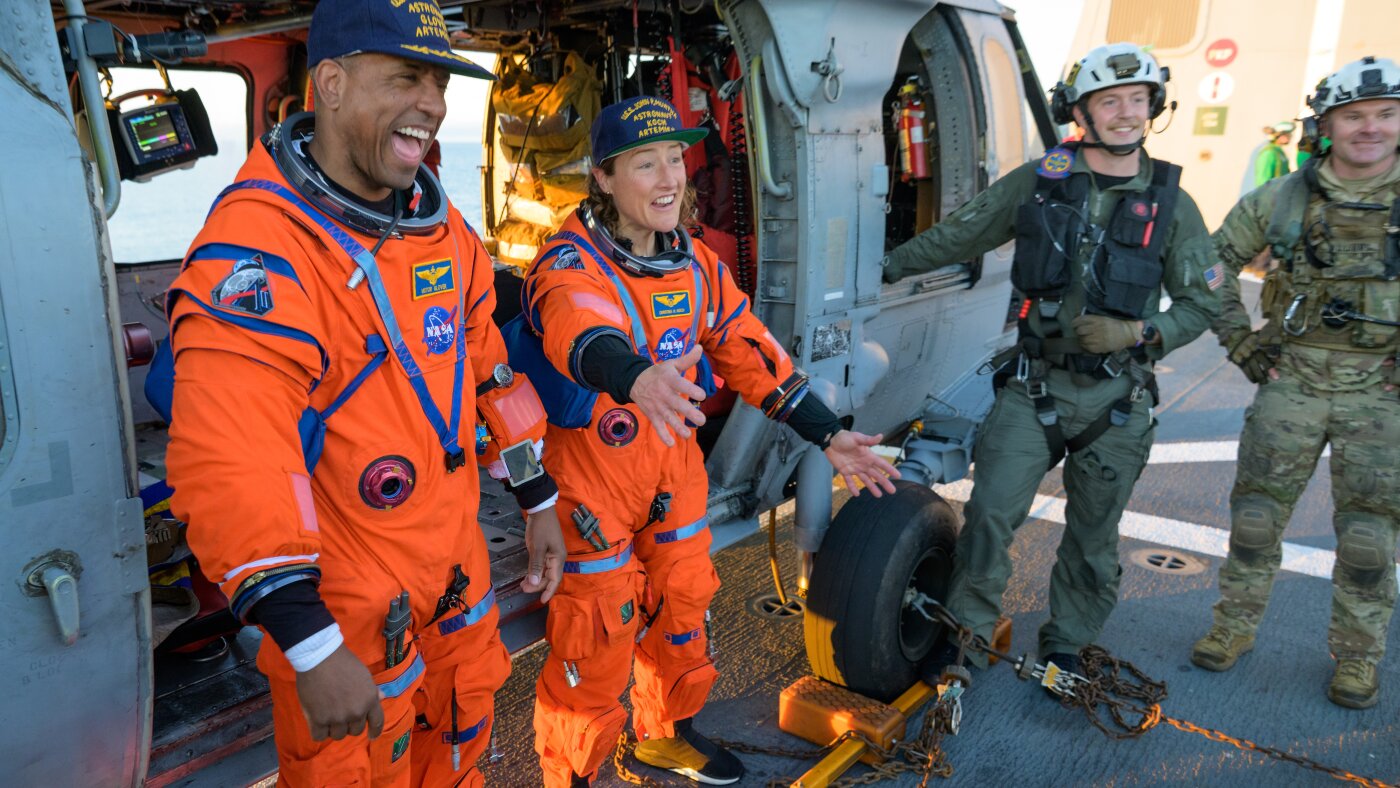
Artemis II splashdown captures nationwide attention

Video: Police Fatally Shoot Man After Stabbings at Grand Central Subway Station

Trump blasts Spanberger ahead of Virginia meetings, says state faces tax base exodus like New York, California
-

 Atlanta, GA1 week ago
1 teenage girl killed, another injured in shooting at Piedmont Park, police say
-

 Georgia5 days ago
Georgia House Special Runoff Election 2026 Live Results
-

 Pennsylvania6 days ago
Parents charged after toddler injured by wolf at Pennsylvania zoo
-

 Arkansas2 days ago
Arkansas TV meteorologist Melinda Mayo retires after nearly four decades on air
-
 Milwaukee, WI6 days ago
Potawatomi Casino Hotel evacuated after fire breaks out in rooftop HVAC system
-

 Indianapolis, IN1 week ago
Fighting Illini begin Final Four preparations in Indianapolis
-

 Technology1 week ago
Anthropic essentially bans OpenClaw from Claude by making subscribers pay extra
-

 Detroit, MI1 week ago
Puppy rescued after getting stuck on chimney in Detroit