Nebraska
Nebraska overcomes 18-point deficit in second half to upset Wisconsin 80-72


LINCOLN, Neb. (AP) — Nebraska loves to play at Pinnacle Bank Arena, and the record shows it.
No. 6 Wisconsin, on the other hand, might be getting a complex about the place.
For the second straight year, the Cornhuskers pulled off a dramatic comeback to beat the Badgers. On Thursday night, they erased an 18-point second-half deficit to win 80-72 in overtime. Last February, Nebraska erased a 17-point second-half deficit en route to an overtime win.
Nebraska coach Fred Hoiberg said he made sure to remind his players of that in the locker room when they were down 43-27.
“A huge win for us,” Hoiberg said. “We knew the importance of this. I’m proud of the guys for finding a way to dig in and come back when things were not looking good.”
Rienk Mast scored early in overtime to give the Huskers the lead for good, and when time expired the students spilled onto the court for the second time this season. The first was Jan. 9 when the Huskers beat then-No. 1 Purdue 88-72.
C.J. Wilcher scored 16 of his 22 points in the second half, Mast finished with 20, and the Huskers (16-6, 6-5) improved to 6-0 at home in Big Ten play and 14-1 overall.
It was Nebraska’s biggest comeback since erasing a 19-point deficit against Iowa in 2013. Since 2000, Wisconsin had been 120-0 when leading by 15 or more points at halftime.
“I thought we got completely away from what makes us good,” Badgers coach Greg Gard said. “The shots we settled for at times, turning the ball over and gambling defensively when we didn’t need to gamble … just doing some very uncharacteristic things.”
AJ Storr matched his season high with 28 points to lead the Badgers (16-5, 9-2). Max Klesmit and Chucky Hepburn had 13 apiece.
The Huskers were coming off an embarrassing 73-51 loss at Maryland and found themselves down as many as 19 in the first half.
“Coach got on us about having our heads down,” Wilcher said. “That gave us a little spark and helped us play with a little bit of edge.”
Mast said he and his teammates were a bit taken aback by Hoiberg’s halftime speech.
“We needed that,” Mast said. “When you have a coach that’s super chill and then is super loud, it’s, ‘Come on guys.’”
Wisconsin struggled the entire second half against a more aggressive Nebraska defense. After shooting 55% in the first half, the Badgers dipped to 36% in the second and got sloppy with the ball.
When Wilcher hit a deep 3 to pull the Huskers within seven points, he beat his chest and asked the crowd for more noise. The fans obliged and were on their feet for the final 12 minutes of regulation and all of overtime.
“The roof came off the place,” Hoiberg said, adding that it was the best environment he has experienced in his five years at Nebraska.
Brice Williams’ two free throws in the final minute of regulation gave Nebraska its first lead at 67-65. Storr’s layup tied it and Mast and Williams missed two shots in the last 20 seconds.
Nebraska capitalized on a run of eight Wisconsin turnovers over eight minutes in the second half to tie it at 52. The Badgers were ahead 63-56 after Klesmit scored 11 points over two minutes.
But Nebraska came back again, got the game to overtime and posted one of its biggest comebacks in program history.
Big picture
Wisconsin: The Badgers had as nearly as many turnovers (10) as field goals (11) after half.
Nebraska: The Huskers posted their second win over a top-10 opponent in the same season for the first time since 2013-14.
Hepburn homecoming
Wisconsin’s Hepburn, playing 50 miles from his hometown of Omaha, was met with boos each time he touched the ball. Hepburn had strongly considered Nebraska, but picked the Badgers after the Huskers fired Tim Miles in 2019.
Hepburn played a big role in the first half. In a span of 29 seconds, Hepburn made a fallaway jumper and had two layups off steals, with a free throw tacked onto the second. Another layup pushed the Badgers’ advantage to 17 late in the half.
Up next
Wisconsin: Hosts No. 2 Purdue on Sunday.
Nebraska: Visits No. 14 Illinois on Sunday.



We need to do our homework on Nebraska canal plan
Re: “Colorado’s water war with Nebraska comes to a head,” Sept. 21 news story
Farming in northeastern Colorado has never been easy, and it is getting harder. Markets are tough, input costs are up, and young people are leaving. What keeps communities in Northeastern Colorado going is agriculture, the water, the ground, and the community that ties everything together. The proposed Perkins County Canal — to carry South Platte River water into Nebraska — threatens all of it.
When you take water off farmland, the damage does not stop in crop yields. Equipment dealers, elevators, local banks, and businesses all feel it. Schools and roads will suffer. We have seen what happens to towns that lose their agricultural base, and we cannot let that happen again without a real fight.
That fight needs to be a regional one. I am asking communities across northeastern Colorado to come together and hire an independent economic consultant to assess the true local impact of this project (acres affected, jobs at risk, income lost, tax base eroded).
The Corps of Engineers will do its own analysis, but we need our own numbers. If their conclusions do not match what our communities are actually facing, we need the documentation to say so and demand they take another look.
Rural communities have always figured out how to help each other when it counts. This is one of those times. I urge local officials, water boards, farm bureaus, and civic leaders to set aside any differences and work together on this. The permit process will not wait, and neither can we.
Kimberly L. Kinnison, Ovid
Don’t let our children be ‘policy pawns’
Re: “District accused of violating Title IX,” March 14 news story
The Trump administration seems intent on the persecution of transgender children, excluding them from bathrooms, sports and school activities. Refusing to allow transgender children to participate in school in a manner consistent with their gender identity promotes the exclusion of particularly vulnerable children.
Participation in sports, access to bathrooms in which they feel comfortable, and full inclusion are critical components of healthy development for all children.
Some children are taller, faster, or stronger, have been training with private coaches or attending schools with better facilities, but the requirement of biological uniformity applies only to transgender children.
Exclusion harms children. Is this in dispute? Our children are not political pawns.
Jane Cates, Jefferson County
Don’t forget the Denver Chamber Music Festival
Re: “Classical blast,” March 15 feature story
Thanks to Ray Rinaldi for a terrific article about classical music festivals in the mountains this summer. I’d like to add one, and it’s right here in town: the Denver Chamber Music Festival from June 5 to June 13. World-class musicians, including the amazing classical/bluegrass violinist Tessa Lark, our first composer in residence, and local favorites Stephanie Cheng and Margaret Dyer Harris, and the members of the Colorado Cello Quartet.
All performances are at the Newman Center for the Performing Arts; tickets available at denverchambermusicfestival.org. Avoid Interstate 70 and enjoy phenomenal music in Denver!
Alix Corboy, Denver
Editor’s note: Corboy is executive director of the Denver Chamber Music Festival
Sign up for Sound Off to get a weekly roundup of our columns, editorials and more.
To send a letter to the editor about this article, submit online or check out our guidelines for how to submit by email or mail.

SEWARD, Neb. — More than 300 students pursuing church work professions gathered at Concordia University, Nebraska, for a church work student luncheon on Tuesday, Feb. 24, 2026, an event that combined networking, a taco and nacho lunch buffet and remarks from Mick Onnen of Lutheran Hour Ministries of Nebraska.
The luncheon drew several special guests, including Concordia University System President Rev. Dr. Jamison Hardy; Concordia University Education Network Executive Director and Concordia University System assistant to the president Rev. Dr. Paul Philp; Concordia University System Vice President Rev. Douglas Spittel; Lutheran Church-Missouri Synod Minnesota North District President Rev. Brady Finnern; Emmanuel Lutheran Church and School (Asheville, North Carolina) Senior Pastor Rev. Dr. Jeff Skopak; Metro East Lutheran High School Theology Chair Mr. Jon Giordano; and Mr. Gary Thompson.
A discussion panel featuring the ministry team from Seward’s St. John Lutheran Church was a centerpiece of the event, focusing on how church workers serve together.
“Each of us shared about our role on the team and how to work best in team ministry. One of the blessings of all of the other church worker professions outside of pastors is that all of the others are naturally trained to serve on a team. When I was in the seminary, there was no instruction on team ministry. Thankfully, I was trained as a teacher first before becoming a pastor. Our staff shared with the students the joys and the challenges when serving on a team,” said St. John Lutheran Church Pastoral Leader Rev. Scott Bruick ’87.
Bruick also pointed to the size of the gathering and the students’ future roles in ministry. “It was great to see so many future church workers at this luncheon. We pray that the Lord will continue to shape the hearts of the men and women studying at the university as He prepares them to share the hope of Jesus in the lives of those to whom they will be called to serve and to serve alongside of them,” he said.
St. John Lutheran Church Deaconess Jeri Morrison said the panel aimed to help students understand how different roles fit together in congregational life.
“It was incredible to see so many students who are focused on church professions. [Our] panel was able to explain each of the church work vocations and how we work together for the care of the congregation. Regardless of vocation, each needs to know not only their own role, but each of the others and how they fit together,” Morrison said.
Morrison also described how seating was organized to encourage conversation among students and guests. “I appreciated how tables were somewhat assigned so that a guest was at each table and the variety of church work students were also distributed as evenly as possible. It was very easy to find a table with a pre-deaconess student and be the guest at that table,” she said.
Panel participants also commented on the large turnout of church work students. St. John Lutheran School Principal Barb Mertens said she was struck by the number of students and the range of programs represented.
“When I walked into the room, I was pleasantly surprised by the number of students in the room. I noticed at the tables there were different table tents that revealed that in the room were pre-seminary students, teachers, and the Director of Christian Education. Over the past several years, there has been a great concern about the number of eligible teachers for Lutheran Schools across the United States. At the church worker lunch, the number of students studying to be in one of the areas of church work was hopeful. It was evident to me that Concordia Nebraska had intentional programs to encourage students into church work,” Mertens said. “It was enjoyable to hear their stories about choosing Concordia and their excitement about their current studies. God will use all of them for His ministry.”
Among the students attending was sophomore Lydia Fink, who is majoring in elementary education, minoring in general science and pursuing her Lutheran Teacher Diploma at Concordia Nebraska. She said the lunch served as a reminder of the community she has found through the church work program and the university’s support for students preparing for ministry.
“I would have never imagined that something like this would be part of what I get to receive as a future teacher. It is so interesting to think that one day we will all be spread out, serving where God has called us across the United States, and I am sure even overseas,” Fink said. “It has been amazing to see how Concordia Nebraska has created a place where church workers, along with students in other vocations such as business, science, and math, are being prepared to support ministry. We need both church workers and lay members to be faithful stewards, and Concordia is clearly equipping us for that calling.”
Students from various church work programs were intentionally grouped at each table with university faculty and staff. At the close of the event, Hardy led the group in a closing prayer and in singing the Doxology.
St. John Lutheran Church Director of Parish and School Music and Concordia Nebraska adjunct professor Paul Soulek said the gathering was encouraging for those preparing to serve.
“The Holy Spirit continues to call, gather and enlighten the Church, and seeing these vessels of God’s Word together in one place is nothing less than inspiring,” Soulek said. “In addition to my full-time call to St. John, I serve as adjunct faculty in the Concordia music department, teaching Arranging and Applied Organ and directing the Male Chorus. Bridging these two roles-and connecting university students with the parish life at St. John-is an incredible privilege. It is an unexpected path that has quickly become one of the most rewarding aspects of my vocation.”
Concordia Nebraska currently has 309 students in church work programs. Those programs include the Lutheran teacher diploma, director of Christian education, director of parish music, pre-seminary, pre-deaconess and classical Lutheran educator certification.
“It was exciting to witness both the amount and the breadth of interest in church work professions. It’s easy to be encouraged about the future with so many young men and women on the path to serving our Lord’s church,” said St. John Lutheran Church Associate Pastor Rev. Nathan Scheck. “It’s a joy to serve across the street at St. John and partner with Concordia Nebraska in its work.”

This story is made possible through a partnership between Grist and The Flatwater Free Press, Nebraska’s first independent, nonprofit newsroom focused on investigations and feature stories.
Rick Wheatley owns a property with about 80 acres in Nebraska’s Otoe County — an area east of Lincoln known for its farmland, apple orchards, and Arbor Day celebrations. Wheatley’s land, a portion of which is used for growing corn and soybeans, has been in his family for generations. Sometime last fall, a representative from a private energy developer Tenaska approached Wheatley about possibly purchasing the land.
Wheatley said the representative mentioned the company was trying to assemble and secure the right to purchase 2,000 acres near a gas pipeline for a power plant that could serve an AI data center.
“At first he kind of slipped and said for AI, they need their own generating stations for AI,” Wheatley said. “But then they kind of backpedaled it.” According to Wheatley, the Tenaska representative then told him that the company planned to have a business park.
“And I thought, ‘What do you mean it’s a business park? Who’s going to build out there in the middle of nowhere?’” Wheatley said. In the end, he chose not to deal with the company. However, he wasn’t the only one to get a knock on his door.
Since December, Tenaska has entered into agreements with landowners for over 2,600 acres across southeast Nebraska under two different LLC names, according to county deed records. The agreements allow Tenaska the exclusive option to buy the land. Tenaska did not respond to requests for comment about the land deals.
According to documents obtained by the Flatwater Free Press and Grist, Tenaska appears poised to build a utility-scale natural gas plant to power one of the largest data centers in the country. The documents suggest that Google would operate the data center and that the project may also be one of the largest test cases for carbon capture and storage, a controversial way to deal with runaway emissions that has not yet proven effective as a solution for climate change.
Nebraska, like many other states, is approaching a tipping point as it relates to energy demand, who can afford to supply it, how practical its emissions goals are, and the desire for economic activity to steadily grow. A recent report by the energy research and development nonprofit Electric Power Research Institute found that Nebraska is one of seven states that is on track to have data centers use over 20 percent of their total electricity consumption by 2030.
At the same time, a bill intended to allow for the creation of privately owned and operated power plants that serve large industrial facilities and are hooked up to the grid is being considered by the state legislature. Tenaska has publicly supported the bill, which was proposed by Governor Jim Pillen. The proposal could hinge on this bill’s passage.
According to the documents, which were shared at a private meeting of a Nebraska public power district in January, the proposed data center would use between 1,000 and 3,000 megawatts of power from a combined cycle natural gas plant. If the facility were to operate at the higher end of that range, it would generate more power than the largest power plant in the state.
As outlined in the documents, the proposed project names three companies: Google, Tenaska, and natural gas and carbon dioxide pipeline company Tallgrass Energy. Tenaska, an Omaha-based company, would be responsible for powering the new data center, while Tallgrass would potentially supply both the natural gas and transport the captured carbon.
The documents state that the proposed project could be online as soon as 2029, though it’s unclear how close this proposal is to becoming a reality. Neither Google nor Tenaska responded to multiple inquiries and requests for comment. Tallgrass, in a statement to Flatwater, denied being involved in the project.
Kenny Zoeller, director of policy research for Pillen’s office, acknowledged that the companies tied to the proposed project have been part of discussion that ultimately led to the legislation. But they are not the only ones, he said. The governor’s office also consulted with the state’s public power districts, he said.
If the bill passes, private power plants for large industrial facilities would then be able to hook up to their local power district’s grid and sell excess power back. The state’s public power districts have endorsed the measure, and the Omaha Public Power District, or OPPD, said it is aware of a potential project that could be impacted by the bill — though the power district reiterated it doesn’t comment on specific projects. OPPD, Nebraska Public Power District, and Lincoln Electric System said in statements they do not discuss potential customers until they’re announced publicly, noting those proposals can involve nondisclosure agreements.
According to Zoeller, the bill was not drafted for any single industry or project. The goal, he said, is to make Nebraska economically competitive while ensuring ratepayers don’t have to pay for a large user’s power needs.
“There have been multiple companies that have indicated to the Governor and his office that legislation like this would make Nebraska a competitive place for investment,” Zoeller said in a statement. “However, no investment has ever predicated on the passage of LB1261.”

Tom Williams / CQ Roll Call via Getty
Google’s parent company, Alphabet, plans to continue ramping up its overall data center investments in 2026, spending up to $185 billion on what it calls technical infrastructure, according to the company’s earnings call in February. Google already has three data center locations in Nebraska. From 2021 to 2023, the company claims that it has supported about 13,300 jobs, and since 2019 has invested over $3.5 billion in the state’s digital infrastructure.
The scope of the company’s proposal, as outlined in the documents, is massive. The data center itself would be among the largest in the country, according to Kenneth Gillingham, a professor of environmental and energy economics at Yale University.
The amount of power would be significantly more than the 800 megawatts needed across Lincoln Electric System’s service area in the summer when energy demand is at its highest. The gas plant would be the largest power plant in Nebraska. And if the project does incorporate carbon capture and storage, it would be the largest operation of its kind in the country, Gillingham said.
“In the U.S., there’s nothing that large with CCS,” he said, using the acronym for carbon capture and storage.
Nebraska is a public power state, and under current state law, private power generation from fossil fuels is allowable, but those facilities cannot connect to the grid. The governor’s bill would make it possible for private energy developers and operators, like Tenaska, that want to generate more than 1,000 megawatts of power specifically for a large industrial customer to connect to the grid and sell any excess electricity back to the local public power district.
While the developer can use any energy source, Joshua Fershée, dean of Creighton University’s law school, said this bill would make it easier to use fossil fuel generation.
The power plant would have to be on the same property or next to the industrial user, and would have to be approved by the power review board. The private generator would have to have an agreement in place with the local utility before Jan. 1, 2032, and the customer would have to pay all fees and costs tied to hooking up to the public power district’s grid.

Naomi Delkamiller / Flatwater Free Press
Google announced its first carbon capture and storage project last October for a 400-megawatt gas plant in Illinois that will support its data centers in the region. The project in Nebraska would be significantly larger.
“Google has very ambitious net-zero targets, and they have the money and they could do it,” Gillingham said. “This would be a huge investment by Google, fundamentally, to see if it can be done at a larger scale and more cost effectively than it’s ever been done before.”
Much like the overall proposal, though, it’s unclear if the carbon capture piece will actually materialize. Although the documents obtained by Flatwater and Grist specifically mention Tallgrass as the potential natural gas supplier and transporter of the captured carbon, Steven Davidson, Tallgrass’ senior vice president of government and public affairs, said the company currently does not have partnerships for a new data center or a Tenaska gas plant in Nebraska.
“While we are not in a partnership with anyone to build a data center in Nebraska,” Davidson said in a statement, “Nebraska is an exceptional state for investing and growing in a manner that respects local communities, expands opportunities for families to succeed, and focuses on long-term collaboration to improve people’s lives.”
Davidson expressed support for the governor’s bill.

Over the last several months, as Tenaska scoured southeast Nebraska for land to house the potential data center and power plant, the company found several landowners willing to sell — including one state lawmaker.
Senator Myron Dorn, whose district spans Gage County and parts of southeast Lancaster County, signed an agreement with Tenaska earlier this year, allowing the company the exclusive right and option to purchase about 80 acres he owns in Gage County. Dorn said during their conversations, representatives mentioned both data centers and a power plant and had talked about a pipeline, but they didn’t outright say the land would be used for a data center powered by a gas plant.
Dorn, who is in his eighth year in the legislature, had not publicly disclosed the potential land deal as a conflict when he was contacted by the Flatwater Free Press and Grist last week. He said he had not looked at the governor’s bill and was unsure if the agreement he reached with Tenaska posed a conflict of interest that would require disclosure.
“Hadn’t thought of it. Didn’t realize the bill was out of committee and up that quick,” Dorn said.
Scott Danigole, executive director of the Nebraska Accountability and Disclosure Commission, said that if passing LB1261 would increase the likelihood of the sale, Dorn should file a conflict of interest form before any discussion or vote on the bill.
Last Tuesday, he filed a disclosure noting the agreement and potential conflict of interest it posed. That filing came the same day the legislature began debating the bill.
Filing the form does not preclude the senator from voting on the bill. On his disclosure form, Dorn explained his decision not to abstain from voting.
“My vote is only one of 49,” he wrote. “This bill will benefit the entire state and any landowner who may contract with a private entity. It is not exclusive to my property.”
The bill advanced through its first of three votes last week, after which it would head to the governor’s desk.

New Jersey Gov Sherrill signs law barring ICE agents from wearing face coverings to shield identities

Chronic back pain may have met its match with hormone treatment, scientists say

Rams star Puka Nacua sued for alleged assault and battery amid accusations he bit woman

Spring clean your digital footprint: Why retirees are scam targets
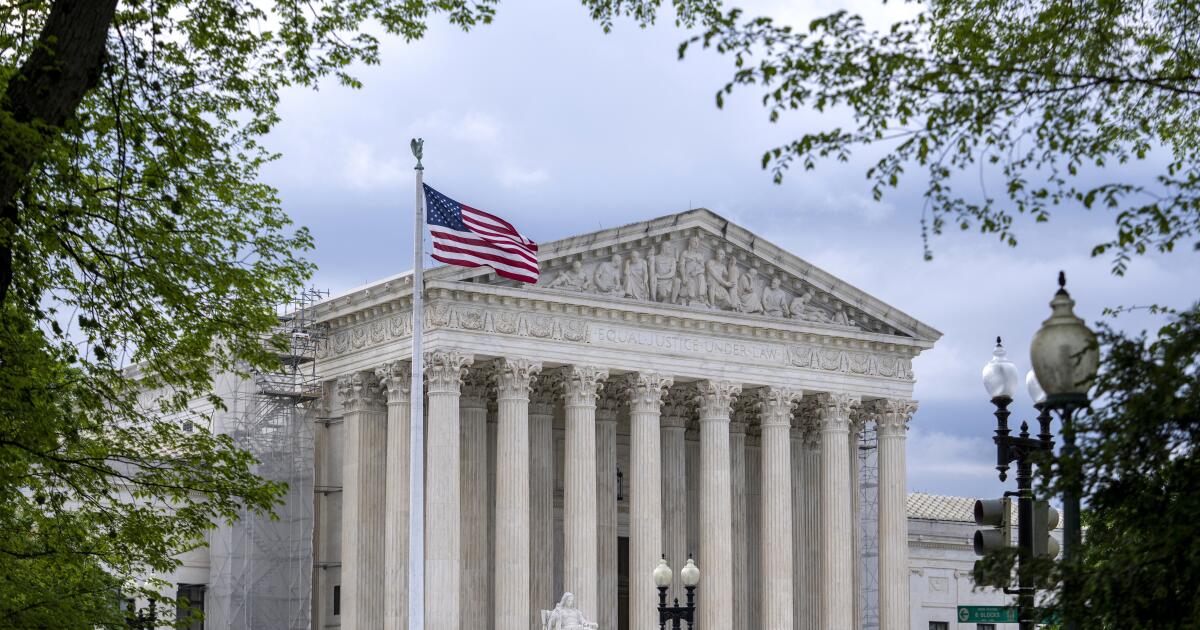
Supreme Court makes it harder for music and movie makers to sue for online piracy

Florida High School Football Rankings: Top 25 teams – Oct. 21

How old is Bo Nix? What to know about Oregon quarterback ahead of 2024 NFL Draft

Cleary's 21 help Le Moyne down Central Connecticut State 69-64 in OT

99th annual Pony Swim held in Virginia

Indiana Members Credit Union announced as new anchor tenant at Bottleworks District
New Jersey Gov Sherrill signs law barring ICE agents from wearing face coverings to shield identities

Escalation in the Middle East – Not Europe’s war? MEPs in the Ring

War with Iran disrupts fertilizer exports as U.S. farmers prepare for planting season

White House unleashes on Raskin for clinging to ‘deranged’ Jack Smith ‘lies’ in latest Trump docs flare-up

‘Keffiyehs seized, left to die’: Inside the Palestine Action hunger strike
-

 Detroit, MI1 week ago
Drummer Brian Pastoria, longtime Detroit music advocate, dies at 68
-

 Georgia1 week ago
How ICE plans for a detention warehouse pushed a Georgia town to fight back | CNN Politics
-

 Movie Reviews7 days ago
‘Youth’ Twitter review: Ken Karunaas impresses audiences; Suraj Venjaramoodu adds charm; music wins praise | – The Times of India
-
 Science1 week ago
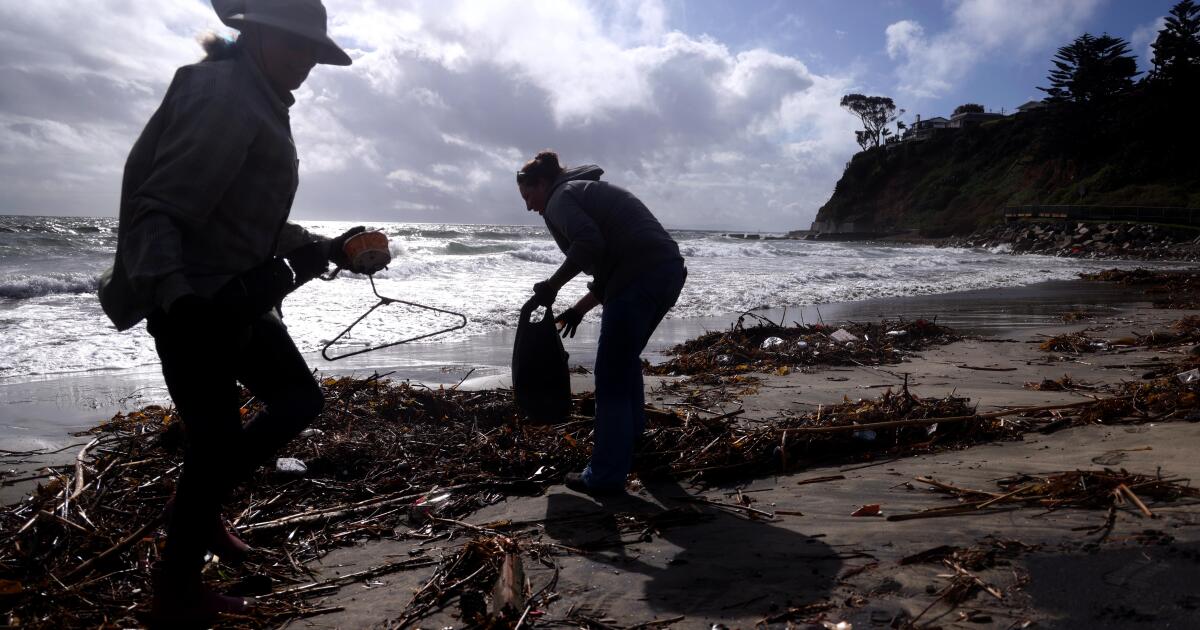
Industrial chemicals have reached the middle of the oceans, new study shows
-

 Science1 week ago
How a Melting Glacier in Antarctica Could Affect Tens of Millions Around the Globe
-

 Culture1 week ago
Test Your Memory of Great Lines From Classic Irish Poems
-

 Sports5 days ago
IOC addresses execution of 19-year-old Iranian wrestler Saleh Mohammadi
-

 New Mexico3 days ago
Clovis shooting leaves one dead, four injured