Missouri
Illinois and Missouri senators split over clawing back public broadcasting, foreign aid funds


Missouri and Illinois’ senators are at odds over legislation clawing back money for public broadcasting and foreign aid.
Senators are debating what’s known as a rescission package, which would effectively rescind authorization for funds that Congress already appropriated. It’s a major priority for President Donald Trump, who even threatened to not endorse Republican senators who don’t support the package.
Among other things, it would strip out billions of dollars worth of foreign aid.
The legislation also would rescind more than a billion dollars for the Corporation for Public Broadcasting – which provides money to PBS and NPR affiliates, like Nine PBS in St. Louis and St. Louis Public Radio, across the country.
Missouri GOP Sens. Josh Hawley and Eric Schmitt voted to proceed with the legislation on Tuesday, while Illinois Democratic Sens. Tammy Duckworth and Dick Durbin opposed moving forward with debate.
Schmitt is handling the legislation on the floor. And he said on Tuesday that the bill corresponds with what voters approved when they brought President Donald Trump back to the White House last year.
“In a time of extraordinary debt, this bill is a first step in a long but necessary fight to put our nation’s fiscal house in order,” Schmitt said. “But it’s about much more than just that, this package isn’t just about how much we spend but about what we spend it on. It’s about whether or not we’re still a sovereign nation, a people in command of our own destiny.”
During his speech on Tuesday, Schmitt dubbed NPR and PBS “American Pravda” – a reference to a communist publication during the time of the Soviet Union. He pointed to prior comments made by NPR CEO Katherine Maher and former NPR editor Uri Berliner that he said show the public radio company’s bias.
“They are the arms of the left wing activist class, taxpayer funded platforms for political propaganda masquerading as journalism,” Schmitt said.
Eric Lee
/
St. Louis Public Radio
Durbin said the cuts to the Corporation for Public Broadcasting will hurt rural America the most – especially because some of those stations depend on CPB funds to operate. He also said the cuts to foreign aid could backfire.
“This is the reputation of the United States as to whether we care,” Durbin said. “This is why American defense officials have even told us for generations that they support these programs, as they say, it’s far cheaper than military intervention and wildly effective.”
Durbin said the debate isn’t about cutting wasteful spending – but rather obedience to Trump.
“There’s no doubt about it. There’s a risk for the Republicans who stand up for principle. The President has turned this vote away from a discussion of the merits of the cuts … into a loyalty test,” Durbin said. “Donald Trump doesn’t care about the impact of these cuts. He only cares about the bended knee. The craven congressman. The servile senator.”
Because Republicans are planning to revise the bill, it will need to go back to the House in order to go to President Trump’s desk. Unlike other legislation, rescission bills only need a majority vote to pass.



KANSAS CITY, Mo. (KCTV) – Dozens of dispensaries have been ordered to close after Missouri Attorney General Catherine Hanaway said they are selling without licenses.
The AG’s office sent cease-and-desist letters to 33 dispensaries. Of those, 13 are in the Kansas City area, according to information provided by the state.
Each location is accused of selling cannabis or marijuana products without a state license, or selling other products deceptively marketed as marijuana, according to Hanaway.
Hanaway’s office also said testing found some products contained things such as lead, arsenic, and ethanol. They also used deceptive labeling and packaging, including designs that may target children, according to a news release.
Here are the locations named by the AG’s office:
- Big Chiefs Kush Waldo (Kansas City)
- Dr. Smoke (Kansas City)
- It’s A Dream (Kansas City)
- KC Kush (Kansas City)
- Main Smoke Shop KC (Kansas City)
- Mr. Niceguy (Kansas City)
- Prohibition Cannabis (Kansas City)
- Center Smoke Shop (Independence)
- Gray Area Cannabis (Independence)
- Herb Depot (Independence)
- Sacred Leaf (Independence)
- Super E Cig Smoke Shop (St. Joseph)
- Vapor Maven (Cameron)
The letters demand each of the above the businesses stop selling the products in question.
The full letter sent to the businesses is below.
Copyright 2026 KCTV. All rights reserved.
Missouri
Missouri Senate committee hears bill on private school bathroom policies for transgender students

SPRINGFIELD, Mo. (KY3) – Missouri lawmakers are once again debating restrictions involving transgender students.
A Missouri Senate committee heard testimony on a bill that would allow private schools to enforce bathroom and locker room policies based on gender assigned at birth on Tuesday morning. Senate Bill 1558 would prevent cities, counties, or other local municipalities from adopting ordinances that would force a private school to change its bathroom policy, and defend private schools from lawsuits about bathroom use with state funds.
The bill was introduced following a U.S. Supreme Court ruling last year that students can use the bathroom that matches their preferred gender. Republican lawmakers want to keep that ruling from applying to private schools in Missouri.
Senate Education Chairman, Republican Sen. Rick Brattin, defended the legislation during the committee hearing.
“I think this is common sense, and it’s unfortunate we have to actually pass legislation like this,” Brattin said. “Now all of a sudden it’s like, we’ve created this social contagion that no one knows what sex they are or that it’s a ‘construct’, but society for all of human history has been male and female.”
Guillermo Villa-Trueba, PhD, a lobbyist for the Missouri Catholic Conference, testified in support of the bill on behalf of religious private schools.
“It’s very helpful for Catholic schools and private religious schools in general so we can enact policies that align with our religious beliefs and with biology,” Villa-Trueba said.
Democratic State Sen. Maggie Nurrenbern said the legislature spends too much time on bathroom-related legislation.
“Here in the education committee, we have spent a tremendous amount of time talking about these issues,” Nurrenbern said. “And I can say in the last six years working in the education committees, both in the House and Senate, I am tired of talking about bathrooms, and I wish we could spend a heck of a lot more time talking about classrooms.”
Samantha Jones, a Missourian who testified against the bill, said the measure is based on incorrect assumptions. Jones drew on her own experiences as an intersex person.
“It is an incorrect assumption that gender is rigidly binary and that sex is as well,” Jones said. “Attacking the transgender and nonbinary and intersex community is an unnecessary waste of time, tax dollars and other state resources.”
The bill is one of 52 measures dealing with transgender issues being considered by Missouri lawmakers. Missouri currently has no statewide regulations on which bathrooms transgender people can use in public. Twenty-one other states, including Kansas, have some kind of regulation in place.
To report a correction or typo, please email digitalnews@ky3.com. Please include the article info in the subject line of the email.
Copyright 2026 KY3. All rights reserved.
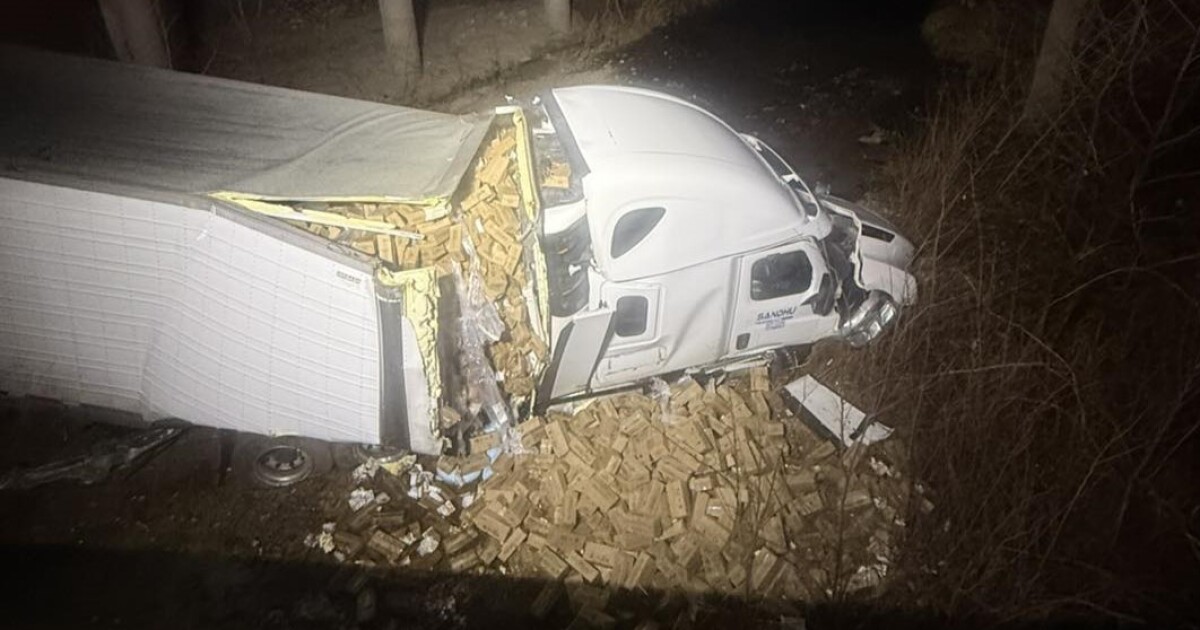
A tractor-trailer carrying tofu that crashed southwest of Rolla has been stinking up a part of Phelps County for weeks.
The semi crashed March 1 on Interstate 44 near a ravine known as Tater Hollow.
Local authorities say no one was hurt, but the crash scene at the 172-mile marker is still there. One local resident wrote online that the rotting tofu left behind smells similar to catfish bait.
“For those of you who drive by this everyday and wonder to yourself ‘why is this still sitting here three weeks after the crash?’ You are not alone,” wrote officials from the nearby Doolittle Rural Fire Protection District, which responded to the wreck.
Pictures of the site on the fire department’s Facebook page show the semi buckled in a ditch below a low bridge. The front part of the trailer burst open, and dozens of rectangular-shaped boxes, presumably containing tofu, poured out of the truck.
In a social media post, the fire department said cleanup has been slow as the Missouri Department of Transportation works with the truck company’s insurance carrier.
“As we have gathered, it has been a logistical nightmare. We have been given the runaround while attempting to recoup the costs that our department endured during the response and initial cleanup,” the post said.
MoDOT officials said they are working closely with the Department of Natural Resources and the Missouri State Highway Patrol to figure out how to get the truck out of the ditch.
“We are looking at a towing company to coordinate that removal, and it could begin as early as the end of this week,” said MoDOT Central District Communications Manager Marcia Johnson. “But it is going to be a time-consuming removal that could cause some traffic impacts.”
Johnson added that the cleanup could be slightly more complicated than other operations because the wreck involves food products.
For residents nearby, the cleanup can’t come soon enough.
“In case you were wondering, tofu tends to stink pretty bad after sitting out for three weeks!” said the fire department’s post.

Escalation in the Middle East – Not Europe’s war? MEPs in the Ring

War with Iran disrupts fertilizer exports as U.S. farmers prepare for planting season

Detroit Pistons and A Kid Again team up to give children with illnesses a special night at the arena

Yankees top Giants 7-0 as robot umpire debuts

GOP considering Dallas for potential 2026 Midterm National Convention

Florida High School Football Rankings: Top 25 teams – Oct. 21

How old is Bo Nix? What to know about Oregon quarterback ahead of 2024 NFL Draft

Cleary's 21 help Le Moyne down Central Connecticut State 69-64 in OT

99th annual Pony Swim held in Virginia

Indiana Members Credit Union announced as new anchor tenant at Bottleworks District
Escalation in the Middle East – Not Europe’s war? MEPs in the Ring
War with Iran disrupts fertilizer exports as U.S. farmers prepare for planting season

White House unleashes on Raskin for clinging to ‘deranged’ Jack Smith ‘lies’ in latest Trump docs flare-up

‘Keffiyehs seized, left to die’: Inside the Palestine Action hunger strike

LaGuardia Crash Timeline: Moments Before Air Canada Plane Collided With Fire Truck
-

 Detroit, MI1 week ago
Drummer Brian Pastoria, longtime Detroit music advocate, dies at 68
-

 Georgia1 week ago
How ICE plans for a detention warehouse pushed a Georgia town to fight back | CNN Politics
-

 Movie Reviews7 days ago
‘Youth’ Twitter review: Ken Karunaas impresses audiences; Suraj Venjaramoodu adds charm; music wins praise | – The Times of India
-
 Science1 week ago
Industrial chemicals have reached the middle of the oceans, new study shows
-

 Science1 week ago
How a Melting Glacier in Antarctica Could Affect Tens of Millions Around the Globe
-

 Culture1 week ago
Test Your Memory of Great Lines From Classic Irish Poems
-

 Sports5 days ago
IOC addresses execution of 19-year-old Iranian wrestler Saleh Mohammadi
-

 New Mexico3 days ago
Clovis shooting leaves one dead, four injured